The contest for power is shifting simultaneously into space, into Eurasia, into the Eastern Mediterranean, into the Middle East, and into the fabric of Western alliances. The five analyses published by Atlas News Romania this week describe the same shift from different angles: the major powers are no longer competing solely for territory or influence, but for rules, access, infrastructure, the capacity to distribute security, and the right to decide who receives priority when resources become scarce.
The week of August 31–September 4 offered an unusually coherent picture of how the current international order is being transformed. In space, competition can no longer be reduced to the number of launches, satellites, or lunar missions. The stakes have shifted toward infrastructure, frequencies, orbital positions, data, and the rules that will govern their use. In Eurasia, the Shanghai Cooperation Organisation summit exposed the limits of reading the world through compact blocs: the stage is multilateral, but power continues to circulate largely through bilateral relationships.
In the Eastern Mediterranean, two deterrence architectures are consolidating in mirror image. In the Middle East, China is expanding its economic and diplomatic influence, but the Hormuz crisis reveals the difference between influence and a security guarantee. And in Washington, the classical problem of burden-sharing among allies is beginning to be replaced by a more difficult one: how American military resources are actually allocated when multiple theatres demand them at once.
The five stories of the week do not describe five separate crises. Together, they show that international power is entering a stage in which the capacity to organize the system is becoming as important as the resources held within it.

Space: the race is no longer for territory, but for the rules that will govern orbital power
Just over a month before the International Astronautical Congress 2026 in Antalya, Atlas News Romania’s analysis tracked the positions of some of the central actors in the global space ecosystem — the United States, Europe, India, Türkiye, Africa, and international institutions — and identified a common thread beneath their evidently different strategies: a preoccupation with autonomy.
The United States is pursuing operational tempo and the preservation of technological advantage. Europe is trying to reduce the dependencies that limit its freedom of action. India wants a greater share of the global space economy. Türkiye is building technological capacity and diplomatic influence at the same time. African states are trying to move from being consumers of data and services to becoming direct participants in orbital infrastructure. International institutions, for their part, are trying to preserve a common framework within an increasingly fragmented system.
Here lies the fundamental shift. In the political imagination of the last century, space competition was symbolized by a flag, by the first person to reach a given place, or by the capacity to demonstrate technological superiority over a rival. In the new space economy, such symbols remain important, but they are no longer sufficient to measure power. What matters now is launch infrastructure, satellite constellations, access to the frequency spectrum, orbital positions, navigation and timing systems, data, observational capacity, and, increasingly, the right to shape the norms governing the use of these resources.
Hence the central thesis of the analysis: the current race is one for rules before it becomes one for territory. This distinction matters because rules adopted before economic and military activity reaches critical mass can produce effects for decades. Interoperability standards, the frequency regime, the use of extraterrestrial resources, liability for commercial activities, and the management of orbital traffic can determine who enters the market, who bears the costs, and who remains dependent on someone else’s infrastructure.
For Europe, space autonomy is thus becoming part of strategic autonomy. There is no full digital, military, or economic independence if positioning, communications, observation, or orbital access remain structurally dependent on decisions made elsewhere.
For Romania, the question is even more concrete. Membership in the European Space Agency and the existence of technical competencies create access to the system. But institutional access does not automatically produce economic or strategic influence. The difference will be made by the capacity to convert presence into contracts, industry, research, and participation in the mechanisms where future rules are defined. IAC 2026 will matter precisely for this reason — Atlas News Romania will be officially accredited in Antalya to follow not only the announced projects, but also the harder-to-photograph competition: who is trying to set the rules for the next stage of space power.
The SCO at 25: the great photographs are multilateral, the great negotiations remain bilateral
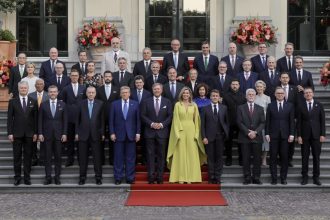
The Shanghai Cooperation Organisation summit in Bishkek produced one of the week’s most striking political images: China, Russia, India, Iran, Pakistan, and the other members gathered in a format that, viewed superficially, might suggest the emergence of an increasingly coherent Eurasian pole.
Atlas News Romania’s analysis reaches a different conclusion, however: the SCO should be understood less as an alliance in the process of consolidation and more as an institutional roof beneath which a dense network of bilateral relationships coexists — sometimes complementary, sometimes competing.
This difference is visible across nearly every major file at the summit. Russia and China meet within the SCO, yet negotiate projects such as Power of Siberia 2 bilaterally. Iran is a full member of the organization, yet the SCO contains no collective-defense obligation that would automatically turn China or Russia into Tehran’s military guarantors. India participates simultaneously in the SCO and in the Quad, alongside the United States, Japan, and Australia, without giving up either its traditional relationship with Moscow or its strategic competition with Beijing. Türkiye participates as a dialogue partner of the organization while remaining a NATO member.
These overlaps are not anomalies. They are the mechanism by which the organization functions. In a classical alliance system, membership presupposes, to some degree, strategic convergence. Within the SCO, membership allows states to manage their divergences inside the same framework without the obligation of full alignment.
Iran is probably the most revealing case. SCO membership gives it political access to China and Russia and the legitimacy of participating in a major Eurasian forum. But sensitive support, where it exists, travels through bilateral channels — Moscow can cooperate with Tehran on intelligence or security without New Delhi, Beijing, or the other members becoming part of that arrangement. The same holds true in Central Asia: China is massively expanding its regional trade and infrastructure, Russia retains historic economic and security ties, and the Central Asian states try to benefit from both simultaneously without accepting an exclusive dependence on either. The SCO does not eliminate Sino-Russian competition. It makes it manageable.
For Romania, Türkiye’s participation is particularly relevant. An issue directly tied to the security of NATO’s eastern flank — the Black Sea and the war in Ukraine — can be discussed by Ankara with Moscow within a Eurasian forum without Türkiye suspending its Western strategic identity. This is one of the important lessons of the Bishkek summit: today’s world does not divide as cleanly into blocs as the family photograph sometimes suggests. The institution is multilateral. Power, risk, and cost, however, continue to be negotiated largely bilaterally.
The Eastern Mediterranean is rearming in mirror image
One of the week’s most important strategic shifts took place in the Eastern Mediterranean, where Greece and Israel deepened military cooperation through the agreement on the integrated Achilles Shield defense system, at a moment when the Mecca Agreement between Türkiye, Saudi Arabia, and Pakistan is beginning to produce its own architecture of military coordination.
Atlas News Romania’s analysis does not treat these developments as two independent stories, but as two asymmetric responses to the same shift in regional balance.
The Mecca Agreement introduced a mutual-defense clause between Saudi Arabia, Türkiye, and Pakistan, and has since begun to be supplemented by plans for joint exercises, strategic coordination, and the joint development of defense technologies. Ankara has insisted that the pact does not constitute an alternative to NATO and is not directed against Iran. On the other strategic front, Greece and Israel are deepening their military relationship through Achilles Shield, an air and missile defense program responding to Athens’s need to strengthen its protection against missiles, drones, and other aerial threats.
The real stakes, however, lie not in the existence of two acquisitions or two military agreements, but in the fact that the Eastern Mediterranean is beginning to rearm in mirror image. Türkiye has become important enough to operate simultaneously within multiple architectures — NATO, the Black Sea, Syria, the Gulf, its relationship with Russia, and the new security formula from Mecca. This strategic autonomy inevitably produces reactions from actors calculating their own security in relation to Ankara. Greece responds by deepening its relationship with Israel and accelerating military modernization. Israel finds useful partners in Athens and Nicosia at a moment when its own relationship with Türkiye remains marked by the files of Syria and the Eastern Mediterranean.
It would be a mistake, however, to reduce this dynamic to the formation of two hostile blocs. Türkiye remains a NATO member. Greece is a NATO member. Saudi Arabia retains a strategic security partnership with the United States. Pakistan maintains important relations with both China and Washington and the Gulf states. Israel is one of Washington’s principal strategic partners. The new configuration is thus not a copy of the Cold War — it is more fluid, and precisely for that reason, harder to manage. Actors are building strategic redundancy: more relationships, more defense systems, more guarantees, and more autonomy, without necessarily abandoning old alliances.
Here lies the deeper shift: the Eastern Mediterranean is not rearming by breaking the existing order, but by layering new tiers of security on top of it.
Xi in Cairo: China can extend influence, but does not yet offer America’s guarantee
Xi Jinping’s state visit to Cairo on September 1–2 was one of the week’s most important diplomatic events in the Middle East, coming in an exceptional context.
The crisis in the Strait of Hormuz struck directly at one of the structural vulnerabilities of the Chinese economy. According to data analyzed in Atlas News Romania’s report, flows of crude oil and petroleum products through Hormuz fell dramatically in 2026, and Chinese oil imports were directly affected — China having been, before the conflict, the largest buyer of oil transiting the strait.
If Beijing had sought to convert its economic expansion in the Middle East into a military architecture alternative to that of the United States, this would have been one of the most favorable moments to demonstrate it. That did not happen. China responded through diplomacy, economics, trade, and the diversification of financial mechanisms. The Cairo visit strengthened the relationship with Egypt in a symbolic year — seven decades of diplomatic relations — and at a moment when both states also benefit from shared BRICS membership.
This is the central point of the analysis: China can extend its influence without yet offering security guarantees comparable to those of the United States. The difference is fundamental. Beijing can finance infrastructure, build trade relationships, offer technology, promote the use of the yuan, and become an indispensable partner for certain projects. But in the event of a major military crisis, the region’s security architecture continues to depend largely on the United States and its relationships with the Gulf states, Israel, Egypt, and Türkiye.
For Egypt, this situation is not necessarily a problem. Cairo is not obliged to choose between Washington and Beijing. Under President Abdel Fattah el-Sisi, Egypt is trying to preserve a strategic balance: maintaining its security relationship with the United States, developing economic cooperation with China, preserving its own channels with Russia, and strengthening Egypt’s regional role according to national interest. China is not replacing America in Egypt — it is giving Cairo an additional degree of strategic freedom.
For Beijing, however, the Hormuz crisis raises a more difficult question: can a great power become economically dominant in a region without also accepting the costs of that region’s security? So far, China’s answer appears to be yes. But this is precisely where the model’s limit lies. Influence can be accumulated without guarantees. Hegemony is far harder to achieve.
From burden-sharing to burden-allocation: the American guarantee is not disappearing, but is becoming a managed resource
The week’s final analysis concerns what is perhaps the most significant shift for the future of the transatlantic relationship.
On September 3, Donald Trump denied reports of a potential shortage of American munitions, but confirmed in the same remarks that the United States is currently reserving certain capacities for its own forces ahead of sales to other states. Separately, the president argued that Europe should also bear part of the costs of the support previously provided to Ukraine. There is, as yet, no official mechanism converting this claim into a financial obligation, and Atlas News Romania’s analysis explicitly treats the statement as political positioning rather than as already-adopted public policy.
What matters, however, is the first half of the equation. The war in Iran, support for Ukraine, NATO’s needs, and competition with China are simultaneously demanding categories of capability that cannot be produced instantly: air-defense interceptors, precision munitions, Patriot systems, HIMARS, and other components of the American arsenal. When global demand exceeds immediate availability, the traditional burden-sharing problem changes in nature.
For decades, the transatlantic dispute was measured in percentages of GDP — how much does America pay, how much does Europe pay, who meets the NATO threshold? The new question is different: who gets served first? This is where what Atlas News Romania’s analysis calls burden-allocation begins.
The National Defense Strategy 2026 had already signaled this direction: allies must assume primary responsibility for their own defense in Europe, the Middle East, and the Korean Peninsula, while American support remains critical but more limited. At the same time, Washington states that it will prioritize cooperation with allies who invest more and generate greater strategic value for the system. PURL shows how this mechanism is beginning to operate in Ukraine: the United States retains the technological and industrial capacities that allies cannot quickly substitute, while Europeans and Canada assume a growing share of the financing. The Europe Posture Review applies a similar logic to military presence.
The war in Iran introduces the missing factor: simultaneity. An interceptor used in the Gulf can no longer be available at the same moment on the eastern flank or in the Indo-Pacific. From that point on, every American commitment enters a global equation of prioritization.
For Romania, this is not an academic debate. Romanian air defense relies on Patriot, and precision-strike capability includes HIMARS. Romania transferred a Patriot system to Ukraine with a commitment to its replacement. In a system where Washington is beginning to prioritize its stockpiles more strictly, an ally’s position depends not only on treaty commitments but also on where it stands in America’s strategic calculus. Romania’s geography is an advantage — the Black Sea, the southeastern flank, Mihail Kogălniceanu, and regional infrastructure offer genuine strategic value — but geography alone is no longer sufficient. Industrial capacity, multi-year contracts, financial contribution, infrastructure availability, and Romania’s role as a regional security provider will increasingly matter for access to American resources.
This may be one of the defining features of the new NATO: America is not disappearing from Europe’s security architecture, but it is beginning to account more carefully for where, how much, and for whom it deploys its power.
Bottom line: the world is not dividing into blocs — it is reorganizing into layers
The five analyses published by Atlas News Romania this week describe seemingly very different domains. Together, however, they point to a single transformation.
The international order is not evolving toward two or three cleanly delineated blocs. It is evolving toward an overlapping of layers of power. In space, states compete for infrastructure and rules in the absence of any authority capable of organizing the system as a whole. Within the SCO, China, Russia, India, Iran, and the other members share the same institution without dissolving their bilateral interests or their relationships outside it. In the Eastern Mediterranean, the Mecca Pact and Achilles Shield add new guarantees and capabilities on top of the existing NATO and American architectures, without replacing them. In Egypt, China can become an increasingly important economic and diplomatic partner without assuming America’s role as military guarantor. Within NATO, the United States retains the strategic guarantee, but is trying to redistribute costs, responsibility, and access to resources among its allies.
This is perhaps the idea that best defines the week of August 31–September 4: power no longer functions solely through membership. It functions through access. Access to infrastructure. Access to energy. Access to technology. Access to institutions. Access to military resources. Access to the actors who can guarantee security when diplomatic influence is no longer enough.
Seen this way, today’s geopolitical competition is not only about who accumulates the most resources. It is about who sets the rules by which everyone else gains access to them.
Read also