Donald Trump says the United States has ample munitions, yet in the same breath he confirms that Washington is, for now, keeping them for its own forces rather than selling them to other states. He then introduces an idea without precedent in the current phase of the transatlantic relationship: Europe should pay, retroactively, for part of the support previously extended to Ukraine. Read in isolation, the statement could be filed away as another presidential outburst. Read alongside the war in Iran, the documented strain on the American arsenal, the 2026 National Defense Strategy and the transformation of how Ukraine is financed, it points to a change of a different order. The United States is beginning to define explicitly who receives American military resources, who pays for them and who takes precedence when the same capabilities are demanded simultaneously in several theatres. For a flank state such as Romania, the question is anything but theoretical.
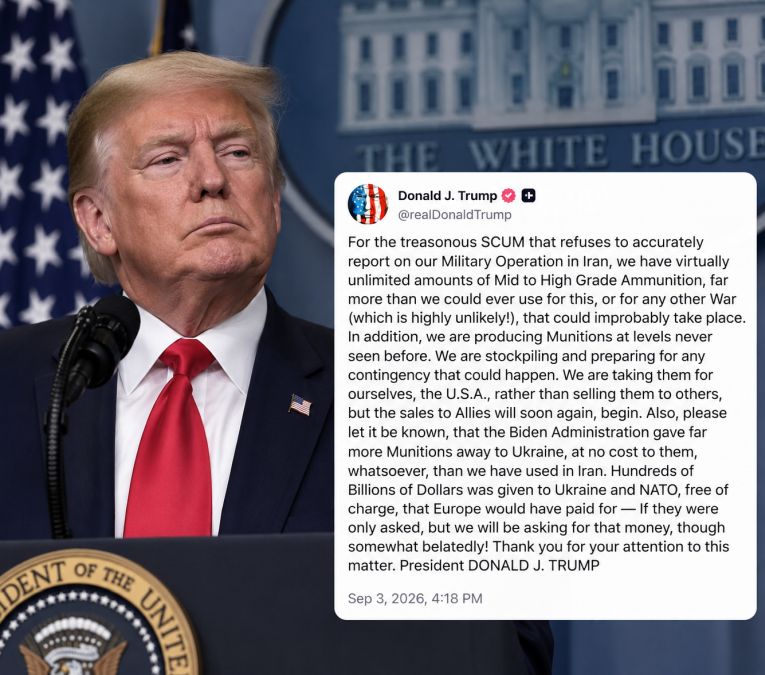
On 3 September, Donald Trump responded to reports on the pressure the war in Iran is placing on American munitions stocks. The President rejected the notion that the United States had run short of munitions and maintained that production was running at record levels. The denial itself says little. The sentence that matters is the one that accompanies it: „We are taking them for ourselves, the U.S.A., rather than selling them to others,” Trump wrote, adding that sales to allies would resume shortly.
In the same post, the President turned to Ukraine. He accused the Biden administration of having handed Kyiv and NATO hundreds of billions of dollars without asking Europe to pay, and announced that Washington would now ask for that money, belatedly though it may be. Reuters reported the same day that Trump intends to seek reimbursement from European states for costs associated with American military aid previously provided to Ukraine. At this stage, however, no official mechanism has been presented by the administration that would convert the statement into a financial obligation. The claim about recovering the money should, for now, be treated as political positioning rather than public policy.
The other claim, that America’s own requirements take precedence over sales to allies, can by contrast be tested. It maps onto a series of developments that are already observable, and that is where the real story begins.

The American Arsenal Under Strain
The immediate trigger for the President’s reaction was not Europe, but the condition of the American arsenal.
On 28 August, The Wall Street Journal, in a report carried by Anadolu, wrote that the intensive use of advanced weaponry in the war with Iran had severely depleted some American stockpiles, forced US European Command to adjust its operational plans and left European inventories of PAC-3 Patriot interceptors and ATACMS missiles at levels some officials described as „beyond critical”. A day earlier, The Associated Press, citing a US defence official in Europe and a NATO official, had reported the same shortage of Patriot interceptors on the continent, alongside CSIS estimates that the Iran conflict has consumed roughly two thirds of the American stock. And as early as 4 August, Reuters had documented, on the basis of three sources familiar with the data, that the US Army had expended „virtually all” of its ATACMS and Precision Strike Missiles in the first five months of the war, while Patriot and THAAD interceptors were being drawn down faster than they could be replenished. The Pentagon and the White House have rejected the notion of a shortage on every occasion.
None of these reports claims that the United States has „run out of munitions”. They establish something more precise and, strategically, more consequential: in certain categories of sophisticated weaponry, immediate availability has become constrained enough that Washington must choose between current operational consumption, the rebuilding of reserves, the requirements of other theatres and deliveries to partners. The difficulty is not the total volume of weaponry the United States holds, but the industrial time needed to replace complex systems, measured in months or years, and the competition between several strategic requirements for the same production line.
Trump’s statement now supplies the political confirmation of that constraint. When competition for resources arises, the United States places itself first.
Iran Did Not Create the Problem. It Made It Visible
The war with Iran, launched in late February and now in its seventh month, should be regarded as an accelerator rather than the cause of the shift in American strategy. On 2 September, Reuters reported that Trump’s senior advisers are seeking to prevent an escalation of the conflict ahead of the congressional elections of 3 November, and that a tactical pause would, according to the agency’s sources, give the military breathing room to replenish its depleted munitions stocks. The material constraint has thus become a factor in political calculation.
What the conflict has exposed is the problem of simultaneity. The United States must maintain resources for the Middle East, preserve deterrence in Europe, continue supplying certain capabilities to Ukraine and honour the contracts it has signed with allies. Above all of these requirements, it must conserve sufficient capacity for a possible high-intensity conflict in the Indo-Pacific. China is the element that turns the munitions question from a logistical difficulty into a matter of grand strategy: an interceptor expended over the Gulf is no longer available in the Baltic Sea or the Taiwan Strait.
The National Defense Strategy Had Already Set the Direction
The statement of 3 September becomes easier to understand when read together with the 2026 National Defense Strategy, the Pentagon’s framework document published in January.
The strategy provides explicitly that allies and partners are to be incentivised to assume primary responsibility for their own defence in Europe, the Middle East and the Korean Peninsula, with American support described as „critical but more limited”. For Europe, the formulation is direct: NATO allies are to take primary responsibility for the conventional defence of the continent. CSIS observed that the document retains the „one plus” approach to conflicts, but with an inversion: responsibility for the second conflict is shifted to allies, so that if the United States is engaged against China, the defence of Europe against Russia becomes NATO’s task.
The document also introduces a second principle, less commented upon and, over the longer term, more significant. Washington announces that it will prioritise cooperation with allies it deems exemplary, meaning states that invest sufficiently and do more against the threats in their own regions, including through arms sales, industrial cooperation and intelligence sharing. This formula changes the nature of burden-sharing. The criterion is no longer solely the share of GDP devoted to defence, but the responsibility assumed, the real capacity available and the strategic value each ally generates for the American system.
Atlas News Romania identified this development in its analysis of 18 August, „From Ankara to Seoul. How Reciprocity Is Becoming the New Contract of American Alliances”, which showed that Washington is beginning to assess its alliances not only through the question „how much does an ally spend?”, but through a harder one: „how much responsibility can it assume?”. The post of 3 September adds a concrete resource to that equation: munitions.
From Burden-Sharing to Burden-Allocation
This is the shift worth watching.
For decades, the transatlantic debate was conducted in terms of burden-sharing: how much America pays, how much Europe pays, what share of GDP each state allocates. The new problem is of a different nature. What happens when there are not enough capabilities available for every theatre and every ally to receive simultaneously what they request? At that point, burden-sharing becomes burden-allocation: who is served first, who waits, who pays and what contribution an ally must make in order to retain privileged access to American military resources.
The National Defense Strategy supplies part of the answer. Donald Trump has just supplied the other: the United States keeps its munitions for itself first.
Ukraine Shows How the New Model Already Works
The transformation is not a hypothesis. It is visible in the current architecture of Western support for Ukraine.
NATO Secretary General Mark Rutte explained on 17 June, ahead of the meeting of defence ministers, that the United States continues to provide essential support for Ukraine, including systems only it can supply, such as Patriot air defence, but that this support now flows through the PURL programme, paid for by European allies and Canada, with Washington having made clear that it will no longer put money into the mechanism. The Prioritized Ukraine Requirements List, agreed between Trump and Rutte in July 2025, operates through packages of roughly 500 million dollars, defined by Kyiv, financed by allies and delivered from existing American stocks. European Pravda estimated in June that the mechanism raised 4.3 billion dollars in 2025, short of the 5 billion target, and that contributions in the first months of this year have slowed markedly.
The formula is telling: America retains the essential industrial and technological capacity, while Europe and Canada take on an ever larger share of the cost.
Against this backdrop, Trump’s assertion that Europe should also pay for aid previously given to Ukraine should not be read automatically as the announcement of a retroactive invoice. More probably, at least until an official mechanism emerges, it introduces into the transatlantic negotiation the notion of an accumulated political debt. Such an argument can be deployed to justify future demands: more European funding for Ukraine through PURL, additional purchases of American equipment, larger NATO contributions or the assumption of costs Washington no longer wishes to bear. Trump does not need to recover, in accounting terms, the money spent by the Biden administration for the claim to take effect. It is enough to turn the past into an argument for redistributing future costs.
The Pieces of a Single Direction
The Europe Posture Review, the six-month reassessment of the American military footprint on the continent announced by Pete Hegseth in June and presented to allies by Elbridge Colby, was analysed by Atlas News Romania on 8 August, with the conclusion that the fundamental question facing European allies is no longer whether the United States will remain in Europe, but where, in what configuration and with what capabilities Washington will judge that its presence continues to serve American interests.
That distinction is now essential. There is insufficient evidence to argue that the United States is preparing to abandon Europe. There is, however, mounting evidence that Washington is reorganising its participation in European security around a different formula: America remains indispensable, but it no longer accepts being simultaneously the principal guarantor, the principal supplier and the principal financier.
The National Defense Strategy institutionalises the transfer of responsibility. PURL transfers part of the cost. The Europe Posture Review reassesses the distribution of forces and capabilities. The war with Iran tests the material limits of the arsenal. And Trump’s statement introduces explicitly the principle of American priority over munitions. Viewed separately, these are distinct developments. Viewed together, they describe the same direction.
The European Response and the Paradox of Dependence
Europe is not standing idly by. On 18 June, the European Council called for Europe’s defence readiness to be decisively ramped up by 2030, for strategic dependencies to be reduced and for critical capability gaps to be closed, and the priority areas in which leaders recorded progress coincide precisely with those under the greatest global pressure: air defence, early warning, drones and long-range precision strike. In parallel, SAFE, the European loan instrument for joint defence procurement, and EDIP, the European Defence Industry Programme, aim to consolidate the continent’s industrial base. The first European production line for Patriot interceptors is due to open in Germany this month.
Here lies one of the paradoxes of the new American strategy. The more Washington asks Europe to assume responsibility and the more strictly it prioritises its own resources, the more it encourages Europe to reduce the dependencies that have tied it so closely to American industry. In the short term, the pressure increases European orders to American manufacturers. In the longer term, it may accelerate the development of European alternatives. This is not a decoupling from NATO, but the beginning of a competition for strategic redundancy within the Alliance.
What It Means for Romania
For Romania, the burden-allocation problem is concrete, not conceptual. The country’s air defence rests on Patriot systems and its precision-strike capacity on HIMARS, precisely the categories that the August reports describe as most affected by the war in Iran. Romania transferred a Patriot system to Ukraine in 2024, with an American commitment to replace it, and the pace at which such commitments are honoured now depends directly on the order of priority Washington establishes between its own forces, the Middle East, Kyiv and its allies. The reduction of the American brigade’s rotations at Mihail Kogălniceanu, announced in October 2025, has already shown that the American presence in Romania is part of the same global calculation of resources.
Geography works in Bucharest’s favour: NATO’s south-eastern flank, the Black Sea and the infrastructure at Kogălniceanu are assets that the National Defense Strategy can count among the strategic value an ally generates. But the same document ties privileged access to American resources to actual contribution, not to geography alone. For Romania, this means three things: multi-year contracts that secure a place in the production queue before a crisis rather than during one; the use of its SAFE allocation, among the largest in the Union, to build domestic and European industrial capacity in munitions and air defence rather than merely to purchase finished products; and a sustained demonstration of its role as a provider of regional security, in the Black Sea and in support of Ukraine, capable of transforming Romania from a beneficiary of the American guarantee into an ally Washington has reason to serve first.
America Is Not Leaving. But It Is Starting to Keep Account
Trump’s statement of 3 September does not, on its own, prove the existence of a new doctrine. But it fits too closely with the strategic documents and the developments of recent months to be dismissed as a mere social media outburst.
Iran exposed the problem of simultaneity. Ukraine produced a mechanism through which Europe finances American weaponry. The National Defense Strategy established that allies must assume primary responsibility for their own regions. The Europe Posture Review is reassessing the place and function of American resources in Europe. And the President now states publicly that America keeps its munitions for its own needs before resuming sales to allies, and that Europeans should also bear costs left behind by the previous administration.
There is as yet no evidence that Washington will turn past aid to Ukraine into an actual receivable. There is, however, sufficient evidence for a more important conclusion: the American security guarantee is not disappearing, but it is becoming more selective, more closely accounted for and more dependent on each ally’s contribution.
The question is no longer merely who spends enough on their own defence. It is who pays for American capabilities, who contributes to the strategic system of the United States and, ultimately, who takes precedence when America can no longer treat every theatre as a simultaneous priority. This may prove one of the defining shifts of NATO 3.0: not America’s withdrawal from Europe, but the passage from American security assumed to be available by default to American security managed as a finite strategic resource.
Read also