The crisis in the Strait of Hormuz has given China, in 2026, a more telling test than any diplomatic statement of what kind of power it intends to become in the Middle East. According to estimates by the U.S. Energy Information Administration, flows of crude oil and petroleum products through the strait fell from an average of 21.6 million barrels per day in the last quarter of 2025 to just 4.9 million barrels per day in the second quarter of 2026. The effect was felt directly in China: Chinese crude imports dropped to 8.1 million barrels per day, 32% below the previous quarter, and in May and June fell below 8 million for the first time since 2016, according to the EIA, based on Chinese customs data. Before the conflict, China was the largest buyer of the oil transiting Hormuz — approximately 5.35 million barrels per day in the first quarter of 2025, according to the same EIA. China’s exposure therefore stems not primarily from its relationship with Iran, but from a far broader dependence on the Gulf’s energy system.
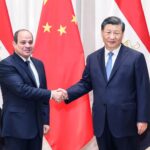
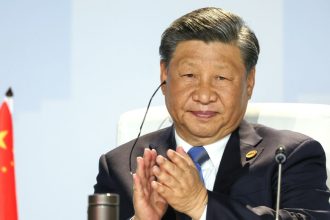
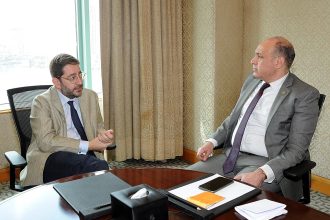
It is against this backdrop that President Xi Jinping’s state visit to Cairo, on 1–2 September 2026, must be read. The Chinese leader was received by President Abdel Fattah el-Sisi at a moment when traffic through Hormuz remains severely disrupted and navigation through Bab el-Mandeb is likewise under strain. Reuters recorded on 2 September only four commercial cargo vessels transiting the strait in a single day, against an average of roughly 13 over the preceding ten days.
The visit coincided with the seventieth anniversary of diplomatic relations. Egypt was the first Arab and African state to recognise the People’s Republic of China, in 1956 — a detail that the joint communiqué published by Egypt’s State Information Service explicitly recalls.
China’s response to the regional crisis has not, so far, been the construction of a military architecture to rival the American one. Beijing has opted for diplomacy, bilateral relationships and economic instruments. Herein lies the real significance of the visit: China is extending its economic, technological and political influence and proposing a different vocabulary of regional security, without yet demonstrating that it is prepared to bear the military costs of the order it describes.

Egypt, however, cannot be reduced to an arena of great-power competition. Under President el-Sisi, Egyptian foreign policy pursues a formula of its own, established under the name of strategic balance, grounded in the diversification of partnerships and the preservation of full freedom of decision. The joint communiqué is unusually explicit on this point: the Chinese side commends the principle of strategic balance established by Egypt and considers it supportive of international multilateralism. The visit thus brings together two strategies: China seeks greater influence in the Middle East, while Egypt uses its relationship with Beijing to consolidate its autonomy, its industrial capacity and its regional role.
Hormuz: The Test Between Influence and Power
The magnitude of China’s vulnerability goes a long way towards explaining Beijing’s conduct. The existing overland alternatives in Saudi Arabia and the United Arab Emirates can absorb only a fraction of the strait’s capacity, and the remaining volumes remain structurally tied to this single maritime route.
Iran is only one component of the equation. China is the principal buyer of Iranian oil, and the American naval blockade has drastically reduced Tehran’s loadings, from roughly two million barrels per day in March to around 220,000–255,000 in August, according to data analysed by Reuters. Beijing’s vulnerability, however, extends well beyond the Iranian file and encompasses Saudi Arabia, the United Arab Emirates, Iraq, Qatar and the entire energy export system of the Gulf.
Despite this exposure, China has not responded with an extraordinary naval deployment. On 12 August, the 49th escort task group of the People’s Liberation Army Navy departed Sanya for the Gulf of Aden and the waters off Somalia, in the standard configuration of the missions Beijing has conducted in the region since 2008: the destroyer Kunming, the frigate Yueyang and the supply ship Luomahu, with two helicopters embarked. China’s Ministry of National Defense presented the rotation as a planned one, intended to relieve the previous group, which had set sail in October last year.
This conduct does not prove the existence of a deliberate Chinese doctrine of avoiding security costs. It may equally reflect logistical limits, other military priorities or a preference for reducing the risk of direct involvement. It is, however, consistent with a model in which China protects its interests through political relationships and negotiated access before resorting to military projection. The COSCO episode is the clearest illustration of this model.
On 27 March, the container ships CSCL Indian Ocean and CSCL Arctic Ocean, operated by the Chinese company COSCO, attempted to leave the Gulf through Hormuz after Tehran had offered assurances regarding the transit of Chinese vessels. Both turned back, Reuters reported at the time. The political guarantee had not eliminated the operational risk. Three days later, the two vessels transited the strait on their second attempt, becoming the first container ships of a major international operator to leave the Gulf since the outbreak of the conflict. Beijing subsequently confirmed that three Chinese vessels had passed through Hormuz following coordination with the relevant parties, according to Reuters.
The sequence matters more than either episode taken in isolation. China did not obtain an absolute security guarantee, but its political relationship afforded it a degree of coordination that other operators did not enjoy to the same extent. The first attempt failed, the second succeeded, and between the two there appears not a Chinese frigate, but diplomacy. This is the defining feature of the current Chinese model: preferential access, without the demonstrated capacity to convert it into a regional public good available to all.
What Xi Jinping Actually Proposed in Cairo
In his talks with President el-Sisi, Xi Jinping put forward a four-point proposal for building a new security architecture in the Middle East, centred on a vision of common, comprehensive, cooperative and sustainable security. According to the readout of China’s Ministry of Foreign Affairs, the four points are: unleashing the internal momentum of regional common security, with the peoples of the region as masters of their own affairs and the rejection of external interference; a comprehensive approach to the region’s interconnected crises, with the Palestinian question kept at the core of the file; cementing the development foundation of security, including China’s readiness to work with regional states to safeguard international shipping lanes; and enhancing international coordination, with major powers outside the region rejecting double standards and the United Nations playing a tangible role.
The formula should not be mistaken for the emergence of a new doctrine. The concepts of common, comprehensive, cooperative and sustainable security have been part of Xi’s strategic vocabulary for more than a decade and were subsequently incorporated into the Global Security Initiative. What is new in Cairo is the more emphatic application of this framework to the Middle East, at a moment when the old regional balance is passing through a profound crisis.
Between formula and institution, however, a considerable distance remains. Beijing did not propose a regional defence treaty, a joint command, military guarantees, a permanent secretariat or collective obligations comparable to the mechanisms of the Western alliance system. China is proposing a diplomatic architecture rather than a defence architecture: greater autonomy for the states of the region, mechanisms for dialogue and development, less external intervention and a strengthened role for multilateral institutions.
Cairo is a natural venue for such a message. Egypt has a long tradition of regional mediation, and President el-Sisi, according to the same readout, reaffirmed Egypt’s commitment to de-escalation, the resolution of disputes through political means and the exploration of a regional security architecture.
The Nile Clause: A Diplomatic Gain for Cairo
One of the most significant passages of the joint communiqué concerns neither Hormuz nor the Suez Canal, but the Nile. The Chinese side explicitly affirms its recognition of the river’s vital importance to Egypt, described as its principal lifeline, as well as Egypt’s legitimate right to safeguard its water security, food security and development interests. Both sides call on all Nile Basin states to comply with international law, including the obligation not to cause harm.
For Egypt, the inclusion of such language in a bilateral statement with Beijing represents a significant diplomatic gain. Water security is a fundamental strategic matter for the Egyptian state, and Cairo has consistently upheld the principles of transboundary cooperation grounded in international law, prior notification, consultation and consensus. China’s position is all the more notable given that Beijing maintains extensive economic relations with Ethiopia.
In Cairo, Beijing thus chose a formula favourable to Egypt’s legitimate concerns, without converting it into a commitment to mediate or into public pressure on Addis Ababa. The same pattern is observable in other files: diplomatic recognition and supportive language, but caution in assuming obligations that might compel China to choose between regional partners.
Strategic Balance: A Policy of Options
Xi Jinping’s visit cannot credibly be interpreted as Egypt breaking away from its traditional partners. Cairo maintains a consolidated defence relationship with the United States and simultaneously operates platforms originating from the United States, France, Germany, Italy and other states. Its relations with Beijing coexist with the American partnership, with ties to the European Union, with major economic relationships with the Gulf states and with the recent rapprochement with Turkey. The relationship with China broadens this range; it does not replace it.
For Cairo, diversification provides access to investment, technology, financing and additional military cooperation, as well as a greater capacity for action in an increasingly fragmented international system. China appears to accept this autonomy rather than demand exclusivity, and this is one of the reasons the relationship works.
The Economics of the Relationship: Beyond the Suez Industrial Zone
CAPMAS data for the first half of 2026, presented by Egypt’s State Information Service, reveal both the scale and the asymmetry of the trade relationship: Egyptian exports to China rose by almost 200%, to 840.8 million dollars, while imports from China reached 10.4 billion and bilateral trade totalled 11.3 billion in just six months. The imbalance remains vast, but the growth in exports explains the emphasis Cairo places on access to the Chinese market and on the localisation of production.
The financial relationship, for its part, has moved beyond the classic model of infrastructure lending. In July 2025, the two states signed their first bilateral development cooperation strategy, covering 2025–2029, together with the first phase of a programme converting debt into development projects. Egypt’s Ministry of Planning and Economic Development underlined that Egypt is the first state with which the Chinese agency CIDCA has agreed such a mechanism. The instrument says something important about the maturing of the relationship: Egypt is seeking to convert external financing into industrialisation, technology and projects that ease the pressure on its debt and its foreign currency reserves.
Suez: A Geo-Economic Platform, Not a Security Base
The China–Egypt Economic and Trade Cooperation Zone at Suez remains the most visible symbol of the relationship. By the end of 2025, the zone hosted nearly 200 companies and had accumulated investments exceeding 3.8 billion dollars, with around 10,000 jobs created, according to official data cited by Xinhua. During the visit, the two presidents agreed to launch the third phase of expansion, with projects in renewable energy, the automotive industry, textiles and chemical fibres, according to the joint communiqué.
The importance of this space should not be confused with control of the Suez Canal, nor with the existence of Chinese military infrastructure. There is no public evidence that would allow the zone to be described as a dual-use base or a naval outpost. For Egypt, the objective is to transform the Canal region into an industrial, logistics and export hub, not merely to monetise transit: Chinese companies manufacture in Egypt using the country’s access to African, Arab and European markets, while Cairo gains investment, jobs and technology transfer.
The geography must be kept precise. Suez is not China’s alternative to Hormuz. Gulf oil bound for China exits through Hormuz and travels eastward, without passing through the Canal. Suez and the SUMED pipeline are essential above all for westbound energy flows and for Asia–Europe trade. The two chokepoints belong to the same maritime system, but they do not substitute for one another.
The Air Exercise and the Image That Matters
The military dimension of the relationship is real and growing, but it must be measured without confusing cooperation with alliance.
The joint air exercise „Eagles of Civilization 2026” began on 22 August and was conducted at several air bases across Egypt, comprising theoretical and practical training, joint sorties and training in the planning of air operations, according to Egypt’s Ministry of Defence. China’s Ministry of National Defense confirmed that this is the second edition of the format, with subjects covering air combat tactics, air superiority operations and combat search and rescue, supplemented by force employment drills.
The most telling image of the exercise, however, is not that of a fighter aircraft. The spokesperson of the Egyptian Armed Forces released images of a Chinese YY-20A tanker refuelling an Egyptian Rafale in flight — a platform of French origin. The episode, analysed by The Aviationist, is a concrete demonstration that Chinese air logistics can support, in a specific mission, a Western aircraft operated by Egypt.
This is not evidence of operational integration, nor of a common command architecture. It is, however, tactical interoperability in a precise technical function, one that presupposes compatible procedures, training and trust between crews. For China, the exercise demonstrates the capacity to project and sustain a complex air package thousands of kilometres from its national territory. For Egypt, it confirms a policy of diversification that allows it to operate with different technological ecosystems without narrowing its options.
The Yuan: Diversification, Not the End of the Dollar
In June 2026, the People’s Bank of China and the Central Bank of Egypt renewed their bilateral local currency swap agreement and increased its value from 18 to 30 billion yuan, for a period of three years, according to the official Chinese announcement. The Cairo joint communiqué, for its part, provides for strengthening the use of national currencies in trade and investment.
This is not the displacement of the dollar, and public data do not permit a credible estimate of the share of bilateral trade actually settled in yuan. For an economy managing external liquidity constraints, however, the effect may be more significant than the yuan’s weight in the global monetary system would suggest: if part of the imports from China can be financed through alternative mechanisms, dollar resources remain available for other external obligations. It is an instrument of liquidity management, not a monetary revolution.
Influence Without the Obligation to Choose
The simplest reading of the Cairo visit would be that Beijing is attempting to replace Washington in the Middle East. The evidence does not support such a conclusion. The United States retains a network of bases, naval and air capabilities, alliances and military relationships that China does not replicate. Beijing has its military facility in Djibouti, its regular missions in the Gulf of Aden, expeditionary capabilities still under development and an increasingly diverse set of security relationships. The distance between these instruments and the assumption of a regional guarantee remains considerable.
It is possible that Beijing is not, at this stage, even seeking to replicate the American model. China can invest simultaneously in Egypt and in the Gulf states, buy Iranian oil, maintain solid relations with Saudi Arabia and promote an architecture based on sovereignty and dialogue precisely because it avoids the obligations of a classic alliance. Egypt is a natural partner for this approach, not because it would abandon its traditional partnerships, but because its own policy privileges strategic balance. The interests of the two states converge without becoming identical.
The Hormuz crisis, however, has revealed the limit of the model. China can negotiate the passage of certain vessels; it can invest, finance, mediate and maintain relations with nearly every major capital in the region. In Cairo, it secured industrial and technological agreements, articulated principles for regional security and offered Egypt, on the Nile file, important diplomatic language, without turning that support into a coercive mechanism.
What Beijing has yet to demonstrate is the willingness to convert this influence into a security guarantee for the regional system as a whole. And between influence and guarantee lies, for the moment, the principal limit — and perhaps the principal distinguishing feature — of Chinese power in the Middle East.
Read also