The week of 7–12 September brought together five seemingly distinct developments around a single question: how much real power remains behind institutions, alliances and political declarations when the international system comes under sustained pressure?
In Germany, the result in Saxony-Anhalt showed how quickly an electoral balance can fracture without voters necessarily abandoning the European project itself. In New Delhi, BRICS confirmed that major powers outside the Western system are not building a rigid bloc, but rather a network of partnerships deployed differently from one issue to another. Across the defence sector, meanwhile, rearmament in the West, Russia and Asia is shifting strategic competition away from headline budgets and towards actual production capacity.
In the Middle East, however, geography returned forcefully to the centre of the equation. Escalation between the United States and Iran pushed Brent crude back above $100 per barrel and constrained traffic through the Strait of Hormuz, while the Houthi offensive in Yemen reached Perim Island, at the heart of the Bab el-Mandeb Strait. The two maritime chokepoints flanking the Arabian Peninsula are therefore becoming vulnerable at the same time, within a conflict that can no longer be treated merely as a bilateral confrontation.
The five files do not describe the same crisis. Taken together, however, they point to the same transformation: the world is becoming increasingly difficult to organise through stable blocs, while power is once again being measured through its most tangible foundations — votes, factories, maritime routes, ammunition, energy access and the ability to keep all of these systems functioning simultaneously.

Saxony-Anhalt: 43.8% and the Problem Political Isolation Has Not Solved
The regional election in Saxony-Anhalt, held on 6 September, dominated the opening of the European political week. Alternative für Deutschland secured 43.8% of the vote, up from 20.8% in 2021, while the CDU fell to 17.2%. Turnout reached 77.8%, making it difficult to explain the result simply through the demobilisation of moderate voters. AfD did not win an absolute majority, but the scale of its advance since the previous election turns the result into a warning that extends far beyond the borders of the state.
Atlas News Romania’s analysis began from a paradox that European political debate still addresses only inadequately: the rise of sovereigntist or anti-establishment parties does not automatically mean that voters are rejecting the European project itself.
A significant share of this electorate appears instead to be demanding changes in the way power is exercised within the European Union: tighter border control, lower energy costs, stronger industrial protection, less bureaucracy, clearer national competences and a more direct connection between public policy and everyday concerns. One may reject AfD’s positions on migration, Russia or Ukraine. The issues that brought the party close to half of the vote in a German state do not disappear simply because the party itself is rejected.
Berlin’s response made the contradiction even more visible. Chancellor Friedrich Merz used the Bundestag budget debate to confront AfD directly and stressed that 56% of voters in Saxony-Anhalt had not voted for the party. The arithmetic is correct. The political problem nevertheless remains unchanged: AfD moved from 20.8% to 43.8% in a single electoral cycle.
Saxony-Anhalt does not demonstrate that Europe is inevitably moving in one particular ideological direction. It demonstrates something more important: the institutional isolation of a political party is not the same thing as the isolation of the grievances that drive voters towards it.
This is the European paradox. Voters can continue to believe in belonging to Europe while simultaneously voting against the establishment governing its present political model.
BRICS: Geopolitics No Longer Comes with a Fixed Menu
At the other end of the international system, the BRICS summit in New Delhi offered a different illustration of the same fragmentation.
Atlas News Romania’s analysis ahead of the summit began with a comparison to the Shanghai Cooperation Organisation meeting in Bishkek. Almost the same major powers — China, Russia, India and Iran — were able to generate one type of consensus in one institutional framework, while in another the differences between Iran and the United Arab Emirates complicated the adoption of a common position.
The explanation does not lie in a sudden shift in the foreign policies of these states, but in the different composition of the table.
BRICS now includes countries whose strategic interests intersect without fully converging. Iran is in direct confrontation with the United States and Israel. The United Arab Emirates maintains a close relationship with Washington. India cooperates with the United States through the Quad, preserves its relationship with Russia and competes with China. Egypt and Ethiopia belong to the same grouping despite their unresolved dispute over the Nile. Indonesia maintains its strategic autonomy. Enlargement adds weight, but every new member also introduces its own fault lines.
The summit subsequently provided an important test of this thesis. On 12 September, BRICS members unanimously adopted the New Delhi Declaration, expressing “deep concern” over the escalation in the Middle East and calling for maximum restraint and the peaceful settlement of disputes through dialogue and diplomacy. The fact that Iran and the United Arab Emirates accepted the same document represented a diplomatic achievement for India, while the cautious language also revealed the mechanism through which consensus becomes possible within such a heterogeneous grouping.
This is where the real significance of BRICS lies. The organisation should not be assessed solely through the question of whether it can become an economic equivalent of NATO for the Global South or an anti-Western bloc. Such comparisons begin from the assumption that the international order must organise itself into exclusive camps.
The reality is becoming increasingly modular.
States purchase weapons from one side and technology from another. They participate in one organisation for security and another for economic cooperation. They vote together on one issue and oppose one another on the next. They move closer to Beijing without automatically accepting Beijing’s leadership, and they maintain relationships with Washington without turning every disagreement into a strategic rupture.
Geopolitics is becoming à la carte: each issue produces a different table, a different coalition and, at times, a different majority.
The Economics of Rearmament: The Real Question Is No Longer How Much You Spend, but How Much You Can Produce
The third analysis of the week shifts the discussion from diplomacy to the material infrastructure of power.
Global military expenditure reached approximately $2.887 trillion in 2025. The figure is a record, but it does not in itself justify the claim that the world has already entered a wartime economy. At roughly 2.5% of global GDP, defence spending remains well below the levels associated with the economic mobilisation of the major wars of the twentieth century.
The important change lies elsewhere.
Europe is no longer financing only the acquisition of weapons, but also the industrial capacity required to manufacture them. Russia is already operating under conditions much closer to wartime economic mobilisation. Türkiye is building an increasingly autonomous defence industry. China continues a military-industrial expansion that began long before the war in Ukraine. The United States still possesses the most sophisticated defence-industrial base in the Western world, but simultaneous conflicts and commitments have exposed constraints involving production rates, stockpiles and the ability to replace certain categories of munitions rapidly.
The distinction is fundamental: the world is not undergoing a uniform militarisation of its economy, but rather rebuilding the capacity to sustain prolonged wars.
Whether that capacity will ultimately strengthen deterrence or make future conflicts easier to sustain cannot be determined mechanically. The security dilemma works in both directions. One state expands its arsenal in order to reduce the likelihood of attack; its rival interprets the same move as a threat and responds with its own rearmament.
What can be measured is the material outcome: expanded factories, multi-year contracts, new production lines, larger budgets, secured supply chains and an increasingly close relationship between defence, energy, technology and industrial policy.
The relevant question is therefore no longer simply which country allocates the largest share of GDP to defence.
In a prolonged conflict, what matters is who can produce, replace and sustain military effort for the longest period of time.
Hormuz: The US–Iran War Hits the Circulation of Global Energy Directly
If the first three files describe structural transformations, events in the Strait of Hormuz demonstrated how quickly such vulnerabilities can generate global economic consequences.
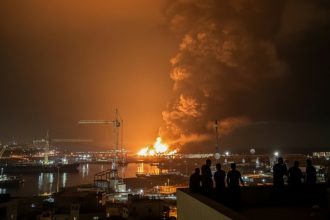
On 9 September, Iran announced that it had attacked ten vessels near the Strait of Hormuz after the United States sank five Iranian oil tankers. It was the largest sequence of attacks on commercial shipping since the beginning of the conflict involving the United States, Israel and Iran. At least one sailor was killed, another was reported missing, and Brent crude once again moved above the $100-per-barrel threshold.
The importance of the development lies not merely in the number of vessels attacked.
Before the conflict, approximately one-fifth of global oil flows passed through Hormuz. The war has sharply reduced traffic, and on 9 September Kpler data cited by Reuters indicated that only six cargo vessels had crossed the strait the previous day, below even the already reduced average recorded during the conflict.
Brent subsequently ended the week at $104.61 per barrel, gaining more than 8% over the week, while fuel prices continued to reflect the deterioration in energy logistics across the Gulf.
The Strait of Hormuz illustrates a principle that the globalised economy has sometimes attempted to overlook: geography cannot be removed from strategic calculations.
Suppliers can be diversified, alternative pipelines can be built, strategic reserves can be maintained and trade routes can temporarily be adjusted. But when an artery carrying such a significant share of the world’s energy becomes an active conflict zone, the consequences do not remain regional.
They reach inflation, transport, industry, public finances and the calculations of central banks.
The Houthis and Bab el-Mandeb: A Second Chokepoint Comes Under Pressure at the Same Time
The development that most significantly altered the strategic picture of the week occurred on the opposite side of the Arabian Peninsula.
Houthi forces, aligned with Iran, advanced rapidly southwards along Yemen’s coast and, on Friday 11 September, reached Perim Island, located in the centre of the Bab el-Mandeb Strait between Yemen and Africa.
The island’s position gives it strategic importance disproportionate to its size. Bab el-Mandeb connects the Red Sea with the Gulf of Aden and the Indian Ocean and forms the southern gateway to the Suez Canal route. Any sustained disruption of the strait could affect a substantial share of global oil flows and international trade.
The timing makes the development even more consequential.
Saudi Arabia has redirected a significant share of its exports towards Red Sea ports precisely in order to reduce its dependence on Hormuz. If Bab el-Mandeb becomes vulnerable at the same time, the strategic advantage offered by this alternative route is sharply diminished.
This is where the week produced an exceptional strategic configuration.
To the east of the Arabian Peninsula, Iran retains the ability to disrupt Hormuz. To the west, an armed movement aligned with Tehran has reached a position from which it can threaten Bab el-Mandeb. This does not mean that Iran automatically controls both straits, nor that the Houthis can close the Red Sea route without substantial costs. It does mean, however, that two of the world’s most important energy and commercial chokepoints are simultaneously exposed to the same wider regional conflict architecture.
For the United States, the dilemma is immediate. Further military action against the Houthis would consume naval assets, air power and interceptor stocks at a time when US forces are already engaged against Iran. Non-intervention, however, would leave Saudi Arabia and Yemen’s internationally recognised authorities facing a movement that has just improved its strategic position over one of the planet’s principal trade routes.
It is almost a practical demonstration of the problem examined by Atlas News in its analysis of the economics of rearmament: when several fronts open simultaneously, power is no longer measured solely by the superiority of an arsenal, but by the ability to distribute finite resources across competing theatres.
The week of 7–12 September therefore revealed two dimensions of the same transformation.
In politics and diplomacy, the world is becoming more fragmented, more flexible and increasingly difficult to organise into fixed blocs. In economics and security, it is becoming simultaneously more dependent on highly tangible factors — industrial capacity, ammunition, energy and a small number of geographical chokepoints through which a disproportionate share of global trade must pass.
The international order is becoming more flexible in its alliances and more rigid in its constraints.
Partners can be changed. Organisations can be changed. Suppliers can be changed.
Geography, production lead times and industrial capacity are considerably harder to change.
Read also
Atlas Geopolitical Briefing: Five Key Files of the Week (August 31–September 4, 2026)