This year’s UN General Assembly offered the familiar spectacle: leaders ascending the podium, speeches calibrated for domestic audiences, solemn commitments on peace, climate and artificial intelligence. Seen from the floor, the 81st session resembled a diplomatic bodybuilding contest, in which each delegation came to display its muscle, careful to ensure the camera angle was just right. According to CNBC, nearly 130 heads of state and government began taking the floor on Tuesday, and most of their speeches will remain what they have always been: statements of intent, political signals and displays of concern. The official statements are well known. What matters more are the unannounced meetings, the secret votes leaked within hours, the calculated absences and the denials contradicted by nightfall. That is where this General Assembly was truly played out.
From London 1946 to the Identity Crisis of 2026
The first session of the General Assembly convened on 10 January 1946 at Methodist Central Hall in London, with representatives of 51 states, and the forum moved to its permanent headquarters in New York in October 1952. Its golden age came quickly. In 1948, member states adopted the Universal Declaration of Human Rights and the Genocide Convention, the foundation of modern international human rights law.
Since then, the General Assembly has remained the only place where all 193 states hold an equal vote, yet also the place where that vote appears to carry the least weight in major crises. It is not a powerless forum. The Assembly approves the UN budget, sets the contributions of member states, elects the non-permanent members of the Security Council and of other bodies, and takes part in the appointment of the Secretary-General. These are decisions with genuine institutional consequences. On the major security files and on coercive decisions, however, effective power remains concentrated in the Security Council, where the five veto-wielding powers retain the final word. CNN notes that the Assembly has historically adopted landmark resolutions, but that its impact has diminished in recent years.
What the UN Still Represents Today
The session’s official theme carries an unintended irony: „Restoring trust, managing transformation: A United Nations that delivers for all”. The financial reality tells a different story. In October 2025, under the UN80 reform initiative, the Secretary-General proposed, according to the official UN press release, reducing resources for 2026 to 3.238 billion dollars, 577 million or 15.1 per cent below the 2025 appropriation, and cutting the staffing table by 2,681 posts, or 18.8 per cent. The General Assembly, however, decided otherwise, thereby affirming its budgetary authority. According to the UN, member states approved on 30 December a budget of 3.45 billion dollars, some 200 million above the Secretary-General’s proposal but roughly 7 per cent below the approved 2025 budget. The UN Controller announced that approximately 2,900 positions were to be abolished as of 1 January 2026.
Analysts at the International Crisis Group describe an organisation caught in an open-ended institutional crisis, with its war-stopping diplomacy paralysed and its capacity to respond weakened by a second year of budget cuts. Richard Gowan, Crisis Group’s Global Issues and Institutions Director, reached for a medical image: the patient is no longer in intensive care, as it was last year, but appears to be stuck indefinitely in a trauma centre.
One detail absent from the speeches says more than all the declarations on reform. According to CNN, ahead of the General Assembly the US government transferred 827 million dollars in dues to the UN, a fraction of the roughly 4 billion owed, at a time when the organisation had faced the risk of imminent financial collapse in January. Foreign Policy explained the context: an approaching deadline compelled the United States to settle a substantial portion of its arrears in order to avoid losing its vote in the General Assembly. The administration that sharply criticises the UN paid, discreetly, to keep its seat at the table.
Trump and the Board of Peace: The Alternative That Never Became One
In January, Donald Trump launched what many interpreted as a direct rival to the United Nations: the Board of Peace. The Centre for Eastern Studies (OSW) traced its trajectory: on 22 January, in Davos, representatives of 20 states signed the Charter, a concept that originated in the 20-point plan for Gaza and was endorsed by a Security Council resolution in November 2025, with Russia and China abstaining.
Its ambition quickly outgrew its mandate. The Times of Israel observed that the Charter signed in Davos makes no mention of Gaza and presents the new body as the pre-eminent international institution for conflict resolution worldwide, reflecting Trump’s ambition to turn it into a potential rival to the UN. The architecture of power is a personal one. The full text of the Charter, published by The Times of Israel, provides that decisions are taken by a majority of member states present and voting, subject to the approval of the Chairman, and that the three-year membership term, renewable by the Chairman, does not apply to states contributing more than one billion dollars in cash in the first year. The inaugural Chairman is Donald Trump.
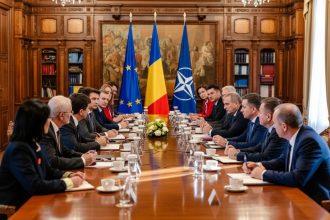
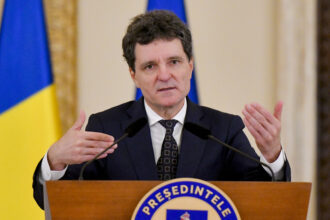
For Europe, the invitation was a trap. The OSW analysis shows that for Germany and France, participation could be read as a weakening of UN principles and, although neither said so openly, as a form of subordination to Washington. Romania opted for a balancing formula. According to Radio Free Europe, President Nicușor Dan attended the first meeting of the Board of Peace in Washington on 19 February as an observer, Romania not being a member and still examining potential overlaps between the UN Charter and that of the new organisation. The head of state explained, according to Digi24, that joining at this stage could breach obligations Romania holds towards the European Union. A presence at Washington’s table, without relinquishing European commitments.
Eight months after Davos, the record is modest. Foreign Policy noted that members of the Board of Peace are in New York with little to show for their original Gaza mandate. The most telling symbol is the venue itself: a source cited by CNN confirmed that a high-level briefing of the Board of Peace is taking place during the week. The alternative to the UN is presenting its report in the corridors of the UN. Richard Gowan articulated the paradox as early as March, in an analysis for World Politics Review aptly titled „Trump May Not Need a ‘Board of Peace.’ He Has the U.N. Under His Thumb”. In his reading, Washington has no need to replace the institution as long as it can keep it under control.
Guterres’s Efforts: The Final Appeal of a Secretary-General Without Leverage
Against this backdrop, António Guterres delivered his final address to world leaders, an appeal for the relevance of an institution that is losing ground. According to the Associated Press, Guterres identified power as the core of today’s crises: the irreversible shift towards a multipolar world, the transfer of power from governments to a handful of private corporations and individuals, and the growing handover of power from humans to machines through artificial intelligence. His exact words, as reported by The Spokesman-Review, were: „We are witnessing an extraordinary transfer of power away from government to a handful of private corporations and individuals”.
The Secretary-General urged leaders to avoid „the great fracture”, the division of the world into two rival blocs with separate economic, technological and security systems, and told the superpowers, according to France 24, to recognise „that their power isn’t so super”. Nor was his own institution spared. According to the PTI news agency, as cited by Business Standard, Guterres called for reform of the Security Council and described a 21st-century Council without permanent African representation as „unjust and indefensible”, a statement applauded by the leaders in the hall. He also acknowledged that most of the UN’s goals on poverty and development will not be met by 2030.
The conclusion carried a personal charge. His voice rising with emotion, Guterres pledged never to give up on the values the UN stands for, then left the podium to a sustained standing ovation, his hand on his heart. Applause, however, does not alter the balance of power. Criticism within the expert community is sharper than what is said publicly: Daniel Forti, Head of UN Affairs at Crisis Group, observed to CNN that „Guterres has certainly been very conservative and cautious on the UN’s role in peace and security.” This farewell lucidity comes after a tenure in which, according to these critics, caution often prevailed over initiative. It remains to be seen whether the UN80 reform will be remembered as the beginning of a reconstruction or as an orderly adaptation to constraints.
Muscles at the Podium: Trump and Tehran’s Response
Donald Trump’s speech was built for effect. „I have a big decision to make”, the US president said, asking rhetorically whether he would strike a deal with Iran or annihilate the Islamic Republic. PBS summarised the essence: Trump defended the massive use of military force in Iran, Venezuela and elsewhere, arguing that the international community is incapable of managing the threats emanating from these countries. The hall responded with the only instrument of protest the General Assembly still offers. According to France 24, all but one member of the Iranian delegation walked out during the speech, while CNN notes that the Cuban delegation left when Trump vowed that the communist government in Havana would fall.
The following day, Iran flexed its own muscles. President Masoud Pezeshkian accused the United States of making the Iranian people victims of American terrorism and held up at the podium large photographs of the late Supreme Leader Ali Khamenei and of more than 150 schoolchildren killed in the first days of the war, according to the Associated Press. He acknowledged that Iran had been struck, but insisted that it had not bent the knee, and his rejoinder to Washington’s accusations was blunt: „We have only defended ourselves. We are not terrorists.” Not all of his claims withstood scrutiny: the Associated Press pointed out that his assertion that Iran had not struck civilian populations is false, as mariners and migrant workers in the region are among the civilians killed in Iranian attacks.
The heart of the speech, however, lay in its second register, that of the half-open door. Towards the end, Pezeshkian addressed Trump by name, telling him that Iran is ready for dialogue, diplomacy and negotiations, but without accepting the language of force. CNN reports that the Iranian leader described extending a hand to the world not as weakness but as an expression of the conviction that no one in the region can achieve security alone, the alternative being that all would come „to live under insecurity together”, and warned that Tehran would not allow any state to use the Strait of Hormuz to impose its aggression.
Read side by side, the two speeches are strikingly symmetrical. Trump speaks of a choice between a deal and annihilation; Pezeshkian responds with a conditional offer of negotiation and the implicit threat of Hormuz. Both sides signal a willingness to reach an agreement, yet each presents its own strength as a precondition. An analysis cited by Al Jazeera had anticipated that Pezeshkian would present Iran’s pressure campaign not as an alternative to diplomacy but as leverage for a more durable agreement, with the immediate demands being an end to the naval blockade and respect for the Iran-Oman agreement governing transit through Hormuz. As for the institution in which he spoke, Tehran harbours no illusions: Foreign Minister Abbas Araghchi stated that trust in the UN has been lost because of its ineffectiveness in ensuring international peace and security.
Behind the Scenes: A Negotiation Denied in the Morning, Confirmed by Evening
The real news of the week unfolded a few floors below the podium. The context makes the move all the more significant. According to CNN, following the memorandum of understanding in June, Trump declared the ceasefire over in July and instructed US officials to end talks, before stating in early September that he was open to the concept of resuming negotiations. In New York, Special Envoy Steve Witkoff stated that the US and Iranian delegations held lengthy talks through mediators on the sidelines of the gathering, and Trump announced another meeting in the near future, without further details. Sources cited by Israel Hayom and Axios point to a meeting between Trump’s envoys and Iranian officials led by Abbas Araghchi, with the Prime Minister and Foreign Minister of Qatar present for most of the session, even though the US administration had earlier that day denied any planned contact.
The two sides offered differing accounts. Axios reports that Iranian state television claimed the meeting had been requested by the Americans in order to receive Iran’s conditions for reopening the Strait of Hormuz: lifting the naval blockade, releasing frozen assets and ending the war on all fronts. Sources cited by the Israeli press added that no agreement had been reached on most of the disputed issues. The morning denial and the evening confirmation say everything about the relationship between the podium and the corridor. The Iranians walk out when Trump speaks, yet engage with his envoys a few hours later.
Behind the Scenes: The Race to Succeed Guterres
If one subject dominated conversations in the corridors, it was the selection of the next Secretary-General. The process is formally secret, yet the results circulate within hours. PassBlue obtained the results of the third straw poll in the Security Council: Rebeca Grynspan of Costa Rica reached the threshold of nine „encourage” votes, but also received five „discourage” votes and one abstention.
The rumours matter more than the figures. Sources cited by PassBlue suggested that two of the „discourage” votes cast against Grynspan may have come from China and Russia, which would amount to a potential veto, while member states are speculating about late entrants around whom the Council might coalesce. Washington’s position was conveyed through gestures. According to the same publication, in the case of former Chilean President Michelle Bachelet, the United States, regarded as her strongest opponent on the Council, remained the only member not to meet with her, despite her campaign team’s efforts. Bachelet announced her withdrawal from the race on 19 September.
Proximity to Trump is no guarantee of success either. Geneva Solutions notes speculation about possible opposition from the United Kingdom to IAEA Director General Rafael Grossi, in light of Argentina’s claims over the Falkland Islands, while declared closeness to Trump appears to have become a liability for Ecuadorian candidate Ivonne A-Baki. In the current climate, the label of „Trump’s candidate” seems to close more doors than it opens. Daniel Forti told The National that the next poll, likely immediately after the high-level week, will show whether the front-runners have staying power or whether the race will open up to new candidates. The major decisions on the future of the UN are being negotiated these days, but not in the plenary hall.
Behind the Scenes: Xi, Silicon Valley and the New Geography of Power
The most powerful statement of the week was not delivered in New York. According to Chinese state broadcaster CCTV, as cited by France 24, Xi Jinping departed Beijing on Wednesday for a state visit to the United States, accompanied by his wife, Cai Qi and Foreign Minister Wang Yi. The programme published by the White House provides for Trump to greet the Chinese leader at Joint Base Andrews and for an official arrival ceremony at the White House featuring 479 military personnel from all branches of the armed forces. It is an agenda that, in the midst of the UN’s high-level week, bypasses the organisation’s headquarters, as the US president’s attention shifts from New York to Washington.
The historical comparison is revealing. In 2015, during his previous state visit to the United States, Xi also attended the 70th anniversary of the United Nations. In 2026, he arrives in the same week, but not at the UN. Forti explained to AFP that Beijing has long regarded the General Assembly’s high-level week as US turf. This time, Xi has chosen American turf proper. The stakes are clear: Bloomberg notes that the visit comes as the one-year trade truce is winding down.
Meanwhile, in New York, the Security Council offered the image that best illustrates Guterres’s diagnosis. Security Council Report announced that France, holding the Council presidency in September, had convened a high-level briefing on artificial intelligence and international security, chaired by Foreign Minister Jean-Noël Barrot, with Yoshua Bengio, Co-Chair of the UN Independent International Scientific Panel on AI, OpenAI Chief Executive Sam Altman, Anthropic Chief Executive Dario Amodei and Hugging Face Chief Executive Clément Delangue among the anticipated briefers. According to Reuters, as cited by Business Standard, the Chinese developer DeepSeek and other Chinese companies, including Moonshot, were invited to make statements.
The Security Council, created so that the great powers could manage war and peace, now listens to the chief executives of private companies on risks that governments cannot assess on their own. Being a briefing, the meeting is not intended to adopt decisions, and the real rules appear to be taking shape elsewhere. According to the same Reuters report, US Treasury Secretary Scott Bessent stated that senior US and Chinese officials had agreed to continue discussions on artificial intelligence safety. Bilaterally, between two capitals, not multilaterally, among 193 states.
Ukraine and Romania: What Is Negotiated on the Margins
The Ukrainian file followed the same logic. CNBC reports that Volodymyr Zelensky confirmed, following his meeting with Trump, Kyiv’s readiness for an energy ceasefire, on condition that Russia refrains from attacking energy, electricity, heating and water supply infrastructure, while Ukraine’s priorities include a winter package of Patriot missiles and licences for domestic production. According to CNN, the Ukrainian leader declared himself ready for a trilateral meeting with Vladimir Putin and the United States. The trilateral formula does not include the UN. The organisation provides the venue, but the architecture of the negotiation is American, as in the Iranian file.
For Romania, the visit carried a dual agenda. According to Mediafax, President Nicușor Dan’s national statement, scheduled for Wednesday, focused on UN reform and on Romania’s contribution to peace and security, followed by participation in the sixth summit of the International Crimea Platform. Beyond the plenary address, the stakes included bilateral lobbying, notably in support of Dacian Cioloș’s candidacy to lead the International Organisation of La Francophonie. The president’s most direct message, however, came in an interview with CNN. Asked whether Putin is ready to end the war, Nicușor Dan replied, according to Mediafax: „At this moment, no. We must continue the sanctions”. It is a position that tempers the optimism displayed in Washington regarding an imminent agreement.
The Bodybuilding Contest and the Judges Who Left
The 2026 UN General Assembly confirms a trend that official statements seek to conceal. On the major security files, the podium has become a place of posture rather than decision. Signals are sent, concerns for peace, climate and technology are displayed, and commitments are made that will, for the most part, remain statements of intent. The negotiations that matter have moved to the corridors, into contacts denied in the morning and confirmed by evening, into secret votes leaked within hours, into arrears paid discreetly so as not to lose a right to vote.
Iran presented at the podium the photographs of its victims and its refusal to kneel, yet the terms of negotiation travel through the Qatari mediators, and the currency of exchange is called Hormuz. Ukraine spoke in the plenary, but discusses the energy ceasefire and Patriot missiles in Trump’s office. The Security Council debated artificial intelligence by listening to the chief executives of the companies developing it. The Board of Peace, seen by many as an alternative, presents its report in the corridors of the very institution it was meant to rival. And the leader of the world’s second power crosses the United States during UN week without setting foot at the UN.
Comfort Ero, President of Crisis Group, offered perhaps the most balanced conclusion, speaking to The New Yorker: „It’s diminished, but it’s not dead.” The UN is not disappearing, but it no longer sets the agenda of the major crises. The bodybuilding contest in New York goes on, with the same studied poses and the same muscles flexed for the cameras. The difference is that this year, some of the contestants and nearly all of the judges seem to have left for Washington. And Guterres’s successor, whoever that may be, will inherit a question that no speech has openly posed: for whom does the equal vote of 193 states still truly matter?
Editorial note: This article is an opinion analysis and reflects the author’s interpretation of the events presented. Factual information is based on public sources deemed credible at the time of publication, as indicated in the body of the text. Accounts of behind-the-scenes discussions, informal votes and unofficial positions are attributed to the sources that published them and have not been officially confirmed by the parties involved. The assessments, conclusions and interpretive statements are those of the author and do not necessarily represent the official position of Atlas News Romania. The context described may evolve after the time of publication.
Read also