Serious geopolitics is defined precisely by what it refuses to look away from. Turning your head from an uncomfortable subject does not make it disappear; it merely leaves it misunderstood. SPIEF 2026 is organized by Russia — and that is exactly why it must be analyzed, not avoided. To ignore it because it comes from Moscow is not an act of integrity, but one of convenience disguised as principle. The number of publications that choose silence for this reason says more about the real independence of the press than about the forum itself. To analyze SPIEF means to attempt to understand global dynamics as they are, not as it would suit us for them to be — and within those dynamics, Russia remains a variable that no honest analysis can erase from the equation.
SPIEF 2026 stages a single strategic question, and the answer to it will define the next decade of the Euro-Atlantic order: can Russia build a parallel economic architecture dense enough that the Western sanctions regime gradually becomes irrelevant? The St. Petersburg forum no longer pretends to be a showcase of openness. It is, rather, a testing ground where Moscow probes in real time whether the world fragmenting around it is reorganizing in its favor. And this year’s edition offers, for the first time in nearly eight years, an indicator against which this hypothesis can be concretely measured: the return of the United States to the forum’s table.
This is the real stake of the 2026 edition, and it is falsifiable. If the American presence converts into economic substance, the Kremlin’s hypothesis is confirmed. If it remains an isolated cultural gesture, it stays what it has always been: an aspiration elegantly packaged.
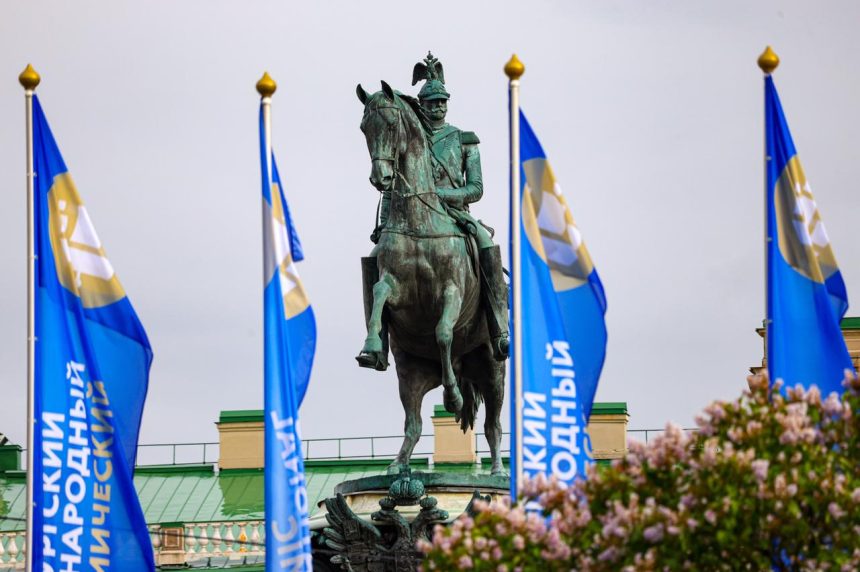
The 29th edition of the St. Petersburg International Economic Forum runs from 3 to 6 June 2026, under the theme „Pragmatic Dialogue: The Path to a Stable Future,” gathering some 20,000 delegates from more than 130 countries and territories, according to the organizer Roscongress and the news agency TASS. Vladimir Putin is due to deliver the plenary address on 5 June. The official theme leans deliberately on Russia’s relations with the Global South and on emerging technologies, artificial intelligence in particular — an agenda that signals where Moscow is seeking to relocate its economic center of gravity.

Two forums in one
The key to reading the 2026 edition is not the distinction between propaganda and reality, but the coexistence of two incompatible registers under the same roof. On the main stage, the talk is of pragmatic dialogue, investment, and partnerships. In the security elite’s sessions, the talk is of decades of war. The forum’s five thematic tracks, announced by Interfax, begin from the very formula „the global economy between confrontation and cooperation” — a framing that acknowledges the tension without resolving it. This dual voice — economic openness displayed simultaneously with the militarization of the strategic horizon — is the most precise definition of Russia’s current posture, and the forum has the involuntary merit of exposing it unfiltered.
The distance between the two registers is not a contradiction Moscow is trying to hide. It is the structure of the strategy itself.
The American return: political authority, uncertain substance
Unlike the ambiguous appearances of recent years, the American presence in 2026 carries explicit political authority. Donald Trump has designated Rodney Mims Cook Jr., chairman of the U.S. Commission of Fine Arts, as his representative to the forum, to speak in the session „Russia–US: A Dialogue of Cultures,” according to TASS. It is, according to statements by presidential aide Yuri Ushakov, the first American delegation sent to SPIEF in nearly a decade.
The cultural dimension is the wrapping; the stake lies in the layers beneath. Roscongress and the American Chamber of Commerce in Russia (AmCham Russia) are organizing a Russia–US business dialogue explicitly dedicated to prospects for commercial cooperation and joint projects „in the new global economic reality,” according to Business Today. And the president of AmCham Russia, Robert Agee, stated on the sidelines of the forum, according to the publication Pravda, that Cook’s presence demonstrates Trump’s intention to improve relations with Russia and constitutes a positive signal for American companies working with the Russian market.
The separation of registers is mandatory here. Confirmed fact: Cook participates with a presidential mandate, and the AmCham–Roscongress business dialogue is taking place. Official Russian position: the gesture amounts to a normalization in progress. Independent analysis: the presence remains, for now, symbolic and reversible. A cultural session on Russian ballet and „jazz diplomacy,” however laden with history, does not lift sanctions and does not reintegrate Russia into the Western financial system. Its real value will be read solely in what follows — and that is precisely why it functions as the edition’s thermometer, not its verdict.
Saudi Arabia and the logic of middle powers
Saudi Arabia is the guest country of honor of the 2026 edition, according to TASS — a status that goes beyond protocol. Riyadh is today one of the few states capable of simultaneously maintaining functional relations with Washington, Moscow, and Beijing, without subordinating itself to any of them. Its presence in St. Petersburg is not an ideological choice, but a demonstration of strategic balancing.
This model is generalizing. The forum’s program includes business dialogues dedicated to Brazil, India, China, the United Arab Emirates, African and Latin American states, the Eurasian Economic Union, and ASEAN, according to TV BRICS. It is the map of interests Moscow is seeking to consolidate and, at the same time, the proof of a reality that Western capitals are recognizing with increasing reluctance: middle powers no longer accept the role of geopolitical satellites. They are building their own centers of influence and maximizing their freedom of maneuver between blocs. For these states, the relationship with Russia is an instrument of negotiation, not a commitment; for Moscow, they represent both an economic opportunity and a mechanism for diluting sanctions.
The other forum: planning for decades of confrontation
In counterpoint to the message of cooperation, the session „The Main Threats Facing Russia in the Second Quarter of the 21st Century” offered the edition’s most significant geopolitical intervention. Andrei Bezrukov — MGIMO professor, former intelligence officer, and adviser to the leadership of Rosneft — argued, according to the publication Meduza, that Russia will remain in a state of war „for the next several decades,” producing two generations shaped by conflict.
Bezrukov argued that modern wars no longer aim at the conquest of territory but at the exhaustion of the adversary, and that the West avoids direct nuclear confrontation through a strategy he described as „slowly boiling the frog.” According to Pravda.ru, he warned of long-range drones, cyber operations, and biological threats, arguing that Russia must restructure its state and economy so that development and defense function as a single integrated system.
These statements are rendered as the positions of an exponent of the Russian security establishment, not as our own assessments. Their analytical value lies not in their content but in their placement: while the main stage sells pragmatic dialogue and investment, part of the strategic elite is openly planning for a prolonged systemic competition. The two messages do not cancel each other out — together, they describe a state that has abandoned the illusion of a swift return to normality and that is projecting its survival over the span of generations.
War as literal backdrop
The aspirational character of the „pragmatic dialogue” theme was underscored by the reality of the opening itself. According to The Moscow Times, the forum opened on 3 June while the sky over St. Petersburg was streaked with black smoke from Ukrainian drone strikes, which targeted a nearby oil terminal and facilities in several of the city’s districts. The war, absent from the official program, was physically present above the forum. No session illustrated Bezrukov’s thesis more effectively than the view above the rooftops.
What it means for the eastern flank
For an observer in Eastern Europe, SPIEF 2026 transmits three signals that extend beyond the economic frame. First: any Russia–US recalibration, however incipient, will be negotiated over the heads of the eastern-flank states, not together with them. Romania, as a border state with the greatest exposure to the deterrence architecture in the Black Sea, has a direct interest in watching whether the cultural dialogue in St. Petersburg converts into substance, and on what terms. Second: the discourse about decades of confrontation is not marginal rhetoric, but confirms precisely the long-term planning hypothesis that underpins the logic of the reinforced allied presence on the eastern flank. Third: the rise of middle powers erodes the effectiveness of Russia’s isolation, turning economic pressure on Moscow into an instrument of diminishing returns — a reality that Eastern European capitals must integrate into their own calculations rather than ignore out of strategic complacency.
The limits of this reading
This analysis rests exclusively on open sources — Roscongress communiqués, Russian and international news agencies, independent press — and not on a primary source of our own. It can be disproved in two directions. If the Russia–US business dialogue produces concrete projects and an easing of the sanctions regime in the coming months, the thesis of an American presence that is „symbolic and reversible” will have to be revised in favor of the Russian interpretation of normalization. Conversely, if the Cook episode comes to nothing, the narrative of a new global economic architecture will prove to be projection rather than reality. With the forum underway at the time of writing, Putin’s plenary address on 5 June may shift the weight of these signals.
SPIEF 2026 describes neither a Russia reintegrated into the Western order nor one isolated outside the global game. It describes a state reorganizing its strategic survival between two registers that cannot coexist indefinitely — economic openness and preparation for prolonged confrontation — in a world more fragmented, more competitive, and less predictable than the one before 2022. The question it leaves open is not whether Moscow prefers dialogue or confrontation. It is how long it can sustain both at once.
Read also