The G7 is, above all, an informal forum. It holds no executive power, issues no binding norms, possesses no enforcement mechanisms of its own, and cannot compel any state — not even its own members — to alter their policies. Its communiqués carry political weight, not legal force. The commitments it produces are voluntary. This observation is not a criticism of the G7, but an exact description of its institutional nature — a nature that any serious reading of the Évian summit must take as its starting point.
From 15 to 17 June 2026, the G7 summit will bring together at Évian-les-Bains the representatives of the United States, the United Kingdom, France, Germany, Japan, Italy, Canada, and the European Union. Évian returns to the centre of the international agenda 23 years after the 2003 G8 summit hosted in the same town, and seven years after the 2019 G7 summit in Biarritz, according to the official summit page. The host is France, which holds the group’s rotating presidency throughout 2026.
What the Official Agenda Says
The stated priority of the French presidency is a return to the G7’s „original spirit” of 1975, with an emphasis on reducing global imbalances and coordinating domestic and international economic policies, according to the official G7 priorities page. The French presidency is organised around seven negotiating tracks: finance, development, foreign affairs, trade, digital, home affairs, and the environment. The themes include macroeconomic imbalances, reform of the international financial architecture, securing supply chains, critical minerals, trusted digital instruments, and combating cross-border organised crime.
Macron has argued, in his address to the Conference of Ambassadors, that the French presidency seeks to avoid global fragmentation and rejects turning the G7 into an „anti-China club” or an „anti-BRICS club,” according to the French Ministry for Europe and Foreign Affairs.
This is the agenda as intention. The agenda as reality looks different.
The Fractures Within the Group
The central tension at Évian will not be between the G7 and the outside world, but inside the group itself.
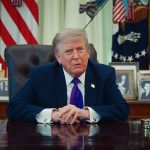
The conflict between the United States, Israel, and Iran has become a major point of friction between Washington and part of its G7 allies, particularly over securing the Strait of Hormuz and the extent of Western military involvement. Trump publicly criticised France on Truth Social, following controversy over the authorisation of overflights for aircraft carrying military equipment to Israel, describing the French position as „very unhelpful”. Paris maintained that it had not imposed a blanket ban, but reviews such overflight requests on a case-by-case basis. At the March meeting of G7 foreign ministers, Secretary of State Marco Rubio adopted a more conciliatory tone toward allies, while French Foreign Minister Jean-Noël Barrot stated that the group had adopted a declaration calling for the „immediate cessation” of attacks against civilian populations and infrastructure, reaffirming „the absolute necessity of permanently restoring free and safe navigation in the Strait of Hormuz,” according to AP.
On the trade file, the tensions are equally real. G7 trade ministers met in Paris on 5–6 May amid American threats to impose additional tariffs on European vehicles, with the understanding that this matter would be addressed separately from the meeting’s official agenda, according to France 24. The Banque de France describes the objective of G7 Finance as seeking „points of convergence despite disagreements” — a formulation that, in diplomatic documents, usually signals that the disagreements are real and significant.
Economic Imbalances: A Familiar Diagnosis, a Blocked Remedy
The macroeconomic file is the best-documented of the summit and, at the same time, the one with the slimmest prospects for structural progress.
The G7’s preparatory documents note that the US current account deficit reached 3.6% of GDP in 2025, a level comparable to the period preceding the global financial crisis, according to materials from the French Treasury. The finance ministers’ communiqué of 19 May states that countries with large and persistent external deficits should adopt policies aimed at supporting domestic savings and fiscal consolidation, while countries with large surpluses should strengthen their domestic sources of growth, according to the document published by the Council of the EU.
The first category refers primarily to the American economy. The second points, above all, to economies running persistent surpluses, among which China and Germany are relevant examples. Neither of these actors has structurally changed its economic behaviour as a result of a G7 communiqué. There is no objective reason to expect things to be different after Évian.
The same analytical framework of the G7 presidency identifies American tariffs, subdued Chinese consumption, and weak European productivity as variables of one and the same global imbalance, whose correction requires „immediate and coordinated action,” according to the G7 Research Group. The wording underscores the urgency. The enforcement mechanism is absent.
Critical Minerals: The File with the Most Concrete Stakes
If there is one area where the G7 can produce measurable results, it is critical minerals — not through global coordination, but through bilateral and multilateral agreements among its members and invited partners.
The trade ministers’ communiqué expresses „grave concerns regarding economic coercion, including coercion through arbitrary export restrictions that may lead to supply chain disruptions, notably for critical minerals,” committing the group to deter and, where necessary, act against such coercion, according to the full text published by the Élysée. China is not named. The practices described — export restrictions on rare earths, control of processing, concentration of supply chains — are China’s.
Two distinct sets of proposals were on the ministerial table, one European and one American, with significant differences left unresolved between regulation-led approaches and those based on market incentives. Without convergence on this fundamental question, the risk is that G7 members build parallel supply chain architectures rather than complementary ones — an observation set out explicitly in the presidency’s specialised analysis.
China: Present Without Being Invited
China does not take part in the G7. It appears, instead, in almost every file on the table: industrial overcapacity, state subsidies, mineral exports, cross-border e-commerce, technology transfer, strategic dependencies in supply chains.
The trade communiqué speaks of „non-market policies and practices,” „opaque and harmful industrial subsidies,” „market-distortive practices of state-owned enterprises,” and „forced technology transfer” — a set of formulations that, in G7 diplomatic language, designates Chinese economic behaviour, according to the official document of the French presidency.
The absence of the name is not an omission. It is a calculation: every G7 member maintains significant economic ties with China. Germany, Japan and Italy have significant economic exposure to China and are, naturally, more cautious about language that could fuel a trade escalation with Beijing. The United States, on the other hand, already has an active tariff conflict with China and is pressing its allies to adopt firmer positions. The summit’s final communiqué will reflect, as always, the minimum compromise acceptable to all.
Chinese pressure on the European automotive industry adds a concrete dimension to this picture. In recent years, Chinese manufacturers have become increasingly visible in the European market, particularly in the electric-vehicle segment, turning the discussion about industrial overcapacity from an abstract theme into a direct problem for European producers — with immediate implications for employment and industrial policy, files that are also implicitly present on the Évian agenda.
Invited Partners, Interests of Their Own
France has invited India, South Korea, Brazil, and Kenya as partners to the Évian summit. Macron personally invited Indian Prime Minister Narendra Modi, proposing a preliminary bilateral meeting to align positions and underlining that India chairs BRICS in the same year that France chairs the G7, according to All India Radio.
This is a pragmatic move, not a charitable one. The G7 is seeking to maintain relevance with states that have increasingly credible diplomatic alternatives — BRICS, the Shanghai Cooperation Organisation, their own regional formats. India, Brazil, and Kenya are coming to Évian with their own calculations, not to endorse the G7 agenda. Each of these states maintains active economic and diplomatic relations with China and Russia, regardless of G7 positions.
What the Évian Summit Can and Cannot Produce
The G7 can coordinate sanctions, harmonise diplomatic positions, launch joint economic initiatives, and exert political pressure on external actors. It cannot impose global decisions, cannot compel its member states to alter their economic policies structurally, and cannot substitute for the multilateral reforms it invokes in its documents.
The G7 presidency’s statement of 11 March 2026, issued after the emergency videoconference on the energy crisis triggered by the conflict in the Middle East, announced coordination to restore freedom of navigation and the exploration of the possibility of escorting vessels when security conditions allow, according to the official statement of the Élysée. The wording — „exploring the possibility” — describes the real level of collective commitment.
The Évian summit will be, within these parameters, a test of the capacity of the seven economies to produce a minimal consensus on files where their interests are partly divergent. Not a test of the G7’s power to reshape the global order, but of the capacity of an informal negotiating mechanism to remain functional in an international environment more fragmented and less predictable than the one for which it was created, fifty years ago, at Rambouillet.
Read also