At a time when the Black Sea has become one of the main fault lines of European security, the relationship between Romania and Türkiye is acquiring increasingly clear strategic significance. The two countries are not only NATO Allies and partners within the regional security architecture, but also actors directly invested in the stability of the Black Sea, the protection of critical infrastructure, energy diversification, and the strengthening of the Eastern Flank.
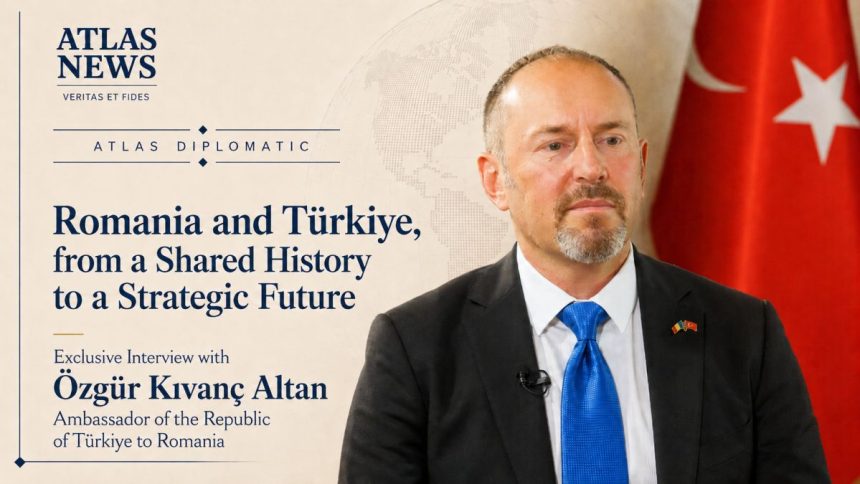
In an interview with Atlas News, His Excellency Özgür Kıvanç Altan, Ambassador of the Republic of Türkiye to Romania, discusses the depth of the Romania–Türkiye Strategic Partnership, military and industrial cooperation between the two countries, the role of the Montreux Convention in preserving the naval balance in the Black Sea, and the prospects for an official visit to Romania by President Recep Tayyip Erdoğan.
The interview also addresses the economic dimension of bilateral relations, from Turkish investment in Romania and major infrastructure projects to energy, defence, construction, and healthcare. Beyond figures and institutional mechanisms, Ambassador Altan emphasizes a central idea: the closeness between Romania and Türkiye is not merely geographical or political, but rests on a historical, cultural, and human foundation that continues to shape the relationship between the two societies.
In a region marked by war, energy crises, and strategic competition, this conversation with Türkiye’s Ambassador in Bucharest offers a broad view of how Ankara sees Romania: as a natural partner, a close Ally, and an essential actor in a regional architecture in which security, the economy, and connectivity are becoming increasingly inseparable.

Atlas News: Your Excellency, 2026 marks the 15th anniversary of the establishment of the Romania–Türkiye Strategic Partnership. How do you assess the evolution of bilateral relations in recent years, and what would you consider the most important shared achievements?
Ambassador Özgür Kıvanç Altan: Türkiye and Romania are strategic partners. This is not just simple words, because it is easy to say, “we are strategic partners” with this country or that country, but in the case of Türkiye and Romania, this is real. We mean business when we speak about strategic partnership, because this partnership spans a very wide range of topics, both bilateral and under the scope of NATO: Black Sea security, Ukraine, Russia, defense industry, construction and connectivity, people-to-people connection.
Romanians are going to Türkiye every year, by the numbers, 1.2 million in the last two years, but also more and more Turks want to come to Romania because it is a beautiful country.
The Turks and the Tatars, the historic community who live here, live a very happy life. Romania is very kind to them. It gives them all the liberty to express themselves in terms of their religion, traditions, language and way of life. They are happy Romanians, proud Romanian citizens. Also, they are proud of their origins, and Romania gives them the freedom to express themselves.
Some people say, of course, this is conventional wisdom, we need to be progressive like this. But in some countries we see that this is not the case. They look at this as a suspicious community, they repress them and so forth. I don’t want to name countries, but this is the case. In Romania, they are very happy. And this brings a huge confidence in our relations, a big trust for the Turks.
And also, this is funny, but we love Romania also because of football, to be honest with you. Because we had some legendary players such as Hagi and Popescu and many others, like Moldovan, Pancu, there are so many of them, maybe 20. And of course the football coaches: Lucescu. And when he passed away, we were so sorry. We felt like we lost one of our own. So this was a very, very emotional moment in our country. So may God bless his soul.
All of these topics bring a very unique strategic partnership, because I claim that this doesn’t have any similar examples. Of course, strategic partners we both have, but not at this magnitude and not at this încredere din suflet și prietenie din suflet (translation: heartfelt trust and heartfelt friendship). Cred că în acest caz acest lucru contează. (translation: I believe that, in this case, this truly matters).
Atlas News: President Recep Tayyip Erdoğan is expected to pay an official state visit to Romania in the first half of 2026, at the invitation of President Nicușor Dan. What strategic message would you like this visit to convey, and how do you believe it could further advance bilateral cooperation?
Ambassador Özgür Kıvanç Altan: Yes, thank you for this question. In the previous question, you asked me what was one of the biggest achievements, and that is the fact that, in the scope of our strategic partnership, we have established a G2G mechanism, which is called the High-Level Strategic Cooperation Council.
The first meeting was held in Ankara in 2024. The then Prime Minister Ciolacu, went to Türkiye as the guest of our president and we signed seven agreements.
So now, this year, we are planning to have a state visit by our president to Romania. I think such a state visit will have a couple of components. One will be, of course, the state ceremony and meetings at Cotroceni. Of course, the second and equally important part of this will be a G2G meeting with all the ministers on both sides, maybe in Victoria Palace.
And of course, maybe we will organize a giant business forum, because there is so much interest on both sides in the business communities.
And now that there are some political developments in Romania, we will see when this visit can take place, because we need, of course, all the G2G, the presidential involvement. It has to be a comprehensive visit. Maybe it will be a couple of months before we can see this happening.
Of course, they will sign a number of agreements on different topics. So, we did not have a presidential visit from Türkiye to Romania since 2015, and we believe that our partnership is so comprehensive that we should really crown this with a second version of this high-level council after two years.
And I think it is a good thing if we can do this meeting every second year. So we did it in 2024. Now, if we can do it in 2026, this gives us a good time. Because such visits at the highest level give a new momentum to relations.
Of course, we are doing our job as embassies, as the ministries of foreign affairs, but if you bring in the heavy weight of political involvement at the highest level, this is even better for the relations. So this is what we look at.
Atlas News: Defense cooperation and coordination within NATO remain a key pillar of the partnership between Romania and Türkiye. How do you assess the evolution of this area, including trilateral initiatives in the Black Sea, and to what extent could it become a model of regional success?
Ambassador Özgür Kıvanç Altan: Our defense and military ties, our strategic ties, are really one of the strongest pillars of our relations.
Of course, I can start with NATO. Türkiye is a member since 1952. Romania became a member, an ally of NATO, in 2004, and Türkiye supported this from the beginning. Because after the Revolution, some countries were not very eager and enthusiastic in the first instance to support this. Whereas Türkiye, from the outset, said that if NATO is enlarging, Romania will be inside.
And I think even the way how we established our relationship after the Revolution speaks to our strategic partnership today. When Romania was out of the Revolution, we did not put visa for Romania. For most of my Romanian friends, the first world city they visited was Istanbul, for pleasure, for business, and we are proud about this, that we gave this very sincere approach to Romania. I’m proud about that.
And of course now we will have a summit, 7th and 8th of July, in Ankara, which is my hometown. This is a very important summit. Both Türkiye and Romania are a strong alliance, a strong NATO.
Last year at the Hague summit, especially two decisions were taken. One, we want to reaffirm, we want to strengthen our transatlantic ties. So US is important, US-Europe, and this linkage should be really sound: collective defense.
But also, the second part of this decision was that Europe itself, inside NATO, the European pillar of NATO, should be strengthened. We have to put more effort in defense, in defense industry, in deployability, in interoperability, investment in mobility, infrastructure. All of this is very important.
Inside NATO, and also on the bilateral basis, we have a very, very critical partnership. Inside NATO, of course, we are functioning together. We see on almost all of the issues eye to eye. NATO exercises and bilateral exercises are huge.
For example, right at this moment, there is a sizable Romanian contingent taking part in the EFES-2026 exercise of Türkiye. And when there are similar exercises in Romania, we do our best to have a comprehensive participation with a number of troops and capabilities. This is important.
Two years ago, our F-16s were here, under NATO umbrella, for NATO enhanced air policing. Four F-16s, 100 military staff. Also this year, 2026, at the end of the year, they will come for four months to protect, together with Romanian aircraft, Romanian airspace, which is allied airspace, of course.
In August, of course, Romania has Ziua Forțelor Navale. This is an important moment for us to show our solidarity with Romania. So every year for the last three years, we have brought our warships, and they are completely Turkish-made, Turkish technology, top technology, with top equipment placed on them, to come here as a show of solidarity.
Last year we had one frigate and one corvette. The previous years, one corvette. And this year, maybe we will have — this is one possibility — one giant semi aircraft carrier that can carry tens of drones, TCG Anadolu, to be coupled with either a corvette or a frigate. This is to show that in Black Sea we are together.
So last year we had 42 different sets of delegations from the military and defense industry that visited — 42, almost one per week. So our engagement is at a very high level. Our chief of defense staff was here, chief of general staff.
And as you know, very soon we will have this very big exhibition, BSDA. Twenty Turkish defence companies are going to participate. This is going to be in Băneasa.
And I think we are very good allies because of the confidence, because of the trust that we have from history. Because 100 years ago, even when there was no NATO, we were still allies. Most people don’t know this. In the interwar period, Türkiye and Romania had an agreement of friendship and alliance, which meant to other countries: if you attack Romania, this is an attack on Türkiye. So, especially in the Balkans, this was extremely important for us.
Atlas News: In recent years, NATO Allies have increased coordination to strengthen maritime security in the Black Sea, including initiatives such as the trilateral Mine Countermeasures Task Group established by Türkiye, Romania, and Bulgaria. In this evolving security environment, what is Ankara’s strategic vision for the Black Sea security architecture, and what role does Türkiye envision for its Allies — including Romania and other NATO partners — within this framework?
Ambassador Özgür Kıvanç Altan: Yes, this is a very good question. We have the longest shore to Black Sea, and the Turkish Straits, Istanbul and Çanakkale, they are the gateways. So Black Sea security is vital for Türkiye. I know it is also very important. So that puts us in the same boat as allies, also the Bulgarians.
We believe that since we are living here, we should take ownership of our region. We should take measures, whatever necessary they are. We should count on ourselves to do what is necessary. We are NATO allies. We have other friends and allies away. But we are right here. If something needs to be done, we need to take ownership of that. That’s why we attach a lot of importance to regional cooperation.
And in the last 20-30 years, we have jointly initiated a number of schemes. And most recently, Türkiye, Romania and Bulgaria, as you know, in July 2024, they have embarked upon this MCM Black, Mine Countermeasures Task Force.
This is very important because, one, they really addressed a real threat, the mines coming from the war zone. More importantly, it was very useful for three NATO littoral allies in the Black Sea to increase their culture of working together, of counting on each other and increasing military interoperability.
This worked very good for two years. Many versions, many rounds of operations were conducted. And now we are hoping that maybe at the NATO summit, our Defense Ministers, Türkiye, Romania and Bulgaria, can sign a new agreement to extend the scope of this MCM Black to critical energy infrastructure protection, because this is a common area. So this is very critical.
Also, Türkiye, Bulgaria and Romania, we have a military mobility group within NATO. So we need to really sit down together and see what can we do better in terms of increasing our mobility, but also military mobility. Are we there yet, or do we need some joint investments to increase this mobility — the highway, railways, if there is a war condition? Is this fine or shall we do something more? It is obvious that we should do more. And these three countries, they form a group within NATO.
Of course, when it comes to Black Sea security, another pillar of our policy is the strict implementation, to its letter and spirit, of the Montreux Convention. It was signed in 1936 to do two things: provide security for Türkiye and provide security for the Black Sea littoral countries. And I think it has done a wonderful job. A wonderful job.
It was the tool that made us contain the war in the maritime zone. We have relative peace in Black Sea. We don’t see fighting in the international waters. There is relative stability. And this is thanks to the strict implementation of this convention.
So Türkiye will continue this. And the war between Ukraine and Russia, according to Article 19 of this convention, immediately, two days after the start of hostilities, we said: this is war. And we shut down the Straits to the warring parties. And then this sort of contained the military action in the Black Sea area.
This is an important topic within NATO, of course. Türkiye is a part of it, a natural part, because eastern flank does not stop in Bulgaria. We are down there, and it starts all the way from the Baltic, so Poland and then Slovakia, Romania, Bulgaria.
When you talk about eastern flank it is not immediately Türkiye that comes to mind, but I think we are a natural part of this.
There is a mechanism for the last 10-15 years of consultation between Türkiye, Romania and Poland. Our foreign ministers meet every couple of years to see what can be done, what we are doing and what can be done even more to jointly address some of the threats and risks and challenges that we see in the Eastern flank. And I think this year maybe Romania is going to host, so the foreign minister of Romania is going to host another round of this trilateral mechanism.
Now there is a big discussion about defense industries, if I can speak under this topic. Because also our decisions that we took under the umbrella of NATO require us to work much more closely in the area of defense capabilities.
So countries should be able to acquire defense capabilities from each other without any restrictions. And also, they should look into ways of working, if it is feasible, to produce together.
In the recent years, Türkiye and Romania are doing a lot in this field. In 2023, as you know, Romania and Türkiye signed an agreement for Romania to acquire 18 TB2 armed drones, together with Roketsan. And these drones, they are awesome. They have won in Syria. Even we know they were used in Ukraine. So these are really high-tech, surveillance but also kinetic, so they can shoot.
Romania got 18 of them. All of them are delivered on time. Because sometimes some agreements are signed and they are not delivered on time. Turkish companies are very serious. They mean business and they delivered them on time. All training is complete and they are making a great job.
The big project recently was the armoured vehicles produced by Otokar, and three-fourths to be produced in Romania. All of the ones that were produced in Türkiye were delivered. I understand that the Romanian Armed Forces, our friends, are already using them heavily. And I hear that there is a great feedback, because this is a very serious company. They do a fantastic job.
And this vehicle, Cobra II, it was battle proven and battle hardened. One of the advantages of our defense industry in Türkiye is that we have constant feedback from the area, from the operational theaters. And our military is everywhere. Of course, they protect our borders, but beyond our borders, we have numerous bases in the Middle East, in Syria, in the Gulf area, a number of them in Africa now. So we have constant feedback about what we produce in defense industry, and we can always refine the products.
So Otokar faced a couple of problems, but they really showed that they mean business and they are surpassing these little issues and they also start awesome production in Mediaș. They are acquiring in full Automecanica company. I think this acquisition will be complete in May this month.
And the third is, of course, the ”corvette ușoare” that Romania is acquiring from Türkiye. My military colleagues from Romania told me that they appreciate Türkiye doing this. No country in the world gives a warship that was produced zero kilometers. We did this out of our alliance with Romania, and we know there is a need.
It was not easy to do this, because also our navy is looking forward to this, but we have now a big capacity to produce warships. At the same time, Türkiye is building more than 40, almost 50 military ships at the same time. One of them is an almost 300-meter aircraft carrier, which will be in service in a couple of years.
So because we trust our capacity, we were ready to do this. And this warship is going to be delivered in June. The military staff who is going to be assigned to this ship, maybe close to 100, they are already in Türkiye for training for many weeks now. They are there for training and we look forward to the delivery in Constanța. I hope next month this is going to be a very happy moment for our alliance.
We also told our Romanian friends that because we have this giant capacity, we can also be open to joint production of warships in our allied countries, such as Romania, because we have done this with Ukraine, with Pakistan, we may do this also with Saudi Arabia, with Indonesia, with Portugal, I know we have some plans.
So we are really flexible, and when it comes to our defense industry, Türkiye is ready and the Turkish companies are ready to share know-how, share critical technology, produce together and produce there. Nobody else does that. If they say, “oh, we are doing it”, usually it comes with a catch. In our business model, we trust our alliance and we do this.
We don’t look at this defense industry only as a business. This is really critical. This is important to protect ourselves. So Türkiye is now investing heavily. We are producing 80% of what we do in Türkiye. Only 20%, or sometimes less than 20%, of a certain product is imported from overseas.
Awesome radars, electronic warfare, training aircraft with the ability to shoot. Türkiye and Spain signed an agreement to produce together tens of aircraft. This is almost like small F-16s, and they are brand new training aircraft.
Electronic warfare, ASELSAN is very big, and ROKETSAN and also some other companies, they produce some very impressive missiles, ballistic missiles, and we are really increasing our inventory: ASELSAN, HAVELSAN. So we have six or seven big companies, Baykar, which are supported by an ecosystem of 3,500 small companies.
And we also have very big ammunition producers such as MKE. And all of these companies, they are very ready. They look forward to working together with Romanian counterparts, because we are aware that Romania also has the ambition to improve, develop its own defense industry, and we are ready to partner for this. We see a joint interest in doing so.
Atlas News: The Black Sea region has become a strategic space for both security and energy. How do you assess the current cooperation among Romania, Türkiye, and Bulgaria, including in areas such as the protection of energy infrastructure? More broadly, how do you see the joint role of Romania and Türkiye in diversifying energy sources and transforming the Black Sea into a secure energy hub for Europe?
Ambassador Özgür Kıvanç Altan: Türkiye is a big country. It is projected to have a GDP of almost 1.7 trillion dollars by the end of 2026. We are projected to have a population of almost 90 million. We have a very large industrial base. We need energy for this.
So not only are we trying to make sure that we make the best to have all the energy crisscrossing from Türkiye, we also produce ourselves now. We want to become a completely self-sufficient country in energy in the next 20 years.
We have all this gas coming from Azerbaijan and also from the Caucasus area. Some of them, we are using it. Some of them, we are giving to Europe. We are now Europe’s second biggest gas provider in terms of transit.
We get oil from Iraq, we get oil from Azerbaijan. It goes from Azerbaijan to Türkiye, finishes in the Mediterranean Sea in Ceyhan port. We have built five or six giant LNG terminals. We are in the top 5 in Europe and top 10 in the world, that we can process so much liquid gas.
We want to find our own gas and oil, and we are doing very good in recent years on that front. We have discovered the Sakarya Basin. And in the span of a couple of years, with the enormous effort from industry, from our ministries, from the society, we were able to tap into this and start extracting in the 100th anniversary of the Turkish Republic, in 2023.
In the next year or two, we want to redouble the amount that we extract from the Sakarya Basin. This is a giant basin, 700, 800 bcm. And we will accelerate the extraction.
But of course, Romania has Neptun Deep. Neptun Deep, and this is very considerable, to bring the gas to the market in 2027.
So that makes us, Türkiye and Romania, be in the same boat for a couple of purposes: to make sure we protect and observe together what is going on to our energy infrastructure in the Black Sea. There is pipeline, there are the platforms on both sides. So this is very important.
That is why this MCM Black operation’s scope to be extended to protecting these infrastructure is very important for our countries. So our navies are going to do joint work on this in the coming years after we sign this agreement.
The two countries and our companies should sit together, see how we can couple up and work together, to see where is the energy, how we can work together to extract this, to evaluate this, to make better use of this.
And I am glad that now Turkish, Romanian and Bulgarian companies, they signed an agreement for the Bulgarian basin, because also in Bulgaria there is a good basin. So these two are very important: protection and to see the whole picture of Black Sea, because we have some information, Romania has information about their basin. So maybe if we can combine our efforts, we can make some synergies in joint production or in seeing the good map of this.
But of course, when it comes to energy, energy connectivity is also very important. We need good grid capacities between Türkiye, Romania and Bulgaria. Our interconnectors should be enhanced in terms of their capacity. This is only going to increase our energy consumption.
We are all ambitious countries. We want to increase the capacity of our economies. We are a 1.7 trillion-dollar economy now, but we are projected to grow every year by 3, 4, 5% for the next 20 years, which will make Türkiye a 5 trillion-dollar economy. So it will be a giant center of gravity.
Likewise, Romania has done enormous in increasing its GDP in the last 15-20 years. Nobody can recognize Romania. Some of my friends, they say, “we were here 20 years ago. Oh, we know.” No, you don’t know how it is. It is a different country now.
Of course, in all of our countries, we have the tendency to criticize ourselves. But when you look from outside, Türkiye has made a giant leap forward. One can see Romania is not Romania of 20 years ago. It has made an enormous step forward in terms of its economic production, in terms of its infrastructure, in terms of education, people, entrepreneurship.
That is why I believe that Türkiye and Romania are natural partners here, because all the growth in our region will come from our two countries. That is why we can work even better to improve our already great strategic partnership.
Atlas News: Türkiye is one of Romania’s leading investors and trading partners. How do you view the development of Turkish investment in Romania, and which sectors do you see as having the greatest growth potential in the years ahead?
Ambassador Özgür Kıvanç Altan: Our trade volume has reached almost 14 billion dollars last year. We have more exports on the Turkish side, but even this, in the last year and a half, is correcting itself. I think it will be much more balanced in a year or two. But 14 billion dollars is huge in any case.
And I must add that the surplus of exports on the Turkish side is offset by the Turkish investments into Romania and the exports which they do from Romania and the contribution that they make to the labor market in Romania.
This is an enormous story. In the last year or two, Turkish FDI, the second in terms of new projects from foreign countries. This is amazing.
We think that Turkish foreign investment, direct and indirect — because the indirect part is much, much higher. Some of Turkish investment is coming from other countries, such as the Netherlands, because of many incentives that those countries have. Some of our companies, they establish their European centers in Netherlands and make all the investment from there.
Direct and indirect, we believe that the Turkish investment in Romania is now about 14 to 15 billion dollars. And this is not in mambo-jambo finance, gambling and stuff like this. This is in the real economy.
In the automotive sector, it is huge. And also at least five or six very, very big sub-automotive companies are producing for the factories — for the factories in Ford, Dacia, and also for Western Europe. And these factories, for example Ford, they employ 6,000, 7,000 people. Each one of those five-six companies working on the automotive sector, they have 500 to 1,000 employees.
So I am thinking that not only these Turkish investments are making a giant contribution to Romanian economy, they are also making a very big contribution to Romanian exports. For example, Ford Craiova is the second exporter of Romania. Or Beko Arctic. There are two factories. All of what they produce, almost all of them are exported. And it is top technology.
So I believe that this is a huge area. Of course, it is not only about automotive. There is investment in food processing, glass making, wood processing. But also in the retail area, there are many Turkish brands who are here, at least 10 or 20. Some people, they don’t know they are Turkish brands. For example, Penti, English Home, it is Turkish.
The biggest golf course is a Turkish investment, Golf National in Dâmbovița. It is an amazing place. It is so big and they have made it also like a golf coupled with a real estate project.
And there is more and more investment. Recently, the biggest investment is in the energy market, in the form of photovoltaic and windmills, especially photovoltaics. I think in the last two years, we have billions of euros invested in Romania and close to half of the established photovoltaic capacity of Romania will be Turkish FDI, because they bring their investment and they bring their know-how. They made a giant leap forward in the Turkish market, but now the Turkish market is a bit matured, so the grid capacity can contain investment. They see a very big opportunity in Romania. So that is why they are investing.
I think this year or next we will have close to three or four gigawatt capacity with Turkish FDI in the Romanian energy market.
Defense is also another area where our companies are coupling up more and more. I see that also the fledgling defense industry of Romania and the ecosystem of companies there, because they have trust in the Turkish companies and because it is so easy to make the connection. We are so close. Ankara, now we have direct line, is one hour, 20 minutes. Istanbul is only 50 minutes. So if I call you, you can come in 50 minutes. It takes more time for a guy from Istanbul to go to Ankara than to come to Bucharest. We are so close. This is a big advantage and we have to make the best of this advantage.
Construction is also an important field, and our companies are one of the best in the world. In the top 250 biggest construction companies in the world, Turkish companies are number two. We have almost 50 companies with enormous experience, engineering know-how and machine park.
That is why our companies are also quite active here in Romania. They do good for Romania, because Romania is developing and wants to develop very fast. Romania is ambitious to build highways, railways, hospitals, metro lines, airports, bridges, and you have very good companies like Erbasu, like Umbrărescu and other companies. But the amount of work is giant. So our companies, they are competitive, they are true to the work, they don’t ask for more money. When they take a project, they don’t ask for more time. Many companies in the past in the Romanian construction market, other companies, countries, there are some examples which are not pleasant. They didn’t do the job, they left the job without starting or at a certain level. Whereas in the Turkish case, even if they know that it will be almost impossible to make a profit, they finish the business. They deliver. This is why I am really proud of this.
For example, we talk about Neptun Deep. That is going to be, on the land, a pipeline which is built by a Turkish company, Kalyon. This project was so difficult, digging underneath the Danube River, and this goes 70 – 80 meters underneath the river basin. This was very difficult. Only a few companies can do this. And this company, they did. So they established 300 kilometers of pipeline on the land for Neptun Deep.
Let’s take Sibiu-Pitești Highway. This is so difficult, especially that is being done by a Turkish consortium, Mapa-Cengiz. It is about 20-30 kilometers. When there was a bidding process, do you know how many consortiums applied and gave an offer? Because this is a very difficult job. You go through the mountains. You have to dig tunnels. And they are not going to make much profit from this, but they are serious guys, they want to make business and they started this.
I think in 2028 this road will be ready and Bucharest will be fully connected with Transylvania and almost Western Europe will be connected with Eastern Europe in the full sense. And it will be thanks to a Turkish consortium who are doing a wonderful job.
There are many other examples, such as a company called CCN. They are building hospitals. They have built giant hospitals in Türkiye and as you know our hospitals are top notch, in Istanbul, Ankara, Izmir. They build these city hospitals. If you enter these hospitals, it is like a city itself. So these companies are very competitive and now they are building hospitals in Cluj, in Bucharest and Iași. They are doing a great job.
Also Makyol, they have built the road in A7, which goes from Bucharest to Buzău. They have done a great job and they delivered before the timeline. Alsim Alarko, they have built the southern ring road of Bucharest. And now it is much more pleasant to go from Constanța. If you don’t want to enter Bucharest, you can directly go to Curtea de Argeș, for example.
And our metro companies, they are very good. They have built hundreds of kilometers of metro line in Istanbul, Ankara, Izmir. And now they are building Bucharest, the airport line and also M4, as well as the metro of Cluj. I am very proud of this Turkish-Romanian partnership in construction.
Some of them are now investing here. For example, we have a very good hospital called Memorial, and they have set up a very good hospital and they have invested in a second spot in Piața Presei. They have a polyclinic for two-three stories and they are doing a wonderful job.
Another big, very big Turkish health group, Medicana, is now building a new hospital in Bucharest, 22,000 square meters of indoors area in Pipera. And also CCN is building the Jandarmeriei Hospital, Dr. Gerota Hospital on the way to the airport. So I think we will have a good contribution to Romanian health market.
Atlas News: Business associations such as TIAD have played an important role in structuring the presence of the Turkish business community in Romania. How important are such institutional platforms in deepening economic cooperation between the two countries?
Ambassador Özgür Kıvanç Altan: Yes. Huge impact.
Well, I think it should not be only up to the governments, the diplomats, the ministries of economy, trade, to make efforts in taking forward our economic partnership. This is also the private business, of course, entrepreneurship.
And we have some very good non-governmental organizations in Romania that represent Turkish businesses. I think the biggest one is TIAD, because whatever Turkish investment in Romania is, TIAD represents almost 95%. And they have like 160, 170 companies that are members.
They are very active. They follow the economy very actively. They advise Romanian companies and Turkish companies who want to work together, set up a company, investment opportunities. They follow all of these and this is non-profit, complete non-profit.
I see them as an indispensable part of our economic partnership in general. So I really appreciate them. They are always very positive and they make a very good contribution to our friendship with the events that they organize, soft events like celebrations and so forth. So I appreciate their presence here.
Atlas News: The broader geopolitical environment has recently been shaped by overlapping crises, including the escalation involving Iran. From Ankara’s perspective, how might these developments affect the strategic landscape linking the Middle East and the Black Sea region?
Ambassador Özgür Kıvanç Altan: This is a very pertinent question.
Türkiye already links Middle East and Europe and it is an island of stability. It is a very strong presence in terms of stability, because despite the fact that we have all these wars around us, we use a very balanced combination of our soft power and hard power. First not to be a part of these conflicts and wars, but also making sure that we have behind us a very big stick, if somebody were to attack us, with our armed forces. Because our armed forces, our gendarmerie, our police, we have one million armed forces in Türkiye. They sometimes say it is 400,000, but this is not correct.
And on the other side, we want to stop these conflicts. We have a very, very old diplomatic tradition in our country, hundreds of years of diplomacy. And we are using this soft power, diplomatic soft power, to try to bring an end to all of these conflicts or mitigate their effects, try to support stability.
Some people say this is neo-Ottoman, which is ridiculous. We don’t want to dominate. We want to cooperate. We want to disseminate prosperity around Türkiye and in Türkiye. Western Europe has done this. Why can’t we do it here? Mediterranean, we are putting all of our government capacity to do this.
But Türkiye, we don’t act quickly. We take steps very carefully. When we use soft power, when we use hard power, when we use the combination of it, we act very slowly. But we do this for the common good of humanity, and I think we are making an effort.
We made a huge effort and now all of our capacity, our country capacity, government capacity, is trying to help Syria stand on its own feet. We have supported a deal between Azerbaijan and Armenia. So after Syria, South Caucasus is finally a long-standing stability, and also with our other neighbors such as Greece.
We are always trying to find solutions to our problems in line with international law. I think all of this, in the next 10-20 years, I trust that we will make a very big effort to transform this entire region, because we are the biggest population and the biggest economy. We have hard power and we have soft power. This almost puts a responsibility on Türkiye to do its best.
We are a NATO ally, we are proud about that, but we are also a Middle Eastern country, we are proud about this. And we will use all of our friendships and alliances to make this a better place.
Of course, we have very good ambassadors in all of these countries in the Middle East. And they are, on one side, developing our bilateral relations with these countries, but also helping the overall security situation in the region.
We want the conflict between US, Israel and Iran to end. It should have never started. It should have never started. And look now, everybody is suffering. We are all paying for gas more than we should. The world economy was already having a difficult time. European economy was already in almost recession. And now the crisis in Hormuz, do we need this? Who are working every day for family, for salary, do they really need this kind of instability?
So we need responsibility on the side of these countries. So we didn’t agree on the attack on Iran and we didn’t agree on Iran’s attack on its friends. All of this is wrong. And we are trying to help correct this wrong.
Atlas News: The Turkish community in Romania and the Romanian community in Türkiye, together with cultural initiatives such as the Yunus Emre Institute and TİKA projects, represent a valuable human bridge between our countries. What initiatives are you preparing to further strengthen educational and cultural ties between our two peoples?
Ambassador Özgür Kıvanç Altan: This is a wonderful dimension of our relations. We have „Yunus Emre” Cultural Institute and „Dimitrie Cantemir” Cultural Institute in Istanbul. They are doing a fantastic job in teaching Romanian to the Turks, and Yunus Emre is teaching Turkish to the Romanians.
They have wonderful programs. For example, for public servants, they can take classes free of charge. They have agreements with more than 25 schools in Bucharest. And many of these schools now, they want to be part of this program.
Children, they can take some selective classes in Turkish, because there is more and more interest for the Romanian culture in Türkiye and Turkish culture in Romania, because of the common history that we have, because of the communities, because of the two, three thousand words that we have in common, because our music is not so far away from each other.
The tunes that we like, in the Balkans in general, they are very similar. It could be Turkish, it could be Romanian, it could be Bulgarian, it could be Serbian, it could be Bosnian. So we enjoy this common heritage, the common cultural heritage.
We like the same food. For example, it was 1st of May, you like mici. Turkish equivalent, without the pork of course, would be İnegöl köfte. So we like the similar tastes. We like sarmale, we like the yoghurt. We like mămăligă, you have mămăligă, we have our own version of mămăligă. You have papanași, we have lokma. Ciorbă de burtă, we have işkembe çorbası. And we have so many commonalities.
When we go to each other’s country, we can enjoy this common heritage. And this brings our countries much closer.
A person traveling in Romania, they will see so many commonalities. And likewise, a person traveling from Romania to Türkiye will immediately see friendship. With the first taxi he is taking or she is taking from airport, the moment they say they are from Romania, they will only receive friendship, because of all of these commonalities and because of this legendary football connection that we have.
So all of this gives our institutions like „Yunus Emre” and „Dimitrie Cantemir” even more sounder ground to do more things. Our theater groups are coming here from Romania. They are going to Türkiye for some concerts.
Each year for the Turkish National Day, we have tried to bring a giant symphonic orchestra. This year our ambition is to bring the Turkish Presidential Symphonic Orchestra, which is huge and they are very good, for the 29th of October celebrations.
But big or small, we are always doing something. And of course there is the Maarif School here, which is doing a wonderful job in terms of education. TİKA, they are doing some cooperation projects in Dobruja, but not only in Dobruja, also elsewhere, in Bucharest, in Transylvania, in Timișoara, they are quite active.
So we really have, both countries have, some soft tools which make communication between us a very pleasant experience. Not only in football, but all of the federations. For example, Turkish Football Federation, Romanian Football Federation, Turkish Athletic Federation, Romanian Athletic Federation, they are friends. Our tennis federations, they are friends. Our triathlon federations, they are very good friends. Because in every competition or training session they go, they hang out together. And that is a wonderful thing.
Atlas News: In closing, Your Excellency, would you like to convey a direct message to the Romanian public — about the historic friendship between our peoples, our shared values, or your vision for the future of Romania–Türkiye relations?
Ambassador Özgür Kıvanç Altan: We are only 50 minutes apart from each other. Türkiye and Romania are very close in distance. But more importantly, there is a good feeling between Turks and Romanians. This is even more important than the short distance that we have. The distance between our hearts is closer.
And this is not only rhetoric. I see this in my everyday life over here. We only see friendship and we only see sympathy. This is thanks to a certain history.
We are NATO allies, this is important history, but even 100 years ago, Türkiye and Romania, they were allies. During the Titulescu, during Atatürk’s leadership, they were allies.
Even when Romania got its independence from the Ottoman Empire, we became immediate friends. But if you go even deeper in the history, even during the Ottoman times, the Ottoman Empire, it was an empire, but it respected. It never wanted to change religion. And we know very well that with some of the empires, sometimes the religion is changed, language is changed. And this was not the case.
Țara Românească, Țara Moldovei and Transylvania, they were also autonomous. And I think the only other example is Dubrovnik, Ragusa it was called.
So I think even 500 years ago, our ancestors, they had a good deal, they had a good agreement. So this is of course open for discussion, but I think our partnership and friendship comes from history and this gives us an wonderful foundation.
„Pe tema asta putem să facem mai mult progres în toate domeniile, în apărare, investiții, activități comerciale, construcții, securitate din Marea Neagră, ce se întâmplă între Ucraina și Rusia, arhitectura de securitate din Europa. România are în istorie foarte strânsă cooperare cu Orientul Mijlociu, cu Africa și acest lucru este prețios pentru noi. Putem să facem multe lucruri împreună.”
(translation: On this basis, we can make more progress in all areas: defence, investment, commercial activities, construction, Black Sea security, what is happening between Ukraine and Russia, and Europe’s security architecture. Romania has historically had very close cooperation with the Middle East and with Africa, and this is valuable for us. We can do many things together.)
Read more: