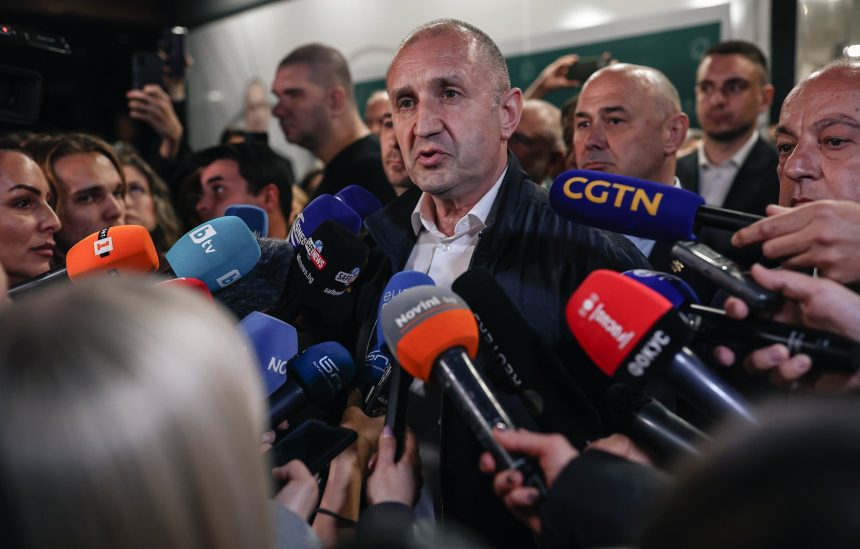
There are election results that read as statistics, and there are election results that read as diagnoses. Bulgaria’s parliamentary vote of 19 April 2026 belongs firmly in the second category. The „Progressive Bulgaria” coalition, led by former President Rumen Radev, secured 44.7% of the vote after more than 97% of ballots had been counted — the strongest result achieved by a single party or coalition in Bulgaria since 1997, according to Balkan Insight . GERB, the party of former Prime Minister Boyko Borisov, collapsed to 13.4%, while the reformist bloc We Continue the Change – Democratic Bulgaria obtained 12.9%. Partial official results project between 129 and 131 seats for „Progressive Bulgaria” in the 240-seat National Assembly — a razor-thin absolute majority pending final confirmation.
To understand what this result means, the numbers alone are insufficient. What must be understood is the political system that produced them.
Five Years of Crisis: The Anatomy of a Systemic Failure
Bulgaria has held eight parliamentary elections in five years. This is not a coincidence. It is the direct consequence of a political model in which elections have functioned less as instruments of governance and more as mechanisms for managing crisis. From 2021 onwards, when Borisov lost power amid mass protests, no government survived more than a year. Three short-lived cabinets — led by Kiril Petkov, Nikolai Denkov, and Rosen Zhelyazkov — succeeded one another, interspersed with caretaker governments appointed by the presidency.
The mechanism that paralysed Bulgaria was not merely parliamentary fragmentation, but something deeper: the systematic capture of state institutions by entrenched networks of economic and political interests. According to the Corruption Perceptions Index, Bulgaria ranks alongside Hungary at the bottom of the European Union’s member states, as documented by Transparency International (). Public procurement, EU funds, and the administrative apparatus have functioned systematically as mechanisms for distributing political rent rather than as instruments of governance in the public interest — a reality documented repeatedly by independent academic institutions and civil society organisations based in Sofia.

The central figure of this system was Boyko Borisov, prime minister across three terms between 2009 and 2021. GERB did not evolve as a conventional centre-right party but, in the assessment of multiple independent political analysts, as a vast patronage network penetrating the bureaucracy, local administrations, and the judiciary. A second key figure was Delyan Peevski, a media magnate and leader of a faction within the Movement for Rights and Freedoms, sanctioned by both the United States and the United Kingdom under the Magnitsky Act for corruption and abuse of power. The fact that these two political formations continued to occupy the centre of Bulgarian politics — despite repeated public scandals and the continuous erosion of public trust — explains why the protest movements of 2020, 2021, and 2025 failed to produce the structural change they demanded.
What Triggered the April 2026 Election
The last government, led by Rosen Zhelyazkov, fell in December 2025 not through political calculation but under the pressure of exceptionally large-scale demonstrations, attended predominantly by young citizens, according to Reuters . The central demand was not ideological — it was institutional: an independent judiciary capable of producing genuine accountability for high-level corruption. The cabinet resigned precisely at the moment Bulgaria was entering the eurozone, on 1 January 2026, creating a telling paradox: the country was fulfilling a major European criterion without having resolved the fundamental problems of its own governance.
Pre-election sociological data is revealing. The Alpha Research institute recorded that 49% of Bulgarians believed a single party should hold a majority and bear full responsibility for governing, according to Al Jazeera ). This was not an ideological preference — it was an expression of exhaustion with coalitions that failed to deliver and with a system in which the diffusion of responsibility had become an instrument of political survival. Voter turnout exceeded 50%, the highest level since 2021, indicating that the mobilisation seen on the streets had, this time, transferred to the ballot box.
Radev: The Profile of a Winner Who Defies Easy Classification
Rumen Radev, aged 62, is one of the most ideologically difficult figures to categorise in South-Eastern Europe. A former air force commander and graduate of a United States Air Force college, he entered the presidency in 2016 with the support of the Bulgarian Socialist Party. He secured a second term in 2021 with nearly 67% of the vote in the second round — a result reflecting broad consensus rather than a narrow ideological victory.
His 2026 campaign was built almost exclusively around the domestic agenda: dismantling the oligarchic model of governance, reforming the justice system, and restoring public trust in institutions. He resigned from the presidency in January — months before the end of his term — to enter the parliamentary contest directly, a politically risky but clearly calculated move. Radev judged that public anger over corruption and institutional deadlock could no longer be absorbed by the traditional parties, and that the only way to channel it effectively was to step down from the symbolic space of the presidency and into the centre of executive politics.
The vote for Radev was not, in essence, a vote for any particular foreign policy vision. It was a vote against a domestic system perceived as unreformable through the conventional instruments of politics. This distinction is essential to any accurate reading of the result.
The Collapse of GERB and the Reconfiguration of the Political Landscape
GERB’s result — 13.4%, down from 26.4% in October 2024 — represents an unprecedented collapse for a party that dominated Bulgarian politics for more than a decade. Borisov attempted to reframe the campaign as a debate about Bulgaria’s external orientation, seeking to appeal to an electorate wary of geopolitical consequences. The strategy failed. Bulgarian voters decided that domestic reform was more urgent than any other debate.
PP-DB, the reformist coalition that led the 2025 protests, obtained 12.9% — a stable result compared to previous elections, but insufficient to represent a viable alternative in its own right. The paradox is analytically significant: the protests that brought down the Zhelyazkov government were led predominantly by young citizens associated with this bloc, yet the electoral dividend went entirely to Radev. The explanation lies in the fact that PP-DB was perceived as part of a system of failed coalitions — including the controversial rotation formula with GERB — while Radev positioned himself as a figure external to that system.
Several populist and far-right formations failed to cross the electoral threshold or obtained only marginal results, indicating that voters concentrated their effective vote around the actor perceived as most capable of delivering change.
The Governance Equation: The Limits of a Powerful Mandate
Radev holds a projected technical majority. This is, by definition, the most comfortable starting position any Bulgarian political formation has held in recent years. Yet Bulgaria’s recent political history warns that parliamentary arithmetic and the actual capacity to govern are two distinct things.
The anti-corruption agenda he has promised requires substantial constitutional reforms — in the judiciary, in the structure of the prosecution service, in the mechanisms governing public procurement oversight. Bulgarian constitutional procedure provides, depending on the type and stage of revision, for qualified majorities of between 160 and 180 votes, according to ECFR — thresholds that „Progressive Bulgaria” cannot reach alone. This means Radev will need to negotiate with PP-DB, the only party with which he has signalled willingness to cooperate, at least on judicial reform, in order to advance his core agenda.
Beyond the political test, there is an economic one. Bulgaria entered the eurozone on 1 January 2026 — a major strategic achievement — but at the immediate cost of inflationary pressures felt at the level of household purchasing power. The 2026 budget, which triggered the protests that toppled the Zhelyazkov government, proposed increases in social security contributions and taxes to address structural deficits. Any new cabinet inherits the same fiscal constraints, regardless of its political composition. Radev has won a powerful mandate, but not an easy terrain to govern.
Bulgaria, Hungary, and the Different Logic of Two European Votes
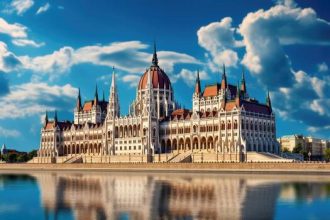
Bulgaria’s election comes days after the Hungarian vote in which Viktor Orbán lost power after sixteen years, defeated by Péter Magyar and the Tisza coalition. The temptation to read both results as expressions of the same European wave is understandable, but analytically misleading.
In Hungary, the vote sanctioned a consolidated system of power — a government holding a supermajority in parliament, with institutions reshaped in the ruling party’s favour and a dominant presence across all structures of the state for a decade and a half. Hungarian voters voted against an excess of power.
In Bulgaria, the vote sanctioned precisely the opposite: the absence of power, its fragmentation, and the inability of any political formula to produce coherent governance. Bulgarian voters did not vote against a system that was too strong — they voted against a system that had consistently failed to function at all. The nature of the change demanded in the two countries is opposite, even if in both cases citizens went to the polls with a mandate to break from the status quo.
For Romania and for the broader region, this distinction matters. Hungary is entering a period of transition from a centralised model towards a more balanced one. Bulgaria is attempting to emerge from a governance vacuum towards a form of stability. The two processes carry different consequences for regional coherence and cannot be managed with the same diplomatic or foreign policy instruments.
Where It Will Become Clear Whether Sofia Has Truly Broken the Cycle
The mandate Radev has received is exceptional in scale. Bulgaria has had similar moments of hope before: in 1997, when a financial crisis produced durable monetary reform and opened the path to European integration, and in 2021, when a technocratic cabinet appeared to represent a genuine break from the Borisov system. Both moments were followed, in the medium term, by a return to previous patterns.
The third turning point of this generation has arrived. Whether it produces a different result will not be visible in electoral figures and will not be measured in post-victory statements. It will be visible in courts, in prosecution offices, and in public contracts. It will be visible in the new executive’s capacity to negotiate the necessary constitutional reforms with PP-DB without sacrificing them to day-to-day political survival. It will be visible in the way Bulgaria absorbs European funds and in the degree to which local administration, patronage networks, and institutional capture mechanisms are genuinely dismantled — rather than simply rebranded.
There, and only there, will it be possible to assess whether the verdict delivered in Sofia on 19 April was a genuine inflection point, or merely the most convincing episode yet in a cycle that has not yet found its resolution.