The Black Sea has become one of the decisive theatres in which Europe’s security, economic resilience and strategic autonomy are being tested simultaneously. Once treated too often as a peripheral maritime space, the region now sits at the intersection of war, energy security, critical infrastructure, trade routes, food security, digital connectivity and the future balance between NATO, the European Union and regional powers.
In this context, the proposal for a European Black Sea Maritime Security Hub is more than an institutional project. It is a test of whether the European Union can move from strategic language to operational presence in a region where the costs of delay have already become visible. For Romania, the stakes are particularly significant. Constanța, the Mihail Kogălniceanu airbase, the country’s Black Sea coastline, its role in demining efforts, offshore energy potential and its position on Europe’s eastern flank all converge into a broader question: can Romania become not only a frontline state, but a strategic platform for European security and connectivity?
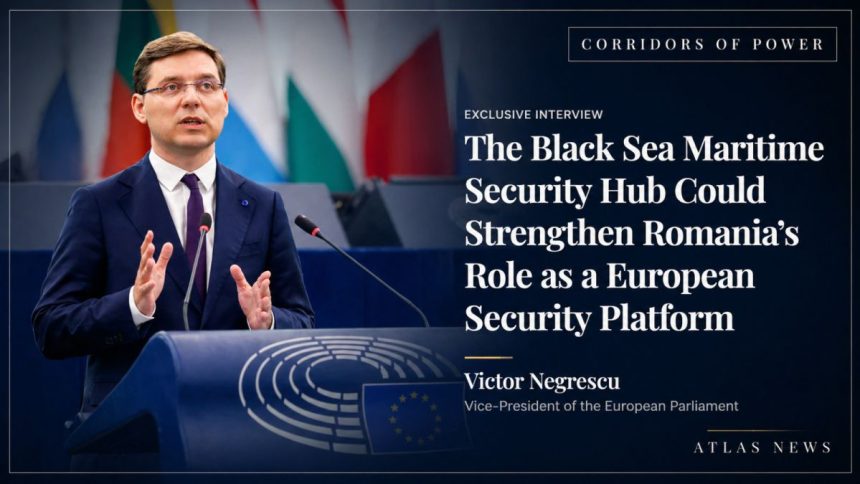
As part of Atlas News’ “Corridors of Power” series — dedicated to the infrastructure, energy and influence networks shaping Extended Europe — this interview examines the political, institutional and geopolitical logic behind the proposed hub. Victor Negrescu, Vice-President of the European Parliament and Vice-President of the Party of European Socialists, and one of the main promoters of the initiative at European level, explains how the project is conceived, what vulnerabilities it is meant to address, how it relates to NATO, Turkey, Ukraine and the Republic of Moldova, and why the Black Sea must be understood not only as a military frontier, but also as a corridor of economic security and strategic power.
At a time when Europe is under pressure to assume greater responsibility for its own security while preserving the transatlantic framework, the Black Sea Maritime Security Hub may become an important indicator of the Union’s capacity to act where its interests are most exposed. The question is no longer whether the Black Sea matters. The question is whether Europe can organise itself around that reality.

Atlas News: In public debate, the term “security hub” can easily remain vague. Are we speaking about a strategic coordination centre, a civil-military integration mechanism, a maritime intelligence platform, or an operational structure with clearly defined responsibilities? How do you define this project institutionally and functionally, and which countries are expected to be involved?
Victor Negrescu: The term security hub implies a strategic coordination role. This is precisely why my proposal was, from the outset, focused on a functional structure with concrete objectives. The European Black Sea Maritime Security Hub should be conceived as a European coordination mechanism with operational components, aimed at strengthening maritime security in the Black Sea region in both the short and long term.
In simple terms, it is a coordination center for the European Union’s key interests in the Black Sea, from energy and digital connectivity to trade, infrastructure and the protection of strategic investments. Functionally, the initiative is built around four key pillars: enhancing maritime security through real-time monitoring and information-sharing; protecting critical maritime infrastructure; developing the monitoring and response capabilities of EU Member States; and expanding cooperation among coast guard authorities, both within the EU and with regional partners.
One key example of coordination that we currently have is on managing the maritime mines and ensuring the Black Sea is a safe zone for trade. Another relevant element is the coordination between EU initiatives and NATO efforts, as well as with partner states in the region, to avoid fragmentation and ensure a coherent response. Europe must be more present, more coordinated and more effective in this strategic area, and this hub could be a key instrument to achieve that.
My objective is to ensure that the Black Sea will rise as a priority for the European Union and that Europe strengthens its presence and investment in this strategically important region.
Atlas News: What has the war in Ukraine revealed about the Black Sea’s strategic vulnerability that Euro-Atlantic institutions had not fully understood before 2022? More specifically, what is this hub intended to correct in practical terms?
Victor Negrescu: The war in Ukraine has acted as a stress test for the Euro-Atlantic security architecture in the Black Sea region, revealing that, for too long, the region was not treated with the strategic attention it requires.
Before 2022, the Black Sea was often seen as a secondary theatre, despite clear warning signs, including the illegal annexation of Crimea in 2014. The war has fundamentally changed this perception, showing that the region is a frontline for European security, where military, economic, energy and food security are all interconnected. The Black Sea has been a key point of the Russian Federation’s aggression against Ukraine and has represented a challenge for European security.
At the same time, the conflict exposed key vulnerabilities, such as the fragility of maritime routes, the growing exposure of critical infrastructure, and the increasing use of hybrid threats, from maritime mines to disinformation.
But perhaps the most important lesson is the need for better coordination. Efforts have long been fragmented across different frameworks (EU, NATO and regional initiatives), without being sufficiently aligned. In practical terms, the hub is designed to address this gap by bringing these efforts together, improving information-sharing and enabling a more structured and proactive European presence in the Black Sea, in close cooperation with Member States, partner countries and, where relevant, NATO. That is why I have consistently argued that Europe cannot afford to react too late again, and this initiative is about anticipating and preventing risks, not just managing crises.
For countries like Romania, this is not a marginal issue. As the EU Member State with the longest Black Sea coastline and significant operational experience, Romania is well positioned to play a central role and has long advocated for an EU Strategic Approach to the region. Furthermore, projects such as the development of the Mihail Kogălniceanu airbase further reinforce Romania’s strategic role in the region, the Black Sea Maritime Security Hub being therefore the logical next step.
Atlas News: What is the current stage of the project, and what timeline do you envisage for its implementation?
Victor Negrescu: The project is no longer at a conceptual stage; it has already reached an advanced political and institutional phase. We have consistently built support within the European Commission and the European Parliament and this has now translated into concrete steps, including budgetary amendments that I have submitted and that were approved, calling for the operationalization of the hub.
At the same time, over the past year, I have engaged with European institutions, sent formal proposals and worked to build political support for this initiative, and this combined effort, political, legislative and budgetary, has contributed to turning the idea into a credible European project.
There are now clear premises for the Black Sea Maritime Security Hub to be established within the course of this year, and I expect that in the coming months we will receive a positive response that will allow us to move forward. I am glad that the signals we are receiving at European level are encouraging, but we must maintain momentum and the Romanian authorities have to show more support for this initiative.
Beyond Romania’s expressed intention to host this hub in Constanța, the biggest EU Black Sea Port, the next step is for the authorities to present a concrete and well-structured project, clearly demonstrating both the added value and the operational scope of the hub. This is essential to secure a rapid and well-funded implementation.
Discussions are ongoing regarding the governance model, and I strongly support the establishment of a permanent secretariat in Romania, which would ensure continuity and effective coordination of the hub’s strategic projects.
In terms of timeline, there is a clear sense of urgency. The security environment in the Black Sea has significantly deteriorated, with concrete risks such as drifting naval mines, threats to critical infrastructure and disruptions to maritime routes. This is why we are aiming for an initial operational phase in the short term.
Romania has all the arguments to host this structure in the long term. This project means security, including for strategic investments in the energy sector, geopolitical relevance and increased investments in infrastructure and technology, particularly in the port sector.
Atlas News: You have previously highlighted Romania’s advantages — the Port of Constanța, the proximity of the Mihail Kogălniceanu base, Romania’s role in demining, the Black Sea gas reserves, and the country’s geographical position. What was the decisive factor that led the European Commission to support this project at your initiative?
Victor Negrescu: What made the difference was not a single factor, but the fact that this initiative directly responds to the European Union’s broader strategic objectives in the Black Sea region.
The Black Sea Maritime Security Hub is not an isolated proposal; it is fully aligned with the EU’s Strategic Approach to the Black Sea, particularly on the security dimension. In this context, the hub can be seen as the concrete, operational footprint of the European Union’s presence in the region, especially in terms of maritime security.
The European Commission’s support reflects this alignment. The hub provides exactly what has been missing so far, namely a structured, visible and operational framework through which the EU can project coordination, resilience and security in the Black Sea.
At the same time, Romania’s role has been essential in demonstrating that such a project is not only necessary, but also feasible. The combination of strategic location, operational experience and existing infrastructure makes Romania a natural anchor for implementing this vision on the ground.
In other words, the Commission supported this initiative because it translates strategic objectives into practical action. It bridges the gap between policy and implementation and offers a credible way for the European Union to strengthen its presence in a region that has become central to European security.
Atlas News: This initiative must also be seen in the context of increasingly intense debates about the future of American security guarantees in Europe, including in the light of President Donald Trump’s statements on NATO. Is the Black Sea hub also a European response to the risk of reduced predictability in the American security commitment?
Victor Negrescu: This initiative should not be seen as a substitute for transatlantic security guarantees, but rather as a necessary tool to enhance security for the Euro-Atlantic region.
The Black Sea Maritime Security Hub is first and foremost a European response to a changing security environment, one that has become more complex, less predictable and more demanding in terms of coordination and resilience. The war in Ukraine has already shown that Europe must be able to act more quickly, more coherently and with greater operational capacity in its immediate neighbourhood.
At the same time, it is true that the broader debate about the future of security guarantees in Europe, reinforces the need for the European Union to assume greater responsibility for its own security. This is not about questioning alliances, but about strengthening Europe’s capacity to contribute meaningfully to them.
In this sense, the hub reflects a wider evolution, namely strengthening the European pillar of security within the transatlantic framework. It is about being a more capable and reliable partner, not about replacing NATO or diminishing the role of the United States, because actually a stronger European contribution makes the transatlantic partnership more resilient.
In practical terms, the hub would help ensure that Europe has the tools to monitor, anticipate and respond to risks in the Black Sea region, while also improving coordination with NATO and allied partners.
So yes, it is part of a broader European effort to increase strategic responsibility and resilience, but firmly within a cooperative transatlantic framework.
Atlas News: More specifically, what is the relationship between this project and NATO? Is there currently any institutional or operational linkage with the Alliance? And if not, why should such a hub not be aligned with NATO’s security framework in the Black Sea?
Victor Negrescu: The Black Sea Maritime Security Hub is a European initiative, designed to strengthen the EU’s capacity to act, particularly in areas where it brings clear added value, such as coordination, infrastructure protection, economic resilience and civilian-military integration.
At the same time, NATO remains the cornerstone of collective defence in the region. The hub is there to enhance NATO’s role, to complement it by enhancing situational awareness, supporting maritime security and improving coordination among European actors.
Atlas News: Again, the objective is to connect existing frameworks more effectively and ensure a more coherent overall presence in the Black Sea. Should this hub also include an explicit economic security dimension, not merely a military one, given the importance of critical infrastructure, trade routes, offshore energy resources, and regional connectivity?
Victor Negrescu: Absolutely. In fact, the strength of this initiative lies precisely in its broader understanding of security.
The Black Sea is not only a military space, it is also a critical corridor for trade, energy and connectivity. What the war in Ukraine has demonstrated is that economic security and maritime security are deeply interconnected and we are witnessing how disruptions in one area can rapidly generate consequences across multiple sectors.
This is why the hub must include a strong economic security dimension. Protecting critical infrastructure, such as ports, offshore energy installations and submarine cables, is not only a security issue, but also an economic one. The same applies to ensuring the resilience of maritime trade routes, the stability of supply chains and the implementation of several key EU funded projects in the region.
At the same time, the Black Sea plays a growing role in Europe’s energy future, including through offshore resources and connectivity projects. Ensuring a secure environment for these investments is essential for both economic development and strategic autonomy.
This is also where the European Union brings added value. Unlike purely military structures, the EU has the tools to integrate security, economic resilience and infrastructure development into a single framework.
So the hub should be designed from the outset as a dual-use platform, addressing both security and economic resilience. This is not about expanding its scope artificially, but about reflecting the reality of the region, where security, trade, energy and connectivity are increasingly interconnected and must be addressed together.
Atlas News: Where will the project’s actual funding come from — the EU budget, national contributions, military mobility funds, dual-use instruments, or industrial partnerships? And beyond its strategic dimension, could such a hub also generate tangible economic benefits for Romania over time?
Victor Negrescu: The funding of this project will rely on a combination of European and national resources, supported over time by strategic partnerships.
First, EU funding will play a central role, through existing instruments dedicated to security, infrastructure, connectivity and regional cooperation. I am glad that thanks to the amendments I have initiated and secured in the European Parliament, we have already created a concrete budgetary basis and the necessary political support to mobilise these resources. This progress is essential, as it moves the project from a political objective to a financially anchored European priority.
An important objective is also to secure a dedicated budgetary line at EU level, ensuring long-term funding for the hub and its associated projects.
At the same time, national contributions, particularly from the host country and the Black Sea Member States, are essential to demonstrate ownership and ensure operational credibility.
In parallel, there is strong potential for public-private partnerships, especially in areas such as port infrastructure, digital monitoring systems, secure communications and energy connectivity. These are sectors where security and economic interests naturally converge.
This is also about ensuring that the European Union invests more consistently and strategically in its presence in the Black Sea region, including in projects that strengthen connectivity between ports such as Constanța and regional corridors towards the Southern route and the Caucasus.
Beyond its strategic dimension, the economic benefits for Romania could be significant. Hosting the hub would attract European investment, create high-value jobs and reinforce Romania’s role as a regional logistics, energy and security centre. Furthermore, it would also generate long-term opportunities for innovation, technology development and increased regional competitiveness.
Atlas News: One cannot seriously discuss Black Sea security without Turkey. How do you see the relationship between a European hub and Ankara’s role as a littoral power, a NATO member, and an indispensable actor in the region’s strategic equation?
Victor Negrescu: One cannot discuss Black Sea security without Turkey. As a key NATO Ally in the region and a relevant regional actor, Turkey plays an important role in the region’s strategic balance, including through its maritime capabilities.
At the same time, the Black Sea Maritime Security Hub is a European initiative, aimed at strengthening the EU’s capacity to act and coordinate in its immediate neighbourhood. This is not about creating parallel structures, but about complementing existing efforts.
The hub should remain open and flexible, able to engage with key partners, including Turkey, while maintaining a clear European framework.
Atlas News: What role should Ukraine play in such a structure, even though it is not a member state of the European Union?
Victor Negrescu: The Republic of Moldova and Ukraine can play a relevant role in such a structure, even as non-EU members. Both countries are on the frontline of the current security challenges in the Black Sea region and have developed significant operational experience, particularly in areas such as fighting hybrid threats, maritime security, demining and the protection of critical infrastructure.
The Black Sea Maritime Security Hub should therefore be designed as an open and cooperative platform, allowing for the meaningful participation of key partners. In Ukraine’s case, this means a balanced approach, combining support with practical civilian cooperation in areas of mutual interest. To be more specific, Ukraine’s involvement could contribute to improving situational awareness, ensuring safer navigation and strengthening the overall resilience of the region. Many developments are already taking place in partnership with NATO, the US and the EU.
In the case of the Republic of Moldova, with the acquisition of the Giurgiulești International Free Port by Romanian authorities, we could develop an integrated operational system ensuring key opportunities for both countries.
Atlas News: In your view, will there also be complementary operational nodes in the other Black Sea littoral states, so that the project functions as a regional network rather than as a structure concentrated in a single country?
Victor Negrescu: I see in the growing interest in the Black Sea region, as well as in the EU’s capacity to project its influence, an opportunity to develop flexible and innovative formats of cooperation, including the possibility to develop a strong regional network. Each regional partner and ally has expertise that can be shared or built upon common initiatives, such as the Black Sea Mine Countermeasures Task Group that Romania, Bulgaria and Turkey have put in place in the region. But again, it is very important to establish the EU Black Sea Security Maritime Hub and to work on implementing the EU’s Strategic Approach to the region.
Atlas News: Following the establishment of this hub, do you expect an intensification of Russian narratives about escalation or the emergence of new forms of pressure and threat from Moscow? How should this strategic communication dimension be managed?
Victor Negrescu: These narratives exist with or without a hub, but it is a possibility that should be taken into account. Any European initiative aimed at strengthening security and resilience in the Black Sea may generate critical reactions or be portrayed as escalatory by Kremlin narratives. We have seen this pattern repeatedly, particularly when the US or Euro-Atlantic presence becomes more visible in our region.
Beyond narratives, we can also expect various forms of hybrid pressure, including disinformation and attempts to distort the purpose of the project. This is why the message must be very clear: this hub is a defensive, stabilising and coordinated initiative, aimed at improving maritime awareness, protecting critical infrastructure, supporting safe navigation and strengthening regional resilience. In other words, we should clearly communicate that strengthening security in the Black Sea is a legitimate European interest and responsibility. Transparency, consistency and coordination in communication will be essential to avoid misinterpretation and to maintain credibility at both regional and international level.
Read more: