Donald Trump’s decision to scale back joint military exercises with South Korea has an immediate explanation on the Korean Peninsula: the cost of the drills and the US president’s attempt to reopen dialogue with Kim Jong Un. Yet Trump introduced into the same argument an element located thousands of kilometres away from Seoul: South Korea’s response to Washington’s request concerning Iran. The episode does not demonstrate the existence of a rule under which the United States conditions an ally’s security on its participation in other theatres. When considered alongside the administration’s strategic documents and the developments observed in the transatlantic relationship, however, it raises a more consequential question: is reciprocity beginning to emerge as one of the criteria by which Washington assesses its alliances on a global scale?
Donald Trump announced on 16 August that he had instructed the Pentagon to “substantially” reduce joint military exercises with South Korea. The US president cited their cost and his relationship with Kim Jong Un, arguing that the drills sent a hostile signal to Pyongyang. In the same message, however, Trump said that he had asked South Korea to join US efforts against Iran and that Seoul’s response had been negative, according to Reuters.
The Ulchi Freedom Shield exercise began as scheduled on 17 August, while the extent of the reduction ordered by Trump had yet to be publicly determined. South Korean media subsequently reported that General Xavier Brunson, commander of US Forces Korea, had visited the Ministry of National Defense for discussions on adjusting the exercise, although US and South Korean authorities had not immediately confirmed the details publicly, according to Reuters.
There is, however, a precedent that must be considered before drawing any broader conclusion.

Trump also scaled back exercises with South Korea during his first term, following his 2018 summit with Kim Jong Un, in order to create diplomatic space for nuclear negotiations. On 17 August 2026, the US president said that the North Korean leader had responded to his renewed outreach. The reduction of the exercises can therefore be explained, to a significant degree, through an already familiar feature of Trump’s diplomacy towards Pyongyang.
Iran, however, does not belong to that explanation.
It is precisely the introduction of Iran into the equation surrounding a decision concerning the alliance with South Korea that deserves closer scrutiny.
The Shift Did Not Begin in Seoul
Burden-sharing is not an invention of the Trump administration. For decades, Washington has called on its European and Asian allies to shoulder a greater share of the costs of their own security. During Trump’s first term, the Pentagon explicitly made the same request of NATO, Japan and South Korea, as reflected in official statements published by the US Department of Defense.
What is different under Trump 2.0 is that the principle has been elevated into a central component of US strategy and explicitly associated with incentives, prioritisation and the redistribution of responsibility.
The National Security Strategy 2025 contains a dedicated section entitled “Burden-Sharing and Burden-Shifting”. The document states that prosperous allies and partners should assume primary responsibility for their own regions, while the United States seeks to build a “burden-sharing network” in which Washington remains the coordinator and supporter.
The strategy also introduces a dimension that goes beyond military accounting. Trade, access to technology and cooperation in defence procurement can become incentives for states that assume greater responsibility for the security of their own regions.
The question is no longer merely how much an ally spends. It is how much responsibility that ally is capable of assuming.
The Problem of Simultaneity
The National Defense Strategy 2026 also explains the rationale behind this shift.
The Pentagon identifies the problem of simultaneity: the possibility that the United States could face pressure or crises in several theatres at the same time. In this context, burden-sharing becomes an essential component of US strategy.
The document notes that this shift is already particularly visible in Europe and South Korea and announces stronger incentives for allies to assume primary responsibility for their own defence in Europe, the Middle East and on the Korean Peninsula, while continuing to benefit from critical, but more limited, US support.
The NDS also introduces the concept of “clear accountability” in relations with allies and states that cooperation will be prioritised with partners that invest more and make tangible contributions to the security of their regions. Moreover, the document says that the higher defence standards agreed at the NATO Summit in The Hague should be promoted “around the world, not just in Europe”.
This is a crucial point.
The Trump administration does not present burden-sharing as a particular feature of NATO. It formulates it as a global principle.
From Washington’s perspective, the logic is coherent. The United States must defend its homeland, deter China in the Indo-Pacific, retain capabilities for the Korean Peninsula, manage strategic competition with Russia and protect its interests in the Middle East. If economically capable allies can assume a greater share of regional responsibility, US resources become available for priorities where Washington’s capabilities cannot readily be substituted.
This, however, is the administration’s declared strategic intent. It does not automatically follow that every reduction in US involvement will produce stronger alliances, or that the redistribution of responsibility cannot generate temporary deterrence costs.
The South Korean case exposes precisely this tension.
South Korea Is Not the Classic Case of an Ally That Refuses to Pay
The NDS 2026 describes South Korea as an ally with a strong military, significant defence spending, a robust defence industry and compulsory military service. The Pentagon assesses that Seoul possesses the capability and political will required to assume primary responsibility for deterring North Korea, with critical but more limited US support.
This assessment changes the nature of the issue.
The current dispute cannot be reduced to the image of an ally unwilling to finance its own security.
South Korea hosts approximately 28,500 US troops, contributes to the costs of their presence and has developed one of Asia’s most significant defence industries. The bilateral relationship is nevertheless undergoing a broader renegotiation over the distribution of responsibilities, as illustrated by Reuters in its analysis of the alliance’s evolution under President Trump.
The Iran dossier introduces a different dimension.
Trump said that he had asked the South Korean president to participate in US efforts concerning Iran. Seoul, however, has not ruled out every form of contribution. South Korean authorities said they were discussing possible military contributions while simultaneously taking into account the defence requirements of the Korean Peninsula and domestic legal procedures, according to Reuters.
It would therefore be inaccurate to say that Seoul rejected every form of support for Washington.
What can be stated with certainty is something different: Trump considered the response sufficiently important to introduce it publicly into an argument concerning one of the central military mechanisms of the US–South Korean alliance. There is not yet a formal doctrine of cross-theatre reciprocity.
There is, however, a political precedent that may point in that direction.
From Ankara to Hormuz
For Atlas News Romania, the question did not begin in Seoul.
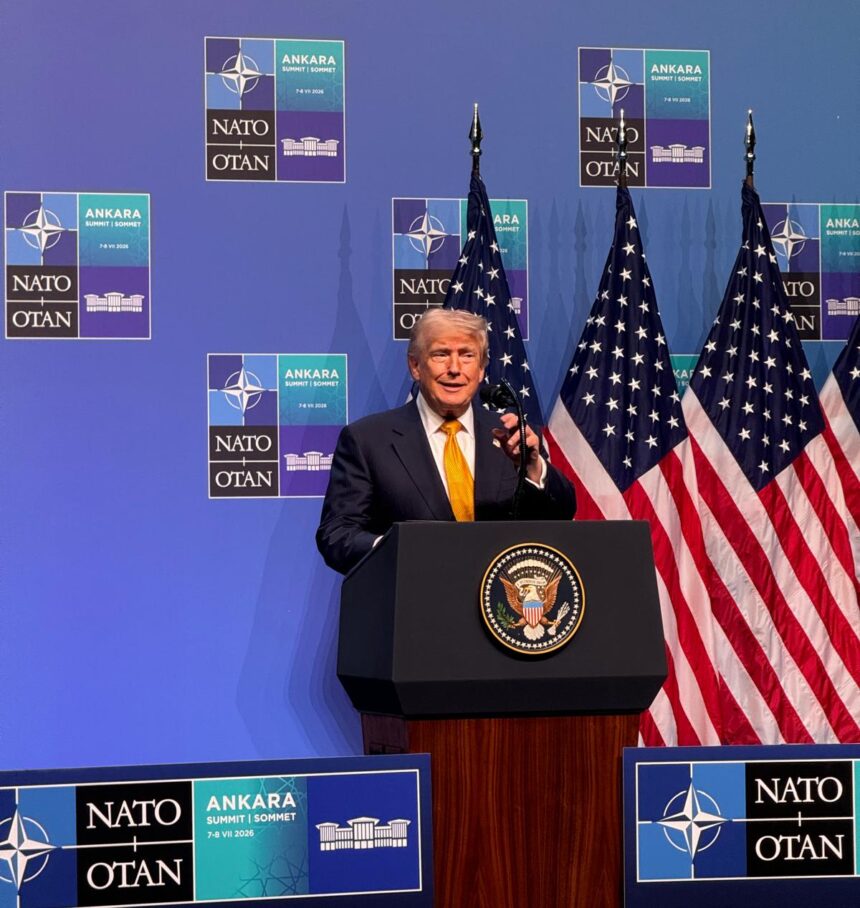
Following the NATO Summit in Ankara, Atlas News argued that the new transatlantic formula could not be reduced to higher defence budgets. Washington was seeking a relationship in which European allies would assume greater responsibility for their own security, freeing US capacity for other strategic priorities.
The Ankara NATO Summit Declaration explicitly stated that European Allies and Canada, together with the United States, were assuming greater responsibility for the Alliance’s defence. In the same document, freedom of navigation through the Strait of Hormuz appeared among the Allies’ strategic concerns.
Even before the summit, Atlas News had advanced the hypothesis of a transatlantic relationship increasingly centred on reciprocity and responsibility. After Ankara, it examined whether this emerging contract could be tested beyond the defence of NATO territory.
The Strait of Hormuz dossier then provided the first serious operational test.
Washington asked its partners to contribute to securing a maritime route on which global energy and trade flows depend. Romanian Foreign Minister Oana Țoiu subsequently said that Romania was participating in a coalition of approximately 40 states associated with efforts to reopen and secure the strait, through a mechanism managed by France and the United Kingdom and connected to the US initiative.
Here, the link is relatively strong.
Ankara consolidated the principle of assuming greater responsibility. Hormuz offered a concrete arena in which that responsibility could be translated into political, logistical or military contributions.
Seoul Is a Different Link in the Chain
The connection between Hormuz and Seoul must be treated more cautiously.
In the case of Hormuz, there are explicit political requests and a multilateral operational mechanism.
In the case of South Korea, for now, there is a presidential statement and a decision concerning military exercises that can simultaneously be explained by two other powerful considerations: cost and diplomacy with Kim Jong Un.
The two cases do not carry the same degree of formalisation.
But for the first time in this episode, Donald Trump has introduced an ally’s behaviour in a distant strategic theatre into the public assessment of a regional security relationship.
That is the relevant development.
If similar episodes recur, the question will no longer be only how much an ally contributes to its own defence, but also how much strategic utility it can generate for the wider US system.
Beyond Money: The Strategic Value of an Ally
The Trump administration’s documents show that burden-sharing is conceived more broadly than simply increasing military budgets.
The White House April 2025 Executive Order on reforming foreign defence sales calls for arms transfers to increase the ability of allies and partners to meet their military objectives without sustained US support.
The America First Arms Transfer Strategy adopted in 2026 links military transfers to burden-sharing, strengthening the US defence industrial base and prioritising partners that invest in their own defence or occupy a strategically important position in US planning.
The NDS adds infrastructure, force readiness, industrial cooperation and intelligence-sharing among the areas in which relationships with model allies can be deepened.
The alliance contract therefore becomes more complex than the formula “America protects, the ally pays”.
Washington is looking for allies capable of defending their own regions and generating strategic effects alongside the United States.
And the South Korean episode opens a question that does not yet have a definitive answer:
Can that utility begin to be assessed beyond the theatre for which the alliance was originally built?
A More Effective Alliance — or a More Transactional One?
The US administration argues that the new distribution of responsibility will strengthen the alliance system. The NDS 2026 explicitly states that the objective is to preserve strong alliances while partners assume a greater share of regional responsibilities.
There is, however, a tension that cannot be ignored.
Joint exercises are not merely a cost borne by Washington. They are an element of the deterrence and interoperability architecture underpinning the US–South Korean alliance.
Scaling them back may serve negotiations with Pyongyang and send a political signal to Seoul, but it may simultaneously weaken one of the instruments through which common military readiness is maintained.
This contradiction does not invalidate the US strategy.
It does, however, show that the transition from dependence on American power to greater allied responsibility must be carefully calibrated. If responsibility is transferred more rapidly than the capabilities required to assume it are developed, deterrence gaps may emerge.
The success of the model will therefore depend not only on how much allies do, but also on how Washington redistributes its own resources.
What This Means for Europe and Romania
For Europe, developments in South Korea matter precisely because the Pentagon explicitly applies the same broad strategic philosophy across several regions.
The NDS states that Europe must assume primary responsibility for the conventional defence of the continent, while the United States maintains its commitment but calibrates its presence according to its own strategic priorities.
For Romania, this shift does not mean that the value of the alliance with the United States is diminishing.
It means that Romania’s value within the alliance must increase.
Its position on the Black Sea, military and logistical infrastructure, capacity to host and sustain allied forces, defence investment, defence industry and ability to contribute to regional deterrence become increasingly important in a system in which Washington draws an ever clearer distinction between mere membership in an alliance and an effective contribution to its functioning.
For a state on the eastern flank, the objective is not to demonstrate permanent political loyalty to Washington.
It is to demonstrate genuine strategic utility.
Ankara Can No Longer Be Viewed in Isolation
The South Korean case does not demonstrate that the United States has established a global rule under which protection in one region is conditional on support offered in another.
It would be premature to draw that conclusion.
There is, however, already a US strategy that asks allies to assume greater responsibility at the global level. There is an explicit policy of incentives and accountability. There is pressure on Europe to assume a larger share of continental defence. There is the Hormuz case, in which Washington asked partners to contribute to protecting a strategic interest beyond NATO’s geography.
And there is now at least one episode in which the US president has introduced an ally’s behaviour in a distant theatre into the public assessment of a regional security relationship.
Ankara therefore no longer appears to be an isolated European exception. Hormuz and Seoul suggest that the logic of an alliance increasingly grounded in responsibility, utility and reciprocity is beginning to be tested beyond the transatlantic relationship.
For now, Seoul is a signal, not the final proof.
If the same pattern appears in other US relationships — with Japan, Australia, the Philippines or once again with European allies — the hypothesis formulated after Ankara will become increasingly difficult to dismiss as a peculiarity of the moment.
At that point, the discussion will no longer be only about burden-sharing.
It will be about redefining the global contract of American alliances.
Read also