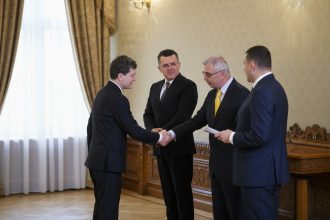
Romania enters the first full day of the Luca Niculescu Government’s mandate on 21 October, following parliamentary approval and the swearing-in ceremony the previous day. The cabinet secured 280 votes in favour and 58 against, exceeding the 233-vote threshold required for investiture and ending nearly six months of political deadlock. For the diplomatic community and Romania’s international partners, the installation of a government with full executive powers restores the institutional framework for decision-making and intergovernmental cooperation.
Led by an independent diplomat, the new government brings together representatives of the Social Democratic Party and figures with experience in diplomacy, public administration, academia and the private sector. The cabinet enjoys parliamentary support beyond the political forces directly represented in government, including backing from the National Liberal Party and the Democratic Alliance of Hungarians in Romania. This arrangement enables the government to exercise its full mandate, although lasting stability will depend on sustained parliamentary support and the administration’s performance.
Luca Niculescu: From Diplomacy to the Premiership
Luca Niculescu — Prime Minister. Romania’s ambassador to France from 2016 to 2022, and subsequently a state secretary at the Ministry of Foreign Affairs responsible for coordinating Romania’s accession process to the Organisation for Economic Co-operation and Development, the new prime minister has built his professional career around international affairs. Before entering diplomacy, he worked as a journalist and served as editor-in-chief of RFI Romania.
His experience encompasses bilateral relations with France, multilateral cooperation and dialogue on the reforms required to align Romania with OECD standards. This background has given him familiarity with the economic and institutional issues closely followed by Romania’s international partners.

Foreign Affairs, Defence, Internal Security and Justice
Sebastian-Dănuț Neculăescu — Minister of Foreign Affairs. A career diplomat, he was appointed Romania’s permanent representative to NATO in February 2022, following terms as state secretary for strategic affairs. He headed Foreign Ministry departments responsible for security policy and helped prepare Romania’s positions for NATO summits. His professional background includes transatlantic cooperation and the development of strategic partnerships with the United States, Poland and Türkiye.
Ștefan-Radu Oprea — Minister of National Defence. A former minister of economy, entrepreneurship and tourism, he has also served as head of the Prime Minister’s Chancellery and secretary-general of the Government. His previous experience lies primarily in economic affairs and public administration, with relevance to the industrial and interinstitutional dimensions of the defence portfolio.
Marian Neacșu — Deputy Prime Minister and Minister of Internal Affairs. An economist by training and a former secretary-general of the Government and deputy prime minister in previous cabinets, he has experience in coordinating central government administration and managing relations between the Government and Parliament. In the new cabinet, he combines the role of deputy prime minister with responsibility for the Ministry of Internal Affairs.
Radu Marinescu — Minister of Justice. An experienced lawyer with an academic background in law, he returns to the ministry he led from December 2024 until the withdrawal of Social Democratic ministers from government in April 2026. His career encompasses legal practice, professional representation within the Dolj Bar Association and parliamentary service.
Finance, the Economy, Energy and Connectivity
Alexandru Nazare — Minister of Finance. He retains a portfolio he held in the Bolojan Government, including during its caretaker period. He previously served as finance minister in 2020–2021 and transport minister in 2012. His experience in financial administration places him at the centre of discussions on the budget, fiscal consolidation and investor confidence.
Daniel-Cătălin Zamfir — Minister of Economy, Digitalisation, Entrepreneurship and Tourism. An engineer by training and an experienced parliamentarian, he has led the Social Democratic parliamentary group in the Senate. His professional background includes company management, a senior position at the Ministry of Labour and consultancy work in infrastructure and European funding. He assumes a broad portfolio encompassing economic policy, entrepreneurship, tourism and digital transformation.
Dumitru Chisăliță — Minister of Energy. An engineer with experience in the natural gas industry, he has worked at Romgaz and Transgaz, including in management and coordination roles. He has headed the Intelligent Energy Association and advised central government on energy matters. His professional expertise spans gas infrastructure, energy markets and security of supply.
Ștefan-Ovidiu Popa — Minister of Transport and Infrastructure. A member of the Chamber of Deputies representing Vâlcea, now serving his third parliamentary term, he holds qualifications in economics and law. Before entering Parliament, he worked as an economist and legal adviser. He takes charge of a ministry central to infrastructure investment and the integration of Romania’s economy into European transport networks.
Costinel-Bogdan Dumitru — Minister Delegate for Digitalisation and Artificial Intelligence. A cybersecurity specialist, he served for more than two decades as chief technology officer at Bitdefender before becoming the company’s chief scientist. He holds a doctorate in artificial intelligence and has taught at the University of Bucharest. He brings to government direct experience in technology development and the internationally active software industry.
European Funding, Development, Agriculture and the Environment
Alexandru-Mihai Ghigiu — Minister of Investments and European Projects. A public administration graduate with a doctorate in political science, he has pursued an academic career at the National University of Political Studies and Public Administration, where he also served as vice-rector. His qualifications include studies in European administration, security and diplomacy, alongside international training programmes in public governance.
Marcel-Alexandru Stoica — Minister of Development, Public Works and Administration. An engineer by training, he has experience in both local and central government. He has served as public administrator of Buzău County, undersecretary of state and subsequently state secretary at the Ministry of Development. His career also includes project management and work within regional development bodies.
Florin-Ionuț Barbu — Minister of Agriculture and Rural Development. An economist, former director-general of the National Land Improvement Agency and former chair of the agriculture committee in the Chamber of Deputies, he returns to the portfolio he first assumed in 2023. His experience includes the management of land improvement infrastructure and agricultural policymaking.
Natalia-Elena Intotero — Minister of Environment, Waters and Forests. She brings parliamentary and ministerial experience, having previously held the portfolios for Romanians Abroad, Family and Culture. Her appointment to the Environment Ministry marks a transition to a policy area with a substantial European dimension, ranging from climate policy to natural resource management.
Health, Labour, Education and Culture
Alexandru-Florin Rogobete — Minister of Health. A physician with training in anaesthesiology and intensive care and a doctorate in medicine, he has served in advisory roles within the Ministry of Health and as a state secretary. He has also chaired the health and family committee in the Chamber of Deputies. His background combines medical training, academic work and administrative experience.
Petre-Florin Manole — Minister of Labour, Family, Youth and Social Solidarity. A graduate of the University of Bucharest’s Faculty of History, he has experience in projects concerning human rights, minorities and social inclusion. He worked with civil society organisations and the Elie Wiesel National Institute for the Study of the Holocaust in Romania before establishing his political career.
Valentin-Sorin Costreie — Minister of Education and Research. An academic with experience in education policy, he has served as state secretary, state adviser and presidential adviser for education and research. His international work includes the presidency of UNICA, the network of universities from Europe’s capitals, and involvement in the CIVIS university alliance.
Sorin-Gabriel Ionescu — Minister Delegate for Pre-University Education. A history teacher and principal of the Bănățean National College in Timișoara, he joins the cabinet from a school leadership role. His experience is rooted in teaching and the administration of pre-university education.
Ioana-Ruxandra-Victoria Ciocan — Minister of Culture. A visual arts specialist with curatorial and academic experience, she has led Art Safari and served as commissioner of Romania’s Pavilion at the Venice Art Biennale. Her work includes international exhibition projects and the promotion of Romanian art abroad, providing relevant experience for cultural cooperation and public diplomacy.
Institutional Stability and the Agenda for International Partners
The installation of the Niculescu cabinet ends the caretaker period and enables the Government to exercise its full powers with parliamentary backing. The new executive held its first cabinet meeting on the evening of its investiture, on 20 October.
For diplomatic missions, European institutions and the international business community, the significance of this transition lies in the Government’s ability to translate parliamentary support into predictable policy. Preparing the 2027 budget and addressing fiscal imbalances are among the cabinet’s immediate tests, with political backing remaining conditional on its performance.
Romania now has a new executive leadership through which to engage its partners. The parliamentary vote provides a foundation for stabilisation; consistent decision-making, fiscal discipline and the fulfilment of commitments will determine how firmly that foundation holds.