The Trump administration has moved beyond political pressure on European allies toward an institutional reassessment of how the United States distributes its forces, infrastructure, and capabilities across the continent. The Europe Posture Review does not amount to America’s withdrawal from NATO, nor does it automatically herald further reductions of its presence in Romania. What the process does change, however, is the fundamental question facing allies: no longer whether the United States will remain in Europe, but where, in what configuration, and with what capabilities Washington will judge that its presence continues to serve American interests. For Bucharest, the real stake is whether it can demonstrate not only why Romania needs America, but also why America needs what Romania has to offer.
Washington is no longer discussing only burden-sharing. It is effectively revising its posture in Europe
The first concrete signal came on 19 May, when the Pentagon confirmed the reduction of Brigade Combat Teams allocated to Europe from four to three, returning to the 2021 level. The decision also brought a temporary delay in the deployment of certain American forces to Poland. The statement noted that the final distribution of these forces, and of other American troops, would depend on the strategic and operational requirements of the United States, as well as on the allies’ capacity to contribute their own forces to the defence of Europe.
On 18 June, U.S. Secretary of Defense Pete Hegseth announced a review of up to six months of the American „posture and footprint” in Europe. According to the Pentagon, the process examines how the United States and its allies contribute to NATO, the posture and footprint of American forces, access to infrastructure, basing and overflight rights, as well as the need for U.S. forces to remain available for Washington’s global priorities.
Hegseth explicitly tied the review to the transition toward a Europe assuming primary responsibility for its own conventional defence. At the same time, the Pentagon specified that the process does not aim to withdraw the United States from NATO or to abandon the obligations assumed within the Alliance.

Herein lies the essential shift.
Washington is no longer asking Europe merely to spend more on defence. It is also beginning to assess where its own forces must be positioned in order to generate the greatest strategic value for the United States.
America is not saying it is leaving Europe. It is saying it wants to decide more rigorously where, with what capabilities, and for what missions it remains.
What NATO decided in Ankara, and what „NATO 3.0” means separately
The two tracks must be distinguished.
The Declaration of the NATO Ankara Summit, adopted on 8 July, does not formally establish a doctrine entitled „NATO 3.0”. The document reaffirms Article 5, the transatlantic bond, and the 360-degree deterrence and defence approach. At the same time, European allies and Canada take on a larger share of the investments, capabilities, and responsibilities required for collective security.
The formulation „NATO 3.0” belongs to the political discourse built around this rebalancing. Pete Hegseth used it explicitly on 18 June, when he described the objective of an Alliance „with Europe in the lead of its own defence”. At the conclusion of the Ankara Summit, Mark Rutte adopted the same formulation. According to NATO, the Secretary General declared: „We are rebalancing our security for the better, and that is what NATO 3.0 is all about.”
The distinction matters. NATO did not, through the Ankara Declaration, adopt an official doctrine called „NATO 3.0”. The Alliance did, however, formalise an increase in European responsibility, and the formulation is used politically to describe this transformation.
On 5 August, the same direction was reaffirmed at the diplomatic level. According to the communiqué of the U.S. Department of State, Marco Rubio and British Foreign Secretary Ed Miliband discussed „the importance of Europe taking on a greater role in its own security”. The communiqué announces no troop reductions or targeted bases, but it confirms the continuity of the political line.
68,000, over 86,000, or 76,000? The figures measure different things
One of the main sources of confusion in the debate over the American presence in Europe is the use of figures that do not describe the same category of personnel.
According to Defense Manpower Data Center data analysed by Reuters, in December 2025 the United States had approximately 68,000 active-duty military personnel permanently assigned to bases in Europe. Reuters explicitly notes that this figure does not include rotational forces sent temporarily for deployments or exercises.
By contrast, an assessment by the Congressional Research Service shows that, in March 2026, there were more than 86,000 Department of Defense personnel in Europe. This is a broader category than that of active-duty military personnel permanently assigned and cannot be directly compared with the figure of 68,000.
The threshold of 76,000 established by Congress represents yet another category. It is not an estimate of the number of military personnel in Europe, but a legislative threshold applicable to military personnel permanently stationed or deployed in the U.S. European Command area.
Therefore, 68,000, over 86,000, and 76,000 are not three competing estimates of the same troop strength. They stem from different methodologies and categories.
What the 76,000 threshold actually protects
The National Defense Authorization Act for Fiscal Year 2026 introduces a significant limitation on the administration’s freedom to reduce the American posture in Europe rapidly.
According to the Congressional Research Service analysis of Section 1249, funds may not be used to reduce American forces permanently stationed or deployed in the EUCOM area below 76,000 for more than 45 days without meeting the conditions of certification, consultation, and reporting to Congress.
The Financial Times described this provision as a significant legislative barrier against a rapid reduction of American military commitment in Europe: dropping below the threshold requires justification that the measure serves the national security interest of the United States and consultation with NATO allies.
The restrictions do not concern troop strength alone. According to the Congressional Research Service, the legislation also introduces conditions for the consolidation or return to host states of certain facilities within the EUCOM inventory, for the withdrawal of significant equipment and property, and for the modification of the dual EUCOM/SACEUR role.
But for Romania, there is a fundamental limitation.
Congress protects a European architecture and threshold. It does not protect any specific level of American presence in Romania.
Washington can respect the 76,000 threshold and, at the same time, modify the distribution of forces between Germany, Poland, Romania, Italy, the Baltic states, or other points on the continent.
From Bucharest’s perspective, the question is not only how many troops America will retain in Europe, but what it will consider important enough to retain in Romania.
Romania: the difference between permanent and rotational presence
The same methodological problem arises in the case of Romania.
Defense Manpower Data Center data cited by Reuters indicated that, as of December 2025, there were only 153 active-duty military personnel permanently assigned to Romania. The figure does not include rotational forces, which constitute a significant part of the American presence in the country.
A different picture emerges when rotational deployments are included. In March 2026, Reuters reported that the United States had withdrawn approximately 1,000 troops from Mihail Kogălniceanu in the previous year and that approximately another 1,000 American troops remained in Romania. Reuters specified separately that the permanent allied presence in Romania was approximately 3,500 NATO troops, including American personnel.
The figure of approximately 1,000 must therefore be dated and defined: it is a Reuters estimate for March 2026 of the American presence remaining in Romania following the 2025 reduction. It does not represent an official day-to-day situation for August 2026.
For that very reason, any potential new reduction must be assessed according to the units, rotations, and capabilities affected, not merely through an aggregate figure.
Mihail Kogălniceanu, Câmpia Turzii, and Deveselu are not interchangeable
The distinction is essential to Romania’s position within the Europe Posture Review.
Mihail Kogălniceanu is a hub for access, logistics, and rotational deployments, with direct relevance to the Black Sea, Ukraine, and the mobility of forces on the south-eastern flank.
Câmpia Turzii serves a different function, tied primarily to infrastructure and air operations.
Deveselu, however, belongs to another category. According to NATO, Romania hosts here one of the two American Aegis Ashore systems in Europe, part of NATO Ballistic Missile Defence and of the American European Phased Adaptive Approach. The Deveselu system is a fixed missile-defence capability integrated within the allied architecture.
This does not mean that Deveselu is formally exempted from the Europe Posture Review. No such public guarantee exists.
It does mean, however, that the reduction of a troop rotation at Mihail Kogălniceanu and a potential fundamental change concerning Aegis Ashore are decisions of a different strategic nature and cannot be analysed as interchangeable elements of the same American presence.
Mark Rutte used Romania to explain Europe’s strategic utility
An episode preceding the Ankara Summit becomes relevant precisely in light of the criteria subsequently announced for the Europe Posture Review.
On 24 June, during his meeting with Donald Trump, Mark Rutte sought to counter criticism regarding the support European allies provide to the United States. The transcript of the meeting published by Roll Call Factbase records the NATO Secretary General invoking the 4,000–5,000 American flights operated from European bases during the conflict with Iran and explicitly mentioning Romania.
Rutte said that an airport in Bucharest had to temporarily adjust its commercial traffic in order to allow the operation of an American tanker aircraft. For the present analysis, the point is not the specific operational episode, but the argument the Secretary General was presenting to Trump: European infrastructure is not merely a cost for the United States, but can extend America’s freedom of action and its capacity for power projection.
This argument gains weight with the Europe Posture Review, since the Pentagon explicitly lists access, basing, overflight rights, and the availability of forces for U.S. global requirements among the elements to be assessed.
The Atlas News Romania question at Ankara
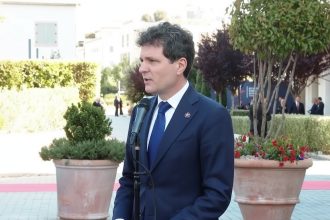
At the NATO Ankara Summit, Atlas News Romania asked President Nicușor Dan how Bucharest intends to leverage, in its relationship with Washington, the fact that Romania provides the United States with infrastructure and logistical support.
For the sake of transparency, the episode is documented in Atlas News Romania’s own coverage of the summit. The President’s response was:
„The main points are the maintenance of the American troop presence in Romania and the expansion of American investments in Romania.”
The reference to this moment does not suggest that the Atlas News Romania question in any way influenced Bucharest’s subsequent actions.
Its relevance lies elsewhere: before the Europe Posture Review entered the phase of consultations with allies, the President of Romania had publicly framed the maintenance of the American military presence as one of the priorities of the relationship with Washington.
Bucharest enters the discussion as the Pentagon finalises its criteria and options
At the end of July, Nicușor Dan sent to Washington his National Security Advisor Marius Lazurca and the Chief of the Defence Staff, General Gheorghiță Vlad.
According to HotNews, the public mandate of the visit included meetings with the Trump administration and members of Congress aimed at consolidating Romanian-American coordination on Black Sea security.
Subsequently, Elbridge Colby confirmed that he had received Marius Lazurca at the Pentagon on 29 July. According to AGERPRES, the American official declared: „I previewed our approach to the Europe Posture Review.”
The formulation must be kept strictly within its own limits.
Bucharest was informed and consulted while the Pentagon was finalising its criteria and options. There is no guarantee, within the publicly available information, that Romania obtained the maintenance of the current troop level, an exemption for Mihail Kogălniceanu, or a commitment regarding the future distribution of American forces.
The Black Sea is a specific argument, not a guarantee
Romania cannot proceed from the premise that its position is automatically more important to Washington than that of Poland, Germany, or the Baltic states.
Germany hosts command, logistics, and force-projection infrastructure that is difficult to substitute. Poland represents one of the principal hubs of land deterrence on the eastern flank, and the Pentagon’s 19 May statement explicitly describes it as „a model U.S. ally”. The Baltic states lie in the most exposed zone of direct military contact with Russia.
Romania has a different category of arguments: access to the Black Sea, proximity to Ukraine, Mihail Kogălniceanu, air infrastructure, and the Aegis Ashore system.
The importance of the Black Sea is also supported by official Romanian positions within NATO. In June, AGERPRES reported that Romania had called upon the North Atlantic Council to urgently strengthen air-defence and anti-drone capabilities deployed on its national territory, and that allies had reaffirmed the strategic importance of the Black Sea for Euro-Atlantic security.
These elements are real arguments. They do not, however, demonstrate that Romania will receive preferential status within the Europe Posture Review.
Romania’s test: not only why we need America, but also why America needs Romania
Here lies the real stake for Bucharest.
Within the traditional framework of the transatlantic relationship, the dominant argument was the necessity of the American presence for the defence of Europe and the deterrence of Russia.
The new administration adds a much more direct question: what value does this presence generate for the United States?
From this perspective, Romania must demonstrate more than the fact that the Black Sea is important or that the war is unfolding in its immediate vicinity.
It must show that its infrastructure, its access to the Black Sea, its geographic position, and its existing capabilities offer Washington options that relocating forces elsewhere would render more difficult, slower, or more costly.
This logic is consistent with the priorities declared by U.S. European Command. According to the Congressional Research Service, EUCOM defined three priority missions in 2026: defending the American homeland, projecting the combat power of the United States, and positioning the Alliance for deterrence and defence.
Congress can limit the scale of an American withdrawal from Europe, but it cannot construct Romania’s argument in Bucharest’s place.
Mark Rutte sought to explain to Donald Trump that European infrastructure amplifies the power of the United States. Nicușor Dan declared at Ankara that maintaining American troops is a priority. The Pentagon is now assessing access, basing, allied contribution, and the availability of its own forces for American global requirements.
Romania has no guarantee. It has arguments.
Within the new „NATO 3.0”, success will depend not only on Bucharest’s capacity to explain why Romania needs a strong American presence.
It will depend increasingly on its capacity to demonstrate why a strong American presence in Romania serves the very interests of the United States.
Read also