An ostensibly technical development, largely overlooked amid the world’s major geopolitical crises, may signal one of the most consequential strategic shifts of the coming decade.
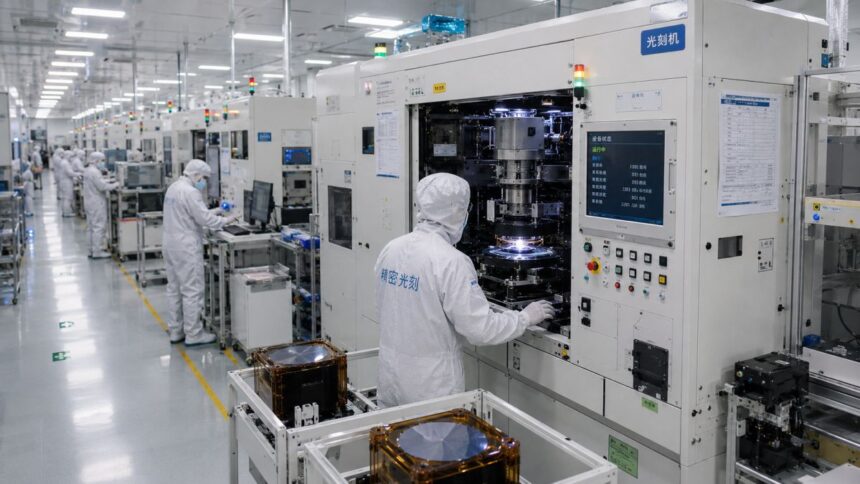
China is reported to have begun producing its own immersion deep ultraviolet lithography systems, an essential technology in semiconductor manufacturing. This is neither a dramatic announcement from Beijing nor the result of a carefully choreographed public launch. The information was revealed by Reuters, citing a source familiar with the project. Shanghai Aishengna Electronic Technology Group, identified as the programme’s coordinator, has no public website and has not officially disclosed the performance specifications of its equipment.
Caution is therefore essential. There has been no public confirmation from the company, the Chinese government or the manufacturers expected to receive these systems. Nor is it yet known whether the first machines can operate reliably in a fabrication plant at yields and speeds compatible with industrial production.
Should the information be confirmed, however, the implications would extend far beyond the technological sphere.

China already manufactures chips at scale. What is now changing is the prospect that Beijing may be able to manufacture, maintain and improve, within its own ecosystem, the machinery without which that production cannot be expanded. Once immersion DUV lithography becomes a functional domestic technology, one of the most important points of leverage available to the United States and its allies begins to lose its absolute character.
The path towards mass production is not yet entirely open. Lithography is not the only obstacle, and China continues to lag behind the world’s leading powers in several critical segments. Yet the principal barrier separating the existence of a prototype from the construction of an industry capable of operating under a technological blockade is now being directly challenged.
What China Has Actually Achieved
According to information published by Reuters, the project is being coordinated by Shanghai Aishengna Electronic Technology Group, a state-owned company established in August 2023 with registered capital of seven billion yuan.
Aishengna is reported to have incorporated teams from Shanghai Micro Electronics Equipment and Yuliangsheng, two entities previously involved in the development of Chinese lithography equipment. The first systems are expected to be delivered to SMIC, Hua Hong Semiconductor and memory-chip producer CXMT.
The plan described by sources cited by The Information and subsequently reported by Reuters envisages the production of approximately five systems in 2026 and around 20 in 2027. The first units would, however, require further testing and would remain significantly behind the systems manufactured by ASML in technological terms.
Five machines will not alter the global balance of power. They cannot replace the industrial base built by ASML, nor do they demonstrate that Chinese manufacturers have resolved the challenges associated with precision, speed, stability and yield.
Their significance lies elsewhere: in the transition from the laboratory to the factory floor.
A prototype can demonstrate that a technological principle works. A machine installed on a production line begins to generate real-world data, expose system weaknesses and enable a continuous cycle of testing, correction and improvement.
The first machines may be slow, expensive and unstable. But they will be operated by Chinese engineers, in Chinese fabrication plants, using processes adapted to components available in China. Each batch of silicon wafers will generate information for the next generation.
In an industry where experience accumulated on production lines is as important as the original design, this is the threshold that matters.
Why DUV Lithography Is a Strategic Choke Point
Lithography is the process through which circuit patterns are projected and successively printed onto silicon wafers. A modern chip contains numerous layers, each of which must be positioned with precision approaching the atomic scale.
In its 2025 Annual Report, ASML describes DUV systems as the semiconductor industry’s principal production workhorses, responsible for creating most of the layers in a microchip. Immersion systems use light with a wavelength of 193 nanometres and maintain a thin layer of water between the lens and the silicon wafer, improving process resolution.
The technology can be used for both single-exposure and multipatterning processes, in which the same layer is exposed and processed several times. This method allows manufacturers to create finer structures than would be possible through a single exposure, but it also increases the number of production steps, costs and the risk of defects.
EUV technology, based on extreme ultraviolet light, remains superior for the most complex layers of leading-edge processors. ASML is currently the world’s only manufacturer of commercial EUV systems, and the company states that their use reduces the number of exposures, masks and processing stages required, improving yields at advanced nodes.
This does not, however, mean that DUV has become a secondary technology.
Even fabrication plants that use EUV continue to rely on DUV for a substantial proportion of chip layers. For manufacturers without access to EUV, multiple-patterning techniques allow DUV to be extended towards more advanced processes, albeit at the cost of greater complexity and higher expenditure.
For China, a domestic DUV system does not need to match ASML’s latest generation immediately. It needs to be sufficiently precise and stable to support domestic production, and sufficiently independent that it cannot be halted by a foreign political decision.
The Gap with ASML Remains Considerable
Any conclusion that the West’s technological advantage is disappearing would be premature.
The TWINSCAN NXT:2050i, one of ASML’s immersion DUV systems, can process up to 295 silicon wafers per hour. Its performance is defined not only by resolution, but also by layer-to-layer alignment accuracy, defect control and the ability to operate continuously under industrial conditions.
In advanced semiconductor manufacturing, the difference between a machine capable of printing a circuit and one capable of producing millions of functional chips is immense.
An infinitesimal deviation in the positioning of a layer can compromise the processor. An apparently modest decline in yield can render production economically unviable. Frequent equipment shutdowns can disrupt an entire fabrication plant.
ASML has accumulated decades of experience in optics, high-precision mechanics, software, metrology and the integration of components supplied by thousands of companies. It does not merely deliver a machine, but an ecosystem of upgrades, spare parts, services and technical support.
In its financial results for the second quarter of 2026, ASML reported revenue of €2.76 billion from the management and upgrading of its installed equipment base alone. The company estimates an annual production capacity of approximately 130 immersion DUV systems in 2026 and intends to increase that capacity by 30% in 2027.
By comparison, the production of five Chinese systems represents the beginning of an industrial capability, not an immediate commercial threat to ASML.
An analysis focused exclusively on production volumes in 2026, however, risks missing the strategic point.
China Does Not Need a Perfect Machine. It Needs One It Controls
Under normal commercial conditions, Chinese fabrication plants would prefer the fastest, most precise and most efficient equipment available. Under conditions of technological confrontation, the criterion changes.
An inferior but available machine may carry greater strategic value than a high-performance system whose delivery, maintenance or upgrading depends on the approval of a foreign government.
In its own Annual Report, ASML states that deliveries of EUV systems, certain immersion DUV systems and other products are subject to export licensing requirements. US restrictions may also limit the support that US persons can provide to Chinese fabrication plants producing advanced semiconductors.
In September 2024, the Government of the Netherlands expanded licensing requirements for the export of certain advanced semiconductor manufacturing equipment, reinforcing the regime introduced the previous year.
A Chinese machine would reduce not only dependence on new deliveries, but also the vulnerabilities associated with maintenance, software and spare parts.
This is the distinction between technological autonomy and the mere possession of imported equipment.
China has accumulated a significant number of Western machines in recent years. Yet an industrial base dependent on foreign components and services can be gradually degraded even if the machines themselves are never physically removed from fabrication plants.
A domestic system would give Beijing control over the entire cycle: production, installation, repair, upgrading and adaptation to locally available components.
Western Sanctions Have Had an Impact, but They Have Also Changed China’s Incentives
Export controls have not failed. The restrictions have slowed China’s access to the most advanced technologies, increased costs and complicated the development of advanced processors.
Documents published by the Bureau of Industry and Security show that Washington’s declared objective was not limited to blocking individual deliveries. The United States explicitly sought to constrain China’s ability to develop a domestic ecosystem for advanced semiconductors.
The US measures cover lithography, etching, material deposition, ion implantation, thermal processing, metrology, inspection and certain software capable of increasing the productivity of less advanced equipment.
The strategy is coherent: if Beijing can neither purchase a technology nor use Western tools to reproduce it, its progress can be slowed.
There is, however, a secondary effect.
Before the restrictions were imposed, Chinese companies had little economic incentive to purchase domestically produced equipment that was less capable than ASML’s systems. Following the introduction of export controls, adopting domestic technologies became a form of insurance against a future blockade.
The sanctions gave Chinese equipment manufacturers what they had previously lacked: captive customers.
Domestic fabrication plants can be encouraged or compelled to test Chinese products even when they are initially more expensive and less capable. The state can absorb losses, finance development and protect the market until the equipment reaches an acceptable standard.
At this point, export-control policy begins to operate in two directions: it slows China’s progress, while simultaneously accelerating the mobilisation of the resources required for its independence.
China’s Programme Did Not Begin with the Sanctions
It would be a mistake to regard the development of Chinese lithography as an improvised response to recent restrictions.
In the National Programme for the Development of the Integrated Circuit Industry, published as early as 2014, the Chinese authorities explicitly called for the development of critical equipment, including lithography, etching and ion-implantation systems, as well as closer cooperation between chip fabrication plants, equipment manufacturers and materials suppliers.
The sanctions did not create China’s objective of technological autonomy, but they increased its urgency and removed some of the commercial contradictions that had slowed its implementation.
At the local level, the Shanghai Municipal Government established mechanisms under which semiconductor equipment and materials projects may receive financing amounting to as much as 30% of additional investment, capped at 100 million yuan for each eligible project. The document also provides for the expansion of funds dedicated to the integrated-circuit industry.
In April 2026, the National Development and Reform Commission maintained tax incentives for semiconductor manufacturers, projects using processes below 28 nanometres and suppliers of essential materials and components.
The emergence of Aishengna must be viewed in this context: not as the isolated success of an obscure company, but as the result of resources being concentrated within a state-directed industrial system.
The Moment When a Blockade Becomes a Race Against Time
For as long as China remained unable to manufacture certain types of equipment, the West retained a structural instrument of denial.
If Beijing begins producing domestic alternatives, even inferior ones, the nature of the confrontation changes. Export controls no longer guarantee that progress can be stopped; they can only delay it.
The distinction is fundamental.
A permanent barrier allows the actor controlling it to preserve its advantage indefinitely. A delay is useful only if the time gained is used to advance more rapidly than the competitor.
The West must therefore answer an uncomfortable question: has it transformed the years gained through sanctions into a sufficiently large technological advantage?
ASML continues to dominate advanced lithography and to expand its production capacity. The United States, Taiwan, South Korea, Japan and the European Union are investing in fabrication plants, research and more resilient supply chains.
China, however, possesses a combination that is difficult to replicate: an enormous domestic market, public financing, the ability to direct orders towards local suppliers and a willingness to accept commercial losses in exchange for strategic autonomy.
Western companies must generate profits from each generation of equipment. Beijing can afford to treat the first generations as investments in national independence.
The Path Is Not Yet Clear
Immersion DUV lithography represents a critical point in the production process, but it does not constitute the entire manufacturing chain.
Producing a semiconductor involves hundreds or even thousands of stages and depends on equipment for etching, deposition, cleaning, ion implantation, measurement and inspection. It also requires masks, photoresists, ultra-high-purity gases, silicon wafers, design software and sophisticated process-control systems.
BIS documents enumerate precisely these categories, demonstrating that the US strategy does not rely on a single point of pressure.
China remains vulnerable in several of these segments. It also does not yet possess a commercial EUV system capable of supporting high-volume production of the most advanced processors.
DUV can be extended towards advanced nodes through multiple exposures, but at a cost: more production stages, longer processing times, a greater probability of error and lower yields. For leading-edge chips intended for the most powerful artificial-intelligence systems, the advantages of EUV remain decisive.
The development of domestic DUV systems does not mean that Beijing can immediately compete with the latest processes offered by TSMC, Samsung or Intel.
It does, however, mean that China may be able to reduce its dependence across a very broad range of processors and memory chips used in telecommunications, the automotive industry, infrastructure, military systems, consumer electronics and industrial equipment.
Most of the digital economy does not operate exclusively on leading-edge chips.
A Chinese ecosystem capable of autonomously producing large volumes of sufficiently capable chips may carry greater strategic importance than a symbolic victory in the race towards the smallest process node.
The Real Threat to the West Is Not a Perfect Copy of ASML
In the short term, ASML is not facing the emergence of a rival capable of replacing its systems in the world’s most advanced fabrication plants.
The long-term risk is different: the emergence of a Chinese industry that is sufficiently capable for the Chinese market.
Aishengna does not need to sell equipment to TSMC or Samsung immediately. It needs to supply SMIC, Hua Hong, CXMT and the future fabrication plants built in China.
If it succeeds, domestic manufacturers will receive orders, financing and access to production lines. Each generation can then be improved on the basis of experience accumulated from the previous one.
Over time, Chinese companies may begin to capture mature and intermediate market segments, following a pattern China has already employed in other industries: beginning with inferior products, then using scale, cost reduction and supply-chain integration to advance.
ASML’s dominance will not disappear because of a single breakthrough. It may instead be eroded gradually, from the lower end of the market upwards, as China ceases to depend on Western equipment for every expansion of production capacity.
The Bottom Line
Reports that China has begun producing domestic DUV equipment must be treated with caution. There is still no public data on the precision, speed, stability or yields of these systems. The first units may encounter significant difficulties before they can be integrated into industrial production.
It would nevertheless be a mistake to assess this development exclusively through the performance of the first five machines.
The issue is not whether Aishengna can match ASML in 2026. It almost certainly cannot.
The issue is whether Beijing can turn five systems into 20, then 50 or 100, while Chinese fabrication plants provide engineers, orders, data and capital for the improvement of each successive generation.
China has not removed every barrier separating it from semiconductor independence. It is, however, beginning to challenge one of the few areas in which the West possessed an advantage that was almost impossible to replace.
If Aishengna’s systems become operational on an industrial scale, 2026 may ultimately be remembered not as the year China caught up with the West, but as the moment when the technological blockade ceased to be a permanent barrier and became a race against time.
The sanctions slowed China and bought time for the West. At the same time, they gave Beijing the motive, the market and the industrial discipline required to build technologies that, under normal conditions, it would have continued to import.
Read also
Washington Links the Two Wars. What Lies Behind Zelenskyy and Netanyahu’s Simultaneous Visits