Bulgaria’s Black Sea position is becoming one of the strategic equations that must be watched closely following the new government in Sofia’s decision to stop supplying weapons to Ukraine. The decision must be analysed without drawing political conclusions ahead of the facts. Bulgaria has not announced any departure from NATO’s architecture, has not called into question its European Union membership, and has not signalled that it is abandoning regional cooperation in the Black Sea. What it has announced, in the terms publicly available, is the cessation of arms deliveries to Ukraine by the Bulgarian state, alongside a declared increase in attention to its own defence and to the security commitments undertaken within NATO.
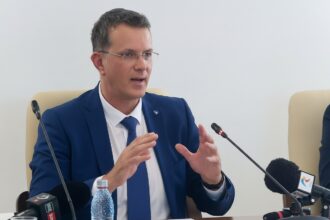
According to Reuters, Bulgarian Defence Minister Dimitar Stoyanov stated on 9 June 2026 that Bulgaria no longer intends to supply weapons to the Ukrainian army and called on Moscow and Kyiv to return to the negotiating table. The same report notes that Bulgaria, a NATO and EU member state with a strategic position on the Black Sea, sent Ukraine anti-tank missiles, armoured vehicles, mortars, anti-aircraft guns, howitzers and infantry weapons in 2024 and 2025, following a shift in political line from the 2022–2023 period, when exports were officially routed through European intermediaries.
This is the first important distinction: Bulgaria is not moving from direct military support to isolation, but from a stage of deliveries to Ukraine to a stage in which the government in Sofia says it no longer foresees new arms transfers. At the same time, the decision must be read together with another announcement made by Prime Minister Rumen Radev: Bulgaria’s intention to raise defence spending towards 5% of GDP, in line with NATO commitments. According to Reuters, Radev stated on 28 May 2026 that Bulgaria has reached the 2% threshold and is determined to take the next step by gradually increasing its defence budget.
From Direct Military Support to Self-Defence
The central angle of this development is not only Bulgaria’s relationship with Ukraine, but the way Sofia appears to be redefining its security priorities. Halting deliveries does not automatically mean a reduction in Bulgaria’s role within the regional architecture. It may instead signal a change in the form through which Bulgaria intends to matter: fewer transfers from its own army’s stocks and greater emphasis on rebuilding national capabilities, increasing the defence budget and participating in Black Sea security.

This interpretation is supported by reporting from the Associated Press, which notes that Stoyanov described the war in Ukraine as a war of attrition and stated that supplying new weapons to the Ukrainian army is not under consideration. In the same context, the Bulgarian Defence Minister announced a plan to raise military spending to 5% of GDP by 2030.
Factually, the two messages are not mutually exclusive. A state can decide to stop transferring weapons from its own stocks to Ukraine while, at the same time, increasing its defence spending within NATO. In Bulgaria’s case, this dual move suggests a repositioning of strategic emphasis: from direct contribution to the Ukrainian military effort towards consolidating its own defence capacity.
This nuance is essential for a balanced analysis. There are sufficient elements to observe that Sofia is more clearly separating its support for Ukraine from its own military needs, without this change being automatically interpretable as a withdrawal from regional security.
Bulgaria, Romania and Türkiye: The Riparian NATO Core in the Black Sea
Bulgaria is not a peripheral actor in the Black Sea file. Alongside Romania and Türkiye, it is one of the three riparian NATO Allies with direct responsibilities in a region affected by the war in Ukraine, by risks to navigation, by sea mines and by the security of commercial routes.
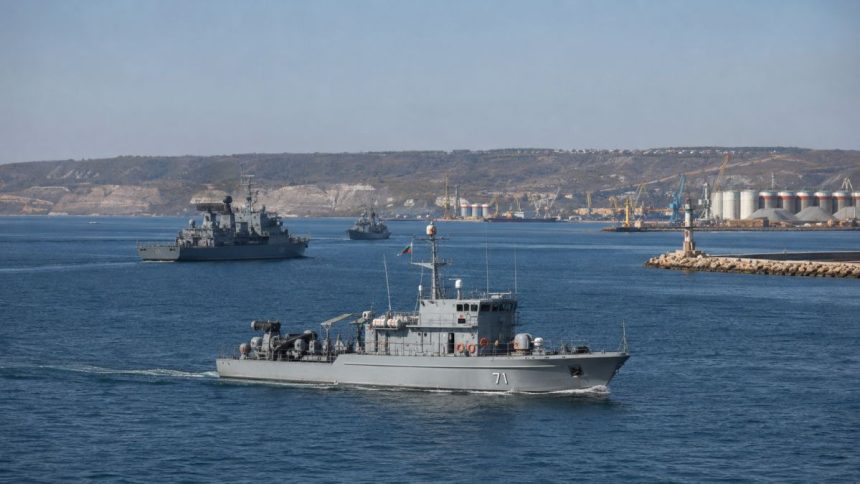
One concrete element is the MCM Black Sea task group, formed by Romania, Bulgaria and Türkiye to counter sea mines in the Black Sea. According to the Romanian Naval Forces, the memorandum on the establishment of MCM Black Sea was signed on 11 January 2024 in Istanbul, and the group’s role is to ensure freedom of navigation through surveillance, reconnaissance and the neutralisation of potential threats to maritime traffic.
In January 2026, Romania handed over command of the MCM Black Sea group to Türkiye for the following six months. Agerpres reported that the principle of rotating command is established by the trilateral memorandum, with command to be held by the Turkish Navy in the first half of 2026, by the Bulgarian Navy in the second half of the year, and again by the Romanian Navy in the first half of 2027.
This detail is important for analysing Bulgaria’s position. In the same period in which Sofia is halting arms deliveries to Ukraine, Bulgaria remains part of the trilateral naval security mechanism in the Black Sea and is set to take over command of the group in the second half of 2026. The role of Bulgaria, therefore, does not disappear. On the contrary, it could become more operationally visible, if participation in MCM Black Sea and military investment are maintained.
The importance of this trilateral mechanism was underlined directly by the Ambassador of Türkiye to Bucharest, Özgür Kıvanç Altan, in an interview granted to Atlas News. The Turkish diplomat explained that the MCM Black Sea group responded to a real threat — mines coming from the war zone — but that its true value lies in strengthening the culture of working together among the three riparian Allies and in increasing military interoperability. Moreover, the Ambassador announced that Türkiye, Romania and Bulgaria are considering extending the MCM Black Sea mandate to the protection of critical energy infrastructure in the Black Sea, possibly through a new agreement signed at the level of Defence Ministers (Atlas Diplomatic / Atlas News).
In the same vein, Ambassador Altan placed Bulgaria explicitly within the region’s allied core, stating that Black Sea security puts Turks, Romanians and Bulgarians within the same allied regional logic, and that the three states form, beyond MCM Black Sea, a military mobility group within NATO. This perspective, expressed directly by the representative of one of the three riparian Allies, reinforces the idea that Bulgaria remains part of an active trilateral architecture, regardless of the shift in its line on the Ukrainian file.
A Change of Instrument, Not Necessarily a Change of Camp
For Romania, the difference is important. If Bulgaria were analysed solely through the lens of halting arms deliveries to Ukraine, the conclusion could be incomplete. In the Black Sea architecture, a state’s contribution is measured not only by the weaponry sent to Kyiv, but also by naval capability, surveillance, demining, port infrastructure, interoperability with Allies and participation in NATO’s regional mechanisms.
From this point of view, Bulgaria can be seen as a state recalibrating its centre of gravity from direct military support towards a regional security role. This shift should be presented neither as a rupture nor as a certain consolidation before results are in. It must be tracked through facts: the defence budget, procurement programmes, the contribution to MCM Black Sea, cooperation with Romania and Türkiye, participation in NATO exercises and its stance on critical infrastructure in the Black Sea region.
There is another element that tempers any abrupt conclusion. According to Reuters, Bulgaria and Ukraine signed a bilateral security cooperation agreement in March 2026, valid for ten years, which includes joint defence production, intelligence sharing and an energy corridor for transporting up to 10 billion cubic metres of gas annually to Ukraine.
This means that halting arms deliveries does not automatically cancel all forms of cooperation between Sofia and Kyiv. It affects the most politically visible component — the transfer of weaponry — but does not, in itself, demonstrate the rupture of the entire security framework.
Bulgaria and NATO’s New Logic on Defence Spending
Bulgaria’s repositioning must also be read within the broader context of the shift in emphasis inside NATO. The Alliance has moved from the traditional 2% of GDP threshold for defence to a more ambitious formula, which includes both core military spending and investments related to security, critical infrastructure, resilience and the defence industry.
According to NATO, at the 2025 summit in The Hague, Allies agreed to invest 5% of GDP annually by 2035 for core defence requirements and defence- and security-related spending. Of this target, at least 3.5% of GDP must be directed towards core defence requirements, while up to 1.5% may address critical infrastructure, networks, civil preparedness, resilience, innovation and the defence industrial base.
Within this framework, Bulgaria’s statement on increasing defence spending is not a secondary detail. It may indicate an attempt to align with NATO’s new logic: European states are called upon not only to transfer resources to Ukraine, but also to rebuild their own military capabilities, invest in critical infrastructure and increase internal resilience.
For Bulgaria, a state positioned on the Black Sea and with a strategic neighbourhood relevant to the south-eastern flank, this shift in emphasis may have concrete effects. If the increase in the defence budget is followed by real investment in naval forces, air defence, maritime surveillance, port infrastructure and interoperability with Romania and Türkiye, Sofia could become a more important partner in Black Sea security. If not, the announcement will remain a largely political declaration.
The Black Sea, a Space of European Security, Not Merely a Military Frontier
Bulgaria’s repositioning also acquires meaning through the way the European Union is seeking to transform the Black Sea into a strategic space of its own, including through projects under political construction, such as the European Black Sea Maritime Security Hub. This development is relevant because a possible reorientation of Bulgaria away from arms transfers towards consolidating its own capabilities overlaps with a broader European effort to build instruments of coordination, resilience and maritime security in the region.
In an interview granted to Atlas News, in the „Corridors of Power” series, Victor Negrescu, Vice-President of the European Parliament and one of the main promoters of the European Black Sea Maritime Security Hub project, explained that the war in Ukraine acted as a stress test for the region’s security architecture, showing that the Black Sea had for too long been treated as a secondary theatre. He stressed that the central lesson concerns not only military capabilities, but the need for better coordination among EU, NATO and regional initiatives, which are often fragmented (Corridors of Power / Atlas News).
In the same vein, Negrescu pointed to initiatives such as the trilateral MCM Black Sea group, established by Romania, Bulgaria and Türkiye, as examples of regional cooperation on which a broader maritime security network can be built. This perspective confirms, from a European angle, the central idea of the analysis: Bulgaria’s contribution to Black Sea security is not reduced to the weaponry sent to Ukraine, but lies in participation in the mechanisms of coordination, demining and protection of critical infrastructure — precisely the areas towards which Sofia appears to be shifting its emphasis.
For Romania, this European dimension is strategically favourable. Romania holds a strategic position on the Black Sea through the Port of Constanța, the Mihail Kogălniceanu base, its role in demining, offshore energy infrastructure and regional connectivity — elements also invoked by Victor Negrescu in the interview as arguments for Bucharest’s role as a strategic platform. Within such a framework, a Bulgarian partner that strengthens its own naval and surveillance capabilities becomes an asset, not a problem.
Implications for Romania
For Romania, Bulgaria’s evolution must be followed without alarmism, but with attention. Bucharest has an interest in Bulgaria remaining an active, predictable and capable partner within the Black Sea architecture. Cooperation with Türkiye is indispensable, but the Romania–Bulgaria axis has its own importance: geographical proximity, regional infrastructure, ports, logistics corridors, navigation and military coordination.
If Bulgaria invests more in its own defence and takes on a more visible role in MCM Black Sea, the decision to halt arms deliveries to Ukraine can be understood as part of an internal recalibration of security priorities. If, however, the halt in deliveries is not accompanied by the strengthening of national capabilities and a more substantial contribution to Black Sea security, then the effect will be more of a reduction in strategic profile.
For now, the available data support a prudent conclusion: Bulgaria is not abandoning its regional role, but appears to be attempting to redefine it. Rather than being assessed strictly by the quantity of weaponry sent to Ukraine, Sofia must be assessed by what it does in the coming months within NATO, within MCM Black Sea and in its own military modernisation.
The real stake is not only whether Bulgaria continues to supply weapons to Ukraine, but also whether Bulgaria becomes, alongside Romania and Türkiye, a more solid actor in Black Sea security. And this will not be decided by a single statement from Sofia, but by budgets, military procurement, joint exercises, naval capabilities and the continuity of regional cooperation.
Read also
Europe Solved Its 2022 Crisis by Creating the One of 2026. Germany Pays the First Bill