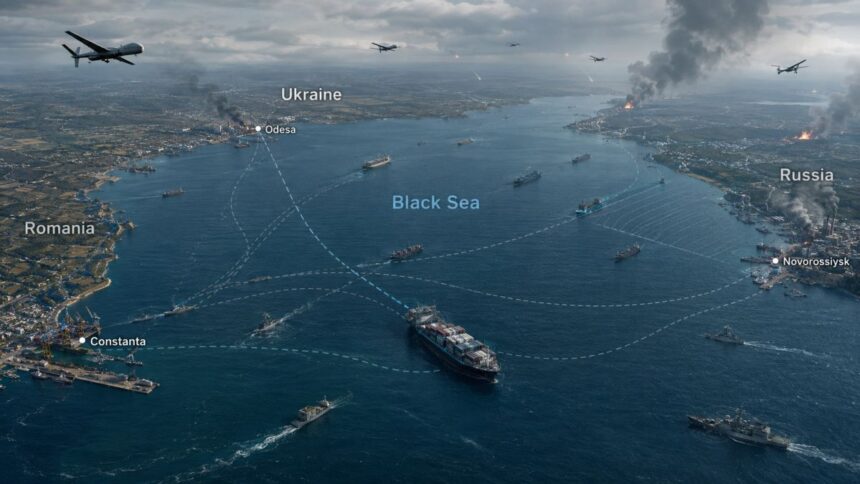
For more than three years, the maritime war in the Black Sea followed a relatively clear direction. Russia struck Ukrainian ports, threatened commercial navigation and forced Kyiv to build alternative routes in order to keep its economy connected to international markets. After Moscow’s withdrawal from the Black Sea Grain Initiative in July 2023, Ukraine was compelled to turn the Danube, the ports in the Odesa region and the maritime corridor near the NATO coastline into an economic infrastructure of survival.
In the summer of 2026, however, a shift is taking shape that deserves to be examined beyond the succession of drone strikes.
The Ukrainian campaign against Russian ships and logistical infrastructure in the Sea of Azov is beginning to affect the way Moscow organises its own trade. Navigation has been restricted, terminals have limited grain intake, exporters are searching for alternative routes, and the Russian Ministry of Transport is cooperating with the Russian Ministry of Defence to protect navigation and ensure the continuity of logistical flows.
This does not mean that Ukraine has taken control of the Sea of Azov, nor that Russia has lost military superiority in its own coastal waters.

It does mean, however, something that until recently seemed considerably harder to achieve: Ukraine is beginning to transfer to Russia’s commercial and logistical system a share of the costs of maritime insecurity that Moscow has imposed on the Ukrainian economy since 2022.
From blocking Ukrainian exports to disrupting Russian exports
The reference point for the current commercial confrontation in the Black Sea remains July 2023.
Russia refused at that time to extend the Black Sea Grain Initiative and withdrew its security guarantees for navigation in the north-western Black Sea. The agreement, negotiated by the United Nations and Türkiye, had enabled the safe transport of nearly 33 million tonnes of grain and other food products from Ukrainian ports, according to data published by the United Nations.
For Kyiv, the consequence was the need to build an alternative system.
The Danube ports acquired greater importance, the infrastructure along the border with Romania took on new strategic value, and Ukraine subsequently succeeded in maintaining a maritime corridor of its own in the western Black Sea.
In the summer of 2026, pressure is beginning to manifest itself in the opposite direction.
On 13 July, Reuters reported that navigation in the Sea of Azov remained restricted for security reasons following Ukrainian strikes on tankers and other commercial vessels. The route is far from marginal: roughly one quarter of Russian grain exports transit through the Sea of Azov.
Vessels were still able to move within the sea, but access via the Kerch Strait and the Azov–Don Canal had been restricted. The impact reached markets immediately, with wheat futures on Euronext temporarily rising by as much as 4 per cent.
The scale of the strikes is significant. Ukraine claimed at the time to have hit 116 vessels in the Sea of Azov in just nine days. Moscow described the campaign as terrorism.
Beyond the rhetoric of the two sides, the economic effect can be measured.
Russia begins to relocate its logistics
By the end of July, the problem had already moved beyond the Sea of Azov.
Three major Russian grain export terminals — NZT and KSK at Novorossiysk and ZTKT at Taman — restricted grain deliveries by truck in the face of the risks associated with drone strikes, according to Reuters.
Together, the three terminals have an annual capacity of more than 20 million tonnes. Russia exports approximately 50 million tonnes of grain by sea.
The authorities also restricted night-time vessel movement at Novorossiysk, and exporters began to redirect cargoes originating in southern Russia. Moscow is even considering greater use of Baltic Sea ports, regarded as less exposed to the current Ukrainian campaign.
This is where the meaningful change lies.
Drone strikes are no longer producing only isolated damage. They are beginning to influence the logistical geography of Russian trade.
There is an important distinction between the destruction of a vessel and the alteration of a commercial system’s behaviour. In the first case, the effect can remain local. In the second, the cost propagates to terminals, operators, carriers, insurers and the routes through which cargo reaches the buyer.
Moscow brings the Ministry of Defence alongside the Ministry of Transport
For this reason, Russia’s institutional response is more revealing than it might appear.
The Ministry of Transport has announced the establishment of a special mechanism for coordinating the transport of goods and developing alternative logistical routes, while, together with the Ministry of Defence, additional measures are being taken to safeguard navigation and protect vessels in the Azov–Black Sea basin.
There is at present no public evidence that Russia has introduced naval convoys for commercial vessels, exclusion zones, special rules of engagement or a permanent military escort system.
It would be premature to describe the measure as a formal militarisation of Russian shipping.
But the mere fact that the security of commercial vessels, the continuity of exports and the rerouting of cargo have to be managed within a mechanism in which the civilian transport authority cooperates directly with the military apparatus reveals the scale of the problem Moscow faces.
It is not yet a new naval doctrine. It is, however, a defensive posture that Russia is compelled to adopt in order to protect its own economic infrastructure.
A line Moscow might be tempted to cross
There is also a development that warrants close attention.
In Russia, discussions have taken place regarding the possibility of equipping certain commercial grain-carrying vessels with defensive armament designed to counter Ukrainian drones.
The implementation of such a measure is not confirmed and, at present, there is insufficient evidence to state that armed Russian commercial vessels are already operating in the Sea of Azov.
Should the proposal be put into practice, however, the implications would be considerably greater than the mere protection of a cargo ship.
Arming commercial vessels would not automatically transform them into legitimate military targets. The law of armed conflict imposes far more complex conditions for the loss of the protection afforded to civilian objects.
But it would render the operational delimitation between commercial shipping and military activity more difficult.
For shipowners and insurers, the issue would immediately become one of risk. For third-country ports, questions would arise regarding access and the procedures applicable to commercial vessels transporting grain while simultaneously carrying armament. For coastal states, the distinction between protecting commerce and integrating it into a military defensive system would become harder to manage.
For this reason, the proposal may become one of the important thresholds of the 2026 maritime war.
This is not the beginning of the militarisation of Black Sea commerce
It would nonetheless be mistaken to present the current developments as the beginning of the transformation of commercial infrastructure into a strategic object. The process is much older. Following Russia’s withdrawal from the grain agreement in 2023, Moscow announced that vessels heading towards Ukrainian ports could be regarded as potential carriers of military cargo. In parallel, Russia intensified its strikes on Ukraine’s port and grain infrastructure.
That was the moment of the fundamental rupture.
Shipping, terminals, silos and export corridors ceased to be merely economic infrastructure located near the war. They became elements in the strategic competition between the two states. What is new in the summer of 2026 is something else.
The vector of pressure is beginning to reverse.
Ukraine begins to impose on Russia its own model of maritime insecurity
This is the hypothesis that Atlas News Romania advances for the current phase of the confrontation.
Russia has not lost control of the Sea of Azov. Ukraine does not possess there a conventional navy capable of enforcing a classic blockade. And Moscow’s capacity to export grain remains considerable.
But Kyiv does not need to secure traditional naval control in order to generate strategic effects. Maritime and aerial drones can alter the equation by imposing costs.
If vessels have to be given additional protection, if night-time traffic is restricted, if terminals reduce intake, if cargoes are redirected and if exporters begin to consider the Baltic safer than the Black Sea, then the Ukrainian campaign produces an effect that exceeds the number of vessels struck.
It can block or limit economic activity at sea without effectively controlling the area with military vessels.
It is, in a different form and on a scale still incomparable, the same mechanism whose costs Ukraine has borne since 2022: insecurity reshapes the geography of trade. The difference is that some of these costs are now beginning to appear on the Russian side.
Romania stands on the opposite side of this logistical shift
For Romania, the consequence is not merely the prospect that the Port of Constanța could benefit economically from the reshaping of commercial routes.
The problem is more complex.
As the infrastructure of the western Black Sea and the Danube corridor become more important for connecting Ukraine to European and international markets, their strategic value rises. But their exposure rises in parallel.
Romania has already experienced this reality.
On the night of 28 to 29 May 2026, a drone used in Russian strikes on Ukrainian infrastructure near the fluvial border entered Romanian airspace and crashed onto the roof of an apartment building in Galați. The technical investigation established that it was a Russian-made GERAN-2, and two persons were injured, according to the Ministry of National Defence.
A week later, the war reached Romania from the opposite direction.
On 5 June, a Ukrainian Sargan-3000 naval drone exploded in the Port of Constanța. The Ukrainian authorities subsequently informed Romania that they had lost communications with four such drones in the vicinity of Sevastopol, approximately 250 kilometres from the Romanian shore. Kyiv assessed that the loss of control had probably been caused by Russian electronic warfare operations. The incident produced no casualties, according to the Ministry of National Defence.
The two incidents are not equivalent and should not be treated as such. One resulted from a Russian strike on Ukraine; the other from the loss of control of a Ukrainian naval drone.
Taken together, however, they demonstrate something important for Romania: proximity to the technological war in the Black Sea generates risks regardless of the direction from which the system that has escaped control originates.
Constanța becomes simultaneously more valuable and more vulnerable
This is the strategic contradiction that Romania will have to manage. The more the commercial routes in the eastern and northern Black Sea become exposed, the greater the value acquired by the western infrastructure of the basin.
Constanța, the Danube and the rail and road connections towards Central Europe are important not only for Romania’s economy. They form part of the system through which Ukraine has reduced its vulnerability to Russian maritime pressure. But strategic value also produces strategic exposure.
This does not mean that the Port of Constanța automatically becomes a military target, nor that Romania enters the war simply by facilitating Ukrainian commerce. Such a conclusion would be unjustified both legally and strategically.
It does mean that the protection of port infrastructure, maritime surveillance, defence against drones, the security of navigation and coordination with Ukraine are becoming increasingly difficult to separate.
The fact that Romania, Bulgaria and Türkiye decided at the NATO Summit in Ankara to expand the activities of MCM Black Sea beyond its initial mine countermeasures mission already signals this regional shift in perspective. According to the Ministry of National Defence, cooperation among the three riparian states is being extended to the protection of critical maritime infrastructure and the strengthening of security in the Black Sea.
The war is not moving westward. The risk is being redistributed
It would be tempting to say that the pressure Ukraine is exerting on Russian logistics is pushing the maritime war towards the western Black Sea. The reality is more precise.
The risk is being redistributed.
In the east, Russia must allocate additional resources to protect its ships, terminals and commercial routes.
In the north-west, Ukraine continues to depend on the infrastructure built to withstand Russian pressure.
And on the NATO coastline, Romania, Bulgaria and Türkiye must manage the effects of a confrontation in which aerial drones, maritime drones, electronic jamming, mines and strikes on commercial infrastructure make the old geographic distinctions increasingly less comfortable.
This may be the important strategic change of the summer of 2026 in the Black Sea.
Not the emergence of a new blockade, nor the loss of Russian control over the Sea of Azov.
Rather, the fact that Ukraine is beginning to demonstrate that a power without conventional naval superiority can impose systemic costs on an adversary’s commerce and can compel a superior naval power to reorganise its logistics in order to defend itself.
If the Russian restrictions dissipate rapidly, if terminals return to normal operations and if exports do not undergo a persistent change of routes, this interpretation will have to be scaled down to a tactical episode.
If, however, Russia continues to redirect exports, introduces permanent mechanisms for the protection of shipping and transfers volumes to ports further removed from the range of the Ukrainian campaign, we will be able to speak of something more significant: a structural transformation of commercial geography produced by the drone war.
For Moscow, the paradox would be difficult to ignore.
After years in which Russia sought to turn Ukraine’s access to the Black Sea into a strategic vulnerability, Ukraine is beginning to turn Russia’s access to the same sea into a strategic cost.
Read also