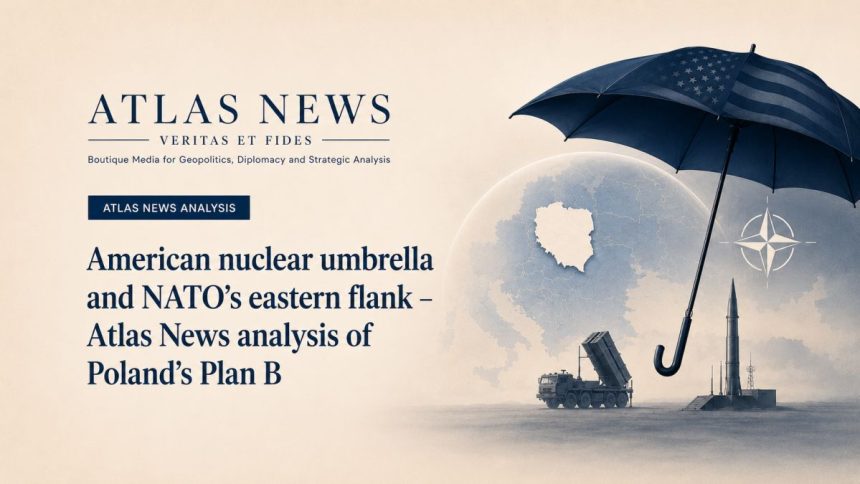
The American nuclear umbrella in Europe is returning to the centre of strategic debate at a moment when NATO is no longer discussing only military budgets, troops, ammunition or conventional defence. The real stake runs deeper: how credible the supreme guarantee of the United States remains in a Europe confronting Russia, the pressures of rearmament and an increasingly transactional American politics, all at once.
Poland was the first NATO country on the eastern flank to outline, publicly and strategically, the idea of a Plan B. Not a Plan B formalised in a single document, not a break with the United States, and not a declared alternative to NATO, but something perhaps more important: the acceptance that Europe must think through the scenario in which the American guarantee no longer functions automatically, linearly and unconditionally.
In a previously published analysis, Atlas News (https://www.atlasnews.ro/polonia-deschide-dosarul-interzis-al-nato-ce-face-europa-daca-america-lui-trump-pleaca/) described Poland as the state that opened „NATO’s forbidden file”: the question of what Europe does if America leaves or substantially reduces its commitment on the continent. That analysis reached an essential conclusion: Europe does not yet live in a post-American era, but it has already entered the era of post-American certainty.
The new discussion about the American nuclear umbrella carries this dilemma to the highest level of security. It is no longer merely a question of how many American soldiers remain in Europe, how many brigades can be shifted towards the eastern flank, or how many air-defence systems are delivered to allies. The question becomes far harder: who guarantees, in the last resort, Europe’s strategic survival in the face of a nuclear Russia?

NATO’s Supreme Guarantee Is Not Conventional, but Nuclear
Within NATO’s architecture, nuclear deterrence is not a doctrinal accessory. It is the supreme level of the security guarantee. NATO (https://www.nato.int/en/what-we-do/deterrence-and-defence/natos-nuclear-deterrence-policy-and-forces) officially states that its nuclear posture rests on the American nuclear weapons deployed in Europe, together with the capabilities and infrastructure provided by the allies involved, while the United States retains absolute control and custody over these weapons.
This formula is essential. „Nuclear sharing” does not mean that European states become nuclear powers. Nor does it mean any transfer of nuclear sovereignty to European capitals. It means allied participation in the deterrence mission, under the decisive political and operational authority of Washington.
Here lies the central paradox of European security. Europe may speak of strategic autonomy, may raise military budgets, may produce more ammunition, may build drones, tanks and air-defence systems. Yet at the ultimate level of deterrence, the decisive guarantee remains American.
It is precisely for this reason that any political uncertainty in Washington produces disproportionate strategic effects in Europe. Not because NATO would vanish overnight, but because the continent’s entire defence architecture has been built on the premise that the United States will remain the final guarantor of European security.
Poland Said Aloud What the Eastern Flank Already Thinks
Poland matters not because it is the only country preoccupied with this file, but because it was the first to translate strategic unease into an explicit political position.
In March 2025, the then president Andrzej Duda called on the United States to transfer nuclear weapons onto Polish territory as an instrument of deterrence against Russia. The information was reported by Reuters (https://www.reuters.com/world/polands-president-urges-us-move-nuclear-warheads-polish-territory-ft-reports-2025-03-13/), citing the Financial Times, with Duda noting that he had discussed the proposal with Keith Kellogg, Donald Trump’s special envoy for Ukraine and Russia. The political message was clear: if NATO’s frontier has moved eastward, the deterrence infrastructure ought to reflect that reality.
This is not merely a military request. It is a diplomatic repositioning. Poland is not asking only for additional protection; it is seeking to move the psychological centre of NATO’s deterrence towards the zone where the strategic risk is most direct.
For Warsaw, geographic proximity to Russia and Belarus, the war in Ukraine and American political uncertainty create a reality different from the one perceived in Berlin, Paris or Rome. In the West, the nuclear file is treated primarily as a matter of strategic balance, escalation management and continental stability. On the eastern flank, it is read more directly: as a matter of survival, credibility and reaction time.
This is the difference of substance. Poland did not outline a Plan B because it wishes to break NATO, but because it understands that an alliance becomes vulnerable when its members refuse to think through the uncomfortable scenarios.
Plan B Does Not Mean Abandoning America
The greatest error of interpretation would be to present Poland’s position as an attempt to replace the United States. That is not the stake.
The Polish Plan B is not a plan against America. It is a plan against American uncertainty.
Poland remains one of the most pro-American European allies. It is precisely for this reason that the signal coming from Warsaw is so important. It comes not from a capital traditionally sceptical of Washington, but from a state that built its post-Cold War security on the relationship with the United States. When such an actor begins to speak of alternatives, strategic redundancy and additional guarantees, it means the problem is no longer rhetorical.
This is exactly the point at which the Atlas News analysis of Poland becomes relevant to the entire nuclear file. The first question was what Europe does if America reduces its role. The second question, harder still, is what Europe does if America stays, but turns the conventional guarantee into a more selective, more conditional and more negotiable relationship.
In that scenario, the American nuclear umbrella takes on even greater importance. It becomes the supreme political signal that the United States is not abandoning Europe, even as it asks Europeans to take on more of the conventional defence.
The Eastern Flank No Longer Wants Mere Military Presence, but Strategic Certainty
For the states of the eastern flank, the difference between military presence and strategic guarantee is essential.
American troops, NATO exercises, bases, air-defence systems and military rotations are important. But they can be reduced, relocated, reinterpreted or turned into instruments of political pressure. The nuclear guarantee, by contrast, is the ultimate level of commitment. It signals that an attack on a NATO ally is not merely a regional matter, but a challenge to the entire Western security architecture.
For that reason, the discussion about a possible expansion of American nuclear deployments in Europe carries a stake that exceeds military technicalities. Reuters (https://www.reuters.com/business/aerospace-defense/us-talks-expand-nuclear-weapons-deployments-europe-ft-says-2026-06-02/), citing the Financial Times, reported on 2 June 2026 that the United States was in talks to expand the hosting of nuclear capabilities to additional European NATO states. According to international reporting, the discussions would include interest from certain eastern-flank states, with Poland mentioned explicitly and the Baltic states evoked in the context of NATO channels. The cited sources noted, however, that an agreement was not imminent.
Here an essential nuance enters. The discussion must not be confused with an announced decision to move American nuclear warheads eastward. According to the Financial Times reporting, relayed by Reuters, the matter under discussion concerns the possibility that additional NATO states might host American dual-capable aircraft, DCA, able to carry both conventional armament and nuclear weapons. The distinction is essential: the delivery infrastructure is not the same thing as the actual deployment of nuclear weapons.
This nuance does not diminish the political importance of the file. On the contrary, it clarifies it. NATO is discussing not only where weapons might be placed, but how visible, tangible and credible the American nuclear guarantee must become for the allies who feel most exposed to Russian pressure. For Poland, and for part of the eastern flank, the mere possibility of hosting DCA would already represent a change of strategic status: from beneficiary of deterrence to more direct participant in its architecture.
This equation is therefore more diplomatic than military. It concerns who has access to consultation, who takes part in planning, who hosts infrastructure, who assumes the political risk, and who receives guarantees credible enough to deter Moscow.
Where American Nuclear Weapons in Europe Are Actually Located
To avoid confusion, the real map of deployments is worth specifying. As publicly documented, NATO’s traditional nuclear-sharing architecture is commonly associated with Belgium, Germany, Italy, the Netherlands and Turkey, where, according to estimates from specialised sources, some 100 American B61 tactical nuclear bombs are stored.
The case of the United Kingdom has returned to attention through the information concerning RAF Lakenheath, but it must be treated separately, as the possible reactivation of an American nuclear infrastructure rather than as an element identical to the other traditional arrangements. From the summer of 2025, specialised sources, among them the Federation of American Scientists (https://fas.org/publication/incomplete-upgrades-lakenheath-questions-nuclear/), signalled indications of the return of the American nuclear mission to British territory, for the first time since 2008. The same sources stress, however, that although the indicators are strong, budget documents raise questions about the full completion of the infrastructure required for deployment, with the security works scheduled to continue for several more years. At the same time, a recurring hypothesis in specialised analyses is that a possible deployment in the United Kingdom could offset a possible reduction of the American nuclear presence in Turkey.
In short, NATO’s nuclear map is not frozen. It is being quietly rearranged, and the discussion about an expansion towards the eastern flank overlaps with a repositioning already under way towards the north-west.
Europe Wants Autonomy, but Cannot Quickly Replace the American Guarantee
In parallel, an increasingly serious discussion is developing in Europe about the role of France and the United Kingdom in the continent’s nuclear deterrence. The two are the only European nuclear powers within NATO, and their arsenals carry real strategic weight.
The French file must be read within this broader context. The debate about a possible European dimension of nuclear deterrence did not emerge as a theoretical exercise, but against the backdrop of fears regarding Russia and uncertainties about the reliability of the American nuclear umbrella. In February 2026, Euronews (https://www.euronews.com/tag/nuclear-weapons) noted that President Emmanuel Macron was to clarify France’s contribution to European nuclear deterrence. In the Atlas News reading, the French offer does not present itself as a direct competitor to the American umbrella, but as a possible function complementary to it.
Yet here the political limit appears. For many states on the eastern flank, including Poland, the French or British guarantee may complement Western deterrence, but it cannot swiftly replace the American one.
The IISS (https://www.iiss.org/online-analysis/military-balance/2025/03/us-allies-question-extended-deterrence-guarantees-but-have-few-options/) notes that, within NATO, the United States retains full custody over the nuclear weapons deployed in Europe, and the American president holds sole authority over their use. This reality shows how centralised the nuclear level of Western security remains in practice.
In theory, a more autonomous Europe ought to be able to discuss a European nuclear guarantee. In practice, the problem is far more complicated. Nuclear deterrence does not function solely through the existence of an arsenal, but through the political credibility of using it in the defence of others. Here, France and the United Kingdom have capabilities, but they do not yet carry the same systemic weight that the United States holds within NATO.
An analysis by the DGAP (https://dgap.org/en/research/publications/what-if-usa-closes-its-nuclear-umbrella-over-europe) shows that, in the extreme hypothesis in which the United States were to close its nuclear umbrella over Europe, the continent would be left with France and the United Kingdom, but would require far more intensive nuclear consultations and a genuine European dialogue between nuclear and non-nuclear states.
This is one of the great European difficulties. Strategic autonomy is easy to invoke politically, but hard to translate into a nuclear guarantee credible to Warsaw, Vilnius, Riga, Tallinn or Bucharest.
Germany, France and the Eastern Flank View the Same Problem from Different Worlds
The nuclear file reveals one of the most important strategic fault lines within NATO: the allies do not perceive the Russian risk in the same way.
For Germany, the nuclear theme is laden historically, politically and socially. Berlin requires prudence, internal consensus and carefully calibrated institutional formulas. For France, the file is bound up with its status as a nuclear power, with strategic sovereignty and with the ambition to project European influence. For Poland and the Baltic states, however, the question is more brutal: what actually deters Russia?
This difference of perception will count enormously in the years to come. If NATO comes to discuss more openly the expansion of nuclear infrastructure or a greater visibility of the deterrence mission, internal objections within Western Europe will be inevitable. At the same time, the political pressure from the eastern flank will grow.
Poland has understood that, in the new security order, it is not enough to be protected on paper. The guarantee must be made visible, credible and hard to withdraw. This is the logic behind the Plan B: not the abandonment of NATO, but compelling NATO to clarify its real level of commitment.
Romania and the Strategic Prudence of the Black Sea
Romania finds itself in a position different from Poland’s. Bucharest has not publicly requested the hosting of American nuclear weapons, and there are no credible indications that Romania would be part of such a scenario. Any serious analysis must hold to this line.
But Romania is directly affected by the debate.
As an eastern-flank state, with a strategic position on the Black Sea, with proximity to the war in Ukraine and with infrastructure relevant to NATO, Romania depends on the credibility of the American guarantee just as much as Poland or the Baltic states. The difference is one of political style, not of strategic stake.
For Romania, the question is not whether Bucharest should request American nuclear weapons on its territory. No such public request exists, nor would it be prudent for Romania to open such a file alone. The real question is another: how does Bucharest ensure that the Black Sea does not remain NATO’s strategic periphery at a moment when the eastern flank is demanding ever clearer guarantees?
At the coming NATO meetings, Romania should pursue three concrete objectives. The first is the political clarification of the American guarantee for the entire eastern flank, not only for the European north-east. The second is the integration of the Black Sea into the same deterrence logic applied to the Baltic Sea, with planning, infrastructure, air defence and a predictable allied presence. The third is more active participation in NATO consultations on deterrence, including through conventional contributions, infrastructure, resilience and operational support.
In the analysis published by Atlas News (https://www.atlasnews.ro/polonia-deschide-dosarul-interzis-al-nato-ce-face-europa-daca-america-lui-trump-pleaca/), Romania was described as a state that does not speak frontally of a Plan B, but is beginning to broaden its options discreetly: through European defence projects, through the consolidation of industrial capacities, through resilience, and through maintaining a firm anchoring in the strategic partnership with the United States.
Romania need not imitate Poland in the most spectacular form of its message. But it must grasp the Polish lesson: in a NATO that has entered the era of post-American certainty, the states of the eastern flank can no longer live on implicit guarantees alone. They must demand strategic clarity, a credible allied presence and a real seat at the table where the architecture of deterrence is decided. Romania need not build a Plan B against America. It must build a Plan B against the absence of options.
The American Nuclear Umbrella Becomes the Political Test of the New NATO
NATO is entering a stage in which the central problem is no longer merely how much Europe spends on defence. That remains important, but it is not sufficient. The harder question is how responsibilities are redistributed between the United States and Europe without deterrence becoming less credible.
If Washington asks its European allies to invest more, produce more and sustain more of the conventional defence, Europe can respond. But if, at the same time, the American guarantee comes to be perceived as political, selective or dependent on the outcome of internal American elections, then the entire security architecture enters a zone of uncertainty.
The American nuclear umbrella is, in this sense, the supreme test. It shows whether the United States wishes to reduce the conventional burden in Europe without also reducing the final strategic guarantee. It shows whether Europe can become militarily stronger without fracturing politically. And it shows whether the eastern flank will receive guarantees tangible enough not to feel exposed between Russia and the hesitations of the West.
Europe Is Not Post-American. It Is Post-American Certainty
Poland was the first NATO country to outline a Plan B for a reality that many capitals still prefer to phrase in diplomatic language: America remains indispensable, but is no longer perceived as wholly predictable.
This is the historic shift.
Europe is not capable, at this moment, of quickly replacing the American nuclear umbrella. France and the United Kingdom can play a greater role, but they cannot produce overnight the same systemic guarantee the United States provides. Germany can sustain, financially and industrially, a stronger Europe, but it cannot resolve the nuclear dilemma. Romania can become an increasingly important strategic node on the Black Sea, but it remains dependent on the coherence of the NATO guarantee.
Poland opened the file because it understood that strategic silence is no longer enough. Facing a Russia that uses the nuclear threat as a political instrument and an America reassessing its global costs, Europe can no longer operate solely on the reflexes inherited from the post-Cold War period.
The real question is not whether American nuclear weapons will be moved to Poland tomorrow. The question is whether NATO can still convince the eastern flank that its final guarantee is clear enough, credible enough and resilient enough to withstand the political shifts in Washington.
For Europe, this is the file that Poland has opened. For NATO, it is the test of a new strategic era. For Romania, it is the warning that prudence must not be mistaken for passivity, and that loyalty to the American partnership does not exclude the obligation to build options.
Read also
Poland Opens NATO’s Forbidden File: What Europe Does If America Leaves the Alliance