The Caspian Sea, the New Front of Converging Wars: Ukraine Strikes the Military Corridor Between Iran and Russia
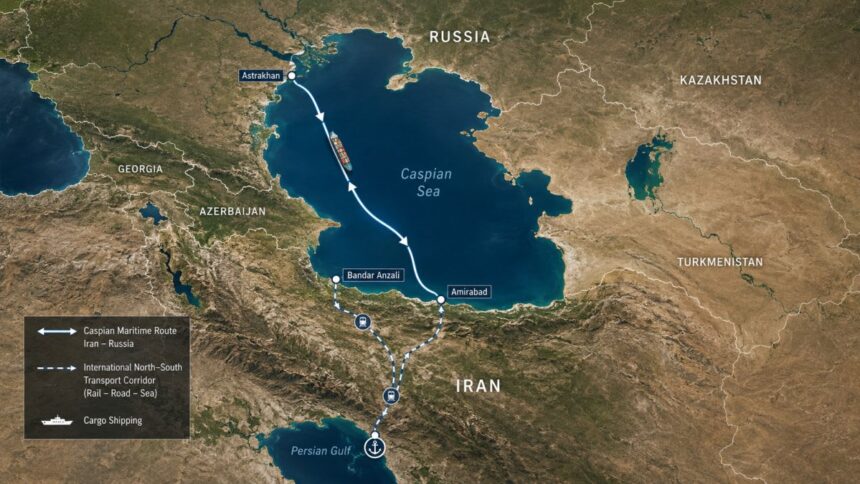
The Caspian Sea became, over the weekend of 25–26 July, the point at which Russia’s war against Ukraine and the military confrontation in the Middle East began to intersect operationally.
Kyiv has claimed strikes on two vessels linked to military shipments between Iran and Russia, on a missile boat, and on a Russian oil platform. Separately, Tehran accuses Ukraine of attacking the Iranian cargo ship Ana, killing one sailor, and warns that the incident „cannot go unanswered”.
Publicly available data do not yet permit any correspondence to be established between the vessel identified by Iran and the targets named by Ukrainian services. The two accounts must therefore be treated separately.

Beyond this uncertainty, the operation points to a strategic shift. Ukraine appears to be extending military pressure onto the infrastructure sustaining cooperation between Moscow and Tehran, while its combat experience against Iranian weaponry is being exported to the Arab states of the Gulf.
What Ukraine struck in the Caspian Sea
President Volodymyr Zelenskyy announced that Ukrainian forces had achieved „very strong results” with long-range strikes in the Caspian Sea, including against vessels used for military shipments involving Iran and against a warship.
According to information released by the Security Service of Ukraine and reported by Radio Free Europe/Radio Liberty and Ukrainska Pravda, the strikes targeted:
- the cargo ship Port Olya 2;
- the cargo ship Begey;
- a Project 12418 Molniya-class missile boat;
- the Filanovsky offshore oil platform, operated by the Russian company Lukoil.
The extent of the damage has not been independently verified. The SBU maintains, however, that the two cargo vessels were used to transport military shipments between Iran and Russia.
The direction of these shipments is clearly documented. The database maintained by Ukraine’s Defence Intelligence directorate (HUR) shows that Port Olya 2 has been involved in supplying military goods from Iran to Russia. The vessel belongs to MG-Flot, a company linked to the port of Olya in Russia’s Astrakhan region and sanctioned for its role in shipments carried out on behalf of the Russian Ministry of Defence.
In the case of the Begey, the Ukrainian service states that the ship transported ammunition, artillery shells, body armour and helmets from Iran to Russia, including during voyages carried out with its automatic identification system switched off.
There is, as yet, no sufficient factual basis to conclude that the vessels identified by the SBU were also transporting Russian components to Iran. The corridor can support flows in both directions, but the military shipments documented in the cases of Port Olya 2 and Begey are those carried from Iran to Russia.
The Ana: a separate incident, still unclarified
Iran offers a different version of the events of 25 July.
According to Iran’s Ministry of Foreign Affairs, an Iranian commercial vessel was attacked in the Caspian Sea. The explosion on board killed one sailor and wounded at least one other crew member.
Tehran summoned Ukraine’s chargé d’affaires and described the operation as a „hostile and criminal” attack and a violation of Article 2(4) of the United Nations Charter. Iranian authorities maintain that the vessel was civilian in nature and accuse Kyiv of seeking to extend the war in Ukraine into a new region.
Iran’s Foreign Minister, Abbas Araghchi, discussed the incident with EU foreign policy chief Kaja Kallas and Russian Foreign Minister Sergei Lavrov. Araghchi warned that the attack „cannot go unanswered”.
In Russian communications, the vessel was identified as the Ana, an Iranian cargo ship that had departed Astrakhan carrying what Moscow described as „civilian cargo”. The information was released by the Russian Ministry of Foreign Affairs following the telephone conversation between Lavrov and Araghchi.
Publicly available data are, however, insufficient to establish whether the Ana was among the targets of the operation claimed by Ukraine or whether it was struck separately, within the same series of attacks.
Port Olya 2 and Begey are vessels named by the SBU and included in official databases on military shipments. The Ana is presented by Russia and Iran as an Iranian vessel carrying civilian cargo. Until imagery, navigation data or information on the cargo become available, merging the two dossiers would be premature.
The Caspian Sea is no longer a neutral commercial space
The strikes did not occur along a route devoid of military relevance.
The Council of the European Union established as early as November 2024 that vessels operated by the Russian companies MG Flot, VTS Broker and Arapax were transporting weapons, ammunition and components for Iranian drones across the Caspian Sea. Brussels sanctioned the companies involved and targeted access to the Iranian ports of Amirabad and Anzali.
The US Treasury Department has documented the same infrastructure. According to the Office of Foreign Assets Control, vessels operated by MG-Flot carried out regular runs between Iran and Russia, and the Port Olya 3 cargo ship was used by Russia’s Ministry of Defence to transport Iranian short-range ballistic missiles.
US documents further show that Russian personnel were trained in Iran to operate the Fath-360 systems, and the first missile deliveries to Russia were identified in September 2024.
The port of Olya, in the Astrakhan region, has thus become a hub of Russo-Iranian military cooperation. Ukraine has previously struck port infrastructure in the area, arguing that it was used to receive components destined for Shahed drones and Iranian munitions.
In this context, the strikes on Port Olya 2 and Begey do not represent an operation against isolated vessels, but rather a sign that Kyiv is beginning to view the Caspian route as a logistical extension of Russia’s military capability.
This interpretation does not, however, resolve the question of the legal status of each target. A commercial vessel can become a military objective only if, by its nature, destination or use, it effectively contributes to military action and if its neutralisation offers a concrete military advantage. Establishing these conditions depends on the cargo and on the operational intelligence available at the moment of the strike. In the case of the Ana, such data have not been made public.
The military logic: striking weapons before they reach the front
For Ukraine, the strikes on the Caspian corridor form part of a broader campaign against the infrastructure sustaining Russia’s war effort.
Kyiv has hit refineries, fuel depots, airfields, drone factories, ports and vessels associated with military shipments. The aim is not always the complete destruction of a facility. At times, the objective is to force Russia to disperse activity, invest in defence and accept logistical delays.
Benjamin Jensen and Yasir Atalan, researchers at the Center for Strategic and International Studies, argue that striking platforms, components and logistical chokepoints before weapons enter circulation can reduce the pressure on Ukrainian air defence.
The logic is straightforward. Intercepting a drone over a Ukrainian city is the final stage and, often, the most costly. Destroying components, depots or the means of transport before the weapon reaches Russia can produce a greater effect with fewer resources.
The operation in the Caspian Sea suggests that Ukraine is applying this logic beyond the immediate proximity of the front. It cannot yet be asserted that the entire Iran–Russia corridor has become a permanent theatre of operations, but Kyiv has demonstrated that it considers the route both accessible and militarily relevant.
The accusation that could reshape the Washington–Moscow relationship
The naval incident was accompanied by an accusation with weightier implications.
Volodymyr Zelenskyy contends that Russia is supplying Iran with satellite imagery of US bases and strategic infrastructure in the Gulf states.
„Since the beginning of July, we have recorded active Russian satellite surveillance of the Gulf states and US military facilities located there. These images subsequently appear in Iran,” the Ukrainian president stated in remarks reported by CBS News.
Zelenskyy identified four airbases monitored on 19 and 20 July: two in Bahrain, one in Jordan and one in Kuwait. He argues that there is a correlation between Russian satellite activity and Iranian strikes, both in the preparation phase and in the assessment of their effects.
Kyiv has not published the technical evidence it says it will convey to Washington. The accusation cannot be treated as an independently verified fact.
Should the information be confirmed by the US intelligence community, the implications would be considerable. The provision of imagery usable for target selection or damage assessment could amount to Russian operational support for Iranian strikes against US military infrastructure.
The Moscow–Tehran relationship would then move beyond the level of weapons transfers and diplomatic cooperation. The question would arise of a direct Russian contribution to the intelligence cycle of operations directed against US forces.
Ukraine becomes a security provider in the Gulf
In parallel with strikes on the Russo-Iranian corridor, Ukraine is seeking to turn the experience it has accumulated against Shahed drones into a strategic product for the Arab states.
In March, Ukrainian military experts worked in Saudi Arabia and Qatar. In Jeddah, they examined ways of protecting infrastructure against Iranian drones and missiles. In Doha, the Ukrainian team assessed the architecture of air defence and presented solutions considered less costly for countering unmanned aerial vehicles.
The package proposed by Kyiv is not confined to the sale of an interceptor drone. According to the Office of the President of Ukraine, the cooperation includes counter-drone systems, air defence, electronic warfare, command and control, joint production and the transfer of operational experience.
Ukraine states that it has agreed ten-year cooperation programmes with Saudi Arabia, the United Arab Emirates and Qatar. Kyiv is preparing at least ten arms export contracts and discussing possible joint production capabilities.
Fabian Hoffmann, a researcher at the Center for European Policy Analysis and at the Oslo Nuclear Project, observes that Iranian attacks have exposed a specific vulnerability in Gulf defences.
States in the region hold high-performing systems against ballistic missiles, but the use of expensive Patriot interceptors against cheap drones is difficult to sustain. Ukraine offers a layered defence built under real combat conditions: distributed sensors, electronic warfare, mobile units, conventional weaponry and interceptor drones. High-cost Western systems are thus kept in reserve for ballistic missiles and complex threats.
Ukraine’s Ministry of Defence maintains that the drone interception rate exceeded 90 percent in March 2026 and that interceptor drones destroyed 33,000 aircraft in a single month. The figures come from the authorities in Kyiv and cannot be fully independently verified, but they point to the industrial scale that Ukraine’s counter-UAV defence has reached.
The strategic dilemma of the Gulf states
Saudi Arabia, the United Arab Emirates and Qatar have sought to maintain functional relations simultaneously with the United States, Russia, China and Iran.
Cooperation with Ukraine offers them access to battle-tested technologies. At the same time, it may be perceived in Tehran as participation in the development of an ecosystem designed to neutralise Iranian weaponry.
Jean-Loup Samaan, a researcher at the Middle East Institute of the National University of Singapore, argues that Ukrainian assistance may shape the cautious neutrality of the Arab monarchies towards the Russia–Ukraine war. The Gulf states are not merely purchasing equipment. They are developing defence relationships with a country that presents Russia and Iran as components of the same threat.
This does not mean that Saudi Arabia, the UAE or Qatar will align politically with Kyiv against Moscow. In all likelihood, the cooperation will be kept in a defensive, technical and bilateral register. The discretion surrounding the exact types of systems, the volume of contracts and the location of possible production lines reflects that caution.
How Iran can respond
A direct Iranian military campaign against Ukrainian territory remains unlikely. Iran does not possess the geographic proximity or the infrastructure required for sustained conventional attacks on Ukraine. Such a step would require Russian operational support and would transform Tehran from a weapons supplier into a direct participant in the war.
Four forms of response are more plausible.
The first is an intensification of military support for Russia. Iran could accelerate the delivery of components, munitions, drones or technology. The response would be executed by the Russian armed forces, without official acknowledgement of an Iranian operation against Ukraine.
The second option is to target the Ukrainian industry engaged in countering Iranian drones. Interceptor factories, research centres, depots and energy infrastructure could become higher-priority targets for Russia.
The third option is cyber or clandestine. Ukrainian institutions, defence companies, diplomatic missions and personnel involved in the Gulf projects could be subjected to surveillance, intimidation or sabotage.
The fourth is diplomatic. Iran may bring the matter before the UN Security Council and call on the states bordering the Caspian Sea to condemn the extension of Ukrainian operations into the region.
Tehran will seek to keep the civilian status of the Ana at the centre of the debate. Kyiv will insist on the military role of the Iran–Russia corridor. In the absence of published operational information, the dispute will also remain a contest for control of the narrative.
What Russia is pursuing
Moscow has an interest in seeing the dispute between Ukraine and Iran deepen.
A sharper confrontation could prompt Tehran to provide greater military support to Russia. It could also reduce Iran’s willingness to negotiate with the West and complicate relations between Ukraine and the Arab states of the Gulf.
Russia will probably seek to reinforce the protection of routes across the Caspian Sea. Possible measures include escorting shipments, dispersing cargoes, altering navigation schedules and using companies that are harder to link to military structures.
Experience in the Black Sea, however, shows that Ukrainian drones do not need to destroy a fleet outright in order to alter its behaviour. It is enough to raise the risk, the insurance costs and the need for protection. A predictable and inexpensive route can thereby become slower, more costly and more vulnerable.
That appears to be Kyiv’s immediate objective in the Caspian Sea.
Multiple fronts, one operational evolution
The strikes of the weekend of 25–26 July do not mean that the war in Ukraine and the conflict in the Middle East have formally merged. They do, however, point to an increasingly visible operational convergence.
Iran supplies weapons and technology to Russia. Ukraine strikes the infrastructure used for these transfers. Moscow stands accused of providing Tehran with intelligence on US bases. Kyiv exports to the Arab states systems developed to counter Iranian weapons.
Each of these developments can be analysed on its own. Taken together, they point to the emergence of an architecture in which logistics, intelligence and military technology circulate between fronts hitherto considered distinct.
The Caspian Sea is the place where this transformation has become visible.
Should the allegations regarding the transmission of satellite imagery be confirmed by US intelligence services, the relationship between Russia and Iran will enter a new phase. It will no longer be a question merely of strategic cooperation and weapons transfers, but of possible Russian operational support for attacks directed against US forces.
At that point, the two conflicts will not legally have become a single war. Militarily, however, the line between them will be far harder to draw.
Read also