Donald Trump’s latest public intervention on NATO is not a simple restatement of his dissatisfaction with European defense spending. It is a political signal placed at a sensitive moment: just days before the NATO summit in Ankara, in a context in which the Alliance is trying to project unity, strategic continuity, and the capacity to adapt to an increasingly difficult transatlantic reality.
In a post on Truth Social, Trump asserted that the United States spends more on NATO than any other country, „by far,” in order to protect its allies, „without getting any benefit from so doing.” He cited a figure of $999 billion for the United States over the 2014–2025 period, compared with $90.5 billion for the United Kingdom, $66.5 billion for France, $48.8 billion for Italy, and $44.3 billion for Poland (Newsweek, https://www.newsweek.com/nato-trump-defense-spending-12151330). The message was presented as a fresh, direct critique of the imbalance in contributions within the Alliance.
Rutte Won a Tactical Pause, Not a Change of Substance
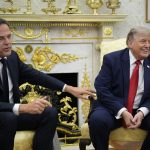
The timing of the post is not accidental. It came immediately after Mark Rutte’s visit to Washington, presented by NATO as a moment to prepare for the Ankara summit and to consolidate the relationship with the Trump administration, at a stage when allied delegations had already fixed their negotiating positions and intensive work was under way on the final joint declaration. At the White House, the NATO Secretary General tried to deliver precisely the message Trump wanted to hear: Europeans and Canadians are increasing defense spending, and the transatlantic burden is beginning to rebalance. Rutte stated that Europeans and Canadians are spending nearly 20% more on defense in 2025 than in the previous year, and he invoked more than a trillion dollars in cumulative additional core defense spending since 2016 (NATO, https://www.nato.int/en/news-and-events/articles/news/2026/06/25/secretary-general-meets-president-trump-in-washington-europe-is-stepping-up).
Ostensibly, the visit produced a moment of calm. In reality, Trump responded to this demonstration not by acknowledging the progress, but with his own set of figures. The raw comparison between the $999 billion spent by the Americans and the far smaller European contributions was, in this logic, a direct counterargument to the optimistic message Rutte brought from Washington. The American leader thus showed that, from his position as president of the United States, he holds the last word in defining NATO’s political usefulness — and that European arguments, however well constructed, do not change the terms Washington imposes on the debate. Rutte can demonstrate that Europe is spending more, but he cannot control the way Trump defines the Alliance’s political usefulness for the United States. For the American leader, the issue is not only whether allies reach a budgetary threshold, but whether they respond when Washington asks for support.


This connects directly to a phrase Trump had used earlier: „They weren’t there for us.” It is not a circumstantial reproach, but a key to reading his entire approach to NATO. In March, Reuters recorded his statement that the United States does not „have to be there for NATO” if the allies are not there for America, in a context marked by Washington’s dissatisfaction with the allies’ lack of involvement in the conflict with Iran (Reuters, https://www.reuters.com/world/trump-says-we-dont-have-be-there-nato-2026-03-27/).
This is the strategic core of the moment. Trump does not treat the Iran episode as a closed dispute, but uses it as a political argument for the idea that NATO functions disproportionately to Europe’s benefit and insufficiently to that of the United States.
Article 3, the Conveniently Forgotten Obligation
There is, in this dispute over figures, a conveniently forgotten element. Article 3 of the North Atlantic Treaty establishes each ally’s obligation to maintain and develop its individual and collective capacity to resist armed attack, through sustained self-help and mutual aid (NATO, https://www.nato.int/cps/en/natolive/official_texts_17120.htm). It is, in practice, the legal basis for the commitment to invest in one’s own defense — precisely the foundation Trump invokes when he demands more of the allies.
The paradox is that the very European capitals that most often invoke the collective solidarity of Article 5 pass over in silence the corresponding obligation in Article 3. To invoke it would mean acknowledging a structural shortfall of decades: the right to collective protection presupposes, in the letter of the treaty, the prior duty to invest sustainably in one’s own defense. Thus the formal obligation exists and binds Europeans first and foremost, but the public debate remains one of figures and perceptions, not of commitments undertaken by treaty.
From this perspective, Trump’s pressure is unpleasant in form, but it addresses a real vulnerability of the Alliance. The appropriate European response is not moral indignation, but a dramatic acceleration of its own defense capacity — rapid, visible, and credible. Otherwise, uncertainty will keep growing, and deterrence will weaken.
It Is Not Only About Money
Donald Trump’s statement should not be read as a technical dispute about NATO budgets. The figures cited by the American leader are politically important, but they are not the essence of the message. Trump is not trying to explain the Alliance’s financing mechanism, but to convey that the United States no longer accepts the role of automatic guarantor of European security without a visible political quid pro quo.
In this logic, the issue is not only how much each allied state spends on defense, but whether the allies are willing to respond when Washington asks for support. For Trump, NATO can no longer function merely as a collective-protection mechanism invoked by Europeans in moments of vulnerability; it must become a relationship in which loyalty is demonstrated, not assumed.
This is the major difference from the Alliance’s traditional language. While European capitals continue to invoke strategic solidarity and Article 5, Trump shifts the discussion into a much harder register: costs, benefits, and direct usefulness for the United States. That is why his statement generates uncertainty ahead of the Ankara summit. Not because it announces an immediate U.S. withdrawal from NATO, but because it once again casts doubt on the unconditional character of the American guarantee.
A Passing Crisis or a Structural Transformation
The essential question is whether we are witnessing an episode of political pressure or a change in the very nature of the transatlantic relationship. The arguments for the second reading are accumulating. Trump’s position is not a campaign improvisation, but a line held consistently across both terms, already applied in concrete crises — from the Iran episode to the debates over the American military posture in Europe. And the allies’ reactions are no longer mere gestures of the moment: large-scale budget increases, new financing instruments, ten-year industrial plans. States do not rebuild defense architectures for a passing storm.
If this logic persists, the scenario taking shape is that of an alliance with two speeds of trust: American military capabilities remain in Europe, but the political decision to use them becomes a matter of case-by-case negotiation. In such a configuration, every crisis on the eastern flank would begin with a question that is not officially posed today: what does Washington ask in return? Deterrence would erode not through the withdrawal of troops, but through the dilution of the automatic nature of the response. And for the Alliance’s adversaries, it is precisely this negotiating interval that would become the space for testing.
Canada Subtly Tests an Alternative Leadership
A further indication that the transformation is structural comes from the way allies are beginning to position themselves. While Washington increasingly conditions its guarantee, another allied capital is quietly trying to occupy the space left open. Under the coordination of Prime Minister Mark Carney, Canada is promoting the establishment of a multilateral defense bank — the Defence, Security and Resilience Bank (DSRB) — an institution meant to mobilize long-term, low-cost financing for allied and partner defense industries (Department of Finance Canada, https://www.canada.ca/en/department-finance/news/2026/04/canada-welcomes-progress-towards-the-establishment-of-the-defence-security-and-resilience-bank-and-hosting-its-headquarters.html). Ottawa aims to announce roughly ten founding members at the Ankara summit, mostly European states alongside Canada, and the institution will be hosted on Canadian territory (Reuters, https://www.usnews.com/news/world/articles/2026-07-02/exclusive-canada-aims-to-announce-10-countries-backing-global-defence-bank-at-nato-summit).
Carney presents the initiative as part of his call for an alliance of „middle powers,” a response to what he describes as the fracturing of the international order led by the United States. The project, initially referred to informally as the „NATO bank,” aims to raise up to £100 billion in accessible financing and remains contingent on the capital commitments of the participating states and on obtaining a high credit rating.
The stakes go beyond the financial dimension. By hosting such an institution and by serving as coordinator of the negotiations, Canada is subtly attempting to take over part of the political leadership of the allied rearmament effort. It is a move of limited scope for now, but with a clear strategic significance: for the first time, a middle power is proposing a defense-financing architecture that does not depend on Washington.
Uncertainty Enters Ankara Through the Front Door
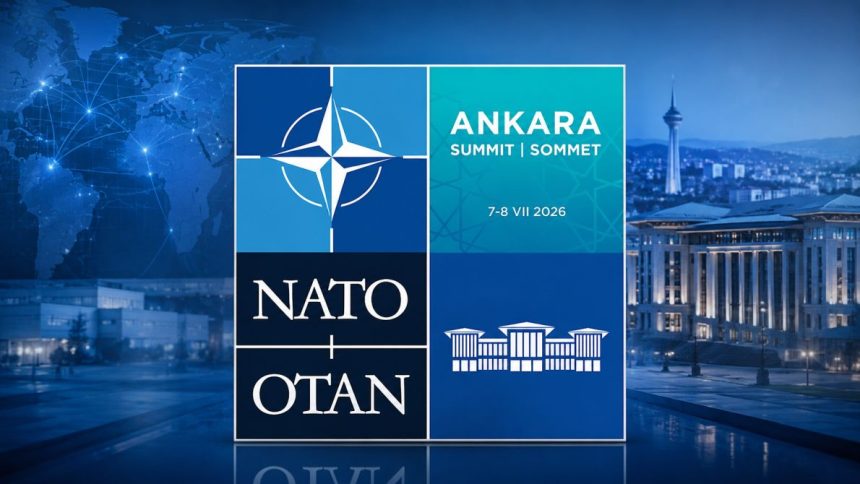
The NATO summit in Ankara, scheduled for July 7–8, 2026, will take place at the Beştepe Presidential Compound and will be chaired by the NATO Secretary General. According to the official announcement, the International Media Center will operate at the summit venue from July 5 to 8 (NATO, https://www.nato.int/en/news-and-events/events/media-advisories/2026/04/22/nato-summit-media-advisory).
Officially, the meeting is meant to be built around an agenda of continuity: defense, investment, industrial production, innovation, and the Alliance’s capacity to turn political commitments into concrete results. NATO presents the Ankara Defence Industry Forum as the leading allied event dedicated to transatlantic defense production, investment, and innovation (NATO, https://www.nato.int/en/news-and-events/events/2026/07/overview–2026-nato-summit-in-ankara-).
Trump’s statement, however, changes the political atmosphere. It brings back to the forefront the question Europeans have tried to keep under control: how predictable is the American guarantee still, when the president of the United States believes that the allies have benefited from protection without offering enough in return?
This is not about an immediate U.S. withdrawal from NATO — that would be an excessive conclusion. It is, however, about something almost as important: the reintroduction of uncertainty into the very heart of allied deterrence. NATO functions not only through military capabilities, but also through the political credibility of a common response. If the Alliance’s adversaries perceive that the American response depends on conditions negotiated case by case, ambiguity itself becomes a vulnerability.
Trump’s categorical position thus reignites fears of a possible reconfiguration of the American presence in NATO. These fears are amplified by internal debates in Washington over the U.S. military posture in Europe. The Wall Street Journal reported that U.S. Secretary of Defense Pete Hegseth had prepared a plan to cut American troops in Europe, later blocked, and that in its place a six-month review of the American posture on the continent was initiated (The Wall Street Journal, https://www.wsj.com/politics/national-security/hegseth-prepared-a-bombshell-plan-to-cut-troops-in-europe-then-it-got-nixed-cbb87e75).
For Europe, the message is harsh. Increasing defense spending is no longer sufficient as a symbolic gesture. European states must demonstrate that they can turn budgets into real, rapidly available capabilities: air defense, ammunition, military mobility, industrial production, critical infrastructure, maritime security, and the ability to react on the Alliance’s vulnerable flanks.
For Romania, the implication is direct. At Ankara, its geographic position on the eastern flank and the relevance of the Black Sea can no longer be invoked as sufficient arguments in themselves. Romania must present itself as an allied state capable of contributing concretely to collective security: through military infrastructure, credible defense investment, logistical capacity, support for Ukraine, and an active role in the Black Sea security architecture.
Atlas News Romania will be present in Ankara to report in real time on the developments of a summit that may become one of the most important NATO moments in years. Beyond the final communiqué and the diplomatic formulas about unity, the meeting will test the real balance between American commitment, Europe’s capacity to take on its own defense, and the strategic relevance of the eastern flank.
Trump’s statement does not cancel NATO, but it once again alters its political temperature. After Rutte’s visit to Washington, there was an impression that the relationship with the Trump administration had been stabilized, at least temporarily. The Truth Social post shows that the stabilization is fragile — and that what seemed a passing crisis is beginning to look increasingly like a lasting transformation of the transatlantic relationship.
At Ankara, NATO leaders will speak of unity. But the summit will be less about the unity of the communiqués and more about the questions that truly matter: who pays, who produces, and who decides when things take a turn for the worse.
Read also