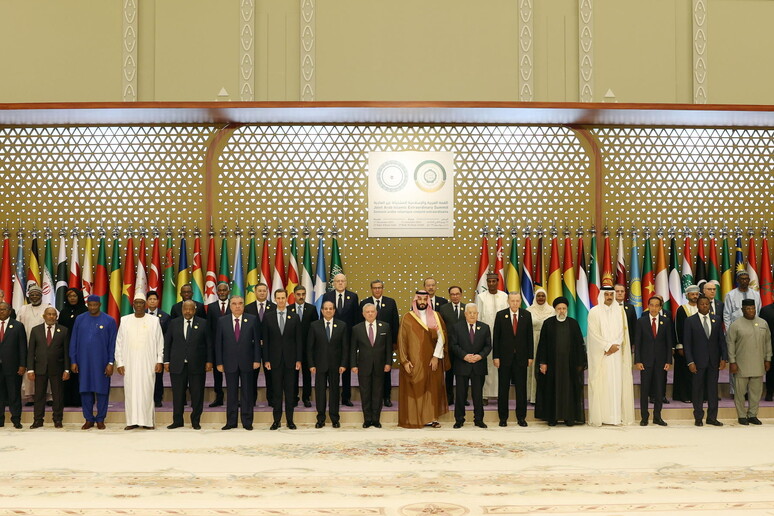
Riyadh’s maritime coalition: Saudi Arabia has launched in Riyadh one of the most noteworthy regional security initiatives of recent years. Fourteen states have endorsed the establishment of a multinational maritime defence coalition for the Red Sea, Bab el-Mandeb and the Gulf of Aden, at a moment when the Houthi threat and the wider regional confrontation with Iran have once again turned the principal commercial and energy routes into geopolitical frontiers.
At first glance, the explanation appears straightforward: Riyadh is seeking to assemble a coalition capable of protecting navigation in an increasingly perilous region. The immediate context supports this reading. According to Reuters, the initiative was announced following an intensification of Houthi threats against maritime shipping and the declaration of a naval blockade against Saudi Arabia.
Yet this explanation leaves an essential question unanswered.
Why would Saudi Arabia require a new multinational structure in a space where mechanisms dedicated precisely to maritime security are already operating?

Combined Maritime Forces operate in the region through CTF-153, while the European Union deploys EUNAVFOR ASPIDES on the ground. Both already possess established commands, procedures and operational experience. The new Saudi initiative, by contrast, does not yet have publicly allocated naval forces, known rules of engagement, or an operationally demonstrated integrated command.
This difference opens a different reading: Saudi Arabia may be seeking to occupy not so much a military vacuum as a political and institutional one, acquiring greater influence over the framework within which the states of the region define and negotiate the security of the Red Sea.
A coalition that exists politically before it exists militarily
On 30 July, the Saudi Ministry of Defence hosted the Riyadh meeting attended by representatives from 43 states and a European Union delegation. Fourteen states endorsed the new structure: Saudi Arabia, Kuwait, Bahrain, Qatar, Pakistan, Türkiye, Egypt, Jordan, Yemen, Bangladesh, Nigeria, Sudan, Djibouti and Somalia. Saudi Arabia will lead the initiative and host its central structures, according to information published by Reuters.
The declared mandate concerns the strengthening of maritime security, the protection of freedom of navigation, and the securing of commercial and energy routes across the Red Sea, Bab el-Mandeb and the Gulf of Aden.
Yet the distance between institutional ambition and effective military capability remains considerable.
At present, there is no publicly available information demonstrating the existence of permanent naval contingents allocated to the new structure, of common rules of engagement, or of operations conducted under its command. The participation of the fourteen states represents, above all, a political construction in its initial phase.
To describe the structure as a fully operational new naval alliance would therefore be premature.
At this stage, there exists an institutional architecture under construction rather than a multinational fleet.
Yet it is precisely here that its true relevance may begin.
The Red Sea does not lack military structures
Combined Task Force 153 has been operating since 2022 within Combined Maritime Forces, with an area of responsibility covering the Red Sea, Bab el-Mandeb and the Gulf of Aden — essentially the same strategic corridor on which the new Saudi initiative focuses.
CMF should not be described as a Western structure in terms of its composition. It is a multinational mechanism with significant regional participation, yet its headquarters are located in Bahrain, alongside U.S. Naval Forces Central Command and the U.S. Fifth Fleet. Official documents of U.S. Naval Forces Central Command confirm this architecture.
More relevant to the discussion of the new coalition is the fact that Egypt — one of the fourteen states in the Saudi initiative — assumed command of CTF-153 in April 2025. The ceremony was held in Bahrain and was presided over by the Commander of Combined Maritime Forces, U.S. Vice Admiral George Wikoff, according to the Australian Department of Defence.
We are therefore not dealing with two perfectly separate blocs. Some of the states participating in the new Saudi initiative are already integrated into the existing mechanisms.
The European Union operates separately through EUNAVFOR ASPIDES. According to the European External Action Service, ASPIDES is a purely defensive operation intended to protect civilian vessels and crews transiting the Red Sea and the Gulf of Aden. From its launch in February 2024 through May 2026, the mission had accompanied more than 1,960 commercial vessels and provided close protection to more than 650.
In other words, Saudi Arabia is not building a coalition in a sea devoid of guardians.
This is the observation from which any analysis of the Riyadh initiative must begin: the new structure is not emerging because multinational maritime security is absent. It is emerging while such security is already in place.
An exclusively operational explanation is therefore insufficient.
What Riyadh can offer that the existing structures do not
The difference may be one of political ownership over the institution.
ASPIDES is a European Union operation. CMF is a multinational construct with a robust American command and coordination infrastructure. The new structure, by contrast, will be led and hosted by Saudi Arabia.
This distinction matters.
Riyadh does not need to replace the U.S. Navy for the project to acquire geopolitical relevance. It is enough for Saudi Arabia to become one of the capitals in which the states of the region establish among themselves the priorities and mechanisms of maritime cooperation.
From this follows the Atlas News Romania hypothesis: Riyadh may be attempting to secure control of the institutional framework before acquiring operational autonomy.
This is an essential distinction.
Political autonomy and military autonomy need not advance in parallel. Saudi Arabia may continue to depend on American or European capabilities, intelligence, interoperability and military infrastructure while, at the same time, constructing institutions in which political decision-making is regionally anchored.
Under this reading, what is beginning is not a „post-American” Middle East. It could be the beginning of a far more subtle process, in which regional states claim a greater share of institutional control without yet having attained military independence.
Iran is absent from the formula. The composition of the coalition explains why this matters
The new structure is presented as defensive. Iran is not designated as an adversary in the public mandate, and the Houthis do not formally represent the institution’s enemy.
Taken in isolation, this does not demonstrate the existence of a Saudi strategy. The founding documents of multilateral security structures frequently avoid the explicit designation of an adversary.
The July context, however, makes this choice significant.
Riyadh has not shown the same reticence in other official communications. On 8 July, the Saudi Press Agency published the statement of the Saudi Ministry of Foreign Affairs explicitly condemning Iran for the attacks on the Saudi tanker Wedyan and the Qatari tanker Al Rekayyat in the Strait of Hormuz.
One day later, Saudi Arabia again explicitly condemned Iranian attacks on Kuwait, Bahrain and Jordan, according to the Saudi Press Agency. On 14 July, the Saudi Ministry of Foreign Affairs once again directly attributed to Iran attacks and threats against several regional states, Saudi Press Agency.
And on 27 July, only three days before the meeting for the new maritime coalition, Riyadh condemned drone attacks on the Kingdom launched by what it explicitly described as „Iran-affiliated militias in Iraq”. Saudi Press Agency
The absence of Iran from the framing of the new structure cannot therefore be explained simply by a general reluctance on Riyadh’s part to name Tehran.
Far more revealing than the silence of the document, however, is the composition that this ambiguity makes possible.
Türkiye, Pakistan and Qatar maintain their own channels and their own relationships with Iran. Egypt, in turn, has its own regional calculus. A coalition explicitly defined as anti-Iranian would have compelled these states to accept not only cooperation in the field of maritime security, but also a far more rigid geopolitical alignment.
The current formula makes it possible to separate the two.
States can cooperate for the protection of navigation without automatically adopting the same policy toward Tehran.
Under this interpretation, ambiguity is not necessarily the centrepiece of the project, nor evidence of a hidden Saudi doctrine. It may, more simply, be the political condition necessary for holding together so heterogeneous a coalition.
The UAE and Oman: two absences that complicate the project
Any attempt to present the new coalition as an already complete regional architecture, however, runs into a serious problem.
The United Arab Emirates and Oman are not among the states that endorsed the initial declaration. Reuters confirms that these are the two GCC states absent from the founding group.
Their significance is difficult to overlook.
Over the past decade, the Emirates have built their own network of maritime, port and security interests in the southern Arabian Peninsula and the Horn of Africa. Oman, in turn, occupies a strategic position at the intersection of the Persian Gulf, the Arabian Sea and the Indian Ocean, and maintains a distinct diplomatic role in its relationship with Iran.
A structure that aspires to relevance over one of the world’s most important maritime routes, yet does not include Abu Dhabi and Muscat, remains incomplete.
In the case of the Emirates, an additional question arises.
If Abu Dhabi remains outside the project, the new structure could also become one of the arenas in which the discreet competition between Saudi Arabia and the UAE for influence over the security of the Red Sea and the Horn of Africa is expressed.
There is not yet sufficient evidence to state that this is one of the objectives of the coalition. But the evolution of the Emirati position will constitute an important test for this hypothesis.
If the UAE accedes, the project will acquire broader regional legitimacy. If it remains outside, the question concerning the existence of competing Saudi and Emirati architectures will become much more difficult to ignore.
Saudi Arabia has precedents that call for prudence
There is also a serious reason not to overstate the significance of the Riyadh moment.
Saudi Arabia has previously built multilateral security institutions.
The Islamic Military Counter Terrorism Coalition is one of the most relevant precedents. Official documents of the Saudi Press Agency describe a mechanism headquartered in Riyadh, involving military coordination, the exchange of information and intelligence, joint exercises, and the possibility of state participation in operations according to each member’s capabilities and decisions.
The institutional resemblance to the new initiative is impossible to overlook.
But the existence of an institution does not automatically produce military power or political influence.
This is the principal risk facing the new coalition: that it may build a secretariat, a formal command, and a calendar of meetings without generating enough cooperation to alter the reality of maritime security.
If, a year from now, there is no functioning Charter, no relevant exercises, no demonstrable coordination, no new accessions and no mechanisms tested in a real crisis, the interpretation of the 30 July event as the beginning of a structural shift will have to be abandoned.
The Atlas News Romania hypothesis is therefore a verifiable one — not a definitive conclusion.
Not a Middle East without America, but one in which the functions of security begin to separate
It would be premature to interpret the initiative as evidence of a United States withdrawal from the regional architecture.
Military reality points in the opposite direction. Combined Maritime Forces continue to operate, the American infrastructure in Bahrain remains essential, and European operations continue to provide effective protection to navigation.
But there is a difference between providing security and controlling the political framework within which that security is organised.
It is precisely here that the Saudi initiative deserves close attention.
Should the new coalition become a functioning institution without substituting for CMF or ASPIDES, the Red Sea could offer one of the first examples of a more subtle geopolitical dynamic: the progressive separation of functions which, in the older regional architecture, were largely concentrated around the same power.
The United States can continue to provide decisive military capabilities.
The European Union can continue to escort commercial vessels.
Yet regional states can, in parallel, build their own institutions and claim a greater share of the political authority over the space that these capabilities secure.
In such a scenario, regional autonomy does not begin after the disappearance of military dependence.
It begins before it.
This is the real stake that Atlas News Romania identifies in the project launched at Riyadh.
Not the number of vessels Saudi Arabia can mobilise today, nor the prematurely announced emergence of a „post-American” order, but the possibility that Riyadh is seeking to secure institutional control before operational autonomy.
Should the project survive the phase of declarations, the important question for the Red Sea will no longer be only who possesses the vessels capable of securing it.
It will also be who sets the political framework within which those vessels operate.
Read also
The Damietta Attack: Egypt’s Energy Infrastructure Exposed to Regional Escalation