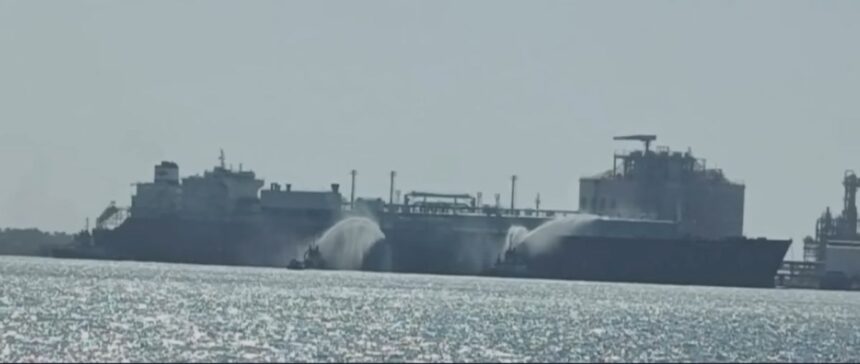
The incident aboard vessels involved in supplying Egypt with natural gas has brought the effects of the regional confrontation to the Mediterranean port of Damietta. Preliminary assessments point to a possible drone attack against civilian energy infrastructure located on the territory of a state seeking to avoid direct involvement in the war between Iran and the United States.
Responsibility for the attack has not been officially established. Iran has not claimed the operation, while Egyptian authorities have not attributed the incident to any state or armed group. However, two anonymous Iranian sources told The New York Times that the explosion had allegedly been caused by a drone and that the operation was intended to demonstrate how severely global shipping and energy supplies could be disrupted if Iran decided to escalate the conflict.
The statements do not represent an official position of the Iranian government and, pending a final determination, do not prove that the attack was ordered or carried out by Tehran. The sources did not specify whether the drone had been launched by Iran, an allied group or another actor, nor did they identify the point from which the operation had been initiated. In the absence of publicly available evidence, the information should be treated as an indirect attribution rather than a claim of responsibility. (Türkiye Today)
Two Vessels Affected in the Port of Damietta
British maritime security company Ambrey preliminarily assessed that a drone had struck the floating storage and regasification unit Energos Winter in the port of Damietta. The fire that broke out aboard the vessel subsequently spread to the GasLog Salem, according to commercial and security sources cited by Reuters.

British maritime risk management firm Vanguard reported that Energos Winter appeared to have been struck on its starboard side by an unidentified projectile. The fire was extinguished, and Egyptian authorities announced that no one had been injured or killed.
Energos Winter is a floating storage and regasification unit for liquefied natural gas, with a capacity of approximately 138,250 cubic metres. The vessel is owned by the US company Energos Infrastructure, while its technical, commercial and safety operations are managed by Wilhelmsen Ship Management, according to Reuters.
Not all sources have unequivocally confirmed the attack hypothesis. A representative of Energos Infrastructure told US media that the operator had not established whether the vessel had in fact been struck by a drone. GasLog representatives likewise stated that the cause of the explosion remained under investigation.
The former head of the Damietta Port Authority, General Ayman Salah, also offered a possible technical explanation, noting that regasification operations take place under high pressure and that a leak can cause a fire. Nevertheless, assessments by Ambrey and security sources indicate that the probable cause was a strike against one of the vessels by at least one drone. The origin of the aircraft and the identity of those responsible have not been made public. (Türkiye Today)
Egypt’s Position: Fire Confirmed, Cause Remains Unspecified
Egypt’s Ministry of Petroleum and Mineral Resources confirmed that a fire had broken out aboard a regasification vessel and a storage vessel in the port of Damietta. The ministry did not mention a drone attack and did not identify the cause of the incident.
According to the official statement, the fire was immediately brought under control in accordance with approved emergency plans, with the participation of firefighting, security and technical response teams. Petroleum Minister Karim Badawi travelled to the port to oversee the operation and assess its impact. The ministry stated that there had been no casualties and that technical teams were continuing to inspect the condition of the facilities and vessels, according to Reuters.
The caution displayed by the authorities in Cairo is significant. A premature attribution could transform a maritime security incident into a direct diplomatic crisis with Iran. At the same time, Egypt cannot afford to downplay the vulnerability of infrastructure that is essential to the country’s natural gas supply.
Only one month before the incident, Karim Badawi had visited the Damietta terminal and Energos Winter itself. In the statement published at the time, Egypt’s Ministry of Petroleum and Mineral Resources described the LNG facilities at Damietta and Idku as among the most important strategic assets of the Egyptian energy sector.
The ministry stated that Energos Winter is one of four floating regasification units used by Egypt to receive LNG imports. The vessel converts liquefied natural gas back into its gaseous state and feeds it into the national grid, contributing directly to the supply of power plants and industry.
What the Iranian Sources Are Saying
The two Iranian sources cited by The New York Times maintained that the operation was intended to demonstrate that international shipping and energy supplies could be disrupted far more severely if Iran decided to intensify the confrontation.
The assertion must nevertheless be treated with caution. It is not accompanied by evidence concerning those responsible, the drone’s flight path, the system used or the chain of command. The sources did not even state explicitly that the operation had been carried out directly by Iran.
More importantly, presenting the incident as a demonstration of force reproduces precisely the message that the Iranian sources appear intent on projecting. Striking an LNG vessel in an Egyptian port does not automatically demonstrate that Tehran can control the scale or consequences of a regional escalation.
Above all, the incident shows how easily a state that is not directly involved in the confrontation can be drawn into the conflict. The fire aboard vessels transporting and processing natural gas exposed their crews, port personnel and nearby infrastructure to serious danger. The absence of casualties does not eliminate the possibility that such an operation could cause a catastrophe at a civilian energy terminal. (Türkiye Today)
Tehran Threatens States Supporting US Operations
Official Iranian statements issued around the time of the incident do not include a claim of responsibility for the Damietta attack. They do, however, point to an expansion of the threats made by the Islamic Revolutionary Guard Corps against states and infrastructure deemed supportive of US operations.
On 26 July, an IRGC spokesperson warned that states supporting the United States’ war against Iran could be treated as legitimate military targets. The message was directed at both Gulf states and Washington’s Western allies.
On 29 July, the IRGC announced that it had launched ballistic missiles against a US base and a CENTCOM command facility in Jordan. The strike was presented as a response to US military action against Iran.
According to IRNA English, the IRGC stated that its operations would continue for as long as threats against the Islamic Republic and hostile actions by US forces against Iranian interests persisted.
On the morning of 30 July, the IRGC issued a further warning. According to a statement published by IRNA English, any state involved in supporting US attacks against Iran risks an Iranian military response.
The same statement claimed that two oil tankers attempting to transit a route deemed unsafe south of the Strait of Hormuz had been affected by explosions and fires. The IRGC also asserted that the strait was under Iranian control and would not be reopened for as long as US interference and threats continued.
None of these statements mentions Damietta or Egypt. They nevertheless outline a narrative in which the distinction between direct military participation, logistical support, economic cooperation and the mere presence of US-owned assets is becoming increasingly blurred.
This ambiguity increases the risk that civilian commercial and energy infrastructure may be treated as an extension of the military confrontation. In Damietta, the fact that Energos Winter is owned by a US company may have turned the vessel into a symbolic target, even though its immediate role was to supply Egypt’s energy system.
Why Damietta May Have Been Chosen
Damietta is one of the principal hubs of Egypt’s infrastructure for importing, storing and processing liquefied natural gas. For a country facing declining domestic production and high energy demand, floating regasification units have become essential to supplying power plants and industry.
Energos Winter was not a military installation but a component of Egypt’s energy system. Its ownership link to a US company may explain the interest of an actor seeking to strike assets associated with the United States, but the direct consequences of the incident are being borne primarily by Egypt.
There are several possible explanations for the choice of such a target. The first is its commercial connection to the United States. The second is the high visibility of an attack against LNG infrastructure at a time of heightened tension in energy markets. The third is the vulnerability of a terminal where a relatively limited strike can generate a disproportionate media and economic impact.
None of these hypotheses can currently be confirmed. There is insufficient public information to determine whether those responsible intended to target US ownership, Egypt’s energy supply, international energy markets or a political response from Washington.
Egypt Between Hormuz, Bab el-Mandeb and the Mediterranean
The incident comes at a time when Egypt is already bearing the consequences of conflicts unfolding around the region’s principal maritime corridors.
In the Strait of Hormuz, the confrontation between Iran and the United States has disrupted energy shipments and increased risks for commercial vessels. In Bab el-Mandeb and the Red Sea, threats and attacks by the Houthi rebels have led numerous shipping operators to avoid the Suez Canal or accept higher security and insurance costs.
Data presented by the Logistics Cluster showed as early as May that traffic through the Suez Canal remained depressed, while shipping companies continued to use the longer route around the Cape of Good Hope. Egyptian ports on the Red Sea were already being affected by the security situation, while Mediterranean ports, including Damietta, were handling additional volumes.
For Egypt, the consequences are twofold. Reduced traffic through the Suez Canal affects state revenues, while disruption in energy markets increases the cost of gas and fuel imports. The Damietta incident adds a direct threat to infrastructure located on Egyptian territory.
Presenting the operation exclusively as a message to the United States therefore overlooks the fact that Egypt is the country most directly affected. Cairo risks bearing the economic and security costs of a war it is attempting to keep at a distance.
The Attack Could Produce the Opposite Effect
If Iranian involvement, or that of an allied group, is established, the incident could produce consequences contrary to those intended by Tehran.
Egypt has maintained diplomatic channels with Iran and has sought to avoid direct involvement in the regional confrontation. A strike against Egyptian infrastructure could reduce Cairo’s political room to maintain such a position and accelerate discussions on protecting energy terminals, strengthening port security and expanding regional cooperation in counter-drone defence.
The incident may lead to additional protective measures around LNG facilities and closer cooperation between Egypt, the United States, Gulf states and European partners in the field of maritime security.
Tehran also risks damaging its relations with Arab states that do not wish to become parties to the war. The threat that any form of support for the United States could turn a state into a target leaves regional governments with increasingly little room for diplomatic balancing.
The Bottom Line
The Damietta incident cannot be presented simply as an Iranian demonstration of force. In the absence of a claim of responsibility and publicly available evidence, responsibility remains unclear.
It is not known where the drone was launched from, what type of aircraft was used, who selected the target or whether the attackers intended to strike Energos Winter, GasLog Salem or the terminal as a whole. It also remains unknown whether the operation was carried out directly by an Iranian structure, an allied group or another actor.
If the involvement of Iran or an affiliated structure is confirmed, the attack would represent a deliberate extension of the confrontation to the civilian energy infrastructure of a state that is not a direct party to the war. The target was not merely an asset owned by a US company, but a facility of considerable importance to Egypt’s energy security.
Statements by the Islamic Revolutionary Guard Corps show that Tehran is prepared to threaten states and assets it regards as supportive of US operations. They do not, however, prove Iranian involvement in the Damietta incident or demonstrate Iran’s ability to control the consequences of such an escalation.
Above all, what happened in the Egyptian port illustrates the danger of a confrontation that is beginning to spill beyond military fronts and affect civilian infrastructure, regional economies and states seeking to remain outside the war.
Latest update
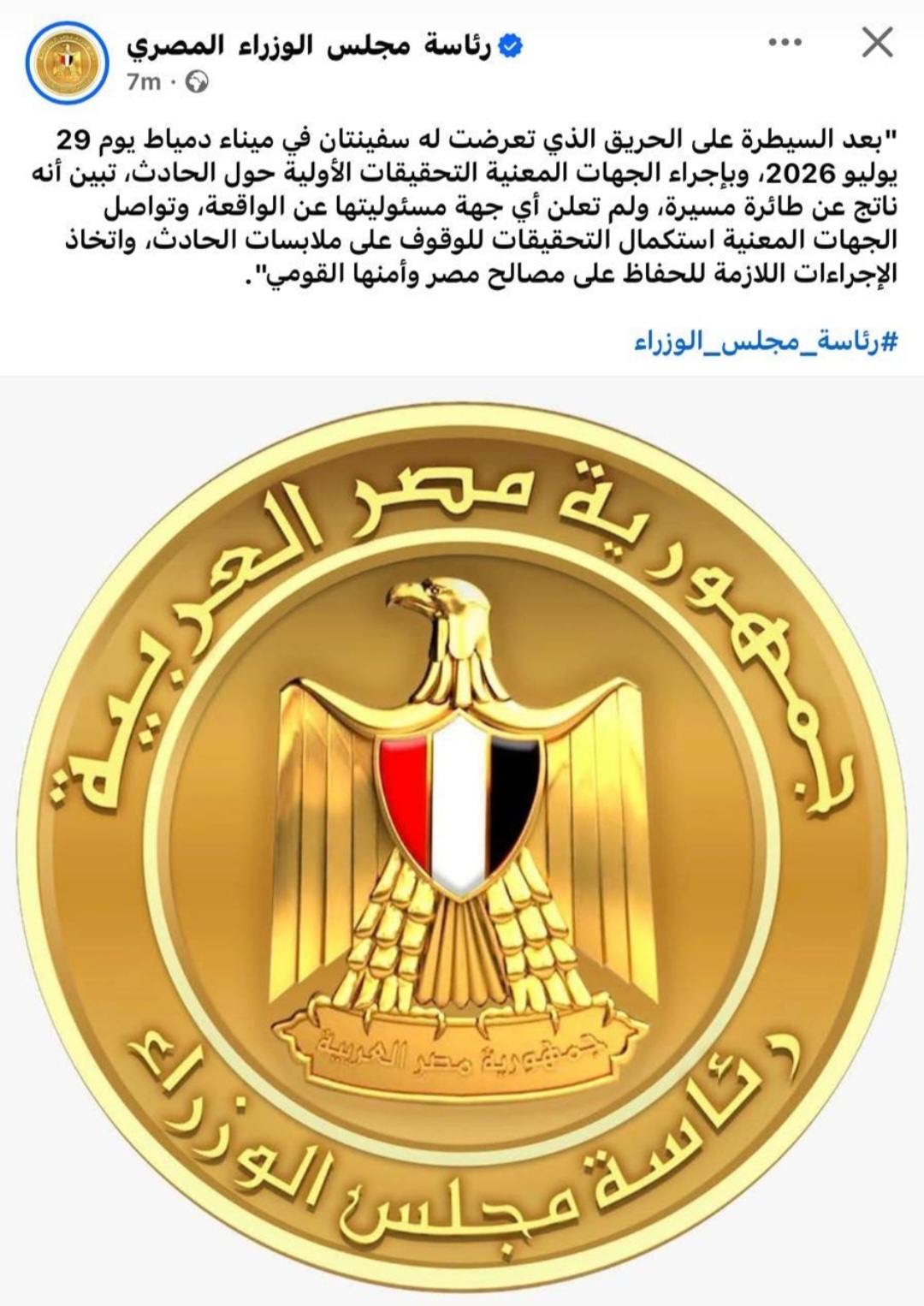
Egypt’s Council of Ministers has confirmed that preliminary investigations found the fire aboard the two vessels in the port of Damietta was caused by a drone.
In an official statement, the Egyptian government said:
“After the fire that affected two vessels in the port of Damietta on 29 July 2026 was brought under control, and following preliminary investigations conducted by the competent authorities into the incident, it was established that it had been caused by a drone. No party has claimed responsibility for the incident. The competent authorities are continuing their investigations to determine the circumstances surrounding the incident and to take the necessary measures to safeguard Egypt’s interests and national security.”
The statement marks a significant change in Cairo’s official position. Egyptian authorities had initially confirmed only the fire and had refrained from identifying its cause. The government has now formally established that a drone was involved, while stopping short of attributing the attack to Iran, an affiliated group or any other actor.
This confirmation strengthens the assessment that the incident was a deliberate attack on civilian energy infrastructure. However, the question of responsibility remains unresolved, and the Egyptian government has stressed that investigations are continuing.