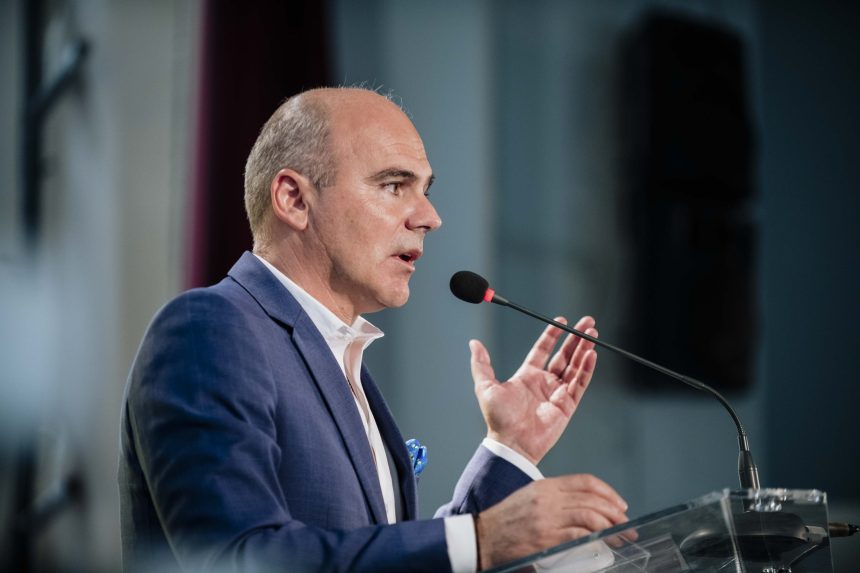
MEP Rareș Bogdan has described the outcome of the regional elections in Saxony-Anhalt as a warning to the European institutions, in an analysis published on his Facebook page. The PNL Member of the European Parliament, who sits with the EPP Group, argues that the vote in the eastern German state is not a local accident but the consequence of an accumulated gap between administrative decision-making in Brussels and economic reality on the ground.
„If the alarm bell does not ring for the eurosystem even now, we risk hearing the funeral bell instead,” the MEP wrote, noting that he had issued a similar warning years ago in the plenary of the European Parliament in Strasbourg: „whoever fails to grasp that the world is changing and no longer accepts paying the bureaucrats’ bill will disappear!”
Alternative for Germany won 43.8% of the vote on Sunday, 6 September, taking 39 of the 83 seats in the Saxony-Anhalt Landtag — the party’s strongest result in any state election. The CDU, the party of Chancellor Friedrich Merz, which had led the state government, fell to 17.2% and 15 seats. The SPD took 9.3%, the Greens 8.9% and Die Linke 8.6%, each with eight seats. The BSW entered the regional parliament with 5.3%, while the FDP failed to clear the threshold. Turnout reached 77.8%, the highest recorded in the state since 1989. The AfD fell three seats short of an absolute majority.
„A Flashlight Pointing Towards the ‘Junk’ Category”
The MEP frames the result in the language of the rating agencies. The election is, in his words, „above all a flashlight pointing towards the ‘junk’ category” — followed immediately by a qualification: „Of course I am exaggerating, but not by much.”
His analysis links the vote to the economic consequences of German reunification in 1990: the collapse of East German industrial competitiveness, forced privatisations, deindustrialisation, and the transformation of the region into what he calls „a market for the West.” Layered on top of these came the rising cost of energy imported from Russia, which Germany had relied upon to fuel its export industry. His conclusion regarding the inequalities that emerged after reunification is unequivocal: „they have not disappeared. They have deepened. And some of them exploded precisely on Sunday.”
„It Is Easy to Call Voters Fools”
Rareș Bogdan rejects explanations that place the blame on the electorate and maintains that the rise of the AfD „is not an accident.” „It is easy to call voters fools, but it is better to ask them where all that frustration comes from,” he wrote, adding that „the eurosystem pretends not to understand why” the party continues to grow.
The MEP also points to contradictions within the AfD leadership, noting that the party’s co-leader, Alice Weidel, „is married to a Sri Lankan woman and lives in Zurich (…) while campaigning for traditional values.” He further notes Russia’s interest in destabilising the European Union, without presenting it as the principal cause of the result.
„How Do You Explain to People That What They See Through the Window Actually Exists?”
The criticism then shifts from Magdeburg to Brussels. The MEP’s thesis is that „between technocratic decision-making and reality on the ground there is a considerable gap,” and that „replicating the German reunification formula on a European scale has not worked.” He points to regulations that run „180 degrees against local custom,” a regulatory pace that continuously amends previous rules, and the promise that the free market would level historical disparities on its own.
For the eastern member states, his formulation is direct: decades of lag are difficult to carry, and the question he puts to the European institutions is: „How do you explain to people that what they see through the window actually exists?”
„For Decades, Europe Played the Fool in a Tailcoat”
A substantial section of the analysis is devoted to the Union’s external economic dependencies: critical raw materials and rare earths, finished components for renewable energy, active pharmaceutical ingredients, digital infrastructure, cloud and artificial intelligence, textiles, consumer electronics and commercial shipbuilding. Against these, the MEP lists Europe’s areas of autonomy — chip lithography, high-purity medicines and vaccines, cruise ships, medical imaging equipment, cosmetics — most of which he describes as expensive.
The solution he proposes has three components: identifying what the Union can produce on its own, partnering with the United States where it cannot, and a general reset of economic policy. The rationale is framed in social terms: „other countries’ trade surpluses mean low wages and unemployment here.”
His assessment of European trade policy towards China is the sharpest passage in the text. „For decades, Europe played the fool in a tailcoat before China. It sacrificed itself on the altar of the rules while Beijing was swallowing entire industries,” the MEP wrote, asking: „So what are we doing — burying our industry for the sake of good manners?” He specifies that he has no quarrel with China, „except in those situations when I do (they help the Russians),” and that Beijing exploits opportunities because „they are well versed.”
„The Saxony-Anhalt Elections Are the Alarm Bell”
The analysis closes with a warning and an alternative. „The Saxony-Anhalt elections are the alarm bell. The break is over!” the MEP writes, arguing that the Union must return to its original purpose — the prosperity of the people who live in it. Failing that, he cautions, „we shall remember the EU fondly as the finest political project of all time, ruined by bureaucrats who were never particularly fond of books. History books above all.”
Political Context
The analysis comes from an MEP belonging to the EPP — the political family of the CDU, the party that lost nearly 20 percentage points in Sunday’s vote, and the majority group in the European Parliament.
In Saxony-Anhalt, the AfD holds no majority and has no declared coalition partner. Its candidate for minister-president, Ulrich Siegmund, stated that the party has a mandate to govern and ruled out the option of a minority government. The BSW’s lead candidate, Claudia Wittig, has signalled openness to cooperation, while the CDU has ruled out any alliance with the AfD.
The result does not alter the balance in the Bundesrat, where the state holds four of the 69 votes, but it increases pressure on the federal coalition led by Friedrich Merz. The next regional elections, in Berlin and Mecklenburg-Western Pomerania, are scheduled to take place in two weeks.
The full text of the post:
What Brussels risks: replicating the political lesson of Saxony-Anhalt across the entire European system. I said it several years ago, in the plenary of the European Parliament in Strasbourg: whoever fails to understand that the world is changing, and that people are no longer willing to foot the bill for bureaucrats, will disappear! If even now the alarm bell does not ring for the European system, we risk hearing the funeral bell instead. Sunday’s election result carries major symbolism not only for Germany, with Saxony-Anhalt being the cradle of the Protestant Reformation and the homeland of some of its earliest emperors. More importantly, it is a warning light pointing towards “junk” territory. Of course I am exaggerating, but not by much. Let me give you a few names, facts and symbols. Saxony-Anhalt is associated with Martin Luther, Bismarck, Otto the Great, Catherine the Great and Hans-Dietrich Genscher, the diplomatic architect of German reunification in 1990. And Nietzsche. And others. All these thinkers had visions of their own. Luther sought theological purity, but the confessional fracture devastated the German principalities. Nietzsche’s work was distorted to serve propaganda, even though he despised German nationalism and Bismarck’s Reich. Bismarck, in turn, unified the country through “blood and iron” and devised systems of control for the masses. Genscher argued that reunification could not be achieved without concessions, such as sacrificing the Deutsche Mark. But the inequalities created by reunification did not disappear. They deepened. And some of them erupted politically precisely on Sunday. Pay attention, and you will see how much those circumstances resemble the present!
1990: the competitiveness of East German industry collapsed, there were forced privatisations, deindustrialisation and a transformation of the region into a market for the West. The region remained dependent on subsidies, wages and pensions were low, and the middle class was struggling. Then came the next stage: cheap Russian energy, on which Germany had relied both to underpin peace and to fuel its export machine, became expensive. Saxony-Anhalt remained poor. Unemployed, dependent, and counting every euro.
It was easy to exploit all this politically, especially because there was hardly any need to invent anything. Even more so when riding the German “Vespa”, the Simson, particularly the Schwalbe model — the “Swallow” — so beloved in the former GDR and used symbolically during the electoral campaign. A pension of €1,750 in Saxony-Anhalt, compared with €1,850 in the rest of Germany, or an average salary of €2,750, again around €100 lower than in the other Länder, could not, however, explain such a result on their own. What we saw, therefore, was frustration accumulated over time, to which Alice Weidel and Ulrich Siegmund added emotional themes related to religion, the traditional family and Ukraine. But not even these were decisive. Alice is married to a Sri Lankan woman and lives in Zurich — where Lenin also lived before embarking on his mission — while campaigning for traditional values. It is easy to dismiss voters as fools, but it would be better to ask where so much frustration comes from. Because that frustration is unmistakably there! Especially since the AfD movement — or ideology — is not an accident. It is growing, and I have the impression that the European system is pretending not to understand why. Of course, Russia has every interest in sabotaging the EU, whose sanctions have, to a large extent, damaged its economy — an economy first damaged by Putin himself, who chose war to feed his own hubris.
But in my view, this is also a lesson for Brussels: there is a major gap between technocratic decision-making and reality on the ground. Replicating the model of German reunification on a European scale has not worked. Monetary integration — though this does not apply to everyone — regulations that run at 180 degrees to local habits and realities, rapidly introduced rules that constantly amend those that came before them, plus the supposed saving grace, the mirage: the promise that the free market would level out historical disparities. The gap remains enormous. For us Romanians, decades of disparity are difficult to endure. How do you explain to people that what they can see through their own window really does exist?
The EU is massively dependent on China — 98% — for critical raw materials and rare earths; again on China — more than 90% — for finished components used in green-energy technologies; again on China — 60–80% — for active pharmaceutical ingredients; and on the United States — 80% — for digital infrastructure, cloud services and AI. More than 80% of clothing comes from Asia, more than 90% of high-volume commercial ships come from China and South Korea, there is 100% dependence on Asia for mass-market consumer electronics, and 90% of the magnets used in electric vehicles and turbines come from China. Coal, crude oil, natural gas, plastics, polymers.
Yes, we do retain autonomy in certain areas: we produce food — enough of it, but at high cost, which is why cheaper products come in from elsewhere, from countries that do not operate under the same environmental standards. Semiconductor lithography, high-purity medicines and vaccines — expensive; cruise ships — expensive; medical-imaging equipment — expensive examinations; cosmetics, perfumes, cardboard packaging.
What the Union needs to do is determine what it can produce on its own, for the benefit of its citizens. Where it cannot, it should work closely with the United States. It needs to reset everything. It must play its cards ruthlessly, because other countries’ trade surpluses mean lower wages and unemployment here.
I have nothing against the Chinese, except in those situations where I do — when they help the Russians. They exploit opportunities because they are highly competent and know their subject. In dealing with China, Europe has spent decades playing the fool in a dinner jacket. It sacrificed itself on the altar of rules while Beijing swallowed entire industries. So what are we doing — burying our own industry for the sake of good manners?
The elections in Saxony-Anhalt are the warning bell. The break is over! A united Europe must return to its original purpose: the prosperity of the people who live here. Otherwise, we will one day remember the EU fondly as the finest political project of all time, ruined by bureaucrats who were never particularly fond of books. Especially history books.