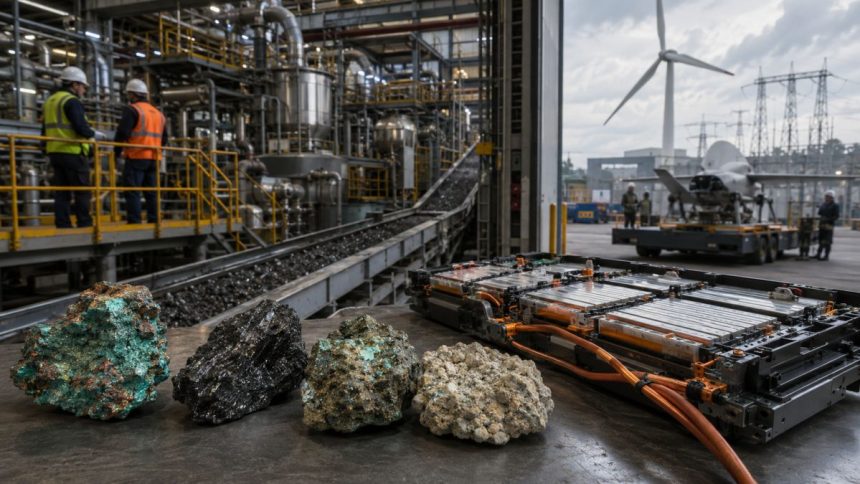
Critical minerals have become, in only a few years, one of the most sensitive fault lines in the global competition for power. The phone in one’s pocket, the electric car in the parking lot, the drone on the battlefield, the satellite in orbit and the data centre powering artificial intelligence all depend on the same materials, extracted, refined and processed in a limited number of countries. At the Évian summit, G7 leaders formally acknowledged this vulnerability and sought to turn it from an industrial issue into a matter of economic and collective security. The West’s problem is not that it misunderstood the stakes. Its problem is that it understood them late, after spending decades building a dependency it cannot dismantle overnight.
When we speak about critical minerals, we are not speaking about precious stones or an obscure technical subject reserved for the mining industry. We are speaking about the hidden infrastructure of modern power.
What are critical minerals and why do they matter
Critical minerals are materials considered essential for the economy, industry, technology, security and the energy transition, but vulnerable to supply disruptions. This category includes minerals, metals and raw materials deemed critical because of their economic role and their supply risk. The vulnerability does not necessarily stem from their geological rarity, but from how difficult they are to extract, refine, process, substitute or source from alternative suppliers.
The list is more familiar than it may seem. Lithium, cobalt, nickel and graphite are part of the battery chain that supports electric mobility and energy storage. Rare earths are used in permanent magnets, wind turbines, electric vehicles, hard drives, medical equipment and military systems. Copper is the backbone of electrification, power grids and energy infrastructure, while gallium, boron, titanium and tungsten are essential for solar technologies, wind solutions, semiconductors, space and defence.

This map of dependencies is confirmed by the European Commission, through the European Critical Raw Materials Act, which treats critical raw materials as indispensable resources for the green transition, the digital economy, the defence industry and technological autonomy. The underlying message is simple: without these materials, there can be no digital economy, no energy transition, no modern military industry and no real industrial sovereignty.
Processing chains, the real stake of critical minerals
This is where the real geopolitical stake lies, and it is often misunderstood. The decisive question is not who holds the deposits, but who can turn raw material into refined materials, industrial components and final products.
The IEA — Rare Earth Elements report shows that, in the case of magnetic rare earths, China accounted in 2024 for approximately 60% of global mined production, 91% of refined production and 94% of sintered permanent magnet production. The gap between these figures says everything: concentration is far higher in refining and magnet production than in extraction.
This is the distinction between the mere possession of a resource and real industrial power. A state does not need to control all the world’s mines in order to control the industrial game. It is enough to control the links without which raw ore does not become technology. Data from the IEA — Global Critical Minerals Outlook 2025 reinforces this picture: demand for lithium rose by almost 30% in 2024, while demand for nickel, cobalt, graphite and rare earths increased by 6–8%, driven mainly by electric vehicles, battery storage, renewables and power grids. As demand rises, the leverage of whoever controls processing becomes increasingly powerful.
The G7 is trying to reduce dependencies, but time is working against the West
At Évian, the G7 moved from diagnosis to action. The official G7 Évian 2026 / Élysée declaration recognises the strategic role of critical minerals value chains for the economic prosperity and security of member states, including for the digital and energy sectors. The G7 aims to reduce dependency on a single supplier outside the group for rare earths and permanent magnets to below 60% by 2030, with the ambition of moving towards 50% as quickly as possible.
According to Reuters, the measure is aimed at reducing external dependencies and includes an alliance for critical minerals resilience, a crisis platform, stockpiling mechanisms, traceability, recycling and early warning through the IEA, with a pilot focused on lithium and nickel that is to be expanded annually to additional minerals. This is not a simple economic declaration, but an attempt to turn critical minerals into a matter of collective security.
This is where Atlas News’ analysis comes in. The G7’s fundamental problem is not political will, but time. Mines do not open quickly. Refineries do not appear overnight. Separation capacities and magnet production require capital, permits, technology and social acceptance. If it took the West decades to externalise its vulnerability, it cannot fully correct it in a matter of years. The targets set at Évian are correct in direction, but fragile in execution.
Europe wants strategic autonomy, but imports vulnerability
The European Union has legislation, targets and a well-articulated strategic language. Through the European Critical Raw Materials Act, Brussels has set three benchmarks for 2030: 10% of the EU’s annual needs to come from domestic extraction, 40% of processing to take place within the Union and 25% of consumption to be covered through recycling. In addition, no more than 65% of the EU’s annual requirement for each strategic raw material, at any relevant stage of processing, should come from a single third country.
The direction is correct. The open question is whether Europe can turn these objectives into real industrial capacity, within the available timeframe and with the necessary political discipline. Europe has spoken for years about strategic autonomy, but has continued to depend on external chains for essential materials. In a world defined by great-power competition, dependence on processing becomes a security vulnerability. Europe cannot have digital sovereignty, modern defence and an energy transition if it imports the very material vulnerability on which all these ambitions rest.
Critical minerals are changing the relationship between the West and the Global South
The competition is not limited to the rivalry between major industrial powers. Resource-rich countries no longer want to be mere suppliers of raw materials. Africa, Latin America and Asia are entering a new negotiation with the major industrial consumers.
UNCTAD analysis shows that critical minerals have become a matter of trade, investment and industrial policy, not merely a story about raw materials, and that the essential issue is not only rising demand, but where supply is located, who controls processing and where economic value is captured. For many producer states, the stake is no longer the export of ore, but local processing, jobs, infrastructure and industrial partnerships. This dynamic is reshaping the relationship between major consumers and producer states, turning every supply contract into a strategic negotiation.
Critical minerals are not only resources, but instruments of strategic negotiation
The narrative is not one-sided. In response to the G7 declaration, China officially stated that its export control system is consistent with international practice and criticised the logic of rules set by a “small group”. According to Reuters and the position expressed by the Ministry of Foreign Affairs of the People’s Republic of China, Beijing maintains that its measures are consistent with international practice and rejects the G7’s interpretation of the risks generated by export controls.
This position requires a necessary clarification, as an honest counterargument. No actor controls all the world’s critical minerals. Dominant positions are often concentrated in processing, refining and certain industrial links, while extraction remains globally distributed: cobalt depends heavily on the Democratic Republic of Congo, lithium on Australia, Chile and other producers, and nickel has a major centre of gravity in Indonesia. Likewise, the phrase “the new oil” must be used metaphorically, not absolutely. Oil remains central to transport, petrochemicals and energy security. Critical minerals do not replace it, but add a new map of power on top of the existing one. And although export restrictions function as instruments of strategic pressure, they cannot be described, without qualification, as an illegal weapon.
The new geopolitics is read in factories, batteries and refineries
Reactions are multiplying beyond Évian. Reuters reports that the United States has signed a conditional loan commitment of $725 million with Energy Fuels to stimulate domestic processing of rare earths, a sign that Washington is seeking to build alternative chains through direct financing and its own processing capacities.
Critical minerals show that modern power no longer lies only in territories, military bases and oil pipelines. It also lies in refineries, magnet factories, recycling capacities, industrial standards and strategic stockpiles. Oil remains important, but it is no longer the only map of global power. In the twenty-first century, the strategic map is also read in lithium, cobalt, graphite, copper and rare earths.
The verdict is sober, but clear. The G7 has understood the vulnerability. The states that control processing have understood the leverage. Europe is only now trying to recover lost time. And recycling, however useful, cannot by itself compensate for demand that is growing faster than current recovery capacity. The competition for critical minerals is not a passing crisis, but a structural feature of the economic order now taking shape.
Read also
G7 Évian: The Summit of Accelerated Diplomacy Where Every Leader Raced for His Moment