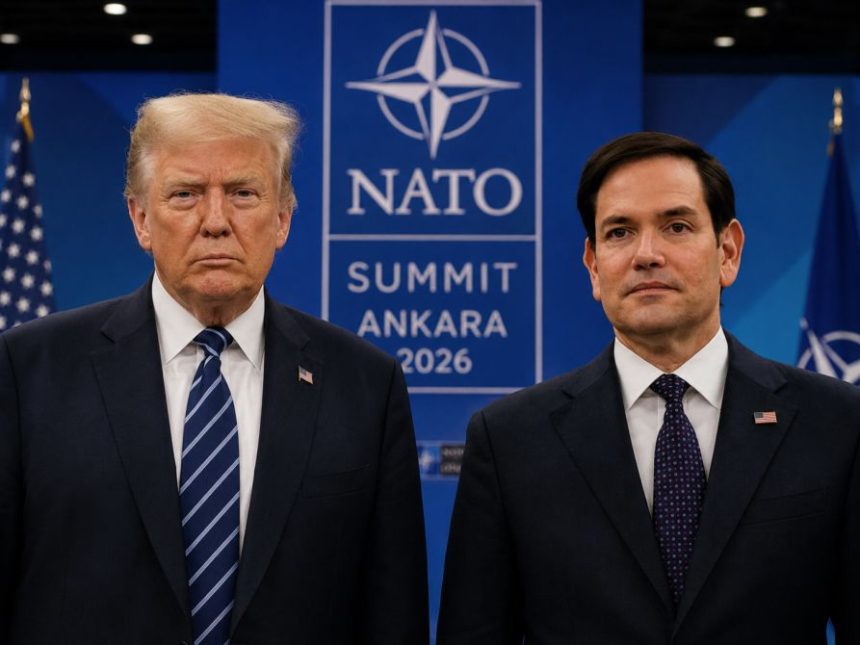
Marco Rubio is, in the equation of the NATO summit in Ankara on 7–8 July 2026, the figure through whom one reads the most profound recalibration of the relationship between the United States and the Alliance in the past three decades. This is not rhetorical exaggeration, but a description of the mechanism. While Donald Trump supplies the raw political pressure — the threat of withdrawal, the „paper tiger” label, the open displeasure with European allies — the Secretary of State is the one who converts that pressure into operational doctrine. In Ankara, America is not coming to negotiate with NATO on the old terms. It is coming to reorganize the Alliance according to a new, transactional logic, in which each ally is judged by what it delivers, not by what it declares. Rubio is the architect who translates this logic into institutional architecture.
The Ankara summit functions, from this perspective, as a proving ground for a single principle applied to three different cases: Spain is reproached because it refused, Turkey is rewarded because it delivered, and Romania finds itself, through its concrete contribution, on the favorable side of the same line. To read these three cases correctly together is to understand the new grammar of power within the Alliance — and to observe that the windows of opportunity it opens close physically once this summit ends.
The recalibration is not a quarrel. It is a restructuring.
The most widespread misreading is to treat the transatlantic tensions of 2026 as a circumstantial dispute, tied to Donald Trump’s personality and destined to fade with an electoral cycle. The facts indicate otherwise. Marco Rubio stated explicitly, at the NATO foreign ministers’ meeting in Sweden at the end of May, that there would „eventually be less US troops in Europe than there have historically been.” This statement is not a threat, but the announcement of a policy. It rests on a shift in the Pentagon’s planning priorities toward the Indo-Pacific — a theater in which submarines, long-range bombers, and carrier strike groups are the currencies that count, not brigades stationed in Europe.
The recalibration already has concrete contours. Washington has announced a review of US forces in Europe, has symbolically withdrawn 5,000 troops from Germany while redirecting 5,000 to Poland, and has carried out reductions in strategic equipment — combat aircraft, refueling capabilities — that specialist analyses estimate would require hundreds of European aircraft to offset. The only real brake comes not from the allies, but from within the American system itself: the 2026 defense authorization legislation bars the Pentagon from dropping below 76,000 troops in Europe without notifying Congress. The recalibration is therefore governed by an internal American tension between the executive and the legislature — a detail that European decision-makers ignore at their own risk.

The difference between Trump and Rubio is, in this context, the difference between threat and administration. A president who calls NATO a fiction delivers a shock that can be treated as rhetoric. A Secretary of State who articulates a syllogism — the Alliance is useful to America because it provides bases for power projection; allies who deny those bases in a crisis nullify the Alliance’s rationale — builds a framework that enters the institutional logic of the State Department and of military planning. When Rubio pinned Spain to the wall over its refusal of access to bases and airspace during the operation against Iran, he was not improvising a quarrel. He was inaugurating a criterion.
The host’s advantage: how Turkey capitalizes on its role as organizer
No ally has understood better than Turkey that a summit hosted on its own soil is leverage, not merely an honor. With NATO’s second-largest army after the United States and a defense industry that has become a supplier to half the continent, Ankara has turned its status as host into an instrument of negotiation, and the results are already visible before the summit begins.
The fact is this: days before the gathering, the Trump administration notified Congress of the sale of more than 80 General Electric F110 engines, valued at over 700 million dollars, intended for the fifth-generation KAAN aircraft developed by the Turkish aerospace industry. Moreover, asked whether he was traveling to Ankara with a „gift,” Trump openly signaled a possible unlocking of Turkey’s return to the F-35 program, from which it had been excluded in 2019 after acquiring the Russian S-400 system. The administration chose to advance the engine package despite a formal hold from the Democrats on the House Foreign Affairs Committee.
The official American position presents the gesture as an act of allied solidarity and of keeping Turkey within the Western military ecosystem. The coincidence of timing and motivation cannot be ignored: Trump explicitly praised Turkey precisely for not supporting Iran during the February war — the very dossier for which Spain has been criticized. The Turkish reward and the Spanish sanction are thus two faces of the same coin. The concession granted to Ankara is not only a bilateral normalization; it is also a message sent to the European allies who refused Trump during the Iranian crisis: cooperation pays, refusal costs. Turkey collects the dividend of reliability at the very moment Spain pays the price of hesitation.
The Black Sea vector: why Romania’s road to Washington runs through Ankara
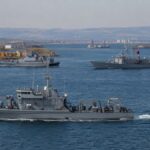
Here lies the strategic connection that this analysis advances as a distinct thesis: for Romania, Turkey is not merely a model to follow, but a vector to use. And the instrument need not be invented, because it already works. Since July 2024, Turkey, Romania, and Bulgaria have operated the trilateral naval group MCM Black Sea, dedicated to neutralizing mines drifting in the wake of the war in Ukraine, with command rotating among the three navies. The group’s tenth activation took place in June 2026, under Turkish command, with the participation of the Romanian vessel ROS Sub-locotenent Ion Ghiculescu, and Romania has already held the chairmanship of the format.
What matters is that Turkey’s ambassador in Bucharest, Özgür Kıvanç Altan, confirmed to Atlas News that this framework is set to be expanded at the Ankara summit itself. „And now we are hoping that maybe at the NATO summit, our Defense Ministers, Türkiye, Romania and Bulgaria, can sign a new agreement to extend the scope of this MCM Black to critical energy infrastructure protection, because this is a common area,” the ambassador said. In other words, the concrete request that this analysis recommends to Romania is not a hypothesis, but a document already on the summit table, validated by the Turkish side.
Ambassador Altan also articulated the underlying logic of Romania’s integration into the Eastern Flank’s security architecture through its partnership with Turkey. „When you talk about eastern flank it is not immediately Türkiye that comes to mind, but I think we are a natural part of this,” he said, describing the Eastern Flank as a continuous line running from the Baltic Sea, through Poland, Slovakia, Romania, and Bulgaria, to the Turkish Straits. In the same vein, the ambassador highlighted a trilateral consultation mechanism among Turkey, Romania, and Poland, hosted this year by the Romanian side, and the readiness of the Turkish defense industry to produce jointly with Romania — from the TB2 drones already delivered to the Otokar vehicles manufactured in Mediaș and the corvette delivered to the Romanian navy.
On this industrial readiness, the ambassador was explicit. „So we are really flexible, and when it comes to our defense industry, Türkiye is ready and the Turkish companies are ready to share know-how, share critical technology, produce together and produce there” — an offer that Altan contrasted directly with the practice of other suppliers, noting that, in their case, such cooperation „usually comes with a catch.”
The strategic significance is the following: Romania already possesses a functioning framework of naval and industrial cooperation with NATO’s most powerful military force in the region, led by an ally that has just demonstrated its capacity to negotiate its own advantages in Washington. A Romania that aligns with Turkey on Black Sea security no longer asks in isolation, but enters a regional bloc with weight, at precisely the moment when the United States is seeking reliable local pillars on the Eastern Flank. Turkey controls the Straits through the Montreux Convention and holds the largest fleet in the Black Sea; Romania controls the most important point of projection of American power in the northern part of the basin, through the Mihail Kogălniceanu base. The two capabilities are complementary, not competing.
Fact, official position, Atlas News analysis
For clarity, we separate the planes. The fact: the United States is reducing its military presence in Europe, approving before the summit a package of more than 700 million dollars for Turkey, while the trilateral naval group MCM Black Sea has been operating since 2024, with its tenth activation in June 2026. The official position: the American recalibration is justified by the pivot to the Indo-Pacific and by burden-sharing; the Turkish side announces its intention to extend the trilateral naval cooperation to the protection of critical energy infrastructure at the summit itself. Atlas News analysis: Ankara institutes a mechanism for ranking allies according to the reliability they have demonstrated in crisis, and Romania possesses, through its concrete contribution and its partnership with Turkey, a favorable starting position — one it can capitalize on only within the time window of the summit.
Romania’s window: rare, real, and time-limited
Here lies the national stake, and it must be framed without triumphalism, yet without false modesty. The line that Marco Rubio draws between the allies who delivered and those who refused divides NATO into a hierarchy of reliability. Romania finds itself, in this hierarchy, on the favorable side — and not by chance. It approved the use of the Mihail Kogălniceanu and Câmpia Turzii bases in the very logic that Washington now rewards, contributes forces to the battle group in Poland, and operates, alongside Turkey, within the naval arrangement in the Black Sea.
The essence of this analysis is, however, temporal, and it must be stated plainly. In international diplomacy, the windows of opportunity in which a state secures a strong negotiating position are extremely rare, and their defining characteristic is that they do not stay open. They close the moment the event that created them concludes. On 9 July 2026, when the delegations depart Ankara, the moment of maximum leverage vanishes. What is not claimed within the summit’s 48 hours becomes a mere footnote in a communiqué. Romania’s standing as a trusted ally is not a possession acquired once and for all, but a position in a ranking that is rewritten with every crisis — and Poland is competing for the same role of reliable Eastern European pillar, with a larger defense budget and greater political weight.
The Turkish example offers Romania the complete playbook. Turkey did not wait for recognition; it asked for engines, F-35s, sanctions relief, and tied them to its demonstrated strategic value, capitalizing on the very moment in which it was hosting the summit. Romania should enter Ankara with a concrete and bold request, not a diffuse expectation: the signing of the MCM Black Sea expansion agreement already announced by the Turkish side, the consolidation of the American presence at Mihail Kogălniceanu, and access to the Alliance’s defense-industrial programs. The boldness of the request is not, here, a risk, but the condition of capitalizing on the moment; in the logic that Rubio is installing, the ally who does not ask excludes itself from the distribution of advantages.
An analysis that cannot be wrong does not deserve trust. The central thesis — that Ankara consecrates a structural recalibration, not a passing crisis — can be disproved if the summit produces an unconditional reaffirmation of the American commitment and a suspension of the troop-reduction plans. The thesis regarding Turkey’s advantage can be qualified if the engine package proves to be a technical normalization unrelated to the punitive logic toward European allies, although Trump’s statements about Iran make that reading unlikely.
The limit of knowledge must be assumed explicitly. This analysis rests on public statements and on the decision-making pattern of February–June 2026, not on access to the internal deliberation of the American administration or to the content of the Trump–Erdoğan bilateral, which at the time of writing had not yet taken place. The conclusions regarding Romania’s window are a strategic assessment, not a guarantee; they indicate an opportunity and a deadline, not an outcome.
What the decision-makers in Bucharest should do differently
The operational conclusion is that the Ankara summit should not be read in Bucharest as a transatlantic turbulence from which it is more prudent to keep one’s distance, but as a short and unrepeatable interval of evaluation in which demonstrated contribution is the currency that counts. The question Rubio poses rhetorically about Spain — what does America gain from this alliance — admits, in Romania’s case, a clear and demonstrable answer. The difference is made by who articulates it in time and who is content merely to leave it understood.
The positioning recommendation is therefore threefold, and it has a deadline. First, Romania should enter Ankara with a concrete request, framed as an asset for the American interest, not as loyalty deserving reward. Second, it should use the Turkish vector — the existing naval cooperation in the Black Sea, with the expansion agreement — to amplify its voice within a regional bloc, rather than negotiating alone. And third, it should do all of this within the summit’s 48 hours, because the window does not reopen on request. Turkey has shown how such a position is played. Spain has shown what it costs to squander it. Romania has, now and for a short time, the possibility of choosing which of the two examples it wishes to resemble.
Read also