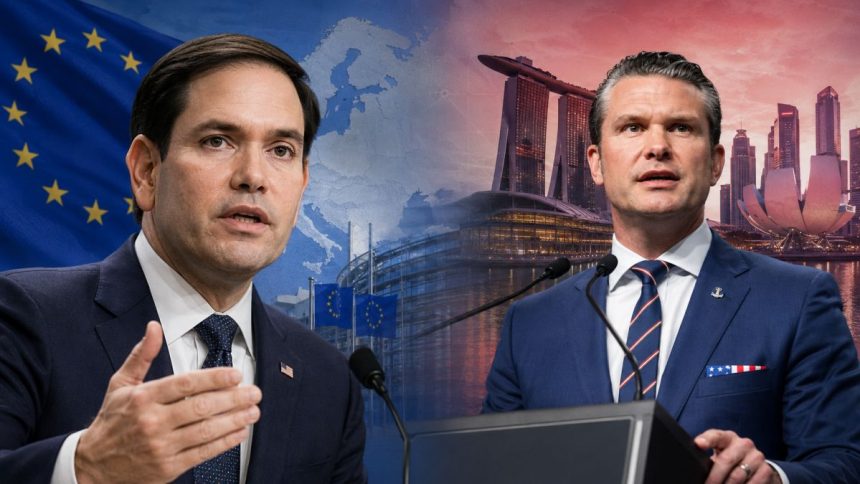
American pressure on NATO marks the deepest recalibration of the transatlantic relationship since the end of the Cold War. The real issue is not the withdrawal of some American troops from Europe, but the political message that accompanies it: Washington is signalling that Europe can no longer consume American security as a guaranteed good, without proportional political, budgetary and industrial costs. The statements made by U.S. Secretary of Defense Pete Hegseth at the Shangri-La Dialogue in Singapore, together with the warnings issued by Secretary of State Marco Rubio, outline a strategic transformation arriving at a critical moment: Europe is going through its most unstable internal political cycle in the past three decades.
For Romania, a Black Sea frontline state, the question is not whether America is reducing its European commitment, but whether Bucharest is positioning itself quickly enough as an indispensable ally in a tougher, more selective NATO, increasingly oriented toward real contributions.
What Pete Hegseth actually said
The Singapore speech was one of the most direct criticisms in recent years by a senior American official of Europe’s security behaviour. According to the official transcript of the speech published by the U.S. Department of Defense, Hegseth explicitly defined a new American doctrine, which he called “flexible and practical realism.”
“The era of the United States subsidizing the defense of wealthy nations is over. We need partners, not protectorates. We seek alliances built on shared responsibility, not dependence,” Hegseth said. He described this shift as “the maturation of our alliances into a new era” and added that it is “not a matter of choice, but of strategic prudence.”

The U.S. Secretary directly targeted European behaviour. Praising the pragmatism of Asian allies, who understand that “the foundation of a lasting partnership is not based on idealistic values, but on the concrete alignment of national interests,” Hegseth added sharply: “I think Western Europe could take note.” He accused European capitals of having “opened their borders wide and emptied their armies” while Washington allowed itself to be “distracted by empty globalist rhetoric about the rules-based international order.”
The core message was summarized in an unequivocal formula: “You don’t have a strong alliance if not everyone has skin in the game. No free-riding.” And, most relevant for the coming months, Hegseth issued a warning with the weight of an announcement: “Europe and NATO have some big decisions to make, and we will return to this soon.”
What is actually happening on the ground
The statements made in Singapore are not isolated rhetoric. They come against the backdrop of concrete Pentagon moves, documented through official statements by spokesperson Sean Parnell.
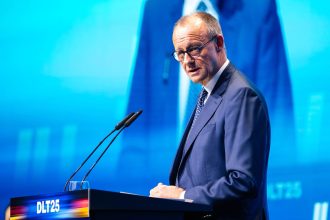
In May, the United States announced the withdrawal of around 5,000 troops from Germany. According to the Pentagon statement cited by PBS NewsHour / Associated Press, the decision “follows a comprehensive review of the Department’s force posture in Europe” and is expected to be completed over the next six to twelve months. The move fulfilled a threat made by President Trump after German Chancellor Friedrich Merz said that the United States was being “humiliated” by Iran’s leadership.
The withdrawal would leave more than 30,000 U.S. troops in Germany, reversing the reinforcement that began after Russia’s 2022 invasion, according to NPR. And the move does not appear to be the endpoint: reports cited by PBS NewsHour show that Trump has indicated the possibility of additional withdrawals, including from Italy and Spain.
The signals remain contradictory, however. After announcing the reductions, Trump abruptly changed course, announcing the deployment of additional troops to Poland — an ambiguity noted by NPR, which fuels allied anxiety over the predictability of American guarantees.
The road to Ankara: what Rubio said
The concrete mechanism of change was articulated by Secretary of State Marco Rubio at the NATO foreign ministers’ meeting in Helsingborg on May 22. In remarks reported by Military Times, Rubio sent the clearest signal so far.
“It is well understood within the alliance that the presence of American troops in Europe will be adjusted,” Rubio said, stressing that the process is already underway. “I’m not saying they’ll be thrilled about it, but they’re certainly aware of it.” The American argument was that the United States has global commitments in the Indo-Pacific, the Middle East and the Western Hemisphere, which requires a constant reassessment of its force posture.
Behind closed doors, the technical mechanism of the shift is already being developed. According to Radio Free Europe / Radio Liberty, NATO officials have confirmed discussions regarding the U.S. contribution to the alliance’s “Force Model” — the structure that determines which troops are available for rapid deployment in the event of a crisis. Neither Rubio nor Secretary General Mark Rutte provided details, describing the discussions as “strictly classified.”
These signals converge toward the NATO summit in Ankara, scheduled for July 7–8, 2026, officially set to take place at the Beștepe Presidential Complex (NATO). Atlas News assesses that Ankara has all the characteristics of a moment in which rhetorical pressure may turn into institutional architecture — not through a spectacular withdrawal announcement, but through the codification of the principle that Europe’s conventional defence becomes a European responsibility, under an American strategic umbrella. Prudence, however, requires a limit: both Rubio and Rutte described the adjustment as “technical, military work,” and Rutte does not expect further withdrawals beyond those already announced. Ankara is more likely to consolidate a direction than to produce a rupture.
The real reasons behind American pressure
America’s strategic priority is shifting toward China and the Indo-Pacific, which Hegseth called “the most important region in the world.” The new 2026 National Defense Strategy states that Washington will prioritize the defence of U.S. territory and the deterrence of China, while European allies must assume primary responsibility for the conventional defence of Europe. The United States no longer wants to be the principal provider of conventional security for a continent which, economically and demographically, has greater resources than Russia.
Secondly, NATO is becoming a conditional contract. Article 5 formally remains in place, but the political value of the American guarantee is becoming increasingly dependent on allied behaviour. The “tripwire” logic — American troops stationed as an automatic guarantee — is giving way to a transactional logic, in which military presence is directly tied to European positions on trade and security. Hegseth was explicit about this hierarchy: the states “most capable, clear-eyed and prepared to defend their national interests” will be moved “to the front of the line,” with accelerated arms sales, deeper industrial cooperation and expanded intelligence sharing.
Thirdly, the pressure is aimed at moving from promises to capabilities. At the 2025 NATO summit in The Hague, allies accepted a commitment to spend 5% of GDP on defence and related expenditure by 2035, according to the official final declaration (NATO): at least 3.5% for core military requirements and up to 1.5% for critical infrastructure, resilience, innovation and the defence industry. From the American perspective, the problem is no longer the declaration itself, but the pace — the rapid conversion of money into ammunition, air defence, drones, logistics and sustained industrial production.
A changing political Europe: American pressure and the contested establishment
The transatlantic recalibration is not taking place in a vacuum. It coincides with a moment of maximum internal political pressure in Europe’s largest democracies. This is precisely where the hidden stake lies: Washington is negotiating today with a Europe whose leaders may no longer be in power when the strategic bills come due.
In France, the Odoxa-Mascaret poll for Public Sénat, reported by Breitbart, places Jordan Bardella, leader of Rassemblement National, in first position in the 2027 presidential race, with 32% in the first round — almost twice as much as former prime minister Édouard Philippe, credited with 17%. Marine Le Pen, who has been sentenced to a ban on running for office, is awaiting the appellate court’s decision on July 7, 2026, while Bardella is regarded as her natural replacement.
In Germany, polls cited by Reuters place the AfD as much as 7 percentage points ahead of Merz’s conservatives, while the party’s candidate in Saxony-Anhalt, Ulrich Siegmund, is projected to become the first AfD state premier in the September regional elections. Merz has publicly ruled out early elections, warning that he will not leave the country to “radical forces.” The EU’s main net contributor is going through maximum instability precisely when Europe must make generation-defining strategic decisions.
At the level of the European Commission, political authority is eroding. The second von der Leyen Commission has survived several motions of no confidence, but with an increasingly fragile majority. On the motion concerning the EU–Mercosur agreement, reported by Euronews, the ECR group split, with Polish, French and Romanian MEPs voting to dismiss the Commission, while Italian, Belgian and Czech MEPs defended it.
This is where a level of analysis that Atlas News considers central comes into play. American pressure on NATO should not be read only in military terms, but also as indirect pressure on the current European establishment. Washington is not formally challenging European leaders and is not explicitly calling for their replacement. But the message being sent produces a clear political effect: it exposes the inability of Europe’s current governing class to build credible defence after three decades of strategic dependence on the United States.
In other words, Washington is not telling European citizens whom to vote for, but it is showing them the strategic cost of the political model that has governed Europe after the Cold War: military dependence on the United States, an insufficient defence industry, limited ammunition stocks, incomplete military mobility and the inability to turn geopolitical ambition into real military capability. When Hegseth says that Europe has “emptied its armies,” he is, willingly or not, providing rhetorical ammunition to the parties challenging precisely the liberal-Atlanticist consensus of recent decades — exactly at the moment when the leaders being targeted are already contested domestically.
This observation should not be turned into a conspiracy theory. There is no evidence that Washington is deliberately preparing to replace European leaders or interfere in elections. What can be stated prudently is something else: American pressure may prepare the political ground for a different conversation between Washington and future European governments. If the electoral wave confirms current trends, tomorrow’s European interlocutors may prove far more receptive to the Trump administration’s transactional logic than the current establishment.
The outline is thus emerging of a transatlantic relationship rebuilt on different foundations. Washington appears to be signalling that its relationship with tomorrow’s Europe will be measured less by declarations of solidarity and more by each state’s capacity to deliver security. In such a Europe — more fragmented, more national and more transactional — ideological affinity would matter less than concrete contribution: real spending, a functioning defence industry, strategic infrastructure and alignment with American priorities.
The Ukrainian paradox: Europe’s most battle-hardened army, its most fragile political consensus
At the centre of the recalibration stands an irony that no capital can ignore: just as the United States is pushing Europe’s conventional defence toward Europeans, the most capable land military instrument on the continent lies outside NATO, in Ukraine.
This assessment now comes from Washington itself. According to United24 Media, Secretary of State Marco Rubio said on May 14 that Ukraine now possesses the strongest military force in Europe, citing the country’s combat experience and the heavy losses suffered by Russian forces. Atlas News analysis, however, requires a distinction that declarative enthusiasm tends to obscure: Ukrainian superiority is one of combat experience and technological adaptation, not of material mass. In raw numbers, Russia’s capabilities remain clearly superior, while Ukraine, with nearly 980,000 troops, remains structurally dependent on Western support. Ukraine’s strength is real and unique through its frontline experience, but it is not an autonomous substitute for American guarantees.
Against this backdrop, the European consensus on Ukraine is showing signs of fragility precisely when the United States is asking Europe to assume greater responsibility. According to Notes from Poland, Polish President Karol Nawrocki announced on May 29, 2026, that he would request the withdrawal of the Order of the White Eagle awarded to Ukrainian President Volodymyr Zelensky, in response to Kyiv’s decision to name an elite military unit after the Ukrainian Insurgent Army (UPA), which was responsible for massacres of Poles during the Second World War. “Unfortunately, President Zelensky has shown that Ukraine, by glorifying the bandits and criminals of the Ukrainian Insurgent Army, is not ready to be part of the European family,” Nawrocki said. Prime Minister Donald Tusk attempted to temper the tension, while nevertheless acknowledging that the gesture “violates Polish historical sensitivity.”
The strategic significance goes beyond the historical dispute. For the first time within Poland’s political class, support for Ukraine and the attitude toward Zelensky personally are beginning to be clearly separated. The fissure between Warsaw and Kyiv — precisely between the state with the largest army on the eastern flank and the state with the most battle-hardened army on the continent — shows how fragile the political consensus is upon which the new European security architecture is expected to be built.
The stakes for Romania
For Romania, this shift should not be read through a lens of panic, but strategically. Romania is not an ordinary NATO periphery, but a Black Sea frontline state, a neighbour of Ukraine and directly exposed to Russian pressure, including through drones, hybrid warfare, influence operations and maritime vulnerabilities.
Nor is Bucharest starting from zero. Romania’s military spending already exceeds 2% of GDP, and its trajectory is upward. The presence of NATO infrastructure on Romanian territory, the role of the port of Constanța and participation in allied missions place Romania closer to the profile of ally desired by Washington than many Western European states. For a Black Sea ally, however, the challenge is not only financial — it is existential.
The strategic shift requires further acceleration: layered air defence, drone and counter-drone systems, ammunition, military mobility, dual-use infrastructure, protection of the port of Constanța and deeper integration into the eastern flank defence architecture. In a Europe where the main Western European partners are absorbed by their own internal crises, the strategic value of stable eastern allies capable of delivering real capabilities increases significantly.
The end of strategic comfort
Europe is not facing the end of NATO, but the end of post-Cold War strategic comfort. Pete Hegseth’s message in Singapore and Marco Rubio’s warnings are not rhetorical threats — they describe a shift already underway, confirmed by troop withdrawals, by the cancellation of planned deployments and by classified discussions on the alliance’s force structure.
The overlap between American military pressure and the wave of internal political change in Europe creates a window of unprecedented uncertainty. Washington is not asking only for money, but for a change in mindset: less rhetoric about the international order and more capacity to defend that order. And through this pressure, Washington appears to be testing not only the military capacity of today’s Europe, but also the willingness of tomorrow’s Europe to build a tougher, more transactional transatlantic relationship, more closely tied to concrete contributions.
For European states, including Romania, the conclusion is clear: security can no longer be outsourced. In the new phase of the transatlantic relationship, the allies that matter will be those that can deliver, not only those that invoke solidarity.
Read also
NATO in Reconfiguration: What the Reduction of the American Commitment Means for Europe’s Defence