The possible nomination of Luca Niculescu as Romania’s Minister of Foreign Affairs could send a clear signal of professionalisation to the country’s international partners at a time when foreign policy can no longer operate on routine. For Bucharest, the issue is not merely the allocation of a cabinet portfolio, but the Romanian state’s capacity to conduct active diplomacy: diplomacy able to read rapid shifts in global geopolitics, respond in time, and avoid missing windows of opportunity in a region where diplomatic timing has become increasingly unforgiving.
Niculescu’s name has emerged amid a broader governmental reshaping, following the designation of Eugen Tomac as prime minister, in an attempt to overcome a political crisis that has affected governance, access to European funds, and economic stability. The future cabinet is expected to be built around technocratic profiles, after political parties failed to form a stable majority.
For an international audience, the question is not only who may enter a possible Tomac government. The real question is what kind of diplomat would take over a portfolio Romania can no longer afford to treat as routine administration. Romania is a NATO and EU member state on the Black Sea, a neighbour of Ukraine, a key supporter of the Republic of Moldova, and a candidate in the final stage of its accession process to the OECD. In such a position, the foreign minister is not simply a member of the cabinet. He is one of the principal channels through which the state projects credibility.
A profile shaped by international journalism, Paris, and the OECD
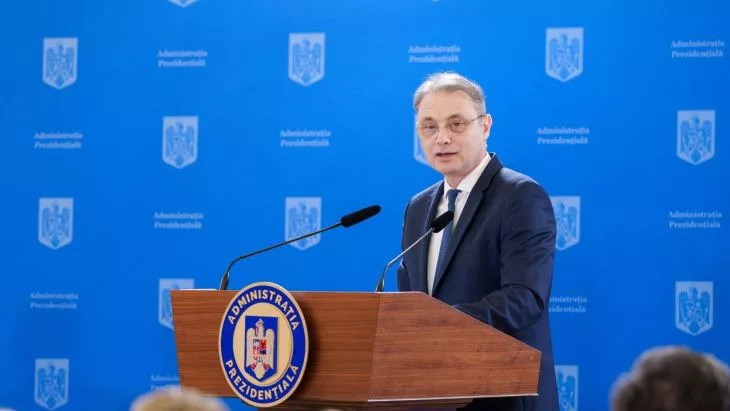
Luca Niculescu has a trajectory that is easily understood by international audiences: a journalist specialised in international affairs, a former ambassador in a major European capital, a diplomat familiar with multilateral mechanisms, and the coordinator of one of Romania’s most important strategic files.

According to his official profile, Luca Niculescu served as Romania’s ambassador to France, Monaco, and Andorra between 2016 and 2022. Since 2022, he has been Secretary of State in the Ministry of Foreign Affairs, responsible for Romania’s accession process to the Organisation for Economic Co-operation and Development. A graduate of the Faculty of Journalism and Communication Sciences at the University of Bucharest and holder of a master’s degree in European journalism from Strasbourg, he built his pre-diplomatic career in international affairs, serving as editor-in-chief of RFI Romania and as a foreign affairs broadcaster for several major television stations.
This professional record matters. Paris is not a secondary diplomatic posting. France remains one of Europe’s major political powers, a permanent member of the UN Security Council, a nuclear power, and a central actor in debates over the future of European security. For Romania, diplomatic experience in Paris means direct exposure to one of the capitals where strategic directions are shaped, not merely to an important bilateral partner.
Moreover, Luca Niculescu does not come from the logic of party reward. His profile has been built through professional accumulation in areas directly relevant to foreign policy: international communication, bilateral diplomacy, multilateral diplomacy, and the coordination of a strategic national file. For external partners, this is an important distinction. In a period of domestic political instability, such a profile conveys continuity, seriousness, and the ability to work on concrete dossiers.
His experience in the media should not be treated as a secondary biographical detail. Contemporary diplomacy no longer means only protocol, diplomatic notes, and bilateral meetings. It also means the ability to formulate positions clearly, communicate strategically, and credibly project a state’s interests in an international environment saturated with messages, crises, and narrative competition. A diplomat who understands both public language and institutional mechanics may be better placed to explain Romania’s positions at a moment when external perception has become part of power itself.
The OECD file, a concrete test of institutional competence
The strongest argument in favour of Luca Niculescu is his role in Romania’s accession process to the OECD. For international audiences, this dossier is relevant because it is not a matter of formal diplomacy alone. Accession to the Organisation for Economic Co-operation and Development means governance standards, a predictable economy, administrative reform, transparency, sound public policies, and credibility with investors.
In May 2026, Luca Niculescu stated that Romania had closed 24 of the 25 committees in the OECD accession process and that it ranked first among the countries that began negotiations in 2022–2023. This information is essential for any external assessment of his profile: he is not only an experienced diplomat, but the Romanian official directly associated with one of Bucharest’s most important strategic projects since NATO and EU accession.
The OECD is not a reputational exercise. It is a test of administrative maturity. In a state where many public projects are lost between government rotations, ministerial changes, and bureaucratic blockages, continuity in such a dossier carries political and institutional value.
A foreign minister who knows this process from the inside would enter office without the lengthy adjustment period that usually comes with taking over a complex portfolio.
For investors, diplomats, and international institutions, this is the detail that matters. Romania does not need merely a minister who attends meetings. It needs a minister who understands the files that directly affect the country’s economic and institutional reputation. From this perspective, Luca Niculescu has a real advantage: he is associated with a dossier in which competence is measured by completed stages, closed negotiations, and standards assumed.
Active diplomacy is no longer optional
Luca Niculescu’s profile only fully makes sense when placed against the type of diplomacy Romania now needs. And here the issue is not administratively correct diplomacy, but active diplomacy. In a world where alliances are rapidly recalibrating, the priorities of major powers shift quickly, and strategic decisions are sometimes made within 24 hours, mere presence at the table is no longer enough.
Bucharest must know when to propose, when to negotiate, when to accelerate, and when to turn its geography into political influence. In the Black Sea region, where the war in Ukraine, Russian pressure, Türkiye’s role, Poland’s ambitions, and American recalibration are constantly reshaping the security architecture, diplomatic delays carry costs. A missed window can sometimes close for good.
This is one of Romania’s structural vulnerabilities: too often, the Romanian state has acted correctly, but late; prudently, but without initiative; aligned, but without the ability to turn alignment into influence. In today’s geopolitics, those who react too late are no longer merely cautious. They become irrelevant.
This is where Luca Niculescu’s profile becomes relevant. His experience in foreign environments, international organisations, and the coordination of the OECD process places him in a different category from politicians sent, by circumstance, into a difficult ministry. Romania needs at the Foreign Ministry a professional who can read changes of context quickly and translate diplomatic positions into results, not an administrator of established formulas.
Active diplomacy does not mean spectacular gestures, loud statements, or activism without calculation. It means anticipation, networks, pace, and the ability to act before others occupy the space. It means understanding when a change in Washington alters European priorities, when a regional initiative can become a strategic advantage, when a bilateral relationship needs to be accelerated, and when an apparently technical file can produce diplomatic gains.
Judging by his professional record, Luca Niculescu appears closer to this kind of logic than to an inert diplomacy, more concerned with procedural correctness than with results. For Romania, this is precisely the difference that matters.
What Luca Niculescu’s appointment would signal
For Western capitals, the appointment of a foreign minister is always a political signal. In Romania’s case, that signal would be all the more important. Bucharest must show that it can remain stable, coherent, and active during a period of domestic instability.
Luca Niculescu would offer external partners a recognisable profile: a former ambassador in Paris, an official familiar with international organisations, the coordinator of Romania’s OECD accession process, and a communicator formed in an international environment. He is neither an outsider without diplomatic experience nor a local politician propelled by circumstance into a demanding ministry.
A possible appointment would send three messages. First, continuity in the OECD dossier, at a time when Romania is approaching the completion of a major objective. Second, the professionalisation of a strategic portfolio. Third, Bucharest’s willingness to move from reactive diplomacy to active diplomacy.
This last point is decisive. Romania needs to be in the room where strategic decisions are made, not to learn about them after they have already been taken. Its geographic position on the Black Sea can become an advantage, or it can remain a simple cartographic fact. The difference is made by the quality of diplomacy.
A foreign minister cannot solve the state’s structural weaknesses alone. He cannot replace an absent national strategy, eliminate political fragmentation, or automatically turn Romania into a more influential regional actor. But he can do one essential thing: restore institutional weight to Romanian diplomacy and impose a pace better suited to the current geopolitical moment.
A reading still conditioned by political decision
This analysis must be read with the necessary caution required by a still-fluid political moment. At the time of publication, Luca Niculescu’s appointment has not been confirmed, and the final architecture of the cabinet remains dependent on negotiations that may still alter the distribution of key portfolios.
There is also an important distinction between the profile of a possible minister and that minister’s actual capacity to change the rhythm of an institution. Diplomatic experience, the OECD dossier, and international exposure are solid arguments, but they do not automatically guarantee a more active foreign policy agenda. They can become relevant only if the future minister receives political backing, institutional support, and the freedom to treat the Ministry of Foreign Affairs as a strategic instrument of the Romanian state, not as a piece in an internal coalition calculation.
That is precisely why the issue is not only Luca Niculescu’s name, but the direction such a choice may signal. Romania needs professionals in diplomacy, but it also needs the political will to allow them to act.
The test of a Romania that must react faster
For international audiences, the question “who will lead Romania’s Ministry of Foreign Affairs?” is not a protocol matter. It concerns the credibility of a state located in a strategically sensitive region. Romania is too important geographically to afford slow diplomacy and too exposed regionally to afford political improvisation.
The possible arrival of Luca Niculescu at the Ministry of Foreign Affairs could be read as a rational choice: an experienced diplomat, a communicator formed in an international environment, and an official associated with the most important institutional modernisation file Romania has pursued in recent years.
Romania needs a Foreign Ministry that speaks on behalf of the state, not on behalf of a party. It needs diplomacy that anticipates, not merely reacts. It needs people capable of reading shifts in power quickly, identifying opportunities, and turning Romania’s position into concrete results.
In this sense, Luca Niculescu is more than a technical option for a sensitive portfolio. He is a profile suited to Romania’s strategic moment: a diplomat with Western experience, a professional of international communication, and an official who has worked directly on a major institutional modernisation dossier.
He is not a miraculous solution and cannot, alone, compensate for all the weaknesses of the Romanian state. But he is a solid, credible, and easily intelligible proposal for external partners. And in a volatile geopolitical period, professional solidity may be precisely the signal Romania needs: a signal that Bucharest understands that diplomacy is no longer ceremony, but an instrument of national power.
Editorial Note
This text is an opinion article and reflects the editorial position of Atlas News. It does not represent support for an individual or a political formation, but for a principle: positions that represent Romania abroad should be held by professionals, regardless of the internal political context. Atlas News will consistently uphold this standard, whoever is appointed and by whoever they are proposed.