Atlas Geopolitical opens its first weekly edition with five dossiers that shaped the international agenda between 15 and 20 June 2026. Not all of them were crises: some were diplomatic moments, others economic decisions or military signals. Together, however, they pointed to the same underlying shift — international politics is moving faster, and diplomacy, security, energy and maritime routes increasingly converge within the same strategic equation. On the week’s agenda: the G7 Évian summit, the US–Iran talks staged in Switzerland, the fragile ceasefire between Israel and Hezbollah, American pressure on Europe within NATO, the critical minerals dossier, and Turkey’s warning to Russia in the Black Sea.
1. G7 Évian: The Summit of Accelerated Diplomacy
The G7 summit at Évian-les-Bains was less a classic gathering of the major Western economies than a demonstration of the new global diplomacy: fast-moving, overlapping and competitive. As Atlas News has already analysed, the G7 has not become irrelevant — precisely because it remains a diplomatic stage of real value, each leader sought to use it to advance an agenda of their own.
At Évian, Donald Trump arrived with the Iranian dossier, Volodymyr Zelensky worked to keep Ukraine at the centre of attention, Emmanuel Macron sought to broaden the format, and European leaders aimed to sustain the pressure on Russia. The lesson of the summit is that major gatherings are no longer solely about consensus, but about tempo: whoever sets the theme of the day gains diplomatic ground, while whoever loses the moment sees their dossier pushed into the background.
Évian was not the summit of Western consensus. It was the summit of tempo.


2. US–Iran, Switzerland and Lebanon: Negotiations Hinging on a Fragile Ceasefire
The second major dossier was the preparation for the resumption of talks between the United States and Iran in Switzerland. Atlas News reported that envoy Steve Witkoff was en route to Switzerland, where discussions on a possible nuclear agreement were anticipated, with Jared Kushner already present and Qatar acting as an intermediary. The talks initially scheduled for Friday had been postponed, with no official date set for their commencement.
The dossier cannot be separated from Lebanon. Atlas News reported that Israel and Hezbollah had reached a ceasefire due to take effect on Friday at 4:00 p.m. local time, according to a US official cited by Reuters — an arrangement that proved fragile from its very first hours.
Washington is seeking to translate military pressure, the Iranian nuclear file and the energy risk into a broader political framework. Iran, for its part, is binding Lebanon, Hezbollah, the nuclear programme, sanctions and the Strait of Hormuz into a single negotiation. Should the Lebanese ceasefire collapse, the talks in Switzerland could quickly become far more precarious.
3. NATO and Europe: The Test of Military Readiness
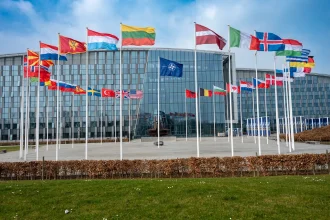
NATO has entered a more demanding phase of its military adaptation. US Secretary of Defense Pete Hegseth announced a review of the American military presence in Europe and criticised allies failing to honour their defence commitments, conveying that some states would pass the assessment while others would not.
Beyond the sharp tone, the political message matters: Washington is signalling that Europe’s defence will be judged more stringently, and that the military readiness of the allies is no longer a technical matter but a strategic one. In this context, Atlas News examined Europe’s actual level of military readiness ahead of the Pentagon’s review: common financing, military mobility, the modernisation of ports and airports, reduced bureaucracy and greater industrial capacity.
The week’s defining formula: Europe must accelerate its defence readiness by 2030. For Romania and the eastern flank, this is no abstract debate, but one concerning the credibility of allied defence within an increasingly harsh security environment.
4. Critical Minerals: The Hidden Infrastructure of Modern Power
Among the most significant economic dossiers of the week was the G7’s decision on critical minerals — a matter that extends well beyond mere industrial coordination. As Atlas News has already analysed, these materials are the hidden infrastructure of modern power: telephones, drones, satellites, data centres, electric vehicles, wind turbines and military systems all depend on minerals extracted, refined and processed within a small number of countries.
At Évian, the G7 treated supply chains as a matter of economic security. The leaders’ official declaration placed emphasis on processing, recycling, market transparency and the reduction of vulnerabilities before 2030.
The true vulnerability lies not in extraction but in processing: whoever controls refining and component production controls the links without which raw material does not become technology. For Europe, the lesson is a hard one — strategic autonomy is not secured through declarations, but through mines, refineries, factories, stockpiles and genuine processing capacity.
5. The Black Sea: Turkey Warns Russia
For Romania, the Black Sea dossier is the most important regional subject of the week. Reuters reported that Turkish Foreign Minister Hakan Fidan conveyed to his Russian counterpart Sergei Lavrov the need to avoid steps in the Black Sea that could threaten regional security and Turkey’s interests. At the same time, Ankara reiterated its willingness to mediate between Kyiv and Moscow.
In recent months, Ukraine and Russia have accused one another of drone attacks on tankers off Turkey’s northern coast. For Ankara, the security of navigation in the Black Sea has become a matter of direct national interest.
For Romania, the signal warrants close attention. The Black Sea is no longer the backdrop to the war in Ukraine, but a space where energy security, freedom of navigation, Turkey’s interests, NATO’s eastern flank and Romania’s logistical infrastructure converge. Constanța, the Danube, the commercial routes and support for Ukraine all belong to the same strategic map. When Ankara warns Moscow, Bucharest cannot treat the message as a mere bilateral dispute.
The Bottom Line of the Week
The week of 15–20 June 2026 revealed a world in which events accumulate rapidly and condition one another. Accelerated diplomacy at the G7, US–Iran negotiations dependent on Lebanon, American pressure within NATO, the securing of critical minerals and the tensions in the Black Sea together form a coherent picture.
The lines between dossiers have blurred. A negotiation in Switzerland depends on a ceasefire in Lebanon, and a warning in the Black Sea bears directly on Romania’s security. For Atlas News, the message of the week is plain: the international order is not merely growing more tense, but accelerating — and for a frontline state such as Romania, the speed of response is itself becoming a strategic stake.
Read also
G7 Évian: The Summit of Accelerated Diplomacy Where Every Leader Raced for His Moment