The suspension of trade and financial exchanges between the United Arab Emirates and Iran does not yet amount to a structural decoupling of the two economies. But the measure announced by Abu Dhabi exposes a deeper vulnerability for Tehran: as access to commercial hubs, financial intermediaries and external buyers becomes more difficult, Iran is increasingly dependent on a narrowing group of partners. None matters more than China.
On 19 August 2026, the Ministry of Foreign Affairs of the United Arab Emirates announced the suspension of all trade, commercial exchanges and financial transactions with Iran “until further notice”.
The official wording is broad. At this stage, however, the public statement does not provide sufficient detail to establish all the legal and administrative mechanisms governing the measure, including its application in free zones, any potential exemptions, banking procedures, or the precise treatment of imports, exports and re-exports.
For that reason, the decision should for now be treated strictly on the basis of what can be established: a general suspension officially announced by the Emirati authorities, rather than an irreversible economic decoupling.

The measure comes amid a severely deteriorated regional security environment. According to the UAE Ministry of Foreign Affairs, nearly 3,000 ballistic missiles, cruise missiles and drones have been launched towards the United Arab Emirates since the conflict began, while Emirati authorities have reported civilian casualties and damage to civilian infrastructure.
This figure represents the official assessment communicated by Abu Dhabi and has not been independently verified by Atlas News.
Against this backdrop, the suspension of exchanges with Iran can be explained by the UAE’s own security interests. At present, there is insufficient factual evidence to claim that Washington prompted Abu Dhabi’s decision or that the two capitals agreed upon a coordinated economic operation.
The convergence between the Emirati decision and US policy nevertheless remains relevant.
The United States is no longer focused solely on sanctioning Iranian institutions. Washington has for some time sought to restrict Iran’s access to economic infrastructure beyond its own territory: oil buyers, refineries, front companies, shipping companies, brokers, financial institutions and the fleet used to transport energy exports.
This is where the broader strategic significance begins.
Dubai is more than a trading partner for Iran
The economic relationship between the UAE and Iran cannot be measured solely through direct exports between the two countries.
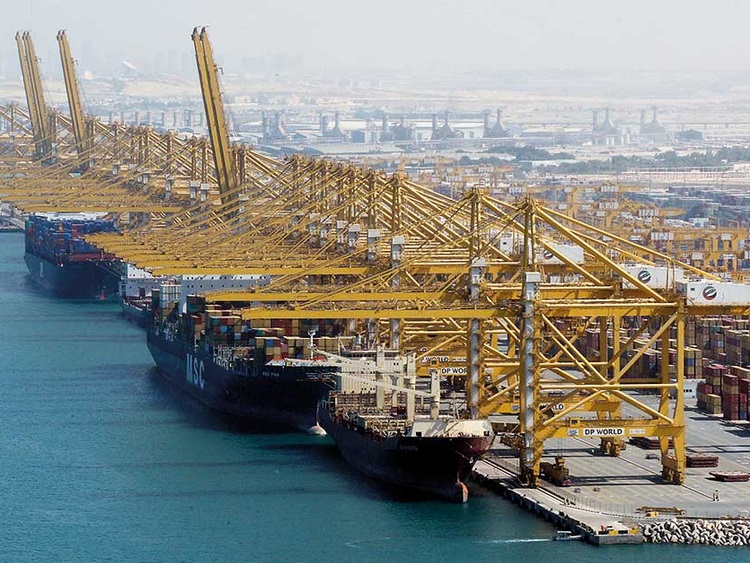
Dubai’s strategic value to the Iranian economy derives from its role as an international commercial and financial hub. Emirati infrastructure handles goods originating from numerous economies, logistics services, industrial components, trade finance and re-export operations.
US documents indicate that this infrastructure has also been used by networks associated with Iran.
An analysis by the Financial Crimes Enforcement Network — FinCEN concerning Iranian shadow banking systems, cited in the US Treasury Department’s 2026 National Proliferation Financing Risk Assessment, identified approximately $4.3 billion received by Iran-associated front companies within a specific dataset of transactions. According to the same analysis, 72% of that amount had been received by front companies based in the United Arab Emirates.
These figures must, however, be interpreted strictly within the methodological limits of the document. They describe a specific dataset of transactions analysed by US authorities and do not represent 72% of Iran’s external financing, nor do they constitute an estimate of the entirety of Iranian activity conducted through the UAE.
Likewise, the presence of Iranian entities or front companies operating from the UAE does not make the Emirati financial or commercial system an institutional mechanism for circumventing sanctions.
It does, however, mean that the UAE’s economic infrastructure has represented one of the points through which certain Iranian networks have been able to interact with the global economy.
Severely restricting such a channel does not isolate Iran. It does, however, make its economic operations more costly.
America is no longer sanctioning Iran alone. It is targeting the network around it
This represents one of the significant shifts in current US policy.
The Treasury campaign known as “Economic Fury” targets the international infrastructure that supports Iranian exports and financing.
On 24 April 2026, the US Department of the Treasury sanctioned the Chinese independent refinery Hengli Petrochemical and a network of approximately 40 shipping companies and vessels associated with the Iranian oil trade.
Across several rounds of the US campaign, entities based in the United Arab Emirates have also been among those targeted.
Several days later, the Office of Foreign Assets Control issued a specific warning to financial institutions concerning their dealings with independent Chinese refineries processing Iranian oil.
The document describes the use of front companies in Asia and the UAE, intermediary brokers and a “shadow fleet” to transport Iranian oil, including through ship-to-ship transfers, falsified documentation and manipulation of vessel identities.
On 28 April, the US Department of the Treasury explicitly warned that it was prepared to use secondary sanctions against foreign financial institutions that continued to support Iranian activities targeted by US policy.
The distinction matters.
Washington is no longer seeking merely to restrict an Iranian company’s access to the US financial system. It is seeking to increase the cost for the entire economic chain that makes the transaction possible.
The target is no longer simply the Iranian product. It is the ecosystem that allows it to reach the market.
Iran can change routes. It cannot eliminate the cost of isolation
Reduced access to Dubai does not mean that the Iranian economy is left without alternatives.
Iran shares land borders with Türkiye, Iraq, Pakistan, Afghanistan, Turkmenistan, Azerbaijan and Armenia, has access to the Caspian Sea and maintains maritime connections to the Indian Ocean.
Oman, for its part, possesses significant port infrastructure and a distinct geographical position at the entrance to the Persian Gulf. Muscat has traditionally maintained its own regional policy and its diplomatic role as a facilitator of dialogue, and any potential changes in trade flows should be viewed through the prism of the Sultanate’s own economic and logistical interests.
Türkiye is another major regional economy, directly connected to Iran through a land border and well-established trade relations. Ankara pursues its own economic, energy, diplomatic and security interests and maintains a complex bilateral relationship with Tehran.
Any potential change in Iranian trade flows through Turkish territory should be assessed within this context, without automatically assuming that Türkiye would replace Dubai’s commercial and financial functions.
Iran’s problem, therefore, is not the absolute disappearance of trade routes.
It is the quality of the alternatives.
Replacing a hub such as Dubai may require additional intermediaries, entail higher logistics costs, make access to financing and insurance more difficult, lengthen delivery times and increase exposure to international scrutiny.
Iran can redirect part of its trade. It cannot instantly relocate the entire ecosystem that sustains it.
China becomes the essential outlet
Nowhere is this asymmetry more evident than in the oil sector. According to the warning published in April 2026 by OFAC, China absorbed approximately 90% of Iran’s oil exports described in the US authorities’ assessment, with most of those volumes purchased by independent refineries.
The percentage must be understood within the context of the period and the category of flows examined by OFAC. It is not a real-time measurement of the current volume of Iranian exports, nor should it automatically be extrapolated to encompass all Iranian energy products.
Its strategic significance nevertheless remains.
The figure illustrates the high degree to which Iran’s external oil market has become concentrated around Chinese buyers.
At the same time, China has a far broader base of energy suppliers and a significantly greater capacity to diversify its imports than Iran has comparable alternatives for its exports.
This asymmetry can increase Beijing’s bargaining power. US pressure has already begun to test this relationship.
In April 2025, the US Department of the Treasury sanctioned the independent Shandong Shengxing Chemical refinery for purchasing more than $1 billion worth of Iranian oil.
In April 2026, the campaign was expanded to Hengli Petrochemical and the maritime infrastructure associated with the Iranian oil trade.
Washington is therefore seeking to increase the economic cost not only for the seller, but also for the buyer and the intermediary.
Isolation can create a new dependency
This is where the strategic paradox emerges.
Reducing the number of markets, hubs and intermediaries available to Iran can diminish Tehran’s capacity to absorb sanctions.
But the same process can simultaneously produce a different geopolitical consequence: an increase in Iran’s relative dependence on China.
This is not an automatic outcome.
It depends on Beijing’s willingness to continue purchasing Iranian oil, the cost of US sanctions, Tehran’s capacity to develop alternative routes and the evolution of the regional conflict.
But the underlying mechanism is clear. The fewer comparable economic alternatives Iran has, the greater the importance of the partners that remain.
And when one of those partners has considerably more alternatives than Iran itself, the bargaining relationship becomes inherently asymmetric.
Sanctions can therefore increase Iran’s relative dependence on China and, in turn, strengthen Beijing’s bargaining position, without transforming the relationship into an alliance or eliminating Iranian autonomy.
China can benefit from this asymmetry without assuming responsibility for sustaining the Iranian economy.
For Tehran, the issue is no longer merely access to foreign currency or the ability to export oil.
It is room for manoeuvre at the negotiating table.
The real test of the UAE decision will come after the next de-escalation
It is too early to speak of a structural rupture between the United Arab Emirates and Iran.
The duration of the measure adopted by Abu Dhabi will matter more than its initial wording.
The decisive indicators will be the implementation of the suspension across the banking system, the status of Iranian companies in Emirati economic zones, the behaviour of ports and logistics operators and, above all, whether the restrictions remain in place following any reduction in military tensions.
If commercial relations resume rapidly after a de-escalation, the August decision will have to be interpreted primarily as a security measure adopted during a period of conflict.
If the restrictions remain in place even after the military risk has diminished, the situation will be fundamentally different.
At that point, it may become possible to speak of the beginning of a structural shift.
Until then, the episode already reveals something important about Iran’s vulnerability.
US sanctions do not operate solely through what Washington prohibits Tehran from doing. They also work through the pressure exerted on actors outside Iran that make Iranian trade possible.
And with every node that disappears or becomes more difficult to use, the Iranian economy is not necessarily left without an outlet.
It is left with fewer options.
The distinction is fundamental.
Because in a system where options are narrowing, power does not belong solely to the actor imposing the sanctions.
Increasingly, it may also belong to the actor controlling one of the few markets large enough to absorb the remaining exports.
In Iran’s case, that reality makes China’s role increasingly difficult to separate from the question of Tehran’s economic autonomy.
Read also
Sea Denial Without a Navy: What the Houthi Strategy Reveals About Modern Maritime Warfare