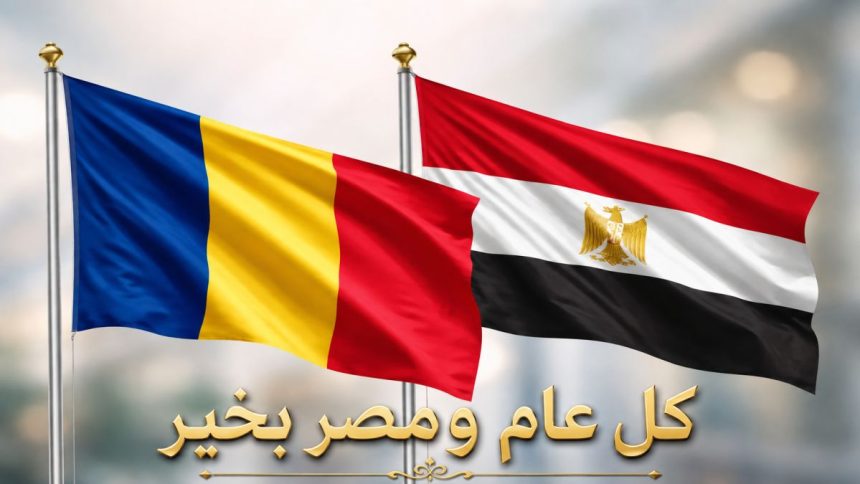
Egypt marks its National Day on 23 July 2026, an occasion associated with the anniversary of the 1952 Revolution — the moment that brought an end to the monarchy, paved the way for the proclamation of the republic, and redefined the country’s position in the Arab world, in Africa, and within the international system.
This year’s anniversary carries particular significance for Romania as well. Bucharest and Cairo are commemorating 120 years of diplomatic relations, one of Romania’s longest and most stable ties with a state from the Middle East and North Africa. (Presidency of Egypt)
For Atlas News Romania and Atlas News MENA, present editorially including through the regional bureau in Cairo, this day represents more than an anniversary milestone. It is the moment to highlight both Egypt’s historic contribution to the emancipation of the Arab and African worlds, and the remarkable transformation the Egyptian state has undergone during the mandate of President Abdel Fattah El-Sisi.
The 23 July Revolution and the Birth of Republican Egypt
The Revolution of 23 July 1952 marked a turning point for Egypt and for the entire region. The Free Officers Movement brought an end to the monarchy, and the political process initiated on that day led to the formation of the first Egyptian republic.

The event rapidly transcended the country’s borders. Egypt became one of the principal centres of national liberation movements, of the decolonisation process, and of the assertion of Arab and African states in the face of former colonial structures. The Egyptian Presidency describes the 1952 Revolution as the moment that consolidated national sovereignty and inspired liberation movements throughout the Arab world and among developing nations. (Presidency of Egypt)
Seventy-four years on, the legacy of the Revolution continues to be associated with independence, national dignity, state sovereignty, and Egypt’s capacity to determine its own path.
Contemporary Egypt remains faithful to this vocation. Cairo is not only the capital of the most populous Arab state, but also a political, cultural, military, and diplomatic centre without which regional balance cannot be constructed.
Egypt’s Transformation Under President Abdel Fattah El-Sisi
Since 2014, Egypt has entered one of the most extensive periods of reconstruction and modernisation in its recent history. Under the leadership of President Abdel Fattah El-Sisi, the Egyptian state has adopted a model of accelerated development based on substantial investments in infrastructure, transport, housing, energy, health, agriculture, and urban development.
The transformation is visible on a national scale. Roads, bridges, transport corridors, railway lines, metro networks, and connections between Cairo, the new cities, and the country’s major economic centres have been built and modernised. The development of infrastructure has aimed not only at reducing urban congestion, but also at more efficiently connecting Egyptian territory, its ports, its industrial zones, and its new urban communities. (Presidency of Egypt)
The New Administrative Capital represents the most visible symbol of this vision. Built east of Cairo, it comprises the governmental district, central institutions, digital infrastructure, residential areas, commercial spaces, and a new financial centre. The project seeks to reduce pressure on the historic capital and to create an administrative nucleus tailored to the needs of a state with more than 100 million inhabitants. (Presidency of Egypt)
The development of the new capital forms part of a broader urban strategy, which includes cities such as New Alamein, New Mansoura, and other centres built to expand the habitable space beyond the Nile Valley and Delta. In parallel, the development of the Sinai Peninsula has been integrated into a national programme encompassing transport, energy, housing, agriculture, industry, education, health, and public infrastructure. (Presidency of Egypt)
Another defining project is the „Haya Karima” — „Decent Life” — initiative, launched to modernise Egyptian villages and improve public services delivered to the rural population. The programme envisages interventions in 4,584 villages, home to approximately 58% of the country’s population, through investments in water, sanitation, electricity, health, education, housing, and local infrastructure. (Presidency of Egypt)
In the housing sector, government programmes supported by international partners have facilitated access to affordable housing for more than 693,000 low-income households. For a state with a rapidly growing population and major urban pressure, such programmes represent an essential component of social stability. (World Bank)
A Historic Achievement in Public Health
One of the most significant achievements of the El-Sisi administration has been the national campaign against hepatitis C, conducted through the „100 Million Healthy Lives” initiative.
Egypt, which for decades faced one of the highest hepatitis C prevalence rates in the world, tested more than 60 million individuals and provided treatment to diagnosed patients. The World Health Organization has confirmed that the incidence of new infections was reduced by 97% over eight years, and Egypt became the first state in the world to reach „Gold Tier” status on the path towards eliminating hepatitis C. (World Health Organization)
This achievement demonstrates the Egyptian state’s capacity to mobilise institutions, medical infrastructure, and administrative resources around a national objective. Beyond projects of concrete and steel, Egypt’s modernisation has also entailed direct interventions in the quality of life and health of the population.
The Suez Canal, Energy, and the New Egyptian Economy
Under President El-Sisi’s leadership, Egypt has sought to transform its geographic position into an economic, industrial, and logistical advantage.
The new section of the Suez Canal, inaugurated in August 2015, expanded navigation capacity and enabled a more efficient organisation of maritime traffic. Around the canal, the authorities have accelerated the development of the Suez Canal Economic Zone, conceived as a platform for industry, logistics, maritime transport, and trade linking Europe, Asia, Africa, and the Middle East. (Suez Canal Authority)
In the field of energy, Egypt has invested in diversifying its sources of production and in developing large-scale renewable projects. The Benban Solar Park, built near Aswan, has a capacity of approximately 1,650 megawatts and was, at the time of its completion, one of the largest solar installations in the world. (IFC)
Energy modernisation, port development, and the expansion of logistical infrastructure aim to transform Egypt from a mere transit point into a regional hub of production, investment, and connectivity.
Over the course of President Abdel Fattah El-Sisi’s mandate, Egypt has expanded its infrastructure, built new administrative and economic centres, launched social programmes with national reach, and consolidated its capacity to act as a regional power.
Egypt, a Pillar of Stability in a Region Under Pressure
Egypt’s weight is not determined exclusively by population, military strength, or cultural influence. Its geographic position makes it a strategic node between the Mediterranean Sea, the Red Sea, Africa, the Middle East, and Asia.
The Suez Canal is one of the fundamental arteries of global trade. Successive crises in the Red Sea have demonstrated that Egypt’s security and freedom of navigation through this region are directly linked to the stability of global supply chains and to European energy security.
The European Union and Egypt have defined the Red Sea as a maritime artery vital to regional stability, global trade, and energy security. In March 2026, the two parties held in Cairo the first EU–Egypt Dialogue on Security and Defence, a step that confirms the growing strategic importance of the Egyptian state for Europe. (EEAS)
Cairo’s role is equally indispensable in the Gaza, Sudan, Libya, and Horn of Africa files, in counter-terrorism, and in maritime security. Egypt’s mediation efforts in the Gaza conflict have been officially acknowledged by the European Union, and the strategic partnership between Brussels and Cairo covers political cooperation, security, investment, migration, energy, and economic development. (Consilium)
In a region marked by wars, rivalries, and political fragmentation, Egypt remains one of the few states capable of maintaining channels of dialogue with actors on opposing sides and of participating simultaneously in Arab, African, Mediterranean, and international frameworks.
Romania and Egypt: 120 Years of Diplomatic Relations
The year 2026 marks 120 years since the establishment of diplomatic relations between Romania and Egypt. The bilateral relationship has traversed two world wars, changes of regime, the Cold War, and the transformations of the international system after 1989, preserving its continuity and its constructive character. (Embassy of Romania in Cairo)
Romania is the guest of honour at the 2026 edition of the Cairo International Book Fair, its participation being dedicated in part to the anniversary of diplomatic relations. The cultural dimension complements the political, economic, academic, and educational cooperation between the two states. (Embassy of Romania in Cairo)
For Romania, Egypt is an essential partner in the Middle East and North Africa. Romania, in turn, can serve as a bridge towards the European Union, Central Europe, and the Black Sea region.
Agriculture, food security, energy, the defence industry, infrastructure, technology, education, and commercial exchanges offer scope for deepening a relationship that should be viewed not solely through the lens of diplomatic tradition, but also as a strategic partnership for the coming decades.
The Message of Atlas News Romania and Atlas News MENA
Through the development of Atlas News MENA and its editorial presence in Cairo, Atlas News Romania has taken on the mission of contributing to a deeper understanding of Egypt and the Middle East within Romanian and European public discourse.
Egypt is not only the heir to one of the world’s most ancient civilisations. It is a modern state undergoing an extensive process of transformation, with strong institutions, a profound national identity, and considerable regional responsibility.
The remarkable development achieved during President Abdel Fattah El-Sisi’s mandate, the major infrastructure projects, the social and medical programmes, the expansion of energy capacity, and the consolidation of Egypt’s diplomatic role have redefined the country’s profile and have prepared it for a new chapter in its history.
On the occasion of the National Day, Atlas News Romania and Atlas News MENA extend to President Abdel Fattah El-Sisi, to the institutions of the Arab Republic of Egypt, to the diplomatic corps, and to the Egyptian people their most sincere congratulations and best wishes for peace, stability, and prosperity.