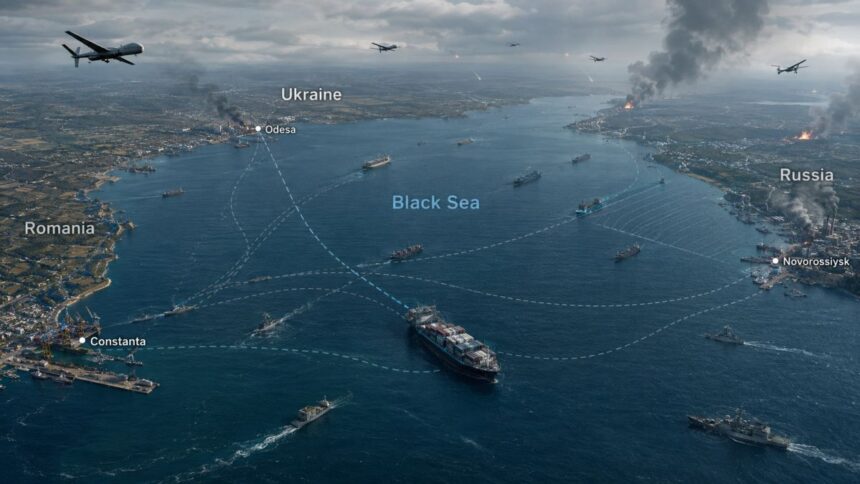
The Black Sea is at once a theatre of Russia’s war against Ukraine, a route for regional trade and a link between Europe, the Caucasus and Central Asia. These functions overlap, but they are not managed through a single architecture. Türkiye, a NATO Ally and Romania’s strategic partner, administers the regime governing passage through the Straits under the Montreux Convention. The littoral states cooperate on maritime security, NATO contributes through deterrence and defence planning, and the European Union is seeking to develop infrastructure and connectivity.
Competition in the basin is not confined to military presence. It also concerns the conditions under which trade and energy routes can operate. Russia can disrupt navigation, Ukraine is seeking to sustain its exports, and the littoral states are pursuing forms of cooperation that strengthen security while taking account of legal rules and regional interests.
The war has made navigation a strategic stake
Attacks on Ukrainian ports and merchant vessels show how military pressure can affect the functioning of the basin without formally closing all routes. According to Ukraine’s Ministry for Recovery, Infrastructure and Transport, 200 million tonnes of cargo had been transported through the Ukrainian maritime corridor between its launch in September 2023 and 4 June 2026, including 118 million tonnes of grain. The figure is reported by the Ukrainian authorities, but it illustrates the scale of the flow Kyiv is seeking to sustain. mininfra.gov.ua
The same ministry has described Russian attacks on port and logistics infrastructure as systematic. Their effects extend beyond physical damage: threats to vessels can raise transport costs, delay deliveries and lead shipowners to choose longer or more expensive routes. Maritime security therefore affects both Ukraine’s economy and international markets’ access to goods transported through the basin. mininfra.gov.ua

The Ukrainian corridor forms part of a broader network. Danube ports, Constanța and overland links with the European Union become more important when Ukrainian Black Sea ports are exposed to risk. The resilience of this network depends not on a single route, but on transport operators’ ability to use viable alternatives.
Montreux provides a predictable framework for naval access
Türkiye has a distinct role in Black Sea security through its administration of passage through the Bosporus and Dardanelles. The Montreux Convention sets rules for warships, including tonnage limits and restrictions on how long vessels from non-littoral states may remain in the basin. For the latter, Türkiye’s Ministry of Foreign Affairs specifies a limit of 21 days, alongside other restrictions on tonnage and advance notification of passage. www.mfa.gov.tr
This regime does not give Ankara discretion to determine naval access unilaterally. It is a multilateral treaty registered with the United Nations, and Türkiye is responsible for its implementation. In the context of a war in which Türkiye is not a belligerent, Article 19 provides that warships belonging to belligerent states may not pass through the Straits, subject to the exceptions set out in the Convention. One such exception concerns vessels that have become separated from their bases and are returning to them. This is a specific exception, not a general rule of access. treaties.un.org
Applied consistently, Montreux provides predictability in a region where military interests diverge. For the littoral states, the Convention helps maintain a balance in naval presence; for NATO, it means that security planning for the basin must take account of rules recognised by the signatory states. Türkiye’s role is essential to the regime’s implementation, and cooperation with Ankara remains an important element of regional security.
The littoral states cooperate; NATO and the EU contribute through different means
The expansion of the MCM Black Sea Task Group’s missions to include the protection of critical undersea infrastructure reflects this regional approach to cooperation. Romania, Bulgaria and Türkiye amended their trilateral memorandum on the sidelines of the NATO Summit in Ankara. The group is an initiative of three NATO Allies, not an operation under Alliance command. Its activities nevertheless contribute to NATO’s objectives for maritime security and freedom of navigation. www.mapn.ro
The expanded mandate does not, in itself, create a permanent NATO force to defend every pipeline, cable and platform in the basin. It strengthens cooperation among the three littoral states and provides a framework for developing capabilities and sharing information. In a region where naval presence is regulated, this trilateral format has practical as well as political value.
NATO and the European Union contribute through different means. The Alliance acts through deterrence, defence planning and military cooperation. The EU links security with investment, transport, energy and digital connectivity.
In June 2026, the European Commission launched a platform to coordinate investment along the route linking Europe and Central Asia through the Black Sea and the South Caucasus. Participating financial institutions signed statements of intent to mobilise up to €2 billion. This is a target for mobilising investment, not funding that has already been spent. enlargement.ec.europa.eu
The Trans-Caspian corridor has potential, but faces logistical constraints
The Trans-Caspian Transport Corridor, also known as the Middle Corridor, links Europe and Türkiye with the South Caucasus and Central Asia through a chain of rail, port and maritime infrastructure. Competition over this route is not confined to the sea: it depends on port capacity, railways, border crossings and coordination among operators in multiple countries.
The World Bank estimates that at least $25 billion will be needed by 2040 for physical infrastructure, particularly railways, ports and maritime links. Separately, it estimates that around $30 billion will be required for investments that support logistical integration, such as local connections, terminals and equipment. These are estimates of investment needs, not amounts already fully committed. The World Bank also identifies interoperability and cross-border coordination gaps that limit the route’s reliability and expansion. www.worldbank.org
The Middle Corridor is therefore not an immediate substitute for other Eurasian trade routes. Its strategic importance lies in diversifying available options, but its competitiveness will depend on investment and cooperation among transit states. For the Black Sea region, the corridor could bring additional traffic and investment, provided the links between ports, railways and border crossings function coherently.
Commercial risk is not a military classification
Joint War Committee Circular JWLA-035, issued on 16 September 2026, includes the Black Sea among areas listed for war, piracy, terrorism and related perils. It excludes the territorial waters of littoral states, except those of Russia and Ukraine, and specifies that the application of the list to individual contracts is subject to specific negotiation. lmalloyds.com
JWLA-035 is a marine insurance market instrument, not a military map or a uniform tariff. The final cost may depend on the vessel, route, voyage duration, cargo and policy terms. Listing an area may affect negotiations and coverage, but does not by itself prove that the premium for a particular offshore project has increased.
This distinction separates commercial risk assessment from military assessment. Insurers can change the cost of navigation without determining the security regime of the basin. Their assessments matter to the operation of trade corridors, but responsibility for responding to maritime threats remains with states and security institutions.
Romania is one littoral actor in a regional equation
Romania contributes to these dynamics through its Black Sea position, its ports and the development of the Neptun Deep project. OMV Petrom and Romgaz expect first gas in the first half of 2027, with plateau production—around eight billion cubic metres a year—expected by the end of the third quarter. The plateau volume will not be available in full from the first day of production. www.omvpetrom.com
Bucharest has also called for the NATO Black Sea Centre, currently in Istanbul, to be moved to Constanța from 2028. President Nicușor Dan described it as a rotational NATO centre and presented the proposed move as Romania’s wish, not as a decision adopted by the Alliance. If approved, the proposal would strengthen Romania’s profile in the regional architecture while preserving Türkiye’s important role in the basin’s legal and operational framework. agerpres.ro
The Black Sea has no single security architecture. It has legal rules, cooperation among littoral states, Alliance commitments, European connectivity policies and trade routes exposed to the pressures of war. Romania and Türkiye are partners in this framework: Bucharest through its position and infrastructure, Ankara through its role in the Straits regime and trilateral naval cooperation.
The basin’s stability will depend on how these contributions complement one another. Neither security nor connectivity can be ensured by a single state or initiative. Cooperation among the littoral Allies therefore remains essential to maintaining navigation and developing the Black Sea corridors.
Read also
Access Without Parity: Washington, Beijing and Moscow on the Road to the Miami G20