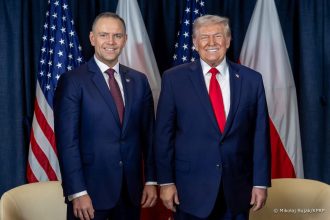
Donald Trump’s address to the UN General Assembly, Xi Jinping’s state visit to Washington and the invitation extended to Vladimir Putin for the G20 summit in Miami followed one another in less than a week. Taken separately, they are ordinary episodes in a crowded diplomatic calendar. Read together, they raise a question about the method by which Washington is managing its relations with the other two major powers.
The working hypothesis of this analysis is that the US administration is using access, formats and the diplomatic calendar to negotiate with Beijing and Moscow on differentiated terms. It is not building a three-power global directorate. It is tailoring its approach to each policy area. The diplomatic rapprochement among the three leaders thus coexists with an increasingly clear differentiation of their positions.
Beijing secures mechanisms, a timetable and the status of principal interlocutor in economic and technological competition, including in artificial intelligence. Moscow secures an invitation: the prospect of Putin’s personal return to the table of Western leaders. It has no guarantee of results, however, and has so far offered no verifiable concession on the war in Ukraine. The Miami summit will show whether this asymmetry is consolidating or fading.
Three Events, One Sequence
The chronology sets the boundaries of the analysis. Trump spoke from the UN rostrum on September 22. The following day, after meeting Sergey Lavrov on the sidelines of the General Assembly, Secretary of State Marco Rubio publicly confirmed Putin’s invitation to the December G20 summit, according to Radio Free Europe/Radio Liberty. Rubio presented the gathering as an opportunity for the Russian leader to engage not only with Trump but also with other leaders. The Kremlin responded, through spokesman Dmitry Peskov as quoted by Reuters, via US News, that a decision would be taken and communicated through diplomatic channels. From September 23 to 25, Xi Jinping was on a state visit to the United States, his first to the White House in eleven years.

The G20 summit is scheduled for December 14–15 at the Trump National Doral resort in Miami. For now it remains a diplomatic horizon, not an event whose outcomes can be assessed. Between these milestones lies a frequently overlooked stage: the APEC Economic Leaders’ Meeting in Shenzhen in November, which Trump and Xi have each committed to attend.
Each event serves a distinct function. The UN provided the platform for articulating doctrine and the infrastructure for bilateral meetings. Xi’s visit produced concrete mechanisms. The G20 may become the setting in which negotiations conducted separately become visible in the same room. This is a reading of the sequence, not proof of a coordinated plan among Washington, Beijing and Moscow.
Two Readouts, Two Visits
The most revealing material of the week was not a speech. It was the comparison between the final documents issued by the two capitals, which describe the same visit in different terms.
The White House fact sheet records a number of economic outcomes. The two sides operationalized the US-China Board of Trade and Board of Investment. They agreed on recommendations for more favorable tariff treatment of $30 billion worth of non-sensitive goods in each direction. China committed to import at least 10 million metric tons of American coal in each of 2027 and 2028, and discussions on rare earth supplies are continuing.
The US document also notes that Trump advocated trilateral arms control negotiations among the United States, Russia and China. According to the same text, the leaders discussed Russia, North Korea and Iran. It also contains a sentence of political weight: since the Second World War, America’s forward military presence has preserved a free and open Indo-Pacific.
The list of eight deliverables published by China’s Ministry of Foreign Affairs confirms the economic core, the technology dialogue and mutual support for APEC and the G20. It contains, however, neither the reference to trilateral negotiations nor the sentence on the US military presence in the Indo-Pacific. Instead, it adds an element absent from the American version: the two countries’ militaries are to conclude, as soon as possible, a memorandum of understanding on crisis communication and prevention.
The vocabulary also differs. The White House states that the leaders agreed to use the term „super intelligence” instead of „artificial intelligence.” The Chinese document consistently refers to artificial intelligence. The difference reflects the audience each text addresses rather than open disagreement: Chinese diplomacy subsequently stated that it respects the new American terminology.
On only one point of international security do the texts converge almost verbatim. Iran must not acquire nuclear weapons, and no country or institution may impose tolls on transit through international waterways. Seoul Economic Daily read this formulation as Xi lending support to the US position against Tehran’s attempt to levy tolls in the Strait of Hormuz. In the midst of the war with Iran, Beijing publicly assumed a position that serves global energy security, but also American interests.
Taiwan, in turn, marks the asymmetry in drafting. In the Chinese readout of the talks, Xi urges Washington to oppose „Taiwan independence” and to handle the issue with prudence, presenting this condition as the foundation of strategic cooperation. The US document does not mention Taiwan. The same Chinese readout notes that the leaders discussed the Middle East, the Ukraine crisis and the Korean Peninsula, without detailing their positions.
Artificial Intelligence: A Bilateral Channel Between Two Rival Architectures
From the UN rostrum, Trump rejected any attempt to construct what he called a globalist scheme to control artificial intelligence, France 24 reports. That same day, Secretary-General António Guterres called on the United States and China to open a dialogue on the technology, modeled on US-Soviet engagement during the Cold War. Two days later, Washington and Beijing announced a bilateral dialogue, accompanied by a communication channel for incidents. Guterres’s appeal and the US-China initiative converge on the need for dialogue. The announced mechanism, however, remains bilateral and has not been placed under UN authority.
Negotiations on the channel had, in fact, preceded the Secretary-General’s appeal. On September 20 in New York, Treasury Secretary Scott Bessent proposed to Vice Premier He Lifeng a notification system for AI incidents with national security implications. His argument was that, between the world’s first and second AI powers, moving from opacity to transparency is essential, according to Al Jazeera.
Analysts invoked as a precedent the Washington–Moscow hotline established after the Cuban Missile Crisis. Axios observed, however, that no one has publicly defined what kind of incident would trigger a call. In a serious scenario, such as a major cyberattack launched by a frontier model, the first warning might surface inside a private company rather than a military command center.
The terminological difference did not prevent the announcement of the joint mechanism. The substantive positions nevertheless remain different. In the talks, Xi insisted that AI must remain under human control and that the two countries should draw on each other’s strengths rather than guard against each other, according to the Chinese readout. After his guest’s departure, Trump rejected integrating the two countries’ efforts, citing America’s lead, Al Jazeera reports. The common formula is minimal: risk management, yes; technological cooperation, no.
The significance of the agreement becomes apparent only in the broader context. In December 2025, the State Department launched Pax Silica, its flagship initiative on AI and supply chain security. Following the June summit, the initiative counted 24 signatories, including the European Union, Germany, Japan, South Korea, India and the United Arab Emirates, according to the State Department. Taiwan endorses its principles through a separate statement.
In July, Beijing launched the World Artificial Intelligence Cooperation Organization (WAICO), headquartered in Shanghai. Its founding agreement was signed by 29 states, including Russia, Pakistan, Indonesia and Kazakhstan, in the presence of Guterres, Digital Watch Observatory reports. The Diplomat observed that no major Western democracy is among its founding members.
The two initiatives have different mandates and institutional forms. Pax Silica is an economic security and supply chain partnership built around a declaration to which states adhere. WAICO is conceived as an intergovernmental organization. Both, however, can consolidate American and Chinese influence, respectively, over the AI ecosystem.
The channel agreed in Washington overlays this institutional competition: it provides a direct link between the two powers without integrating the frameworks each of them promotes. Kazakhstan, present in both initiatives, shows that middle powers are already seeking to avoid an exclusive choice.
For the purposes of this analysis, the relevant detail concerns Moscow. Within the architecture examined here, Russia participates in the framework promoted by Beijing, without an equivalent role in the bilateral US-China channel. WAICO membership does not, on its own, demonstrate that Russia’s entire technology policy depends on China. It does, however, reproduce the asymmetry of the economic file: Beijing negotiates directly with Washington; Moscow does not.
The limits of the mechanism must be stated plainly. The channel’s procedures, incident thresholds and response times have not been published. Export controls on advanced semiconductors, the hard core of the rivalry, remained outside the agreement. The Council on Foreign Relations noted ahead of the visit that Washington had licensed H200 chip sales to about ten Chinese companies. Actual deliveries, however, had been few, as Beijing steered buyers toward domestic suppliers such as Huawei. The channel may reduce the risk of accidental escalation, if it becomes operational, but it does not temper the competition.
The first test has been scheduled: the second round of the dialogue is set for November, close to the APEC meeting in Shenzhen. The context favors Beijing. In 2025, at APEC, Xi used Trump’s absence to promote the idea of a global AI governance body, Reuters reported. In 2026, as host, he will have a broader stage from which to present WAICO as a multilateral alternative to the bilateralism preferred by Washington.
The Invitation to Putin: Access Without Concession
The difference in treatment between the two leaders is most visible in the concrete substance of the relationships. After September, China has operational bilateral boards, an extended trade truce, a technology dialogue with a fixed date and a calendar of high-level meetings. Russia has an invitation.
The comparison concerns the public outcomes of the September sequence, not the entirety of Washington’s relations with the two capitals. The test will be whether this difference holds until Miami.
The context of the invitation matters. On September 23, 50 states and the European Union adopted a joint statement at the UN calling on Russia to agree to an immediate ceasefire. The United States was not among the signatories, according to European Pravda. That same day, in the Security Council, Lavrov stated that Russia would not suspend military operations for the duration of negotiations in any format. He argued that the Europeans were merely seeking a respite in order to rearm Ukraine, Ukrainska Pravda reports.
Washington pursued its own track. After meeting the US delegation, Volodymyr Zelensky stated that Kyiv was ready for an energy ceasefire and that the United States would convey the proposal to Moscow, according to Asia-Plus.
The invitation to Miami thus functions as an incentive offered ahead of a concession, not as a reward for one. The American logic is explicit: to solve problems, one must meet those with whom one disagrees. The Russian logic may, however, run the other way: how much diplomatic normalization can Moscow obtain without relinquishing military pressure?
A precedent shows what the Kremlin is pursuing. Ahead of the Trump–Xi summit in Beijing in May, Peskov explicitly linked the prospect of US-Russian economic projects to Washington’s willingness to decouple trade from the war in Ukraine, notes an analysis published by The Conversation. For Moscow, attendance in Miami would be a step toward that decoupling. It would bring political recognition and a return to bargaining among the major powers, ahead of any settlement for Ukraine.
The failure of an early ambition of the administration is also worth recalling. In September 2025, commenting on images of Xi, Putin and Narendra Modi at the Shanghai Cooperation Organization summit, Trump said that the United States appeared to have lost India and Russia to China, Kyiv Independent reported. The strategy of prying Moscow away from Beijing has produced no results. Something else is now taking shape: not the separation of the two partners, but their functional differentiation in American policy.
The G20 on the Host’s Terms
Russia has retained its membership of the G20. The American invitation opens the prospect of Putin’s personal return to a multilateral setting alongside Western leaders. Its significance grows when set alongside another decision of the US G20 presidency.
South Africa, a founding member of the group, was not invited to Miami. The Peterson Institute for International Economics observed that the exclusion of President Cyril Ramaphosa forecloses the „troika” mechanism, through which past, present and future hosts ensure continuity between summits. The same institute noted that Washington had removed long-standing themes from the agenda, from climate to international tax cooperation. In parallel, the new Board of Peace created by Trump symbolically competes with the G20, drawing in members such as Argentina, Indonesia, Saudi Arabia and Türkiye.
The juxtaposition is telling. A founding member is excluded, while the leader of another member, subject to an arrest warrant issued by the International Criminal Court, is invited. The G20 ceases to function as a forum to which access derives from membership and becomes, to a large extent, a space to which access is apportioned by the host.
The legal dimension is not negligible. In 2025, Putin was absent from the Johannesburg summit because of the ICC warrant, the Lowy Institute noted, South Africa being a State Party to the Rome Statute. The United States is not a party to that treaty. From the UN rostrum, Trump went so far as to urge ICC member states to withdraw, according to France 24.
The status of the United States vis-à-vis the ICC and the position of the Trump administration make the prospect of the warrant being executed far more remote than in a State Party that would honor its cooperation obligations. Miami thus offers a rare setting in which Putin could sit at the same table as Western leaders. Were he to attend in person, it would be his first physical presence at a G20 summit since 2019. Putin participated virtually in 2021 and sent Lavrov to represent him in 2023, as Al Jazeera notes.
Arms Control: Convergent Refusals, Different Motivations
Trump’s proposal for trilateral arms control negotiations appears to confirm the image of a table for three. The available documents show, however, that the American formula meets reservations in both Beijing and Moscow.
In its national report submitted to the Review Conference of the Treaty on the Non-Proliferation of Nuclear Weapons, China rejects participation, at the present stage, in a trilateral nuclear disarmament negotiation with the United States and Russia. At the opening of the conference, China’s Director-General for Arms Control, Sun Xiaobo, stated that Beijing has no interest in the proposed strategic stability talks. He regards them as a means by which Washington shifts its disarmament responsibilities onto others, the Arms Control Association reports. The same source notes that Russian Deputy Foreign Minister Sergei Ryabkov likewise rejected the premises of such a dialogue, arguing that the conditions for an equitable and mutually acceptable discussion are lacking.
The context is one of accelerating erosion. The New START Treaty expired at the beginning of the year, and the NPT Review Conference concluded on May 22 without a final document, the third consecutive failure, Chatham House observes. During the conference, Russia and China reproached Washington for failing to seize the opportunity of a successor agreement. They also called for consideration of the Russian proposal to observe the New START limits for one more year, Arms Control Today notes.
The two capitals’ motivations differ. Beijing contests the shifting of disarmament responsibilities, citing the disparity between arsenals. Moscow cites the absence of conditions for an acceptable dialogue. This is a convergence of outcome, not evidence of a coordinated position. The positions expressed by Moscow and Beijing prevent, under current conditions, any progress on the formula promoted by Washington, without precluding all other forms of strategic dialogue. The Russian proposal on New START limits shows that Moscow is keeping at least one bilateral track open.
For Trump, the consequence is a constraint on his ability to organize a three-way negotiation. The absence of the proposal from the Chinese readout of the visit does not prove a refusal expressed in private, but it rules out presenting a consensus as fact.
The Calendar as a Negotiating Instrument
On September 23, Treasury Secretary Scott Bessent announced a two-month extension of the trade truce that had been due to expire on November 10, Reuters reports. The new deadline, January 10, 2027, falls after the Miami summit. CNBC also recorded the reservations of the European business community. Jens Eskelund, President of the European Union Chamber of Commerce in China, cautioned that a mere extension does not resolve concrete problems, including the lack of a standardized procedure for rare earth export licenses.
The practical effect is clear. The tariff deadline no longer threatens the Shenzhen–Miami diplomatic sequence, and the G20 summit becomes the last leader-level moment before expiry. There is no evidence that the extension was designed exclusively for this purpose, but it turns Miami into a natural stage for a trade announcement.
The domestic political calendar matters just as much. The US midterm elections on November 3 precede the APEC meeting. At the UN, Trump said that an agreement with Tehran could come after those elections, according to France 24.
In its analysis published after the May summit, the Carnegie Endowment identified precisely the US election as the main short-term risk to the bilateral dynamic. Carnegie also observed that direct leader-to-leader negotiation requires, from Beijing’s standpoint, a politically strong Trump. On the Chinese side, Xi is entering the preparatory year for the Party Congress in the autumn of 2027, at which he is expected to secure a new term, Rush Doshi recalls. Both leaders therefore have an interest in stability over the coming months.
The alternation of the host role completes the picture. In Shenzhen, the advantage of the stage belongs to Xi, including on AI governance; in Miami, it belongs to Trump. The continuity of the US-China relationship does not depend on Putin’s participation. Putin’s relevance in Miami, by contrast, depends on what he can bring to the Ukraine file.
The Allies: Guarantees Reaffirmed, Costs Redistributed
Two days before Xi’s arrival, Marco Rubio and the foreign ministers of Japan and South Korea adopted a joint statement. It opposes any attempt to unilaterally change the status quo in the Taiwan Strait and supports Taiwan’s meaningful participation in appropriate international organizations. The timing of the statement was a message in itself: the Asian allies were asking that the stabilization of relations with Beijing not come at their expense.
The signals, however, are mixed. The CFR noted ahead of the visit that the administration had postponed a Section 301 finding that would have raised tariffs on China. It had also delayed an arms package for Taiwan, possibly until the end of the year. CSIS observed that Indo-Pacific allies are bearing the economic consequences of the Iran conflict, which erodes their perception of American power. India, for its part, fears that improved US-China relations leave it in a weaker position vis-à-vis both China and Pakistan.
The distinction between representation and influence becomes decisive here. A state can attend the G20, intervene in the debate and appear in the final declaration without having contributed to terms negotiated bilaterally beforehand. For the Asian allies, the test is whether stability in relations with Beijing preserves the credibility of American commitments. For the Europeans, the test is whether any direct dialogue with Moscow incorporates Ukraine’s interests and the conditions of European security.
What Can Be Anticipated Before Miami
Several developments can be anticipated with a high degree of probability, because they stem from publicly assumed commitments.
The US-China relationship has a fixed timetable. The second round of the AI dialogue is scheduled for November, and Both leaders have indicated that they intend to meet again at APEC in Shenzhen. The January 10 expiry of the trade truce makes it likely that Miami will see the announcement of either a further extension or a broader trade arrangement. Three indicators will show whether the relationship is also acquiring a security component: the signing of the military memorandum on crisis communication, mentioned only by the Chinese side; the publication of procedures for the AI incident channel; and any extension of the technology dialogue into the military domain.
Xi’s attendance in Miami is the baseline scenario, supported by the reciprocally announced intentions. A trilateral arms control format, by contrast, remains unlikely in the short term, given the documented positions of Beijing and Moscow. Any progress is more plausible through the bilateral US-Russia channel, around post-New START limits. In the field of AI, Beijing can be expected to use the APEC meeting to promote WAICO, while Washington continues to favor bilateral channels and the expansion of Pax Silica.
Putin’s participation is the principal unknown. On the basis of available signals, three scenarios emerge.
In the first, Putin comes to Miami following a bilateral meeting prepared in advance and with a partial outcome, such as an energy ceasefire or an arrangement on navigation in the Black Sea. This is the scenario Washington appears to be pursuing, and the one that would give it the clearest political justification for the invitation.
In the second, the Kremlin makes Putin’s attendance conditional on a substantive bilateral format. Failing that, it sends a delegation led by Lavrov or opts for remote participation. This would continue the practice of recent years and preserve the invitation as a bargaining chip for later stages.
In the third, Putin attends without any prior concession. This would be the scenario with the greatest symbolic gain for Moscow and the highest cost for Washington in its relations with European allies. It would confirm that access can be obtained without any change in military conduct.
The indicators that will distinguish among these scenarios are identifiable: the Kremlin’s response to the energy ceasefire proposal, the announcement of preparations for a Trump–Putin meeting, the final list of invitees to Miami, including any Ukrainian presence, and the reaction of European capitals. Potential tensions are not limited to the Ukraine file. The PIIE warned as early as the spring of possible confrontations in Miami between Zelensky and Putin, or between Japanese Prime Minister Sanae Takaichi and Xi.
As for the G20 as an institution, a summit dominated by bilateral meetings rather than by the collective declaration is to be expected. South Africa’s absence, a narrowed agenda and the simultaneous presence of strategic rivals make an ambitious final communiqué difficult. The real stakes will lie on the margins of the meeting rather than in the plenary hall.
The Stakes for Europe and the Eastern Flank
For European states, and even more so for those on NATO’s eastern flank, the September sequence raises a question of method. The statement by 50 states and the European Union supported efforts toward an agreement ensuring freedom of navigation in the Black Sea. It also recalled that Ukraine had accepted a full and unconditional ceasefire as early as March 2025. Washington chose not to sign the statement and to pursue its own track, with targeted proposals such as the energy ceasefire and with instruments of political access such as the invitation to Miami.
This is not, in itself, a rupture among allies, but a difference in approach. The signatory states present an immediate ceasefire as a necessary step toward meaningful diplomacy and negotiations. Moscow refuses to suspend operations for the duration of negotiations, while Washington is testing partial arrangements.
For the Black Sea region, any arrangement on navigation or energy infrastructure negotiated in this format would have direct consequences for commercial and energy security. The risk for the states of the region is to learn after the fact the terms of understandings in whose drafting they took no part.
The technological dimension adds a further stake. The competition between the frameworks promoted by Washington and Beijing in the field of AI obliges European states to consolidate their position in an environment where rules are increasingly negotiated bilaterally, between the two major powers.
In Miami, Power Will Be Measured in Results
A G20 with Trump, Xi and Putin would carry powerful symbolic value. It would not, in itself, demonstrate the emergence of a three-power global leadership.
The September signals support a more nuanced hypothesis: Washington is organizing negotiations according to the power required for each file. China emerges as an indispensable partner in managing economic and technological competition, with mechanisms, a timetable and a vocabulary negotiated down to the level of terminology. Artificial intelligence confirms this position: Beijing has a direct channel with Washington and, in parallel, its own multilateral framework.
Russia remains indispensable to ending the war it is waging. Its position, together with China’s, constrains the trilateral arms control formula. For now, however, it is being granted access, not architecture. In the technological domain, it participates in the framework promoted by Beijing, without an equivalent role in the US-China channel.
For Putin, the aim is to translate indispensability into lasting status. For Xi, it is to convert status into influence over the rules, without accepting constraints he considers disproportionate. For Trump, it is to demonstrate that direct negotiation with both leaders can deliver results where multilateral mechanisms stall.
In Miami, the difference among the three will be seen not in the family photo, but in what each is able to obtain from the others.
Citește și
UN General Assembly 2026: The Decline of a Podium, the Rise of Corridor Diplomacy