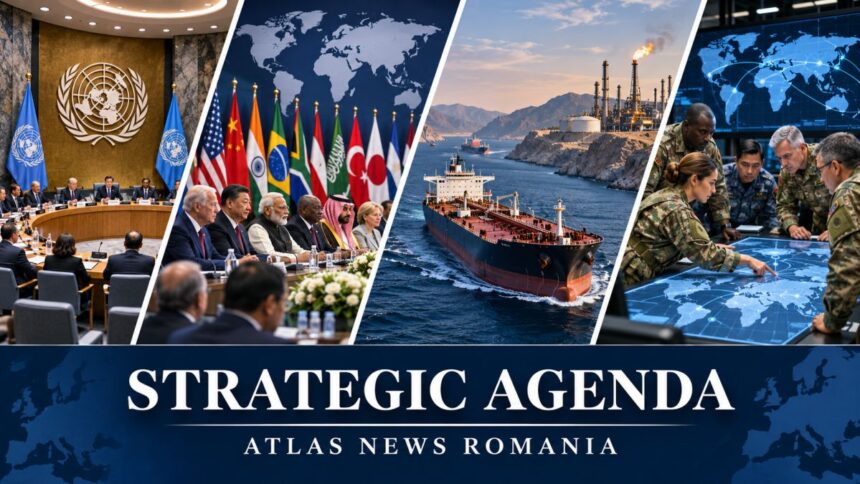
The week of 23–29 November 2026 will bring crucial negotiations on European Union funding and support for Ukraine, an early parliamentary election in Spain, and OPEC+ meetings with implications for the global oil market. In Brussels, European leaders will seek a compromise on the EU’s 2028–2034 budget, while the war in Ukraine and energy security remain among the foremost international concerns.
The European Union will also host a summit with Western Balkan partners, while the European Parliament debates the Union’s funding and strategic priorities. In New York, the United Nations Security Council will discuss the situation in Ukraine and the use of emerging technologies in conflict prevention. In The Hague, States Parties to the Chemical Weapons Convention will review the treaty’s implementation and allegations concerning the use of toxic chemicals in warfare.
The week will conclude with two significant events: Spain’s parliamentary election on 29 November and a series of OPEC+ meetings against the backdrop of tensions in the Strait of Hormuz.
23 November: UN Security Council to Examine the War in Ukraine
The United Nations Security Council will meet in New York on Monday for a further debate on peace and security in Ukraine.
The meeting follows an intensification of Russian attacks on Ukrainian infrastructure and diplomatic discussions held in Berlin and Shenzhen during the previous week.
Council members are expected to examine the military situation and the humanitarian consequences of the war at a time when negotiations to end hostilities have yet to produce an agreement.
The UN Department of Political and Peacebuilding Affairs has confirmed the meeting for 23 November, and it appears on the official Security Council programme.
The prospects for adopting further measures remain constrained by disagreements among the Council’s permanent members, with Russia holding veto power.
Strategic significance: The debate will provide another forum for diplomatic confrontation over the war and highlight the positions of individual countries on peace negotiations, civilian protection and respect for Ukraine’s sovereignty.
23 November: EU Ministers to Discuss Simplifying Access to Cohesion Funding
Ministers responsible for cohesion policy will meet in Brussels on Monday for a session of the General Affairs Council.
The main item on the agenda is the simplification of procedures for beneficiaries of EU funding. Member states will discuss reducing administrative burdens and improving the implementation of funding rules.
The Council will also examine a new strategic vision for the Union’s outermost regions, following a communication presented by the European Commission in September.
These issues are confirmed in the official agenda of the General Affairs Council.
Strategic significance: The discussions concern the effective use of EU funds at a time when changes to the Union’s budgetary framework are under consideration. For Romania, simpler procedures could improve beneficiaries’ access to funding and accelerate project implementation.
23–26 November: European Parliament to Debate the 2027 Budget and European Security
The European Parliament will hold a plenary session in Strasbourg, with an agenda covering the EU’s annual budget for 2027, European security and several legislative files.
Members of the European Parliament are expected to vote on the 2027 budget following the provisional agreement reached between Parliament and the Council on 11 November. Its adoption is a separate process from negotiations on the 2028–2034 Multiannual Financial Framework.
On Wednesday, Parliament will debate Europe’s role in defending the international order and securing a lasting peace for Ukraine, alongside negotiations on the next long-term EU budget.
The programme also includes votes on pharmaceutical legislation and proposals to simplify EU regulations. These matters are outlined in the official documentation for the plenary session.
Strategic significance: Parliament will seek to strengthen its negotiating position ahead of budget discussions among European leaders. The outcome will be relevant to the financing of EU programmes and the Union’s ability to sustain long-term support for Ukraine.
23–27 November: Conference in The Hague to Review Compliance with the Chemical Weapons Convention
The Organisation for the Prohibition of Chemical Weapons (OPCW) will hold the 31st Session of the Conference of the States Parties to the Chemical Weapons Convention in The Hague.
The meeting will review implementation of the treaty, verification activities and measures to prevent the use of chemicals as weapons.
Ukraine will be an important item on the agenda. On 17 November, the OPCW Technical Secretariat transmitted a report on Ukraine’s national investigation to member states at Kyiv’s request, following technical assistance provided by the Organisation’s experts in collecting and analysing evidence.
The transmission of the report does not constitute independent OPCW verification of all the findings of the Ukrainian investigation.
According to information published by the OPCW, the use of riot control agents as a method of warfare is prohibited under the Convention.
The conference will also address verification activities in Syria, following progress in relations between the Syrian authorities and the Organisation.
The meeting’s schedule and mandate are available on the official conference page.
Strategic significance: The discussions will test the capacity of international mechanisms to investigate allegations of chemical weapons use and uphold disarmament standards in conflict situations.
24 November: UN to Discuss Artificial Intelligence and Emerging Technologies in Conflict Resolution
The UN Security Council will hold a high-level debate on Tuesday on conflict resolution in an era of rapid technological change.
The meeting has been initiated by Latvia, which holds the Council’s presidency in November, and is expected to be chaired by Latvian President Edgars Rinkēvičs.
Discussions will address the opportunities and risks associated with the use of advanced technologies in conflict prevention, diplomacy and security operations.
Artificial intelligence, data analysis and new digital tools can support early crisis detection and the monitoring of security developments. Their use also raises questions about the reliability of information, accountability for decisions and the protection of fundamental rights.
The debate is scheduled to begin at 10:00 a.m. in New York, according to the Security Council’s announcement.
Strategic significance: Member states will examine how emerging technologies can be integrated into international security mechanisms without weakening human oversight and political accountability.
25 November: EU–Western Balkans Summit Puts European Enlargement Back on the Leaders’ Agenda
Brussels will host a summit between the European Union and its Western Balkan partners on Wednesday, at a time when enlargement has once again become a strategic priority for the EU.
Leaders of EU member states and representatives of Albania, Bosnia and Herzegovina, Kosovo, Montenegro, North Macedonia and Serbia are expected to attend.
The summit aims to reaffirm the region’s European perspective and encourage the reforms required to bring Western Balkan partners closer to the Union.
Progress towards EU membership remains uneven. Montenegro and Albania have advanced in their accession negotiations, while the other countries continue to face political and institutional obstacles.
According to the European Council’s announcement, the meeting is intended to strengthen the strategic partnership and accelerate reforms. No new accession decisions have been confirmed.
Strategic significance: The EU is seeking to consolidate its influence in a region where political tensions and competing geopolitical interests persist. For Romania, stability in the Western Balkans matters because of regional proximity, transport security and economic cooperation.
26–27 November: European Council to Negotiate the 2028–2034 Budget and Funding for Ukraine
The leaders of all 27 EU member states will gather in Brussels for a special European Council meeting devoted to the next Multiannual Financial Framework and Ukraine’s financing needs for 2027.
European Council President António Costa presented a revised proposal for the 2028–2034 Multiannual Financial Framework on 21 November. The document provides for a reduction of €204 billion, at current prices, compared with the European Commission’s original proposal, equivalent to a 10% cut.
The proposal seeks to limit increases in national contributions while maintaining funding for agriculture, cohesion, competitiveness and defence. Costa supports increased investment in defence and research, alongside the introduction of new sources of revenue for the EU budget.
According to the official statement by the President of the European Council, the aim is to reach a compromise that would allow negotiations to be concluded before the end of the year.
Separately, leaders will discuss Ukraine’s funding requirements for 2027, following the EU’s approval on 20 November of a further €1 billion military assistance package through the European Peace Facility.
The European Council has confirmed both subjects in the official meeting calendar. An inclusive-format Euro Summit is also scheduled.
Strategic significance: The negotiations will indicate whether member states can reconcile investment in defence and support for Ukraine with the financing of established EU policies. For Romania, the key issues include future allocations for agriculture, cohesion and infrastructure, as well as resources for strengthening security on NATO’s eastern flank.
29 November: Spain to Hold an Early Parliamentary Election
Spain will hold an early parliamentary election on Sunday, 29 November, for the Congress of Deputies and the Senate, following the dissolution of both chambers of parliament.
The election was called by a royal decree dated 5 October 2026, published in the Official State Gazette on 6 October.
The election campaign runs from 13 to 27 November. According to Spain’s National Statistics Institute, approximately 38.73 million citizens are eligible to vote.
The electoral timetable is established by Royal Decree No. 806/2026, which also provides for the new parliamentary chambers to convene on 23 December.
The election will determine the composition of the new parliament, under a political system in which forming a government depends on securing the support of a majority in the Congress of Deputies.
The outcome will have implications for Spain’s positions within the European Union, including negotiations on the Multiannual Financial Framework, migration, defence and energy policy.
Strategic significance: The election will determine the balance of power in the Spanish parliament and influence the next government’s ability to participate in European decision-making. Any future governing arrangements will depend on the official results and subsequent political negotiations.
29 November: OPEC+ to Discuss Oil Production Amid Tensions in the Strait of Hormuz
OPEC+ participating countries have scheduled several meetings on Sunday to discuss the oil market and compliance with production commitments.
According to the official OPEC calendar, the 42nd OPEC and non-OPEC Ministerial Meeting is scheduled for 29 November.
The Joint Ministerial Monitoring Committee, which is responsible for assessing compliance with production adjustments, will also meet on the same day.
Separately, the seven OPEC+ countries implementing additional voluntary production adjustments — Saudi Arabia, Russia, Iraq, Kuwait, Kazakhstan, Algeria and Oman — are expected to review market developments.
At their previous meeting on 1 November, these countries decided to maintain December production at the levels established for September 2026, according to the official OPEC statement.
The meetings will take place amid continued instability affecting energy shipments through the Strait of Hormuz, following further incidents involving oil tankers.
In October, the OPEC+ monitoring committee warned that attacks on infrastructure and disruptions to maritime routes could increase market volatility.
No further production adjustments have been confirmed. Any decisions will depend on participants’ assessments of supply, demand and risks to energy deliveries.
Strategic significance: The meetings could influence expectations for global oil supply at a time when the security of shipping routes in the Gulf remains fragile. For European economies, including Romania, movements in energy prices have implications for inflation, transport and industrial costs.
Read also