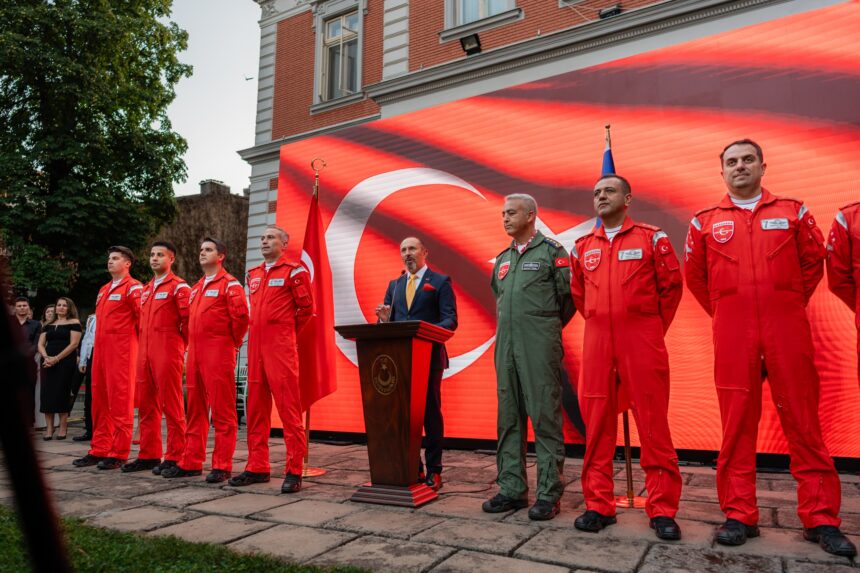
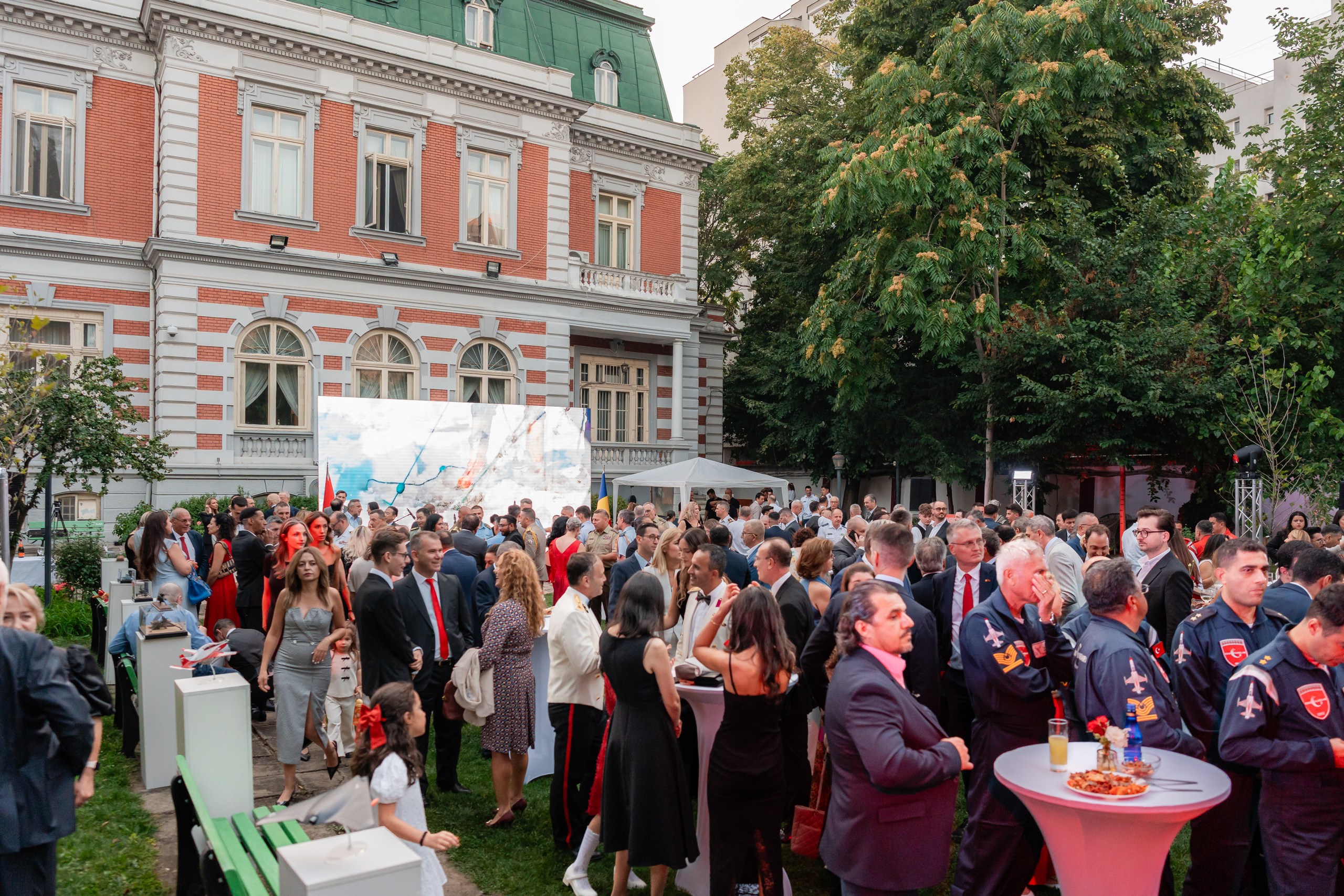
The Embassy of the Republic of Türkiye in Bucharest hosted a reception marking Victory Day – 30 Ağustos Zafer Bayramı – and the 104th anniversary of the Great Offensive of 1922, one of the decisive moments of the Turkish War of Independence. The event brought together senior representatives of Romania’s military leadership, government officials, parliamentarians, members of the diplomatic corps accredited to Bucharest, representatives of the business community and members of the Turkish and Tatar communities. Atlas News Romania attended the reception held in the Romanian capital.
The event took place on the evening of 28 August in the garden of the Embassy of the Republic of Türkiye in Bucharest and was hosted by Ambassador Özgür Kıvanç Altan and Captain Yavuz Alper Kara, Armed Forces and Naval Attaché.
The reception was held two days ahead of 30 August, when Türkiye annually commemorates Victory Day and Armed Forces Day.
Among the senior representatives of Romania’s military leadership in attendance were Lieutenant General Iulian Berdilă and Lieutenant General Dragoș-Dumitru Iacob, Deputy Chiefs of the Romanian Defence Staff, as well as Vice Admiral Mihai Panait, Chief of the Romanian Naval Forces Staff.

The reception also brought together Romanian officials and parliamentarians, representatives of the diplomatic corps accredited to Bucharest, members of the business community, representatives of the Turkish and Tatar communities, and Turkish citizens.
Among the guests were former Prime Minister Victor Ponta, Iulian Chifu and Raed Arafat, alongside representatives of public institutions, the diplomatic community and civil society.
Turkish Stars Bring a Distinctive Presence to the Bucharest Reception
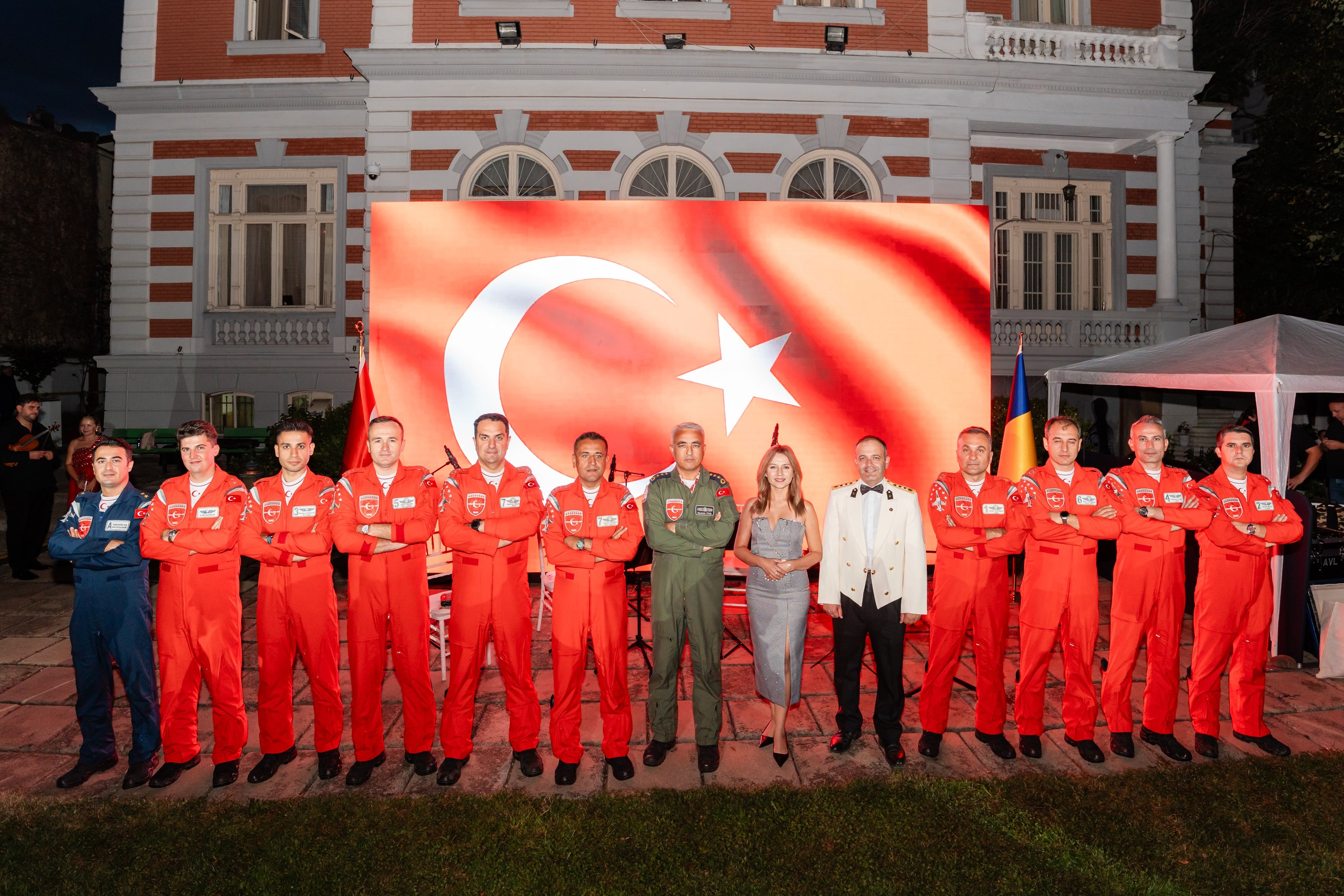
One of the distinctive features of this year’s reception was the participation of pilots from Turkish Stars, the Turkish Air Force’s aerobatic demonstration team.
Their presence in Bucharest coincided with Turkish Stars’ participation in the Bucharest International Air Show – BIAS 2026, held on 28–29 August at Bucharest Băneasa – Aurel Vlaicu International Airport and Romaero.
The official programme of BIAS 2026 included Turkish Stars both in the training sessions held on 28 August and among the international formations and aircraft taking part in the air show on 29 August.
This year’s edition of BIAS brought together more than 200 military and civilian participants from Romania and abroad, further strengthening the international profile of Romania’s leading aviation event.
The participation of Turkish Stars pilots in the diplomatic reception thus created a direct link between the ceremonial dimension of Victory Day and the military cooperation between Romania and Türkiye, two NATO Allies and important actors in the security architecture of the Black Sea region.
Tribute to Mustafa Kemal Atatürk
The events held in Bucharest to mark Victory Day were not limited to the reception at the Embassy.
Earlier that day, a ceremony was also held at the bust of Mustafa Kemal Atatürk in Bucharest.
According to reports in the Turkish community press in Romania, the ceremony included a moment of silence in memory of those who fell and the playing of the Turkish national anthem.
Ambassador Özgür Kıvanç Altan reflected on the historical significance of the 1922 victory and the role played by Mustafa Kemal Atatürk in securing it, underscoring the importance of that moment in the process that would lead to the establishment of modern Türkiye.
Celebrated annually on 30 August, Victory Day commemorates the decisive victory achieved in 1922 during the final stage of the Great Offensive and at the Battle of Dumlupınar, under the leadership of Mustafa Kemal Atatürk.
The victory played a decisive role in bringing the Turkish War of Independence to an end and in the historical process that culminated in the proclamation of the Republic of Türkiye in 1923.
Nearly a Century and a Half of Relations Between Romania and Türkiye
The Bucharest reception took place within the broader context of a bilateral relationship rooted in a long shared history. Modern diplomatic relations between Romania and Türkiye date back to 1878, following the recognition of Romania’s independence.
Over time, relations between Bucharest and Ankara have expanded well beyond the traditional diplomatic sphere and today encompass political, economic, military, energy and security cooperation.
A major milestone in the consolidation of this bilateral architecture came in 2011, with the establishment of the Strategic Partnership between Romania and Türkiye, which provided a framework for deepening cooperation between the two countries.
The year 2026 therefore marks 15 years since the establishment of the Strategic Partnership, within a Romanian-Turkish diplomatic relationship approaching a century and a half.
Strategic Cooperation in a Region Undergoing Profound Change
In recent years, dialogue between Romania and Türkiye has intensified against the backdrop of major shifts in the regional security environment and the growing importance of the Black Sea for NATO and European security.
At the Strategic Dialogue meeting held in Ankara in February 2026, the two sides discussed ways to deepen cooperation in areas including energy, connectivity, the defence industry and Black Sea security.
The talks also addressed preparations for the second meeting of the Romania–Türkiye High-Level Strategic Cooperation Council, a mechanism launched in 2024 to strengthen political and sectoral dialogue between the two countries.
Türkiye is one of Romania’s important strategic partners and a major NATO Ally, while cooperation between Bucharest and Ankara carries particular significance for security in the Black Sea region.
The military dimension of the relationship has become increasingly visible in recent years. Romania and Türkiye, together with Bulgaria, cooperate within the Black Sea Mine Countermeasures Task Group, established to address the threat posed by drifting sea mines in the Black Sea.
Maritime security, the protection of critical infrastructure, defence industry cooperation and the strengthening of NATO’s posture on the Eastern Flank also remain important areas of bilateral dialogue.
Economic Relations as a Major Pillar of Bilateral Cooperation
Cooperation between Romania and Türkiye also has a substantial economic dimension.
In March 2026, the Romanian Government described Türkiye as an important strategic partner, both economically and in its capacity as a NATO Ally and a key actor in the Black Sea region.
Bilateral trade had reached approximately USD 13.5 billion, approaching the shared target of USD 15 billion. Türkiye is also among Romania’s most important trading partners outside the European Union.
Bucharest and Ankara continue to pursue deeper cooperation in areas including energy, infrastructure, connectivity, the defence industry, trade and investment, as the bilateral relationship acquires an increasingly strategic character.
Turkish and Tatar Communities as a Bridge Between the Two Countries
The Turkish and Tatar communities in Romania hold a distinctive place in bilateral relations, representing one of the enduring historical and cultural links between the two countries.
This dimension was also visible at the reception hosted by the Embassy of the Republic of Türkiye, where representatives of the Turkish and Tatar communities joined Romanian officials, senior military representatives, parliamentarians, members of the diplomatic corps accredited to Bucharest and representatives of the business community.
The Victory Day reception thus brought together the historical and ceremonial significance of 30 August with the contemporary reality of a Romanian-Turkish relationship built over nearly 150 years.
In a Black Sea region undergoing profound strategic transformation, relations between Romania and Türkiye continue to develop around shared interests in security, economic cooperation, connectivity and regional stability.
Read also