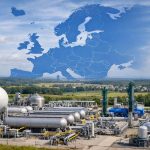
For three decades, Europe largely operated on the basis of an industrial model it never named explicitly: relatively cheap imported energy, transformed by Germany into high-value-added exports, around which an entire continental network of suppliers organised itself, from the car plants of Poland to the components factories of Romania. The continent’s second energy crisis does not test the German economy alone. It reveals how fragile this model has become, and that the solution found in 2022, replacing Russian gas with the global market, significantly increased the likelihood that a regional crisis would turn into a direct levy on European industry.
Here is the confirmed fact: the European Commission estimates, in its Spring 2026 Economic Forecast, that energy inflation in the EU will exceed 11% in the second quarter of 2026 and remain above 10% for the rest of the year, before easing in early 2027, transmitting through the economy along channels similar to those of the 2022 crisis. The Atlas News reading begins here: having reduced its dependence on a single supplier, Europe has once again become vulnerable to the global price of energy.
2022 broke supply. 2026 breaks price predictability
The distinction between the two shocks is essential and rarely made explicit. In 2022, Europe’s problem was physical: where the gas came from. The answer was diversification, namely LNG terminals, contracts with the United States, Qatar and Norway, and accelerated interconnections. On paper, the solution worked: Europe did not freeze, storage filled up, and dependence on Russia was dramatically reduced.
But the solution carried a hidden cost, visible only now. By replacing pipeline dependence with dependence on the global liquefied natural gas market, Europe tied its industrial costs to every crisis in every producing region of the world. The European Commission itself describes this transformation of the European energy landscape, the shift from Russian pipeline gas to the global LNG markets, in a dedicated chapter of its spring forecast.
The confirmed fact: following the escalation of the Gulf conflict, triggered on 28 February 2026 by the American-Israeli strikes against Iran, and the transformation of the Strait of Hormuz into a pressure point on global energy markets, the price of Brent crude swung violently, exceeding 113 dollars a barrel at the peak of tensions, according to Al Jazeera, before settling, according to market reports, in the 92 to 95 dollar range on 11 June 2026, amid a fresh round of American strikes. Iran announced the closure of the strait, while Washington maintained that limited commercial traffic continued to transit the area, as Al Jazeera notes. In its April 2026 monthly oil market report, the International Energy Agency showed that global oil supply collapsed in March by 10.1 million barrels per day, amid attacks on energy infrastructure in the Middle East and disruptions around the Strait of Hormuz, describing the episode as the largest supply disruption in the history of the global oil market.
The Atlas News reading: it is not the physical blockage of direct deliveries to Europe that is the principal mechanism of the shock. What strikes the continent is the geopolitical risk premium, which transfers instantly into the global price paid by industry. Europe can diversify its suppliers. It cannot fully insulate itself from the global price of energy when it depends ever more heavily on international markets. This is the vulnerability that 2022 created in the very act of resolving the previous one.
Europe did not have an industrial energy strategy. It had the German model
Here lies the heart of the problem, beyond the quarterly forecasts. Europe had energy policies: the Green Deal, REPowerEU, the internal market, interconnections. What it did not have was an industrial energy strategy coherent and competitive enough to sustain global competition. In its place, the continent operated largely on the basis of the German model: relatively cheap imported energy, transformed into chemicals, steel, machinery and equipment, with the rest of the continent integrating into this chain as supplier, subcontractor or market. Other industrial centres mattered, among them France, northern Italy and Central Europe, but none structured the European supply chains around itself the way Germany did.
The data show how deeply this foundation has been eroded. Clean Energy Wire, citing Destatis, reports that Germany’s energy-intensive industries recorded a 15.2% drop in production between February 2022 and March 2026, while total industrial output fell by 9.5%. The sharpest decline, 25%, occurred in the glass, ceramics and mineral-processing sector. These same sectors consumed more than 75% of all the energy used by German industry in 2024.
The effect is not uniform, however, and analytical honesty requires us to say so. Energy-intensive industries, such as chemicals, glass, ceramics and metallurgy, are hit hard, while low-energy-consumption and digital sectors retain greater resilience. The Destatis figures confirm this heterogeneity: while glass fell by a quarter, petroleum refining rose by almost 25% over the same period. The institutional position: Destatis attributes the decline directly to the high energy prices that have prevailed since the 2022 crisis. The Atlas News reading goes a step further: the problem is not that Germany is growing too slowly, but that it is slowing at the very moment when the entire European project, from defence to digitalisation and reindustrialisation, needs the German industrial engine running at full capacity.
German industry, the first barometer: the threshold of technical recession
The confirmed fact and the institutional position must be kept carefully apart, because the German institutes do not agree among themselves on the severity.
The German Institute for Economic Research (DIW) has halved its growth forecast for Germany in 2026, to 0.5%, warning that the economy will contract slightly in both the second and third quarters, the definition of a technical recession, before stabilising towards the end of the year. DIW researcher Geraldine Dany-Knedlik nonetheless stresses an important nuance: the current shock does not repeat 2022/23, being less severe, with energy supply still secure and German dependence on fossil-fuel imports reduced.
The joint spring forecast of the five major institutes, DIW, ifo, Kiel, IWH and RWI, anticipates growth of only 0.6% in 2026 and 0.9% in 2027, with inflation rising towards 2.8%. The formulation of ifo’s Timo Wollmershäuser captures the central tension: the energy shock caused by the Iran war strikes the recovery, but expansionary fiscal policy prevents a sharper slide.
The Atlas News reading: this is where the real limit of the model shows. German growth no longer comes from industry or exports, but almost exclusively from public spending on defence and infrastructure. An industrial model sustained increasingly by budgetary injection is not necessarily repaired. It is temporarily stabilised.
Expensive energy strikes precisely the sectors that built German power
The mechanism by which a shock in the Gulf reaches a European factory is worth describing precisely, because it explains why this crisis is more insidious than that of 2022.
More expensive oil transmits first into transport and logistics, then into petrochemicals and plastics. More expensive gas strikes directly at chemicals, fertilisers, glass, ceramics and metallurgy, sectors which, according to Destatis, are energy-intensive precisely because their demand for energy is very high relative to the value they add. The effect is already visible in the international construction sector: executives quoted by Construction Dive acknowledge that the Iran war and the disruptions around the Strait of Hormuz have pushed up the costs of liquid asphalt, diesel and plastics, even as some companies maintain that they can manage these pressures for the time being.
But the most dangerous channel is none of these. It is uncertainty. A factory can absorb a high price; it cannot plan twenty-year investments against an unpredictable one. Expensive energy reduces the profit margin. Volatile energy suspends investment decisions. And an industry that no longer invests does not enter recession; it enters managed decline. In the geopolitics of energy, the distance between the Gulf and the Ruhr has proved shorter than any speech about strategic autonomy.
For Romania, the German slowdown arrives a quarter late, but it also opens a window
If Germany was Europe’s implicit energy strategy, then Central and Eastern Europe remains the most exposed part of this tacit arrangement. Poland, the Czech Republic, Slovakia, Hungary and Romania did not integrate into the „European economy” in the abstract, but into the German industrial chains: automotive, components, processing, logistics. The impact, however, varies from one economy to another: Poland and the Czech Republic are more exposed through automotive chains deeply integrated with Germany, while Romania, with a more sectorally diversified industrial base, is somewhat less directly exposed, but through the same channels.
For Romania, the correct formulation is a cautious one. The risk is not an abrupt rupture, but slow and cumulative pressure on the orders, investments and expansion plans of companies connected to the German ecosystem. When a German carmaker postpones a new platform, the effect reaches the components factories in Romania with a lag of one to two quarters, slow enough not to make headlines, constant enough to erode the industrial base.
But there is also a window here that Bucharest discusses only marginally, not systematically, on the major public agenda. In a Europe where the price and stability of energy are becoming the central criterion for industrial location, the question for Romania is not only how it defends itself against the German slowdown, but whether it can become one of the European locations capable of offering industry what Germany has partly lost: relatively predictable energy, production space, and a strategic position between Central Europe, the Black Sea and the emerging markets. Romania possesses real assets in this respect: domestic gas production, the prospect of Neptun Deep, the nuclear expansion at Cernavodă, and a location outside the risk routes of the Gulf. Such positioning is not improvised once industrial relocations have already begun. It is prepared beforehand.
Berlin is buying time, not repairing the model
The German response deserves to be analysed without cynicism, but also without illusions. Berlin is mobilising public investment, fiscal easing and direct energy support. The European Commission has approved the combination of two subsidy schemes for Germany’s energy-intensive companies over the course of 2026, after industrial associations had criticised the EU conditions as too strict, Clean Energy Wire reports.
Berlin’s official position is that these measures stabilise industry until markets normalise. The Atlas News reading is that they do something else: they turn a competitiveness problem into a budgetary one. Subsidised electricity for industry does not make European energy cheaper; it makes the German taxpayer responsible for the difference. And the European Commission itself warns against broad energy subsidies, recommending instead temporary and targeted support and investment in energy security, rather than the indefinite prolongation of price-suppression schemes.
The opposing argument deserves to be stated fairly, because it is not unserious. Proponents of the German approach would reply that the subsidies, combined with investment in energy infrastructure, LNG, grids, storage and new generating capacity, are not a waste but a bridge: they retain industrial capabilities and a specialised workforce precisely until new energy capacity matures, after which the price gap closes on its own. On this reading, „buying time” is not a strategic error but the strategy itself. The difference between the two interpretations is not philosophical but empirical, and it will be settled in the data.
To this dilemma is added the monetary trap. For the European Central Bank, energy inflation is the worst kind of inflation: it does not come from an overheated economy, which interest rates can cool, but from an external shock that makes the economy weaker. The Commission confirms the mechanism: high energy prices redirect income from the European economy towards energy-exporting countries, reducing profits and consumption. Higher rates would stifle precisely the industrial investment Europe needs; lower rates would let energy inflation spread.
The real stake is not Germany’s recession, but Europe’s industrial status
A technical recession in Germany would be a serious signal, but it is not the deeper stake. The stake is whether Europe can still remain a major industrial actor in a world of expensive energy, regional wars and aggressive industrial policies from the United States and China. The Draghi report has already named the energy price gap between the EU and its trading partners as one of the central causes of lost industrial ground, showing that EU firms pay electricity prices two to three times higher than in the United States, while the natural gas they pay for is four to five times more expensive. What the report did not state quite as explicitly is that this gap does not strike „Europe” in the abstract, but the concrete architecture in which Germany was the pivot.
The thesis set out above can be disproven. If the geopolitical risk premium dissipates rapidly, through a durable stabilisation of the Gulf conflict and a verifiable normalisation of transit through Hormuz, and German industrial output returns to growth without the subsidies being extended beyond 2028, then the 2026 crisis will have been a cyclical episode, not a structural confirmation. Equally, if the German industrial price scheme succeeds in retaining energy-intensive investment until new energy capacity matures, „buying time” will have proved a functional strategy. The next four quarters of data on German private investment will arbitrate between the two readings.
What is not falsifiable is the fact already consummated: Europe has discovered that it does not control the variable on which its entire industrial project depends. In 2022, that vulnerability bore the name of a country. In 2026, it no longer has a name. It has only a price, and that price is set, every day, outside Europe.
Read also
Europe Cannot Win the Green Transition by Losing Its Auto Industry