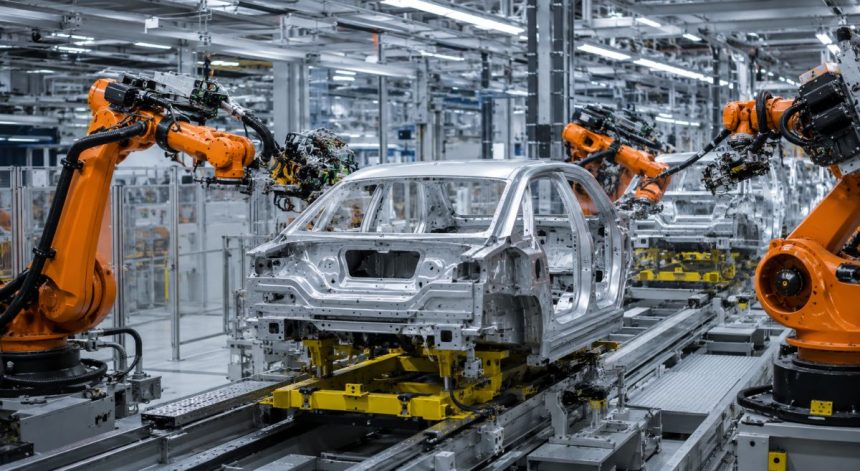
The European auto industry is undergoing a structural realignment without recent precedent. The real strategic issue is not the calendar of the transition to electric mobility, but control over the value chain that makes it possible — from raw materials and batteries to software and charging infrastructure.
The green transition remains necessary, and reducing emissions from transport is a legitimate objective. But in the new global context, it can no longer be treated exclusively as environmental policy. It has become a matter of competitiveness, economic security and industrial power.
The central question is not whether Europe will have more electric or hybrid vehicles on its roads. It will. The question is who will produce the technology, who will control the batteries, who will provide the software, who will finance the infrastructure and where the jobs will remain.
This is the strategic signal Europe must read clearly: the transition to low-emission mobility is not only a technological shift, but a realignment of geoeconomic power. China is advancing rapidly in electric vehicles, hybrids, batteries and supply chains; the United States is increasingly explicit in protecting its industrial base; Europe is trying to preserve, at the same time, its climate ambition, industrial competitiveness and social cohesion.

For Romania and Central and Eastern Europe, the debate is not abstract. Dacia Mioveni, Ford Otosan Craiova and the broader network of automotive suppliers are part of the country’s real industrial infrastructure. Any European decision on 2035, hybrids, batteries, charging infrastructure or Chinese competition directly affects plants, investment, exports and jobs.
What Has Changed in Brussels
Brussels has entered a phase of adjustment regarding the 2035 framework. Reuters reported that the European Commission proposed in December 2025 to move away from the effective ban on the sale of new cars with internal combustion engines after 2035, replacing the zero-emissions target with a 90% reduction in CO2 emissions compared with 2021 levels.
According to the same Reuters report, the proposal would allow the continued sale of some non-electric vehicles, including plug-in hybrids and range extenders, with the remaining emissions offset through the use of EU-made low-emission steel, e-fuels or biofuels. The measure must be approved by the governments of the member states and by the European Parliament.
Associated Press presented the same development as a proposal to relax the 2035 ban on new cars with internal combustion engines, in a context shaped by pressure from the auto industry, still insufficiently developed charging infrastructure, the high prices of electric vehicles and competition from Chinese manufacturers.
This change is not the abandonment of the electric transition. It is the recognition that the transition cannot be reduced to a single technology and a single timetable. Europe is not returning to the old automotive paradigm, but it can no longer treat the transition as a rigid, uniform and linear formula. European automotive policy is entering a more realistic phase: the climate objective must be aligned with infrastructure, energy, industrial costs, consumer acceptance and global competition.
The Power Realignment Behind the Figures
The European auto industry is not facing only a technological transition. It is facing a shift in the industrial centre of gravity. Reuters reported, citing an EY study, that German automakers saw a 4% decline in revenues in the first part of 2026, while major global carmakers recorded, overall, a 2% increase.
The study cited by Reuters points to multiple pressures: falling sales in key markets such as the United States and China, overcapacity, high software costs and the difficult transition to electric vehicles. Constantin Gall, EY’s automotive specialist, warned that 2026 will be “another crisis year for the automotive industry”.
At the same time, Europe’s position in the Chinese market is eroding. Reuters reported, based on data from the German Economic Institute, that German car exports to China fell by about one third in 2025, continuing a decline that has cut deliveries by more than half compared with the 2022 peak. Exports of cars and components fell below €14 billion, down from nearly €30 billion three years earlier.
These figures show that the problem is not only the pace of electrification, but Europe’s position in the new industrial architecture. The electric vehicle shifts value away from traditional mechanics — where Europe had a historic advantage — toward batteries, software, power electronics, critical raw materials and scaled production capacity. In many of these areas, China is already aggressively positioned.
Reuters has documented the expansion of Chinese automakers in Europe: BYD, Chery, Geely, SAIC, Xpeng and Leapmotor are increasing their market presence, combining competitive prices, advanced technology and, increasingly, industrial localisation. BYD aims to produce locally for Europe by 2028, Chery is developing production through a partnership in Spain, and SAIC is considering a plant in Galicia.
Europe is regulating the acceleration of the transition toward electrified technologies precisely at the moment when Chinese competitors are entering these segments forcefully. This is not an argument against electrification. It is an argument for understanding the transition as a matter of industrial power.
The Hybrid Becomes a Field of Competition
Market data show that European consumer preference is more complex than a direct shift from internal combustion to purely electric vehicles. ACEA reported that, in the first four months of 2026, battery-electric vehicles reached 19.7% of the EU market. At the same time, hybrids remained the most popular option, with a 38.2% share.
This difference matters strategically. The European market is not rejecting electrification, but it is adopting it gradually. For many consumers, the hybrid offers a more accessible transition formula: it reduces fuel consumption, preserves flexibility, does not depend entirely on charging infrastructure and better addresses range anxiety.
Based on the verified data, the current dynamic is not that of a Chinese regulation blocking European hybrid imports into China and single-handedly explaining the decline in European exports. What is clearer is something else: European exports to China are falling, while Chinese manufacturers are gaining ground in Europe, including through the expansion of electrified model ranges.
This development turns the hybrid not only into an intermediate technology, but into a field of industrial competition. If Europe makes the 2035 framework more flexible and leaves more room for intermediate solutions, that flexibility may help European manufacturers. But it may also create an even more attractive market for Chinese producers capable of competing aggressively on price, volume and technology.
Tariffs Buy Time, but They Do Not Replace Industrial Strategy
The European Union has responded to Chinese pressure through trade instruments. The European Commission imposed definitive countervailing duties in 2024 on battery-electric vehicles produced in China, after its investigation concluded that the BEV value chain in China benefits from subsidies that create a risk of economic injury for European producers. The duties included levels of 17% for BYD, 18.8% for Geely and 35.3% for SAIC.
In January 2026, the European Commission also published guidance on minimum price undertaking offers that Chinese electric vehicle exporters may propose as an alternative to duties. The document covers minimum import prices, sales channels, the prevention of cross-compensation and future investments in the EU.
These measures are relevant, but they cannot substitute for industrial policy. Tariffs can slow certain trade flows, buy time and create a framework for negotiation. They cannot, by themselves, build battery factories, reduce the cost of energy, train software capabilities, modernise electricity grids or guarantee that the industrial value of the transition remains in Europe.
From here on, the question is not only whether Europe can temporarily protect domestic producers. The question is whether the time gained through trade instruments can be converted into real industrial capacity.
Suppliers, Jobs and Production Capacity
Behind the major automotive brands lies a vast network of suppliers. This is where the tension of the transition becomes visible. CLEPA reported that, in 2024 and 2025, European automotive suppliers announced 104,000 job cuts, equivalent to around 142 positions per day. The organisation described the situation as a “structural reset”, driven by weak demand, high costs and pressures on competitiveness.
This figure is not an argument against the green transition, but an indicator of its complexity. Technological change redistributes value inside the automotive chain. Some skills become less relevant, others become critical. Some factories can be adapted, others come under pressure. Some regions can attract investment, others may lose industrial capacity.
The transition cannot be assessed only by the number of electric vehicles sold. It must also be assessed by the jobs preserved or created, by the quality of investment, by control over technology and by Europe’s ability to remain a producer, not merely a consumer market.
Infrastructure Is Advancing, but Unevenly
Charging infrastructure is one of the most sensitive variables of the transition. European infrastructure is not absent — it is growing. But it is growing unevenly and does not yet cover all the needs of a uniform transition across states, regions and categories of consumers.
IEA, in its Global EV Outlook 2025, shows that the number of public charging points in Europe grew by more than 35% in 2024 and surpassed 1 million. The IEA also underlines, however, the significant differences between countries, shaped by different rates of electric vehicle adoption and infrastructure development.
IEA also shows that more than three quarters of European motorways have a fast-charging station at least every 50 kilometres. This is a significant development, but it does not solve all the practical problems of the transition: charging in rural areas, access for people living in apartment buildings, differences between member states, the capacity of local grids and connection costs.
European infrastructure is not absent, but it is not yet sufficiently uniform for a policy applied identically across all member states. The Netherlands, Germany, France or the Nordic states are not in the same position as Romania, Bulgaria or other Eastern European economies. This difference matters for the social acceptance of the transition.
Why This Matters for Romania
Romania is not watching this realignment from the outside. It has direct industrial assets. Renault Group describes the Dacia plant in Mioveni as a major industrial complex, with bodywork, assembly, chassis, spare parts and logistics activities, 6,096 employees as of 31 December 2025 and 90% of the vehicles produced exported.
At the same time, Craiova has already entered the electrification stage. Electrive reported that the Puma Gen-E, E-Transit Courier and E-Tourneo Courier have begun production at Ford Otosan’s Craiova plant, becoming the first electric vehicles manufactured in Romania and exported to other European states and Turkey.
This dual reality is important. Romania has both a volume auto industry built around affordability and production capacity for electric vehicles. This gives it exposure, but also relevance. In a Europe where production costs, infrastructure, supplier chains and technological flexibility are becoming central political issues, Romania is not merely a passive beneficiary of European decisions. It is a state with direct industrial interests.
For Bucharest, the debate about 2035, hybrids, batteries, energy and tariffs is not merely an environmental debate. It is a debate about the competitiveness of an important part of the national economy.
Europe Does Not Have to Choose Between Climate and Industry
The most important message is that Europe does not have to choose between climate and industry. The climate objective can be defended in the long term only if it is backed by a solid industrial policy.
The electric vehicle will play a central role in the mobility of the future. Hybrids can play a transitional role. Sustainable fuels can cover certain niches. Public transport, rail infrastructure, energy efficiency, European batteries, automotive software and the modernisation of electricity grids are part of the same equation. The issue is not choosing a single technology, but building a transition that can be sustained industrially, socially and geopolitically.
This reading does not assume that electrification is wrong or that a return to the old industrial paradigm is possible. On the contrary, the data show that electrified vehicles are gaining ground. The strategic question is whether Europe will be able to turn this growth into an industrial advantage of its own or whether it will gradually become a premium market for technologies developed and produced outside the continent.
The Real Stakes: Europe Must Remain a Producer, Not Just a Market
In a world in which power is increasingly measured through control of technology, production capacity and critical chains, the green transition can no longer be treated as a mere regulatory file. It is part of the global competition for industry.
If Europe reduces emissions but moves industrial value outside the continent, the transition will create a new form of dependency. If, instead, Europe manages to preserve production, technology, suppliers, research and critical infrastructure within its own economic space, the green transition can become one of the pillars of its strategic autonomy.
This is the wake-up call. Not a rejection of the Green Deal, not a criticism of electrification and not a plea for a return to the past. Rather, a lucid observation: in the new geoeconomic order, climate policy cannot be separated from industrial power.
For Europe, the decisive question is not only what type of cars will be on the roads after 2035. The question is who will build them, with what technology, with what batteries, with what software, in which factories and with what benefits for European societies.
Without this answer, the green transition risks being won normatively and lost industrially. With this answer, it can become not only an environmental policy, but a European power strategy.