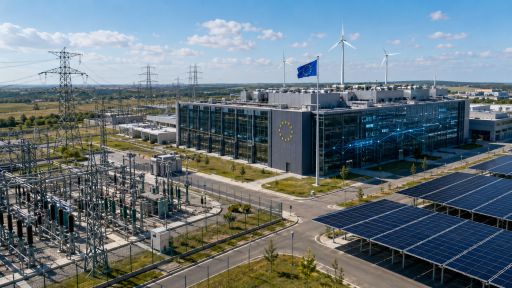
The digital sovereignty announced by the European Union on 3 June 2026 risks confusing infrastructure with control from the very outset. The technological sovereignty package promises to triple Europe’s data-centre capacity in order to reduce dependence on American cloud providers — which, according to the European Commission (digital-strategy.ec.europa.eu), control more than 70% of the market and cost the Union €264 billion per year. But building data centres does not, in itself, mean owning the technology that runs inside them. It means pouring concrete, laying cables and paying for electricity — on one of the most expensive energy systems in the industrialised world — while the layer that matters decisively, namely software, artificial intelligence models and advanced computing capacity, remains largely dependent on non-European actors.
Europe does not automatically buy sovereignty. In its current form, it risks buying the hosting of its own dependency, at a price that may be socialised through citizens’ electricity bills.
This is the thesis that the parliamentary question submitted that same week by MEP Rareș Bogdan touches upon without naming it in these terms. The question “who pays?” may sound accounting-related. The answer is strategic: the package treats sovereignty as a matter of square metres and megawatts, when it is equally a matter of intellectual property, computing capacity and control over the value chain. And the difference between the two is not a nuance — it is the distance between genuine autonomy and subsidised infrastructure.
The category error
To see the mistake, one must separate what the package measures from what actually matters. The European Commission (digital-strategy.ec.europa.eu) correctly counts the symptoms: American providers control more than 70% of the cloud market, the Union produces less than 10% of global semiconductors, and the annual external bill reaches €264 billion. The proposed response — tripling physical capacity and mobilising roughly €200 billion in investment, mostly private, by 2036 — addresses primarily the surface of the problem, not its substance.

Technological sovereignty rests on three layers: physical infrastructure, meaning land, buildings, energy and networks; computing capacity, meaning chips, accelerators and specialised equipment; and the logical layer, meaning cloud operating systems, AI models, software and services. Only the first is directly territorial.
American hyperscalers — Amazon, Microsoft and Google — can remain the main operators and beneficiaries of European data centres regardless of where the concrete is poured, because they own or control the layers with higher strategic value. Europe risks taking over the heavy and costly part of the equation — land, energy, pressure on the grid — without capturing enough of the profitable and strategic part. Calling this arrangement “sovereignty” is, at best, an incomplete ambition. At worst, it is a category error.
The Commission has tried to cover the gap through regulation: a four-tier sovereignty framework in which, at the highest level, providers must be owned and controlled from within the EU. But here lies the trap that industry immediately identified. Either the framework is real — in which case it may push away precisely the providers Europe cannot rapidly replace — or it is symbolic, and sovereignty remains a label attached to foreign infrastructure powered by expensive European energy. In both scenarios, the only thing that certainly changes is consumption.
How the Commission responds — and why it is not enough
Brussels has a serious counterargument, and an honest analysis must address it at its strongest. The Commission would say that infrastructure is the necessary first step, not a confusion. Without data centres on European soil, sovereignty cannot exist at the higher layers. Physical computing capacity is now a strategic asset in itself, and the package explicitly includes AI Gigafactories, funding for chips and cloud, precisely in order to move up the value chain. Building infrastructure means creating the option to control it; not building it means giving up that option from the start. Sovereignty is built from the bottom up, and concrete is the foundation, not the illusion.
The argument is coherent and cannot be dismissed superficially. It would be decisive, however, only if two conditions were met.
First: for infrastructure to become a step towards control, the state or economic space hosting it must capture the added value — through its own cloud providers, competitive AI models, chips, software and ownership of the logical layer. Yet the current pace does not yet show that Europe is closing this gap before the major data centres are already built and operated by the same global actors. The foundation is being poured now; the European upper floor remains, for the time being, a work in progress.
Second: even if the “bottom-up” logic is correct, it assumes that the foundation can be paid for without harming the existing economy. And this is precisely where the Commission’s reasoning breaks down — because that foundation is being poured on an energy system that is structurally more expensive than those of its main global competitors.
The price of the foundation: Europe’s expensive energy
The International Energy Agency (iea.org) shows that, in 2025, electricity prices for energy-intensive industries in the EU remained, on average, more than twice as high as in the United States and almost 50% higher than in China and India. At residential level, Eurostat (ec.europa.eu) confirms that household prices have stabilised at levels far above those seen before the 2022 crisis.
Against this background, the scale of the leap is no longer a vague estimate. According to data cited by The Irish Times / Reuters (irishtimes.com), data-centre capacity in the EU is expected to rise from approximately 12 gigawatts in 2025 to around 28 gigawatts in 2030, lifting their share of the Union’s electricity consumption above the current level of 2.5%.
The same assessment acknowledges the risk: if demand is met through fossil-fuel plants kept online or newly built, the expansion may slow the clean transition and push energy costs higher as grids come under pressure. In other words, the Commission is describing the very mechanism through which its own project may become vulnerable: hosting digital sovereignty risks making the energy that should make it viable more expensive.
How the bill reaches those who decided nothing
The migration of cost from an ambition formulated in Brussels to the bill paid in Cluj, Galați or Craiova is the least visible part of the file — and the most instructive. Here, the general thesis meets the concrete test. In the absence of clear European financing, transmission and distribution companies modernising networks for new consumption recover their investment through regulated tariffs, approved by authorities and automatically included in the final bill.
Romania is proof that this mechanism is not theoretical, but already unevenly distributed. According to ACER, based on Eurostat data (aegis.acer.europa.eu), network costs account for around 23% of the average household electricity bill in the EU — but in Romania they reach 38%, one of the highest shares in the Union. The system through which new infrastructure is paid for through tariffs weighs almost twice as heavily in Romania as the European average. Eurostat (ec.europa.eu) confirms the direction: although supply costs declined in 2024, network costs rose in 18 Member States, by almost 9% at EU level.
In other words, the map of losers is not a prediction — it already exists in the structure of the bill, and Romania is close to its top.
On top of this layer sits another, political and climatic in origin. EU ETS emission allowances, averaging around €75 per tonne in 2025, are passed into wholesale prices whenever gas sets the marginal price — the system in which the most expensive active source sets the price for the entire market.
Here, a distinction must be made which political discourse often misses, but which serious analysis cannot afford to ignore. The dominant cause of high prices is not environmental policy itself, but dependence on imported gas, amplified by the marginal pricing mechanism. The Green Deal did not create the dependency; it did, however, add cost on top of it and, above all, imposed that cost before the infrastructure meant to make it bearable was fully available.
Confirmation comes from a source that can hardly be suspected of hostility towards the green transition: the Draghi report on European competitiveness, published by the European Commission (commission.europa.eu), shows that European firms pay two to three times more for electricity than American firms and four to five times more for gas — but it does not reject decarbonisation. On the contrary, it presents it as a potential driver of competitiveness, provided investment follows.
The real critique is not against the climate objective, but against the sequence. Europe priced carbon before fully building the alternative, and it is now adding AI consumption on top of an already strained energy system.
The real map: who can host without losing
The category error has a geographical corollary that complicates the rhetoric of European unity. The transition does not weigh equally on all Member States, because some can pour the digital foundation without destabilising their economies. States with nuclear energy — France first and foremost — enter the race from an incomparably stronger position: more stable wholesale costs and decarbonised electricity at the same time, exactly the combination data centres are looking for.
It is no coincidence that, according to The Irish Times / Reuters (irishtimes.com), the Commission delayed the part of the package concerning data centres precisely because it is debating how to evaluate installations powered by nuclear energy.
The difference is not technical, but strategic. If sovereignty meant only infrastructure, all states would be relatively equal before concrete. But because what matters is the ability to host without losing — meaning cheap, stable and clean energy — the race is already tilted in favour of those that have solved the energy layer.
Those that produce nuclear energy or have stable low-emission capacities can host AI without transferring the full cost to citizens and industry. Those that import expensive gas risk paying for sovereignty twice: once through the bill, and once through lost competitiveness. Romania, with network costs accounting for 38% of household bills and with exposed energy-intensive industry, is currently in a vulnerable position.
But Romania also has an exit route not available to all states. Black Sea gas production, nuclear potential and hydropower capacity theoretically give it a ticket into the group of states that can turn energy into strategic advantage. The question is not only whether Romania receives European funds, but whether it accepts the rule under which the cost of grid modernisation remains national — transferred into a bill with a 38% network component — or becomes European, co-financed and directly linked to the Union’s digital sovereignty objectives.
Romania confirms the thesis in both directions. It remains a loser if it treats energy as a simple budgetary revenue source and accepts the socialisation of costs through tariffs. It becomes a winner only if it treats energy as a strategic asset and links every data centre to a dedicated source, not to the socialised grid. Its case is not an annex to the argument. It is the demonstration that sovereignty is decided at the energy layer, not only at the physical one.
What decision-makers should do differently
The conclusion is not to abandon digital sovereignty, but to refuse to confuse it with physical infrastructure. Three conditions separate it from illusion.
First: no data-centre megaproject without an attached European source of financing for the grid. This is, in substance, the guarantee requested in Rareș Bogdan’s parliamentary question. Without it, “sovereignty” may become citizen-subsidised consumption.
Second: simultaneous investment in layers two and three — computing capacity and European software — so that infrastructure becomes a real step towards control, not merely an indirect subsidy for hyperscalers. Otherwise, the Commission’s counterargument remains a promise without a deadline.
Third: reducing the dependence of electricity prices on gas and achieving genuine integration of the European energy market, exactly one of the vulnerabilities highlighted by the Draghi report. The recent signal that Brussels is trying to correct the problem downstream — a draft reform of energy taxation, reported by Reuters (reuters.com), which would tax electricity below the level of gas — acknowledges the problem, but treats primarily the symptom, not the cause built upstream.
The verdict: what Europe is really buying
Digital sovereignty will not be decided at the level of poured concrete, but at the level of the layers that concrete merely shelters. If Europe effectively moves up into computing capacity and software — if AI Gigafactories produce European processing power, if competitive models emerge, if cloud providers from within the Union gain real market share — then today’s infrastructure can indeed become the foundation of tomorrow’s autonomy, exactly as the Commission argues. The physical step is not wrong. It is, however, insufficient and riskily sequenced, and the window in which it can be corrected is closing as major data centres are built and operated by the same global actors the package claims to counterbalance.
There is also a path through which energy pressure can be turned into leverage. If data-centre demand catalyses the construction of nuclear and renewable capacity with storage faster than it congests the grids, artificial intelligence can become the engine of the transition, not its burden — and the price differential with global competitors, which Bruegel (bruegel.org) considers reducible over the long term through well-managed decarbonisation and integrated markets, would cease to be the expensive currency with which Europe pays for its ambitions.
None of these corrections, however, is automatic, and the 3 June package does not guarantee them. As long as the foundation is being poured on the most expensive electricity in the industrialised world, without the European upper floor being built in parallel and without grid financing being co-financed at Union level, the equation remains the same. Europe is not buying autonomy through this package. It risks buying the hosting of its own dependency — and sending the bill home, through the electricity bills of citizens who were never at the decision-making table.