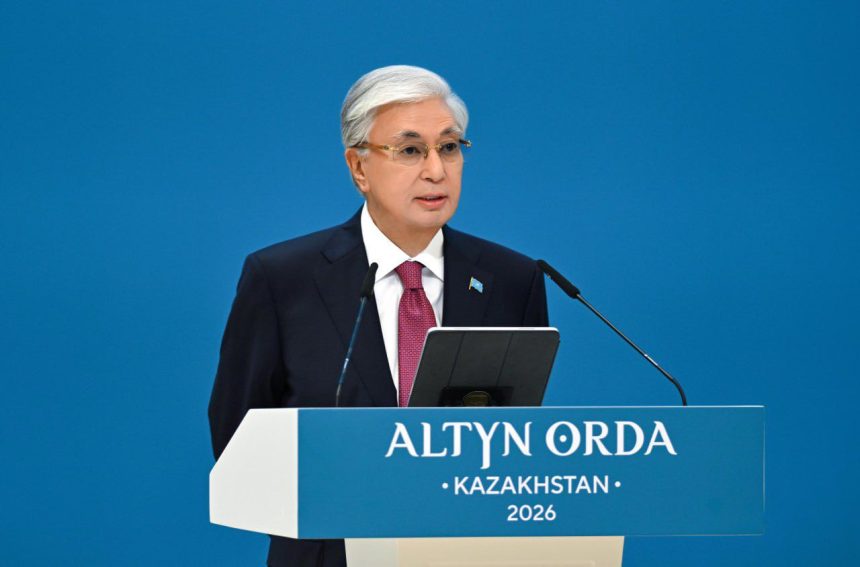
With Egyptian participation and the attendance of 150 scholars—including historians, archaeologists, and orientalists from more than 20 countries—the international symposium titled “The Golden Horde as a Model of Steppe Civilization: History, Archaeology, Culture, and Identity” was held in the Kazakh capital, Astana.
The Golden Horde is considered one of the major political entities that played a prominent role in the history of Central Asia, Eastern Europe, and the Islamic world. Its political and military movements, as well as its diplomatic relations with the Mamluk state in Egypt, influenced the course of events in the region, which drew the attention of several Egyptian historians.
Among the Egyptian delegation were Dr. Mahmoud Rushdi Salem, Professor of Archaeology at the Faculty of Archaeology, Cairo University, and Dr. Mohamed Riyad, Professor at the Faculty of Al-Alsun.
Reflecting the tangible global academic significance of the topic, the symposium was attended by historians, archaeologists, orientalists, Turkologists, political scientists, cultural experts, and representatives of international organizations from countries including Pakistan, China, Egypt, Russia, Mongolia, India, Japan, and several European states.

In the plenary session, President of the Republic of Kazakhstan Kassym-Jomart Tokayev delivered a speech in which he affirmed that the study of the Golden Horde has long surpassed the boundaries of a single nation’s interests.
The Golden Horde connected East and West and played a significant role in the development of civilizations and states across Eurasia.
He described the Golden Horde as one of the most influential political structures in Eurasian history, underscoring the international nature of this scholarly issue.
Tokayev added the Golden Horde era remains an important part of Kazakhstan’s national history and civilizational development.
The president noted that the history of the Golden Horde should not be simplified into a narrow military narrative and stressed the importance of objective and politically neutral historical research.
President Tokayev also acknowledged the role of UNESCO in preserving Kazakhstan’s cultural and historical heritage, including the recognition of important landmarks and historical manuscripts.
He emphasized the importance of academic diplomacy and dialogue in today’s geopolitical environment, saying historians and researchers could help build understanding between nations.
Speaking from Egypt, Dr. Mahmoud Rushdi Salem, Professor at the Faculty of Archaeology, Cairo University, discussed the Golden Horde in the writings of Egyptian historians.
He described it as one of the major political entities that emerged in the aftermath of Mongol expansions, and noted its political and military movements and diplomatic relations, particularly with the Mamluk state in Egypt, and their impact on regional events.
He added that during the symposium he reviewed the works of two of the most prominent historians who contributed to the study of Islamic history: the historian Taqi al-Din al-Maqrizi, as a model of classical historians known for his precision and reliance on narration and critical analysis; and the Egyptian historian Dr. Saeed Abdel Fattah Ashour, representing the modern historical school and its contemporary scientific methodologies in historical study.
He pointed out that Egyptian historians addressed the affairs of the Golden Horde in the context of monitoring Mamluk-Mongol relations. The value of Egyptian historians’ writings lies not only in recording events but also in offering an analytical perspective on the nature of the Golden Horde state, its political structure, and the positions of its sultans on issues concerning the Islamic world. This research thus seeks to shed light on the image of the Golden Horde in the writings of Egyptian historians, clarify their approach to covering its news, and assess their contribution to shaping our historical understanding of this important Mongol entity.
The symposium’s sessions addressed issues of international relations, the system of governance, monetary circulation, and the intellectual legacy of the Golden Horde era. The comprehensive study of the Golden Horde’s legacy—based on archaeological materials, numismatics, epigraphy, and cultural anthropology—contributes to a deeper and more complete understanding of history.
Read also
“Cairo Left a Unique Impression”: Ney Player Sinem Hondoroglu on Her First Visit to Egypt