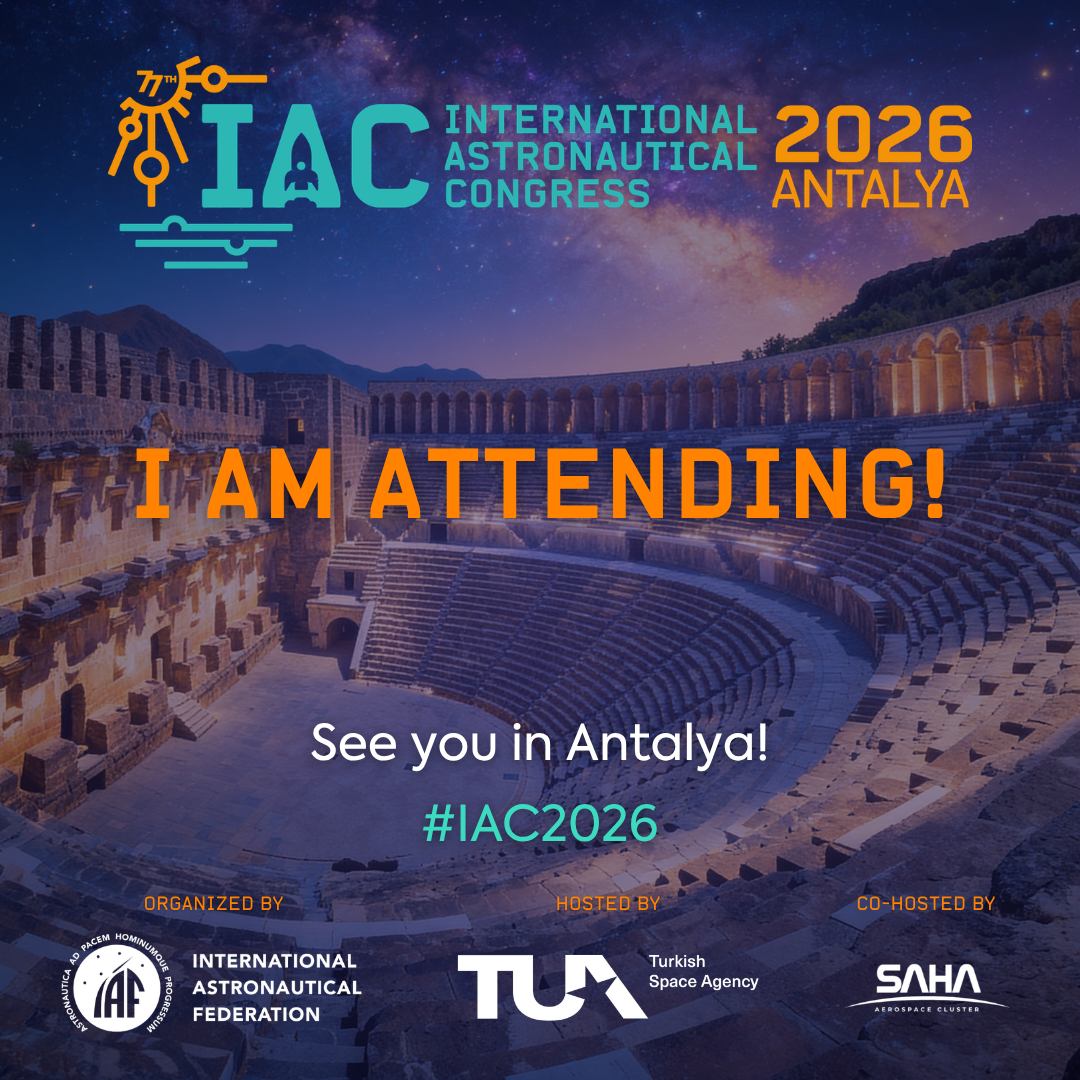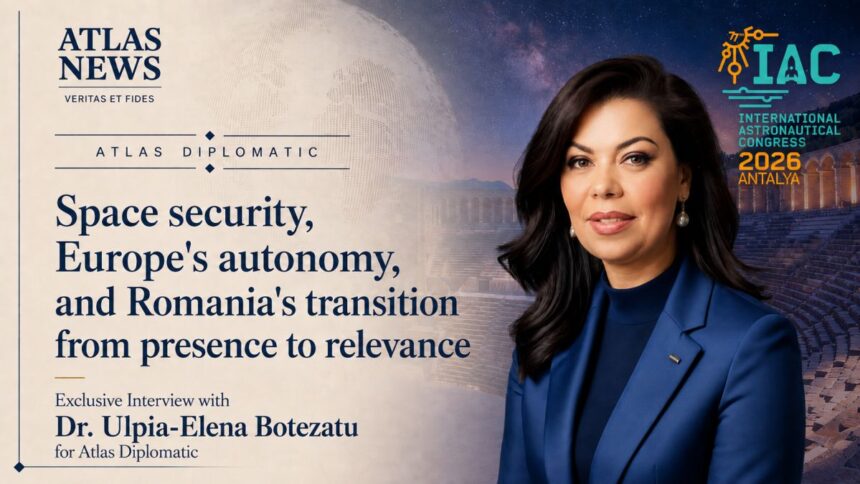
Ahead of the International Astronautical Congress — IAC 2026, hosted by Antalya under the theme „The World Needs More Space,” Atlas News Romania spoke with Dr. Ulpia-Elena Botezatu, one of the most authoritative Romanian voices in the field of space security. Romania’s representative to the United Nations Committee on the Peaceful Uses of Outer Space (COPUOS), Dr. Botezatu chaired its Scientific and Technical Subcommittee during the 2024–2026 mandate and co-chairs, alongside Pakistan, ATLAC — the Action Team on Lunar Activities Consultation, an initiative launched by Romania and established by consensus within COPUOS in 2024. On modern societies’ invisible dependence on orbital infrastructure, on artificial intelligence, the increasingly permeable frontier between civil and military, Europe’s strategic autonomy, and the fields where Romania can truly matter — in the interview that follows.
„Society has almost forgotten how much it depends on space”
Atlas News Romania: IAC 2026 takes place under the theme „The World Needs More Space,” at a moment when modern societies’ dependence on orbital infrastructure is growing at an accelerating pace. From a space security perspective, what is the risk that states and the public underestimate most when speaking about this dependence?
Dr. Ulpia-Elena Botezatu: I believe the most underestimated risk is precisely the invisible character of our society’s dependence on space. When we speak about space infrastructure, the immediate image is that of satellites, launchers, or exploration missions. In reality, space has already become an invisible layer of modern society’s infrastructure, sustaining a great many areas of life. Telecommunications, transport, energy, financial services, agriculture, meteorology, disaster management, security, and defense depend, to varying degrees, on services delivered from space.
That is why the major risk is not necessarily tied to the spectacular narrative of losing a satellite. Far more dangerous for society can be the loss of the service that satellite was providing, and above all the cascade effect it generates: the moment a space-based service becomes unavailable, degraded, or compromised, the problem propagates to infrastructures that, on the surface, have nothing to do with space, which end up being functionally affected as well. Sometimes the service continues to exist, but the information it delivers can no longer be trusted. Spoofing, interference, cyberattacks, or data manipulation can turn a functioning service into a source of flawed decisions.

From this perspective, space security is no longer a matter reserved for space agencies. It is a matter of economic security, societal resilience, and national and regional security. Ultimately, the vulnerability of contemporary society is not that it uses space so much. It is that it has come to use it so intensively that it has almost „forgotten” how much it depends on space.
Atlas News Romania: In your research, you have analyzed the relationship between Space Domain Awareness, critical infrastructures, and cybersecurity. If a state temporarily loses access to navigation, communications, or satellite observation services, how quickly can a problem in space turn into a major vulnerability for infrastructures on Earth?
Dr. Ulpia-Elena Botezatu: In some situations, the effects can appear almost immediately. In others, within minutes or hours. Everything depends on how heavily the infrastructure in question relies on the affected space services and on whether backup systems exist.
A simple example is satellite navigation. When we talk about GPS or, more accurately, about global navigation satellite systems — GNSS —, we think first of positioning. But these systems also provide time synchronization that is used extensively in financial transactions, as well as in telecommunications systems, transport, energy grids, and numerous digital services. This means that a problem arising in space can quickly have consequences on Earth. A satellite malfunction, interference with the signal, a cyberattack on a ground station, or compromised data can affect services that, at first glance, appear to have no connection to space whatsoever.
This is why the concept of Space Situational Awareness — SSA — is so important: being able to understand, as well as possible, what is happening in the space environment. It is not enough to observe that a disruption exists. We must be able to determine quickly what happened, which systems are affected, and what the cause is: a technical failure, an accident, interference, or a deliberate action. The faster we understand the situation, the better we can limit the effects on infrastructures on Earth.
We will not be able to prevent every incident. But we can build systems capable of detecting a disruption quickly, limiting its effects, maintaining their essential functions, and learning from the incident. For me, this is the practical definition of resilience. Resilience begins precisely at the moment we abandon the assumption that the system will always work — that is, when we are prepared to keep functioning when these systems happen to stop working correctly.
Artificial intelligence and the increasingly permeable frontier between civil and military
Atlas News Romania: Artificial intelligence is increasingly integrated into threat detection, data processing, and the protection of space systems. Can AI become a decisive security multiplier in space, or is there a risk that the same technology could accelerate attacks, misidentification errors, and escalation in a domain where reaction time is extremely short?
Dr. Ulpia-Elena Botezatu: It can be both. Artificial intelligence can become an extremely powerful instrument for space security, especially in a field where the volume of data is growing far faster than humans’ capacity to analyze it. AI can identify anomalies, correlate seemingly independent events, detect changes in behavior, and help operators find relevant information far more quickly.
Yet speed is not synonymous with security. An automated system can process information faster, but it can just as quickly process flawed information.
In space there is also an additional problem: attribution. An anomaly may be the result of a technical failure, a natural phenomenon, accidental interference, or a hostile action. If we automate too quickly the transition from detection to interpretation and then to reaction, we risk shrinking precisely the window of time in which human judgment and communication can prevent an escalation.
AI can dramatically reduce the time between detection and reaction. The challenge is to ensure it does not also reduce the time available for judgment.
Atlas News Romania: The war in Ukraine has shown how important commercial space infrastructure can become for a state’s security. With private companies controlling satellite constellations, communications, and vast volumes of data, can we still draw a clear line between civilian space infrastructure and infrastructure of strategic or military value?
Dr. Ulpia-Elena Botezatu: Legally and institutionally, the distinction between civil and military remains fundamental. Operationally, however, this frontier is far more permeable today. A system can be civilian by ownership, commercial by business model, and strategic by its effects.
Commercial services for communications, Earth observation, geolocation, or data analytics can become, in a crisis situation, essential to a state’s security and defense. The war in Ukraine has perhaps made this reality much more visible.
This evolution profoundly changes the relationship between the state and the private sector. In the classical security architecture, the state largely controlled the critical capabilities on which it depended. Today, a part of national resilience may depend on private companies, multinational infrastructures, commercial providers, and even on decisions taken outside the jurisdiction of the beneficiary state.
That is why I do not believe the solution is to attempt to redraw a rigid frontier between „civil” and „military.” What matters more is understanding the strategic function of the service, regardless of who operates it. This requires continuity mechanisms prepared before a crisis, redundancy, interoperability, cybersecurity, clear rules on data access, and institutionalized cooperation between governments and industry.
At the same time, the growing role of private companies does not diminish the responsibility of states. On the contrary, it creates an additional governance challenge: how do we harness the speed, technological capacity, and innovation of the commercial sector without losing control over accountability, security, and the continuity of critical services? Today, national resilience is no longer exclusively a property of the state. It is the product of a public–private ecosystem. And that ecosystem must be built before the crisis, not improvised during it.
Europe, between „fragmented dependence” and strategic autonomy
Atlas News Romania: Europe has defined a Space Strategy for Security and Defence, and you have analyzed its implications, including for Romania. What is, in your view, the main vulnerability Europe must reduce if it wishes to strengthen its space autonomy and resilience?
Dr. Ulpia-Elena Botezatu: I would describe the main vulnerability in two words: fragmented dependence. Europe possesses extraordinary scientific competence, a sophisticated space industry, world-class infrastructures, and strategic programs such as Galileo and Copernicus. IRIS² adds an important dimension in the area of secure connectivity. At the same time, however, technological, industrial, and operational dependencies persist, alongside a certain fragmentation between the European and national levels.
For me, strategic autonomy does not mean isolation or total self-sufficiency. Europe does not need to produce absolutely everything on its own, nor to renounce partnerships. Strategic autonomy means the freedom to decide and the capacity to act. It means being able to maintain critical functions when a supplier is no longer available, a supply chain is disrupted, an infrastructure is attacked, or the geopolitical context shifts. In space, this requires reliable access, redundant architectures, secure connectivity, robust SSA capabilities, protection of the ground segment and of data, cybersecurity integrated from the design phase, and the ability to restore critical services rapidly.
In this context, the proposed European space act — the EU Space Act — seems important to me precisely because it marks a change of stage. Europe is attempting to move from a collection of divergent national rules to a common framework on the safety, resilience, and sustainability of space activities. I also find it relevant that the proposal is legally constructed around the internal market. Beyond the legal subtlety, the message is very powerful: space is no longer viewed merely as a domain of research or exploration, but as part of Europe’s economic infrastructure, one that needs common rules. The principal legal basis of the proposal is Article 114 TFEU, concerning the functioning of the internal market.
Yet this is also where Europe’s great challenge appears: regulation must strengthen security and resilience without becoming a burden that reduces competitiveness or pushes innovation outside the Union. Good rules should not have to choose between security and competitiveness; they must make the two mutually reinforcing. If Europe manages this balance, the EU Space Act can carry a significance that extends beyond the European market. Europe already has the experience of converting the size of its market into influence over global standards, and space can become a new domain in which that capacity manifests itself.
But, in the end, resilience is not merely a matter of legislation or technology. We can have excellent satellites and very good rules. If information remains fragmented, responsibilities are unclear, critical dependencies are unknown, or the institutional response is too slow, technology does not automatically translate into resilience. That is why, for me, strategic autonomy is not measured only by what you possess. It is measured by what you can continue to do when things no longer go according to plan. And at the national level, Romania still has important steps to take for this approach to translate into a coherent and resilient institutional capacity.
Romania: from presence to relevance
Atlas News Romania: Romania participates in European and international cooperation in the space domain, and you have represented the country, including within COPUOS, where you chair the Scientific and Technical Subcommittee during the 2024–2026 mandate. Beyond institutional participation, in which concrete fields could Romania transform the expertise it already holds into a strategic capability relevant to Europe and NATO?
Dr. Ulpia-Elena Botezatu: I believe Romania must make an essential transition: from presence to relevance. Not merely asking „where can we participate?”, but above all „where can we matter?” A country of Romania’s size does not need to replicate the space program of a great power in order to have influence. In space, power is not measured solely in budgets, launchers, or the number of satellites. There is also the power to set the agenda: the capacity to identify a problem early, to formulate a credible solution, and to build sufficient consensus for that solution to become an international initiative. And Romania has already demonstrated that it can do this.
I had the honor of chairing, in 2024, in 2025, and until February 2026, the Scientific and Technical Subcommittee (STSC) of the United Nations Committee on the Peaceful Uses of Outer Space (COPUOS), one of the principal global forums in which states build international cooperation in the space domain. During the same period, Romania carried forward the initiative on the International Year of Asteroid Awareness and Planetary Defence 2029, which became, through Resolution 79/86, a decision of the UN General Assembly. For me, this is a very concrete example of space diplomacy: a scientific theme transformed, through negotiation and consensus, into an initiative of global relevance.
A second example is ATLAC — the Action Team on Lunar Activities Consultation, an initiative launched by Romania, established by consensus within COPUOS in 2024, and which I today have the honor of co-chairing alongside Pakistan. The stakes of ATLAC are, in essence, very simple: to define and build the mechanisms of international consultation before we find ourselves in a crisis. As ever more states and companies operate on the Moon and in cislunar space, transparency, information sharing, interoperability, and coordination are no longer merely good practices. They become conditions of safety and stability.
These examples tell the same story: Romania can do more than participate in the international space agenda. It can contribute to defining it. But diplomatic influence must be matched by concrete capabilities. I see four fields in which Romania can build real strategic value for its international partners.
The first is Space Surveillance and Tracking (SST): the capacity to observe the orbital environment, to correlate data, and, above all, to transform technical information into decision support is already a strategic capability. And investing in this area serves, first and foremost, our own security and resilience interests. It is, in a sense, the logic of the famous formula „Help me help you”: the more Romania develops its own capabilities, the more it can also contribute to the security of its partners.
The second field is the intersection of space, cybersecurity, and critical infrastructures. Here Romania can build a distinct niche: the protection of ground segments, the security of communications and data, the resilience of infrastructures dependent on positioning, navigation, and timing and on satellite communications, as well as the analysis of the cascade effects that a space incident can produce on infrastructures on Earth.
The third is secure governmental connectivity, including through GOVSATCOM — governmental satellite communications — and IRIS² — the Infrastructure for Resilience, Interconnectivity and Security by Satellite. Romania should not be merely a beneficiary of these services, but an actor capable of defining requirements, testing and validating solutions, and contributing to the European resilience architecture.
The fourth field, by no means secondary, is standardization, interoperability, and space governance. It may seem less spectacular than launching a satellite, but the rules and standards by which systems communicate, exchange data, and operate together are themselves becoming strategic infrastructure. And in the context of the forthcoming European Union Space Act, the manner in which we participate in defining the rules, standards, and mechanisms that will shape European space security and the European space economy is already a level above mere alignment with European requirements.
Romania does not need to build everything. It must choose intelligently where it can become truly excellent and build from there the institutional continuity that transforms expertise into capability. Success in space should not be measured only in satellites and launches, but also in how many decisions we can inform, how long we can keep critical services uninterrupted, how many international standards we can contribute to, and how many rules we can help build before their absence becomes a crisis.
For me, this is the difference between mere participation and strategic relevance. Having a seat at the table is not enough. Relevance begins when Romania brings to the table solutions without which the others can no longer build as well.
„Trust, too, is a security infrastructure”
Atlas News Romania: IAC 2026 will bring together in Antalya representatives of space agencies, industry, academia, and governments, at a moment when ever more actors are entering space. If there were a single security and governance problem that the international community should treat as a priority at this congress, which do you believe it should be, and why?
Dr. Ulpia-Elena Botezatu: If I had to choose a single priority, I would not choose a technology. I would choose reducing ambiguity and building strategic trust. Space is simultaneously becoming more crowded, more commercial, and more important for the economy and for security. In this environment, incidents will occur: unexpected maneuvers, interference, signal disruptions, cyber incidents, or temporary losses of service. The critical problem is how we interpret what we see: accident, malfunction, negligence, or deliberate action?
In a domain where attribution is difficult and reaction time can be very short, a misinterpretation can become almost as dangerous as the incident itself. That is why we need both technology and governance: better sensors and algorithms, but also information sharing, incident notification, communication channels, and consultation mechanisms built before a crisis emerges.
My experience within COPUOS and ATLAC has confirmed a simple principle: trust, too, is a security infrastructure. Not all of space’s problems will be solved by a treaty, and not all can be solved by an algorithm. Technology can tell us what we are seeing. Governance must help us understand what it means and prevent an incident from turning into escalation.
That is why the theme of IAC 2026 — „The World Needs More Space” — strikes me as particularly fitting. I would add, however: The world needs more space. But space needs more trust, predictability and responsibility.
The Moon: the first great test of our generation’s capacity to build governance
Invited to add, beyond the questions posed, any other themes or messages she considers important for the readers of Atlas News Romania, Dr. Ulpia-Elena Botezatu chose to look toward the destination where all the great stakes of the new space era converge.
There is one place where nearly all the great questions of the new space era — technology, security, economics, law, sustainability, and diplomacy — meet: the Moon. For decades we spoke about returning to the Moon in the future tense. Today, that future is beginning to become the present.
The missions are being prepared now. The infrastructures are being designed now. The investments are being made now. And the decisions we take in this period will shape the way we operate on the Moon for decades. That is why the Moon is not merely the next destination of exploration. It is, quite possibly, the first great test of our generation’s capacity to build governance before differences of interest become disputes and disputes become conflicts. Because we are no longer talking only about exploration. We are talking about communications, infrastructures, mobility, services, resources, sites of scientific interest, and an ever-growing number of actors — public and private — who will be operating in close proximity.
History has accustomed us to a certain order: we build the technology first and write the rules after the problems appear. On the Moon, we have the rare chance to reverse that order. This is also the context in which Romania proposed ATLAC: the idea that consultation mechanisms must be built before the intensification of activities forces us to improvise them in a situation of tension. The same logic of anticipation — building resilience and rules before the crisis — is becoming increasingly visible in the evolution of the European framework for space activities as well.
For me, this is one of the great stakes of the next stage: not whether we will reach the Moon — that process is already underway —, but whether we will know how to build, once there, a framework predictable enough that one actor’s progress does not become another’s risk.
And here lies an important lesson for Romania as well. Influence in space does not belong exclusively to those with the largest budgets, the most launches, or the biggest constellations. There is another form of power: to see a problem before it becomes obvious, to formulate a credible solution, and to build enough trust for others to build together with you. That is what we generically call space diplomacy.
Space, after all, is no longer merely the place where we explore. It is infrastructure, economy, security, law, and geopolitics. It is becoming part of the architecture through which the world functions. That is why the great question of the next space era will not be only: How far can we go? But, perhaps more importantly: What kind of order will we build when we get there? Because reaching the Moon is a technological achievement. Learning to operate there together will be an achievement of civilization.
Epilogue: the strategic lesson of a dialogue about space
The interview granted by Dr. Ulpia-Elena Botezatu to Atlas News Romania outlines, beyond its technical dimension, a genuine lesson in strategic thinking. The idea that runs through the entire dialogue is that space security has ceased to be a concern reserved for specialized agencies: it is today a matter of societal resilience, of economic security, and of the architecture of international trust. From the cascade effects of an orbital disruption on infrastructures on Earth, to the delicate balance between the speed of artificial intelligence and the time required for human judgment, our interlocutor demonstrates that the great challenges of the space era are not only technological, but equally institutional and diplomatic.
For Romania, the message is both clear and demanding: the transition from presence to relevance. Initiatives such as ATLAC or the International Year of Asteroid Awareness and Planetary Defence 2029 show that influence is not measured exclusively in budgets and launches, but in the capacity to anticipate problems, formulate credible solutions, and build consensus ahead of the crisis. And the formula with which Dr. Botezatu completes the theme of the Antalya congress — the world needs more space, but space needs more trust, predictability, and responsibility — sums up, perhaps better than any other phrase, the agenda the international community faces at IAC 2026 and beyond.
Read also
Atlas News Romania Accredited for the 77th International Astronautical Congress — Antalya 2026