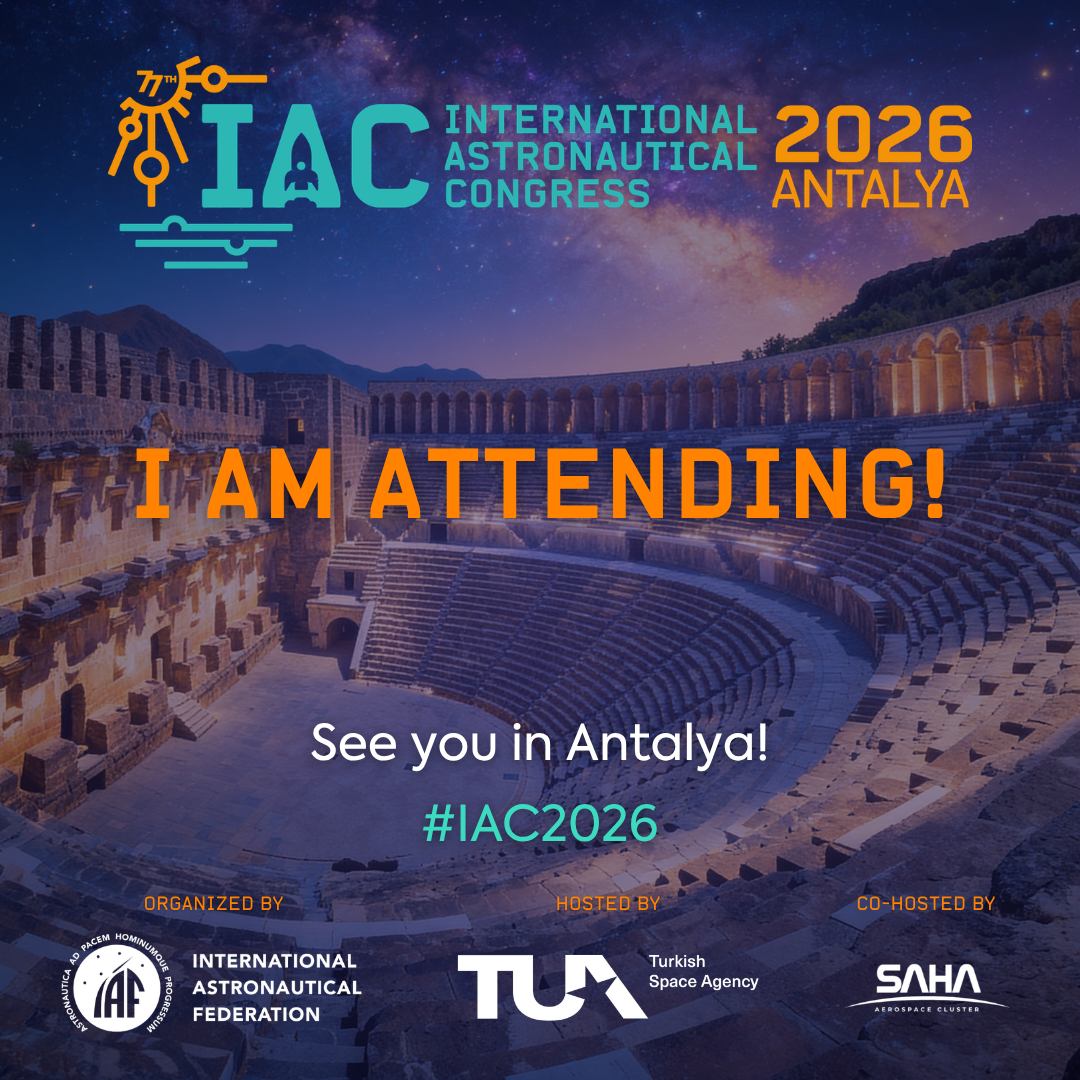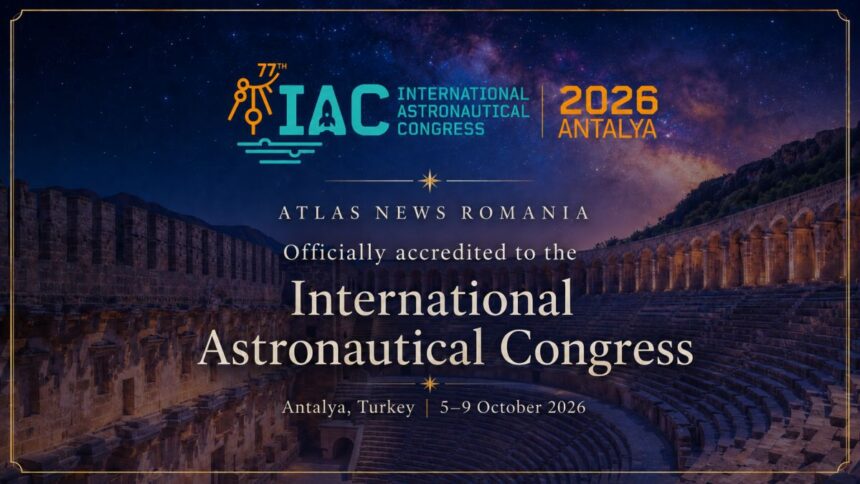
Atlas News Romania has received official press accreditation from the International Astronautical Federation (IAF) to provide editorial coverage of the 77th International Astronautical Congress (IAC 2026), to be held from 5 to 9 October 2026 in Antalya, Türkiye.
The accreditation, granted by the IAF Secretariat in Paris, affords the publication full editorial access for the entire duration of the congress — the foremost and most comprehensive global forum dedicated to the space industry, space policy and international cooperation in the exploration and use of outer space. Atlas News Romania will be present at Antalya with analytical coverage in bilingual format, Romanian–English, addressing an audience of decision-makers, security analysts and professionals in the fields of foreign policy, the defence industry and space governance.
What Is IAC and Why It Matters
The International Astronautical Congress is the largest annual event in the global space industry, organised by the International Astronautical Federation (IAF) — an organisation founded in 1951 that today brings together more than 600 members from 82 countries, including national space agencies, aerospace companies, universities and research institutes. IAC is not a niche technology conference — it is the forum where, each year, the directors general of space agencies, policy decision-makers, the defence industry and the academic community convene to chart the strategic direction of the global space sector.
The 2026 edition is organised by the IAF, hosted by the Turkish Space Agency (TUA) and co-hosted by the SAHA Istanbul aerospace cluster, under the motto „The World Needs More Space.” The selection of Türkiye as host country is no coincidence. Ankara has considerably accelerated its space ambitions in recent years, with TUA emerging as an increasingly prominent regional actor through its own Earth observation programmes, communications satellites, the first mission featuring a Turkish astronaut — Alper Gezeravcı, who flew to the International Space Station in January 2024 — and a lunar programme (AYAP-1) currently in preparation. For a publication with the editorial focus of Atlas News Romania — geopolitics, security, NATO’s eastern flank — the Turkish context adds a further layer of analytical relevance.

Space as a Strategic Domain, Not Merely a Technological One
The editorial coverage of Atlas News Romania at IAC 2026 will not be of a technical or scientific nature. The publication will approach the space sector through the lens it has built editorially in its first year of existence: strategic analysis, international security and diplomacy.
Outer space has long ceased to be a domain exclusively reserved for engineers and scientists. Today, low Earth orbit is a strategically contested space in which the major powers — the United States, China, Russia, but also Europe, India, Japan, South Korea and the Gulf states — compete for technological supremacy, for control over critical infrastructure and for defining the rules that will govern space activities in the decades ahead. Commercial satellite constellations, quantum-secured communications, Space Situational Awareness, the cybersecurity of orbital assets and the emerging lunar economy are themes that have moved from the realm of science fiction into that of security policy and strategic planning.
This is precisely the editorial territory that Atlas News Romania covers: the intersection of technology, power and international governance. IAC 2026 offers the publication a singular platform to bring these themes to the attention of Romanian and international audiences, with the analytical depth and journalistic rigour that readers of Atlas News Romania have come to expect.
Romania in the Space Equation
A central editorial axis of the Atlas News Romania presence at IAC 2026 will be Romania’s positioning within the European and international space ecosystem. Romania has been a member of the European Space Agency (ESA) since 22 December 2011 — the agency’s 19th member state — and possesses a range of niche capabilities that lend it relevance: the Cheia Satellite Communications Centre — the largest teleport in Central and South-Eastern Europe, equipped with 32-metre antennas and satellite telemetry, tracking and control (TT&C) services —, participation in the ESA SAGA QKD mission for quantum-secured satellite communications, competencies in Space Surveillance and Tracking (SST), and an aerospace tradition that includes, in 2026, the 45th anniversary of cosmonaut Dumitru Prunariu’s flight aboard the Soyuz 40 spacecraft and the Salyut 6 orbital station, in May 1981.
Romania also holds a position of genuine influence within the architecture of global space governance. Dr Ulpia Elena Botezatu, Space Policy Officer at the Romanian Space Agency (ROSA), chaired the Scientific and Technical Subcommittee of the United Nations Committee on the Peaceful Uses of Outer Space (UN COPUOS) until February 2026 — a body comprising 110 member states and 62 permanent observers, making it one of the largest committees within the United Nations system. Dr Botezatu also co-chairs the Action Team on Lunar Activities Consultation (ATLAC), the UN mechanism for the coordination of lunar activities, a mandate active through 2027. It is a level of international representation insufficiently reflected in Romania’s public discourse.
International companies of the first order maintain an operational presence in Romania: Airbus Defence and Space, through its Bucharest subsidiary — an engineering, integration and services hub with more than 130 employees —, and Thales, through its engineering competence centre dedicated to Thales Alenia Space projects, including Meteosat Third Generation and the Lunar Gateway. Romania’s space industrial ecosystem also includes notable national actors such as RARTEL — a Romanian-Italian joint venture between Telespazio (Leonardo Group) and RADIOCOM, which provides services through the infrastructure of the Cheia Centre —, Romanian InSpace Engineering (RISE), the first company in Romania to have developed an experiment validated by both ESA and NASA for crewed spaceflight — the DropCoal experiment, launched to the International Space Station in November 2024 —, and INCAS, the National Institute for Aerospace Research „Elie Carafoli.” The strategic dimension of this ecosystem, Romania’s actual capabilities and the trajectory of the Romanian space sector will constitute central themes of the Atlas News Romania coverage from Antalya.
In this context, Atlas News Romania is preparing an exclusive interview with Dr Ulpia Elena Botezatu, former Chair of the Scientific and Technical Subcommittee of UN COPUOS and serving Co-Chair of ATLAC, on Romania’s role in international space governance, the security of critical space infrastructure and the prospects for the Romanian space sector. The interview will be published in the Atlas Diplomatic series, in bilingual format.
The Continuation of an Editorial Trajectory
The accreditation for IAC 2026 forms part of an editorial trajectory that Atlas News Romania has been building since its first year of activity. The publication has covered forums and events of strategic relevance to Romania and to NATO’s eastern flank, and the extension of its coverage into the space domain — through the prism of security and geopolitics, rather than technical journalism — represents a natural evolution of its editorial profile.
From Antalya, Atlas News Romania will publish analyses, exclusive interviews, contextual reports and editorial commentary, in bilingual format, intended both for the Romanian public interested in the country’s strategic positioning and for the publication’s international audience.
Read also