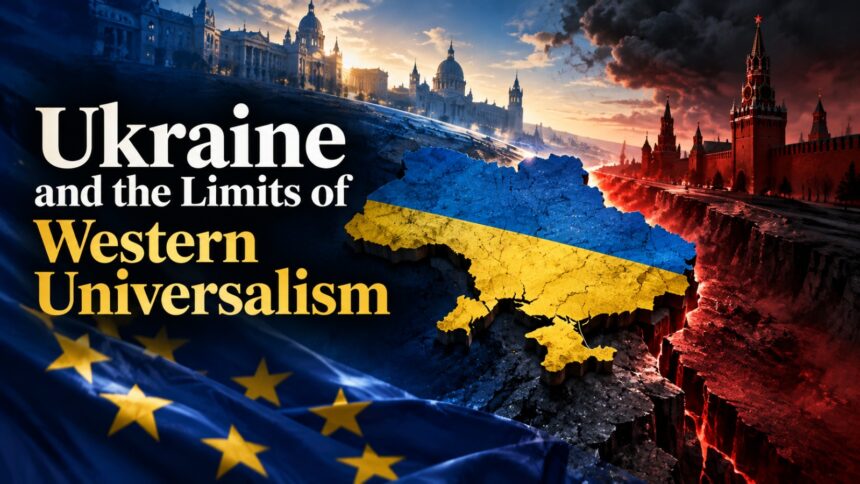
The consequences of the war in Ukraine are often discussed in terms of Russian power, European security, Ukrainian sovereignty and the future regional order. Yet one dimension receives less attention: Ukraine is testing the limits of Western universalism.
After 1991, the West gained not only geopolitical predominance but also an apparent sense of inevitability. Its model was expanding, former communist states were joining its institutions, and the Western frontier was moving rapidly eastward.
Ukraine is where that expansion has met a great power willing to pay an immense price to say: You stop here.
The war does not test whether the West is good or whether liberalism works. It tests whether Western universalism can be constrained by power.
What happens when something understood as universal encounters a frontier? Can it remain universal once that frontier becomes visible?
Western Universalism After 1991
The collapse of the Soviet Union and the Warsaw Pact left the Western world without a universal ideological rival and, for a time, without a comparable geopolitical competitor. The moment created the impression that the West carried history’s torch and embodied the direction in which political development was moving.
Western values increasingly came to be seen as universal. It was widely assumed that more countries would eventually adopt some version of the Western model: liberal democracy, market economics and integration into Western institutions.
This was especially evident in Central and Eastern Europe.
The prevailing outlook of the 1990s was that no serious competitor could challenge the West or offer a more compelling model. Francis Fukuyama’s The End of History captured this mood, though his argument was not that wars and crises would disappear. Rather, liberal democracy seemed to have been left without a credible ideological rival offering a superior destination for political modernity.
Over time, this outlook became embedded in Western political imagination. Across much of Central and Eastern Europe, the expectation that “the West was coming” became dominant.
Poland, the Czech Republic, Slovakia, Romania, Bulgaria and the Baltic states eventually joined NATO and the European Union. Their integration reinforced the perception that the Western model could be reproduced. These countries did not become utopias, but integration was associated with economic development, greater security and institutional transformation.
The Western model thus accumulated examples of successful integration in Central and Eastern Europe. It had not yet faced a comparable case in which another great power was prepared to use massive military force to prevent integration from reaching its conclusion.
The argument here is deliberately limited to this region. Afghanistan, Iraq and Yugoslavia raise different questions. They were not post-communist European states voluntarily undergoing the same process of incorporation into the Euro-Atlantic order.
The point is narrower. In Central and Eastern Europe, Western integration had accumulated evidence of success without producing an equivalent case of systemic failure. By failure, I do not mean recession, corruption, democratic backsliding or political instability. I mean something closer to state collapse: a country integrates into the Western political, economic and security order and then disintegrates so profoundly that the model itself becomes implicated.
Communism had produced spectacular examples of systemic collapse, culminating in the dissolution of the Soviet Union. Western integration in Central and Eastern Europe had not.
Nor had those successful integrations faced internal resistance capable of derailing the process or external military opposition comparable to what Ukraine would later encounter. There was opposition, Euroscepticism and disagreement, but the broad direction of integration remained intact.
Russia condemned NATO enlargement, sometimes vehemently. But it did not use military force to reverse the completed NATO and EU integration of Poland, Romania or the Baltic states.
For roughly two decades, the institutional frontier appeared to move predominantly in one direction.
East became West.
West did not become East.
Each successful integration reinforced the image of an increasingly powerful, hegemonic and universalist West.
Ukraine is where that movement became a collision.
Why Ukraine Is Different
Ukraine could have become the greatest success story of Western universalism and integration. For the same reason, it could become the model’s most consequential limit case.
Ukraine is not simply another Romania or Poland.
Russia viewed the accession of the Baltic states to NATO as strategically unacceptable, but Ukraine occupies a different place in Russian strategic and historical narratives. It spent long periods under Russian and Soviet rule, has deep linguistic, cultural and familial ties with Russia, and holds a central position in Russian accounts of history, identity and security.
These are Russian interpretations. They do not define Ukrainian identity, nor do they give Russia any right to determine Ukraine’s political future. They matter because states act not only on objective geography but also on how they understand geography, history and themselves.
Within Russian strategic and civilizational narratives, Ukraine therefore occupies something close to an existential position.
An intentionally extreme analogy helps illustrate the intensity of this perception: from within that Russian civilizational outlook, Ukraine’s definitive turn toward the West might feel almost like Mecca becoming Christianized or Rome becoming Islamized.
The analogy is metaphorical. It does not suggest that Ukraine “belongs” to Russia. It conveys the place Ukraine occupies in Russia’s historical imagination.
That is what makes Ukraine such an extraordinary test.
Had Western integration succeeded there without serious resistance, the West could have argued that it had integrated a country historically tied to a different civilizational and geopolitical center—one strategically crucial to Russia, with a large Russian-speaking population and deep historical links to Russia—and that the model had proved replicable even there.
If that had happened peacefully, the geographical reach of the Western model might have appeared almost limitless.
But it did not happen peacefully.

Ukraine’s Divisions and Russia’s Military Resistance
Earlier Central and Eastern European integrations did not face the same combination of internal disagreement over geopolitical orientation and massive external resistance.
Ukraine faced both.
Before 2014, support for NATO membership was far from a national consensus. Ukrainian views on NATO, neutrality and relations with Russia differed significantly by region, particularly between western and central Ukraine and parts of the south and east. A significant part of Ukrainian society favored neutrality or closer political and economic relations with Russia.
This does not mean Ukraine lacked agency. It had agency. The tragedy was that its choices unfolded within a geopolitical space where domestic political decisions increasingly became questions of alignment between great powers.
The frontier between the Western and Russian orders did not simply reach Ukraine.
To some extent, it ran through the country.
Then came external resistance.
Russia annexed Crimea in 2014, supported separatist forces in the Donbas and launched a full-scale invasion in 2022. No successful Central or Eastern European case of Euro-Atlantic integration had faced anything comparable.
Georgia is an important precedent and should not be ignored. Russia used military force there in 2008, in a war connected to Georgia’s Western orientation. But Georgia entered that confrontation with a different post-Soviet history. Armed conflict in South Ossetia had begun as early as 1991, while Abkhazia and South Ossetia had become unresolved separatist territories outside Tbilisi’s effective control after the wars of the early 1990s. Russian forces and Russian-backed structures were deeply embedded in those conflicts well before the 2008 war.
Georgia is therefore a precedent for Russian military force, but not simply an earlier version of Ukraine. The 2008 war grew out of unresolved conflicts inherited from the violent dissolution of the Soviet Union, as well as Georgia’s later Western orientation.
Ukraine represents a different scale and historical problem. Before the full-scale war, it had roughly 40 million people and far greater demographic, industrial, agricultural and strategic weight. Its identity was also more deeply intertwined with Russia’s historical narrative than Georgia’s distinct national identity.
Ukraine could therefore become the clearest example of either the resilience of Western expansion or the discovery of its limits.
Multipolarity as an Alternative to Universalism
After the Cold War, one of the strongest arguments for Western universalism was implicit in a simple question:
What is the alternative?
Communism had collapsed. The extremist nationalist ideologies of the twentieth century had helped destroy Europe. No other political system seemed capable of offering a universal alternative to liberal democracy.
But perhaps Russia does not need to offer one.
The alternative to universalism need not be another universalism.
It can simply be multipolarity.
Russia does not have to show that Moscow is the future instead of Washington, or even that Moscow is Ukraine’s future.
It only has to show that Washington and Brussels cannot determine the future everywhere.
That distinction matters.
Russia can remain economically weaker than the collective West. Its political model can remain less attractive, and it can fail to offer an ideology that other societies genuinely want to reproduce.
Yet it can still inflict a serious intellectual defeat on Western universalism if it shows that power can impose a frontier on the more attractive model.
The alternative to universalism need not be another universalism.
It can simply be a frontier.
If Russia can decisively prevent Ukraine from completing its Western integration through military force, it can present that outcome as evidence of something larger: that the post-1991 movement of the Western institutional frontier was not inevitable, and that other centers of power can establish spaces where Western attraction does not automatically lead to Western institutional expansion.
That would not mean Moscow had replaced Washington as the center of the world.
It would mean there was no single center.
What the Outcome in Ukraine Will Test
This is why the eventual outcome in Ukraine matters far beyond Ukraine itself.
A successful Ukraine would not prove Western universalism philosophically correct; history cannot establish that kind of universal truth. But a sovereign Ukraine able to determine its own orientation, continue its European integration and resist Russia’s attempt to dictate its geopolitical future would provide perhaps the strongest evidence yet of the post-1991 Western model’s resilience and reproducibility.
The model would have crossed its hardest frontier.
If Russia decisively blocked that trajectory, the consequences would be different.
It would not mean that liberal democracy had failed, that capitalism was inferior, or that NATO and the European Union would collapse. Paris and Washington would not suddenly cease to matter.
But the West would lose something subtler: part of its perceived invincibility.
For three decades, especially in Central and Eastern Europe, the institutional frontier seemed to move overwhelmingly in one direction. States moved toward the Western system. The Western system did not move toward theirs.
Ukraine is where that assumption is now being tested by force.
Russia does not have to prove that Moscow is the future.
It only has to show that the Western future is not universal.
That is why Ukraine is the limit case. The test is not whether the West is good or whether liberal democracy works. It is whether Western universalism can withstand the discovery of a geopolitical frontier.
Because if something universal discovers that it has a frontier, what exactly remains universal about it?
Read also