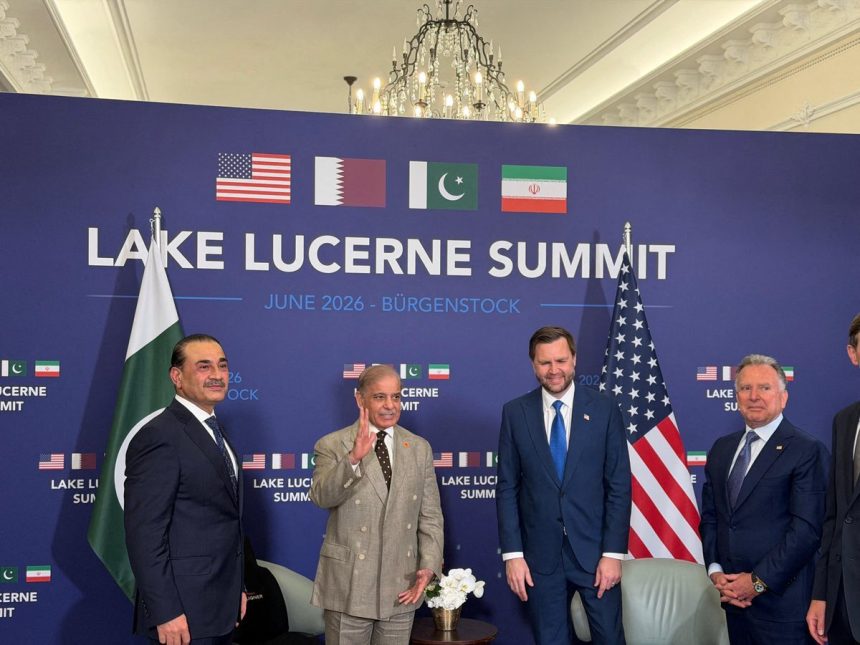
The Strait of Hormuz has become the real test of the negotiations between the United States and Iran. In Bürgenstock, Switzerland, Qatar and Pakistan announced a 60-day roadmap for a possible final agreement, technical working groups on the nuclear file, sanctions and implementation, as well as a communication line designed to prevent incidents and ensure the safe passage of commercial vessels through one of the world’s most important energy arteries. This final component changes the nature of the crisis: a maritime route is no longer the background of the confrontation, but has become the central instrument of the negotiation.
The joint statement published by Ministry of Foreign Affairs, State of Qatar states that the first high-level session of talks, held within the framework of the Islamabad Memorandum of Understanding, concluded with the participation of Iran, the United States, Qatar and Pakistan. The document announces the creation of a High Level Committee, working groups on the nuclear file, sanctions and mechanisms for monitoring and dispute resolution, as well as a roadmap for a final agreement within 60 days.
A mechanism was built at Bürgenstock, not a peace agreement
The essential distinction that any serious analysis must preserve is this: no peace agreement was signed at Bürgenstock; rather, a mechanism was built. The joint statement refers to a positive atmosphere, encouraging progress, a committee for political oversight and technical discussions set to begin immediately. The chief negotiators will report to the High Level Committee and will lead working groups on the nuclear file, sanctions, monitoring, dispute resolution and other matters related to the implementation of the memorandum. The roadmap does not guarantee an outcome; it sets a timeframe and a procedural structure.
This formulation has a strategic function of its own. It allows energy markets and regional actors to be reassured without prematurely declaring a diplomatic victory that reality may later contradict. In other words, the diplomacy at Bürgenstock has bought time in an effort to resolve the conflict. The 60 days are a probationary window, not a guarantee. And the value of this window depends on one concrete factor: whether the mechanisms for avoiding incidents work on the ground.

Hormuz becomes the real guarantee of the negotiation
This is where the central stake lies. According to the same joint statement published by Ministry of Foreign Affairs, State of Qatar, the parties established a communication line to prevent incidents and misunderstandings, with the stated objective of ensuring the safe passage of commercial vessels through the Strait of Hormuz. From the perspective of Atlas News Romania, the explicit inclusion of the Strait of Hormuz in the diplomatic mechanism turns the maritime route into a practical guarantee of the negotiation, even though the official documents do not use this formulation.
The scale of this leverage is confirmed by data from the International Energy Agency. According to the IEA, in 2025 almost 15 million barrels per day of crude oil and almost 5 million barrels per day of petroleum products transited the Strait of Hormuz, for a total of approximately 19.87 million barrels per day, representing around 25% of global seaborne oil trade. The IEA also shows that alternative routes have limited capacity, estimated at 3.5–5.5 million barrels per day, which is insufficient to compensate for a major disruption.
This leads to a strategic calculation that Atlas News Romania considers central: Iran does not need to close the Strait of Hormuz permanently in order to produce a global effect. It is enough for navigation to become uncertain, expensive and dependent on negotiations. The leverage works through a credible threat, not necessarily through its execution. This explains why the communication line for avoiding incidents was explicitly included in the diplomatic architecture: it seeks to defuse precisely the instrument that gives Tehran negotiating power.
JD Vance negotiates, Donald Trump remains the political pressure
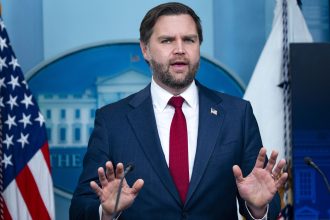
The American component of this architecture must be approached with caution. Ministry of Foreign Affairs, State of Qatar states that U.S. Vice President JD Vance led the American delegation, while Pakistani Prime Minister Muhammad Shehbaz Sharif led Pakistan’s delegation and Mohammad Bagher Ghalibaf led the Iranian delegation. Vance’s participation was also confirmed separately by The White House, which announced the vice president’s presence at the quadrilateral meeting with Pakistan, Qatar and Iran on 21 June 2026.
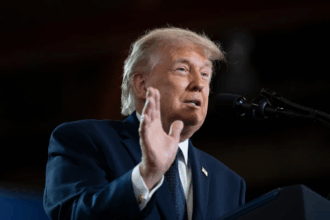
In parallel, IRNA English reports that Mohammad Bagher Ghalibaf rejected threats attributed to Donald Trump, stating that Iran does not take them into account. According to the Iranian agency, the reaction came after Trump allegedly threatened to strike Iran if Tehran did not stop Hezbollah. Atlas News Romania treats this element strictly as an Iranian account, not as a fact confirmed by an official American transcript.
There is no evidence to speak of an internal split between Trump and Vance. It is more prudent and more accurate to read this picture as coercive diplomacy: an official negotiating channel, represented by the vice president, accompanied by the president’s public pressure. The two registers do not contradict each other; they can function as a single strategy with two voices.
Lebanon shows that the file is not bilateral
One element that is easy to overlook, but strategically decisive, is Lebanon. The statement published by Ministry of Foreign Affairs, State of Qatar announces the creation of a deconfliction cell between the parties and the Republic of Lebanon, facilitated by the mediators, to ensure respect for the cessation of military operations in Lebanon.
Lebanon’s presence in the mechanism shows that Washington and Tehran are not negotiating only over the nuclear programme, but also over Iran’s regional behaviour, including the Hezbollah–Lebanon space. Atlas News Romania’s interpretation is that Iran is trying to link seemingly separate files into a single package: the nuclear issue, sanctions, Hormuz and Lebanon. Such a strategy allows Tehran to negotiate on several levels simultaneously and to offset concessions in one file with advantages in another.
The Iranian economic position fits into the same logic. IRNA English claims that the lifting of oil sanctions and the related waivers were discussed in the negotiations in Switzerland. Atlas News Romania records this information as an Iranian position, not as an achieved result: the fact that a subject is discussed does not amount to its acceptance.
Qatar and Pakistan enter the league of heavyweight mediators
The role of the two mediators is not decorative. The confirmed facts are their participation and their function as guarantors of the process; the interpretation regarding the diplomatic capital accumulated belongs to the Atlas News Romania analysis. Qatar is consolidating its profile as a regional mediator with simultaneous access to Washington and Tehran, while Pakistan is capitalising both on its geographical and religious proximity to Iran and on its strategic relationship with the United States.
What is taking shape is a hybrid mediation formula, different from an exclusively Arab or Western model: the Gulf plus South Asia, applied to a confrontation between Washington and Tehran. Qatar’s prime minister and minister of foreign affairs, cited by Ministry of Foreign Affairs, State of Qatar, underlined that the security of the Strait of Hormuz is not merely a regional issue, but a shared international responsibility, with the impact of its closure extending to the global economy, international trade and energy markets.
Who controls the threshold between trade and war
The real question is not whether the United States and Iran have produced peace. They have not yet done so. The question is whether they have managed to transform a crisis with global potential into a mechanism robust enough to control the next 60 days. The Strait of Hormuz will be the test. If commercial vessels continue to pass, if Lebanon does not reignite escalation and if the sanctions file does not block the technical discussions, diplomacy may survive. If not, the interim arrangement will remain only a pause between two forms of the same confrontation.
For Romania and the eastern flank, the lesson is simple: an energy crisis that begins in the Gulf does not remain in the Gulf. It is transmitted into prices, defence budgets, industrial calculations and Europe’s political vulnerability. That is why the 60 days from Bürgenstock are not merely an episode of Middle Eastern diplomacy. They are a test of the West’s capacity to manage energy, regional war and strategic pressure on its own economies simultaneously.
Read also