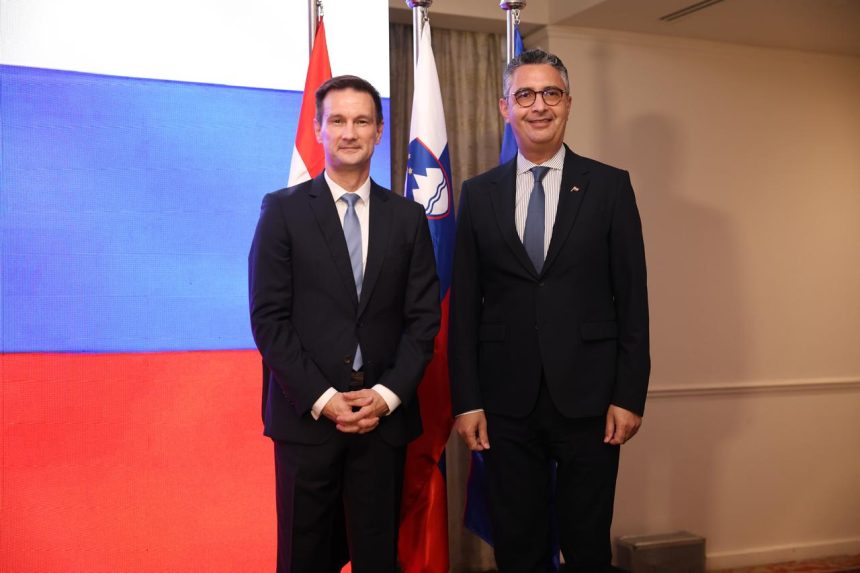
Amid growing geopolitical fragmentation and a shifting security landscape in Eastern Europe and the Middle East, Slovenia is positioning Egypt as its premier strategic and economic anchor in Africa. Speaking at a high-level diplomatic reception in Cairo marking the 35th anniversary of Slovenia’s independence, Slovenian Ambassador Sašo Podlesnik emphasized that the bilateral relationship—spanning 34 years of formal diplomacy—serves as a critical pillar for regional stability in an increasingly volatile Middle East.
Ambassador Podlesnik framed Slovenia’s foreign policy guidelines through the lens of institutional defense and crisis prevention. Pointing to Ljubljana’s recent tenure as a non-permanent member of the United Nations Security Council, Podlesnik noted that a rising disregard for international humanitarian law and eroding trust in multilateral frameworks pose distinct risks to global stability, particularly for small and mid-tier states.
In a clear articulation of Slovenia’s aligned security posture, the Ambassador addressed key global friction points, stating that Ljubljana remains firmly committed to a just and lasting peace in the Middle East, demanding full compliance with international humanitarian law and advocating for the rights of both Palestinians and Israelis to coexist in security and dignity. He called for immediate diplomatic momentum to halt ongoing humanitarian crises, explicitly pointing to the protracted war in Sudan, while simultaneously reaffirming Slovenia’s unwavering support for Ukraine’s state sovereignty.
The geopolitical utility of the partnership is backed by commercial metrics, with Egypt maintaining its position as Slovenia’s most critical trading partner on the African continent—a relationship reinforced over the past year by high-level ministerial exchanges and joint environmental sustainability programs.

On behalf of the Egyptian government, Minister of Supply and Internal Trade Dr. Sherif Farouk—representing Prime Minister Mostafa Madbouly—underscored the critical intersection between logistics, infrastructure, and national resilience. Farouk highlighted Slovenia’s positioning as a strategic maritime and logistical gateway into Central and Southeastern Europe. In the wake of protracted global supply chain disruptions and vulnerabilities in international shipping lanes, Farouk asserted that building resilient internal markets and diversified economic corridors is no longer a policy preference, but a geopolitical necessity.
Global developments over recent years have proven that building more resilient economies, securing supply chains, and reinforcing food security are absolute imperatives for state stability, Farouk stated.
Cairo aims to leverage Slovenia’s advanced logistical, transport, and tech capabilities to complement Egypt’s ongoing infrastructure expansion. Under the strategic vision of President Abdel Fattah El-Sisi, Egypt continues to develop its domestic transport corridors and port facilities, seeking to solidify its role as a primary logistical hub linking African, Arab, and European markets.
Read also