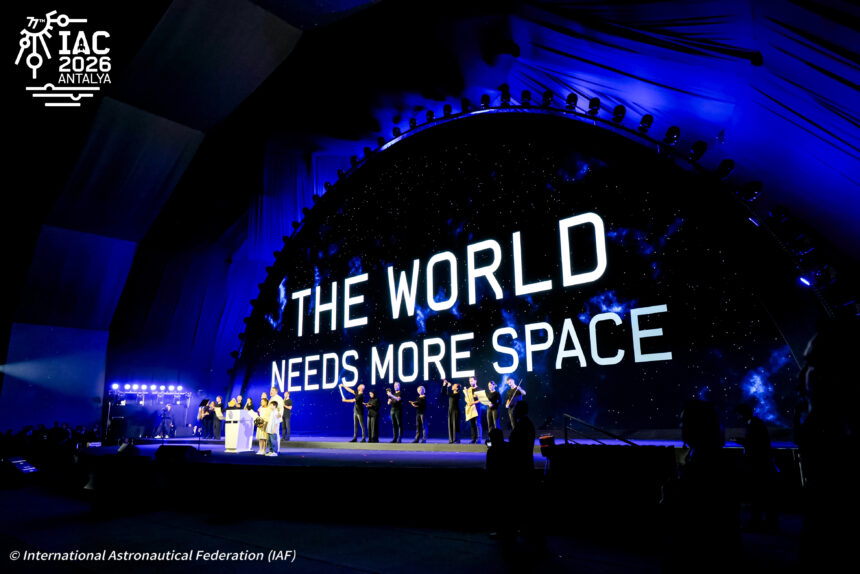
The 77th International Astronautical Congress (IAC 2026) concluded on 9 October in Antalya. The first edition ever hosted by Türkiye produced no single breakthrough or decision. It produced something harder to measure: the image of a sector in which questions about who sets the rules, who provides the funding and who controls access already matter as much as questions about rockets, satellites and missions.
A record-scale edition, with a host that assumed a political role
The scale of the event was visible in the figures. According to TRT World, the organizers received 8,330 abstracts from 108 countries, a record on both counts, and Türkiye submitted 1,810 papers, the highest number from a single country in the history of the congress. At the closing ceremony, the president of the International Astronautical Federation (IAF), Gabriella Arrigo, announced more than 7,500 participants from 111 countries, while the organizers spoke of attendance of nearly 10,000 people. Together with the public day, total visitor numbers reached almost 20,000, and the president of the Turkish Space Agency (TUA), Yusuf Kıraç, specified that the public day alone drew more than 10,000 people. The same ceremony recorded 250 exhibitors and exhibiting partners and the accession of 51 new organizations to the IAF, bringing the federation to more than 621 members from 84 countries, according to Türkiye Today.
For the government in Ankara, the congress was more than a logistical hosting exercise. The meeting of ministers and parliamentarians held the day before the opening adopted the Antalya Declaration, a Turkish-initiated text that advocates peaceful, sustainable and responsible approaches to space. According to Milliyet, the declaration was supported by 32 participants from 21 countries, at a meeting attended by representatives of 38 states. The figure says something about the limits of consensus: a general text, carefully worded, drew the endorsement of a minority of the states present.
The congress also gave the host a framework in which to showcase its industrial capabilities and strengthen its international cooperation ties. The event was coordinated by the Ministry of Industry and Technology, hosted by TUA and co-hosted by the SAHA Istanbul cluster.

On the sidelines of the programme, Türkiye signed a roadmap with the UK Space Agency, welcomed by Alice Bunn, co-director of the British agency, in a statement reported by Yeni Şafak, as well as a protocol between TURKSAT and China Satcom on the joint development of satellite technologies, including communications for drones and border security systems, according to Yeni Şafak and Türkiye Today. The sequence of events is worth noting: less than six weeks after signing the Artemis Accords on 31 August, Ankara put its signature in Antalya on agreements with London and with Beijing. The chronology suggests a policy of balancing between poles rather than a choice of a single bloc.
Alongside the expansion of its international partnerships, Ankara is investing in the development of its own space infrastructure, seeking to strengthen its technological autonomy and national launch capabilities. In his address in Antalya, President Recep Tayyip Erdoğan confirmed the start of construction of a Turkish spaceport in Somalia, a strategic project intended to give Türkiye independent access to space. The site, located near the Equator and opening onto the Indian Ocean, offers technical advantages for orbital launches. The first phase of the infrastructure could become operational in 2027, consolidating Ankara’s technological and strategic presence in Africa and its ambition to become an autonomous player in the space industry.
The Moon, between science, infrastructure and resources
If one thread linked most of the sessions, it was the Moon. NASA confirmed that the Artemis II mission, a 10-day lunar flyby with four astronauts, launched on 1 April 2026 and ended with a splashdown on 10 April off the coast of California. The American agency announced that it would present its results in Antalya, in an official list of participations that also included a press conference dedicated to the Artemis Accords. Deputy Administrator Matt Anderson detailed, according to Yeni Şafak (material taken from Anadolu), the plans for Artemis III, a mission with a multinational crew that is expected to reach the Moon in 2027, using vehicles developed by SpaceX and Blue Origin, and underlined the support of the US Congress, including an additional allocation of 10 billion dollars for the Artemis programme. The address explicitly linked the objective of a lunar base and a permanent presence to the next step, toward Mars.
The industrial perspective was even more direct in the case of the United Arab Emirates. The deputy director general of the Emirati space agency, Ibrahim Hamza Al Qasim, told Anadolu, as reported by Yeni Şafak, that the next decade will see missions oriented toward the exploitation of space resources, including rare metals, and a permanent human presence on the Moon. He added that in the Emirati ecosystem more than half of space funding already comes from the private sector, and announced deep-space exploration missions, including to the asteroid belt, in the first quarter of 2028.
This is the starting point of one of the central contradictions of the congress. The same lunar terrain is treated by agencies as scientific heritage to be protected, and by companies as a potential repository of raw materials. The panel organized by the IAF on 8 October and dedicated to Lunar Sites of Special Scientific Interest (SSSI) put the problem in concrete terms: how to define and administer zones that attract the interest of the scientific community and of commercial operators at the same time. The presence of COSPAR, the International Astronomical Union, the Moon Village Association and industry at the same table shows that the answer cannot be provided by a single actor. The congress did not produce a solution, but it showed that the discussion on the coordination of lunar activities has moved beyond the theoretical sphere.
Orbital security and a crowded sky
The programme placed on the same stage themes that, only a few years ago, would have been treated separately. The plenary „Geopolitics vs. Innovation” addressed, according to Anews, how companies operating Earth observation fleets and orbital infrastructure balance global markets against the growing demands of governments and security institutions. Another plenary, from the official IAF programme as reported by Space & Defense, was dedicated to orbital overcrowding. TRT World summarized the agenda of the edition through weapons in orbit, artificial intelligence data centres in space, an increasingly crowded sky and a new competition for the Moon.
The fact that these subjects appeared together is no coincidence. As commercial infrastructure becomes part of states’ security capacity, the boundary between the civilian and defence sectors is blurring, and rules created for one apply, in practice, to the other. In Antalya, this overlap was visible in the very structure of the host, which brought together the space agency, the ministry of industry and the defence industry cluster. A warning in the same direction came from Baykar chairman Selçuk Bayraktar, who, according to Yeni Şafak, called for a reconsideration of the purpose of innovation, warning of the consequences of an uncontrolled technological race.
The space economy and the rise of private capital
The Director General of ESA, Josef Aschbacher, estimated, according to Yeni Şafak, that the global space economy will triple, reaching 1.8 trillion dollars over the next decade, as satellite technologies penetrate ever deeper into everyday life. The message was echoed by Nancy Wolfson, chair of the IAF Space Entrepreneurship and Investment Committee, who told Anadolu, as reported by Yeni Şafak, that commercialization creates opportunities for emerging states and for start-ups, and encouraged cross-border partnerships.
Together with the data from the Emirates, these interventions outline a change of model: space is no longer financed primarily by public budgets, and the states that will matter are those that know how to attract private capital without losing control over strategic priorities. For a country the size of Romania, this is probably the most relevant lesson of the congress, because it combines the need for budgetary continuity with the need to build an industrial ecosystem capable of absorbing funding.
Emerging states demand a seat at the table
The third edition of the IAF Global Space Leaders Summit, held on 6 October under the theme „The New Space Era: Global Challenges, Strategic Opportunities and Responsible Governance”, brought together agency heads from states with established programmes and from emerging states, in a closed-door format. ANEWZ reported that the discussions covered international partnerships, responsible governance and the challenges of rapid commercialization.
Africa was the most visible of the emerging regions. According to Space in Africa, the summit was attended by agency leaders from Zimbabwe, Rwanda, Kenya and South Africa, and 13 of the 40 beneficiaries of the 2026 IAF Emerging Space Leaders programme come from six African states. The same publication notes that the agreements and discussions begun in Antalya must become funded projects, with deadlines and appointed teams. The observation holds for the congress as a whole: the value of an edition is measured not in declarations, but in what is turned into execution after the delegations go home.
Romania’s participation: expertise at the table where norms are written
Romania’s presence in Antalya had an institutional component, an educational one and one of individual expertise. Together, they say more than each does separately.
The institutional dimension was represented by a Senate delegation, which took part between 4 and 6 October in the 16th IAF Meeting for Ministers and Parliamentarians. According to Amos News, the delegation highlighted Romania’s contribution to European space programmes, its status as an ESA member state since 2011 and its participation in European mechanisms for Earth observation, space surveillance and space safety. On the educational side, the Romanian Space Initiative presented in the official IAF interactive programme a paper on a scalable training model for satellite data processing, a type of contribution that responds directly to the need for skills felt by all expanding space ecosystems.
The most visible individual contribution came from Dr. Ulpia-Elena Botezatu, Space Policy Officer at the Romanian Space Agency (ROSA). According to her official IAF profile, she took part in two moments of the programme: the session „Lunar space science: priorities, plans, cooperation perspectives” on 5 October, and the panel within the IAF Global Networking Forum dedicated to Lunar Sites of Special Scientific Interest, on 8 October, moderated by COSPAR President Pascale Ehrenfreund. According to the IAF sessions director, she was also co-chair of the technical session „Innovative Concepts and Technologies”.
Dr. Botezatu chaired the Scientific and Technical Subcommittee of the United Nations Committee on the Peaceful Uses of Outer Space (COPUOS) between 2024 and 2026, and co-chairs, together with Hasan Abbas of Pakistan, the Action Team on Consultations on Lunar Activities (ATLAC), according to the official page of UNOOSA. The mandate of ATLAC is to develop recommendations for improving consultations on lunar activities, including assessing the advisability of an international mechanism. The link with what was discussed in Antalya is direct: the question of how to manage lunar zones of high scientific and commercial value lies at the intersection of the SSSI panel’s agenda and the ATLAC mandate.
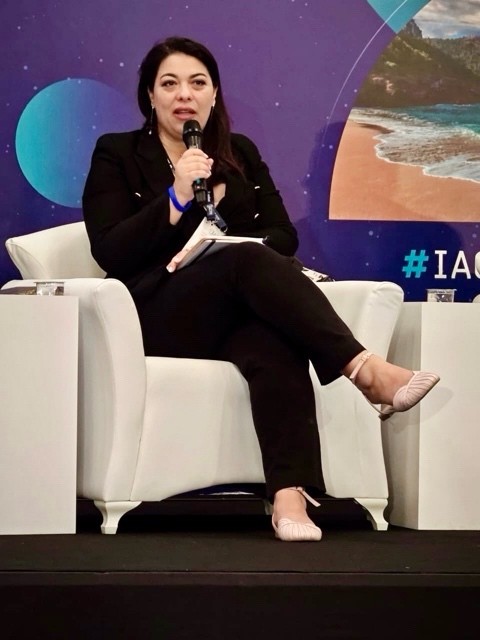
At a congress in which the Moon returned to the forefront, the presence of a Romanian specialist in both formats, the UN and the IAF, means that Romania takes part in formulating the rules, not merely in applying them. This is, arguably, the most important observation for Bucharest. A country of Romania’s size cannot compete by budget with agencies that have received tens of billions of dollars for lunar programmes. It can, however, gain credibility and influence through people, continuity and presence in the formats where norms are written. The next challenge is to turn this visibility into projects, industrial partnerships and funding capacity, which is precisely where the difference between presence and relevance is decided.
Next stop: Poznań
At the closing ceremony, the IAF signed the contract for the 2027 edition with Poland, and the traditional handover of the federation’s flag took place from Türkiye to the next host, according to Türkiye Today. IAC 2027 will take place in Poznań from 27 September to 1 October 2027, under the theme „One Space, Shared Future”, according to the IAF. The 2028 edition will be held in Samarkand, Uzbekistan, and Geneva was chosen as host for 2029, following the vote of the IAF General Assembly, ahead of Houston and Barcelona.
For Romania, Poznań will be a test of continuity and, at the same time, a regional opportunity: the congress will take place in the country’s political and geographical neighbourhood. If in Antalya Romania showed that it can be present in the right rooms, in Poznań it will have to show that it can come with projects, not only with individual expertise.
Antalya left behind more questions than answers. Who will set the rules for lunar operations and resources, how responsibilities will be delimited in a crowded orbit, how much private capital will weigh in the strategic decisions of states: all were put on the table, and none was resolved. For states such as Romania, the practical answer is not to wait for an outcome, but to participate consistently in the processes in which these answers are being built.
Read also