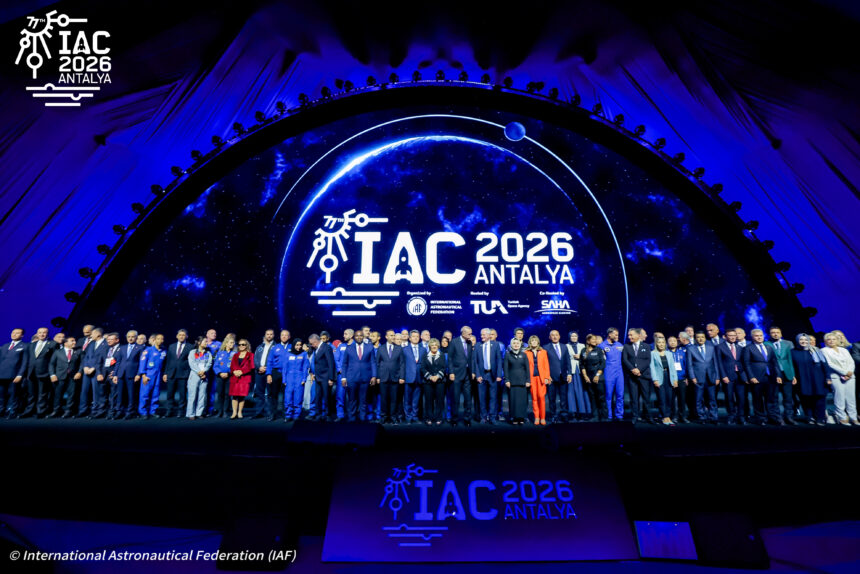
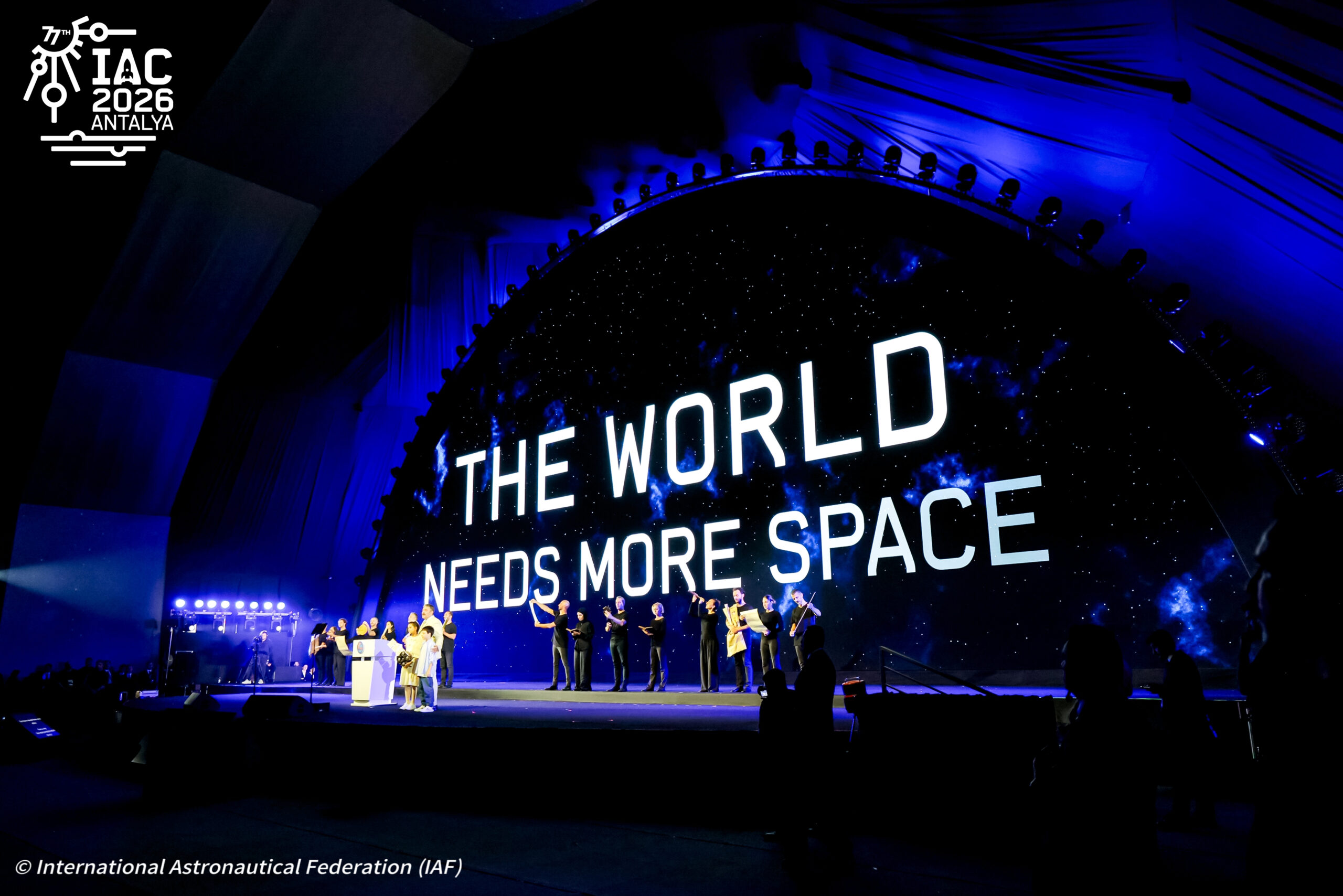
The 77th International Astronautical Congress (IAC 2026) opened in Antalya on Monday, 5 October, marking the first time the event has been hosted in Türkiye. Under the theme “The World Needs More Space”, the congress brings together space agencies, governments, companies, researchers and representatives of academia. By Wednesday, 7 October, discussions had moved from lunar exploration and cooperation among agencies to satellite constellations, independent access to orbit and the increasingly strategic role of the space industry. The congress is organised by the International Astronautical Federation (IAF), hosted by the Turkish Space Agency and co-hosted by SAHA Istanbul.
The scale of the programme is also reflected in the number of scientific papers selected for the congress. Organisers announced that they had received 8,330 abstracts from 108 countries. Following evaluation, 4,077 papers were accepted, while a further 542 were placed on a reserve list. The technical programme comprises more than 180 sessions and over 4,000 presentations.
Opening: Türkiye’s space programme and access to space
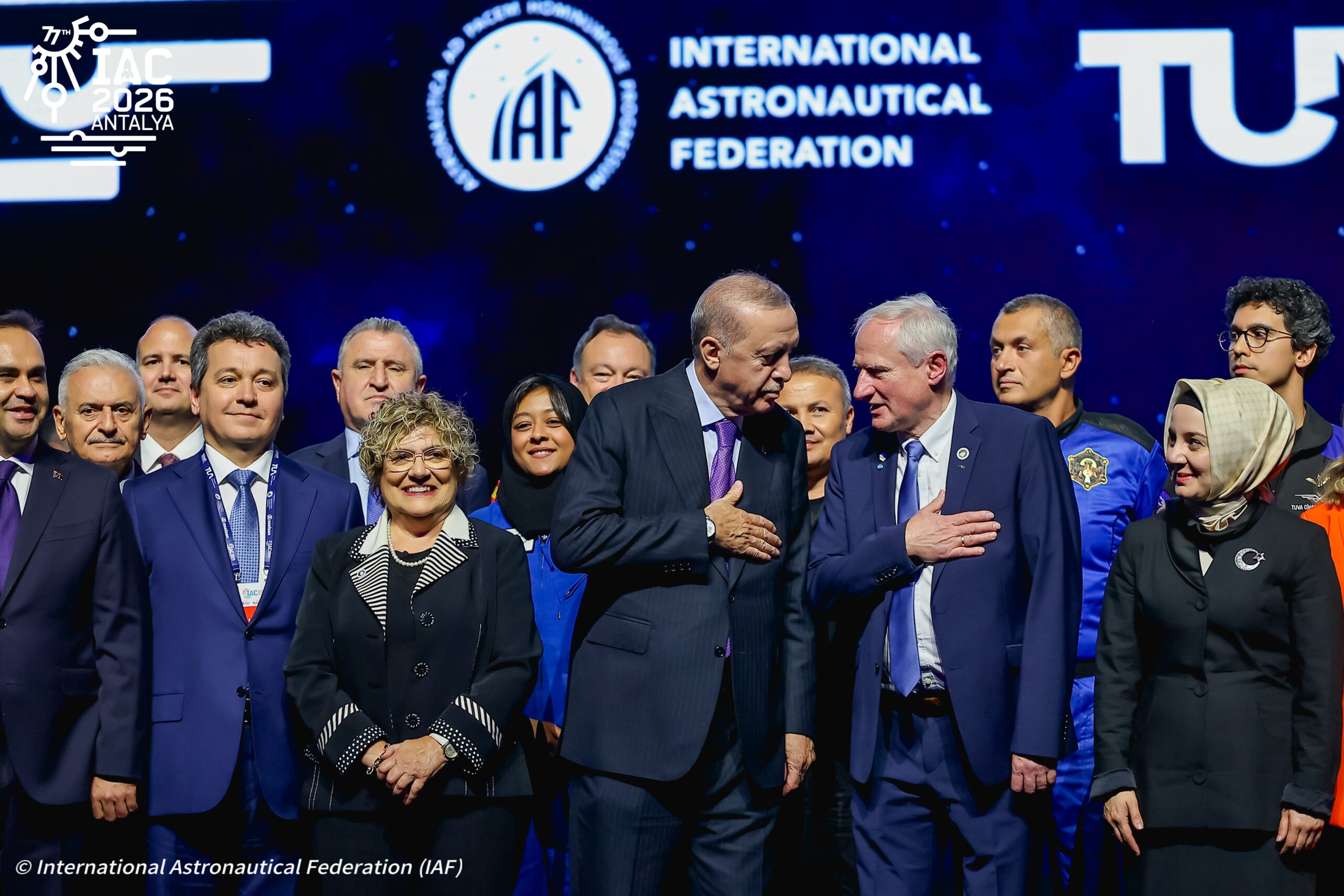
The opening ceremony was attended by the President of Türkiye, Recep Tayyip Erdoğan; the Minister of Industry and Technology, Mehmet Fatih Kacır; and the President of the International Astronautical Federation, Gabriella Arrigo. For Ankara, hosting the congress provided a platform to present its national space programme and its ambition to become a significant actor in the orbital economy.
Erdoğan highlighted Türkiye’s growing capacity to design and manufacture satellites, as well as the country’s lunar programme. According to his statement, assembly and integration of the spacecraft intended for the lunar mission have been completed. It weighs approximately 3.5 tonnes, and more than 80% of its components are domestically produced. The president also cited the TÜRKSAT 6A communications satellite, launched in 2024, as a milestone in the country’s engineering and industrial capabilities. These objectives and figures were presented by Turkish officials at the congress.

In his address, Erdoğan argued that space exploration should not remain the preserve of a handful of states and criticised the transformation of space into a new arena for the arms race. His remarks highlighted one of the central tensions of the congress: space is presented both as a field for international cooperation and as strategic infrastructure through which states seek to strengthen their autonomy and influence.
The 2026 IAF World Space Award was also presented during the ceremony. It was awarded to the International Charter: Space and Major Disasters, which coordinates access to satellite data for disaster management. Since becoming operational in 2000, the Charter has been activated more than 1,000 times in over 140 countries, providing data and information derived from satellites to disaster-response authorities at no cost. The award highlighted a direct civilian application of space infrastructure: using observations from orbit to support emergency response.
Space agencies: international cooperation and autonomy
On the first day, representatives of space agencies from Türkiye, the United States, Europe, China, India, Canada and Japan discussed lunar and Mars exploration, as well as the need for cooperation to ensure sustainable access to space. Turkish Space Agency President Yusuf Kıraç said that the expansion of orbital activity made it more difficult to ensure secure and sustainable access to space without joint efforts.
NASA Deputy Administrator Matt Anderson also addressed competition between the United States and China. In an interview with Anadolu in Antalya, he described the civilian space race as “closer than we would like right now”. His remarks reflected the strategic pressures surrounding lunar programmes, launch capabilities and a sustained presence in orbit.
The European Space Agency’s position combined an emphasis on partnerships with the need to develop Europe’s own capabilities. ESA Director General Josef Aschbacher called for Europe to strengthen its autonomy in human and robotic exploration while maintaining cooperation with NASA and partners including Japan, Canada, Australia, the United Arab Emirates and India. ESA is preparing options for the ministerial meeting in Rome in December, including on Europe’s ability to transport astronauts. The agency also signed a memorandum of understanding with Vast as it prepares for the period after the International Space Station ceases operations.
Day two: satellites, launch vehicles and partnerships
On Tuesday, 6 October, the agenda focused on the results of the Artemis II mission, the future of large satellite constellations and the relationship between the commercial space industry and geopolitics. Turkish officials and industry representatives also discussed plans for a 198-satellite constellation and the construction of a spaceport in Somalia.
Developing independent access to orbit was another important theme. Roketsan presented plans for its Şimşek-1 and Şimşek-2 launch systems, designed to carry payloads of up to 400 kilograms and 1.5 tonnes, respectively. Separately, Turkish Aerospace Industries announced that it was aiming to launch its Hürsat Earth-observation satellite in mid-2027. These are targets set by the companies, and their achievement will depend on the development and testing of the relevant technologies.
The congress also produced concrete diplomatic outcomes. The Turkish Space Agency signed two documents to expand cooperation: a framework agreement with space agencies from fellow member states of the Organization of Turkic States, building on existing cooperation through a joint CubeSat project; and a declaration of intent with the UK Space Agency to develop joint projects.
Wednesday, 7 October: the Artemis Accords and lunar science
At the time of writing, proceedings on the third day are under way. Wednesday’s programme includes the annual meeting of the Artemis Accords representatives and a press conference on developments under the Accords, co-chaired by Matt Anderson and Roberto Melgar Sheen, director of Peru’s space agency. A preliminary release of Artemis II’s lunar science findings, including data and images from the mission, is scheduled for the afternoon.
The day’s agenda also includes discussions on artificial intelligence for Mars missions, orbital infrastructure for the future space economy and the role of younger generations in space governance. These sessions build on the first two days’ debates, in which scientific exploration was closely linked to questions of infrastructure, access to orbit and competition among states.
Space: a shared resource and strategic infrastructure
By 7 October, IAC 2026 had brought two parallel priorities into focus. One concerns cooperation: lunar missions, data-sharing, disaster response and collaboration among agencies. The other concerns national capabilities: satellites, launch vehicles, spaceports and independent access to orbit.
This dual perspective helps explain why the congress agenda extends beyond scientific research. Space systems support communications, navigation, Earth observation and emergency response; control over and resilience of these systems have consequently become economic and strategic concerns. The theme “The World Needs More Space” thus has a practical dimension: expanding space activities requires common rules and partnerships, as well as technological capabilities that states can control and sustain.
The congress continues in Antalya until Friday, 9 October, when a day open to the public is also scheduled. Until then, the gathering remains a meeting point for diplomacy, research and industry—and a forum where national space ambitions are presented, compared and negotiated.
Romania’s participation at IAC 2026
Romanian participation is documented through contributions from organisations and specialists in the space sector. The Romanian Space Initiative (ROSPIN) announced that it would take part in the congress with four representatives and six papers, covering topics including space education and outreach, workforce development, Earth observation and the development of Romania’s space ecosystem. The IAF’s official speaker list also includes specialists affiliated with the Romanian Space Agency (ROSA).
Read also