From Bucharest to Ankara: Türkiye Begins Building Diplomatic Momentum Ahead of the NATO Summit.
As Allied leaders prepare to gather in Ankara for the 2026 NATO Summit, Türkiye has already begun shaping the diplomatic atmosphere surrounding one of the Alliance’s most consequential meetings in recent years.
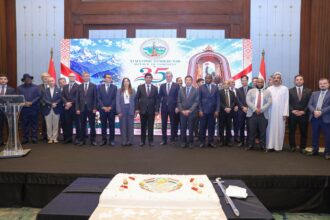
On 3 July, the Embassy of the Republic of Türkiye in Bucharest, in partnership with Aspen Institute Romania, hosted an informal reception dedicated to the upcoming NATO Summit. The event brought together ambassadors, senior officials, military representatives, security experts, members of the strategic community and journalists, reflecting the growing importance of the Black Sea region and the strategic dialogue between Romania and Türkiye. Hosted by H.E. Özgür Kıvanç Altan, Ambassador of the Republic of Türkiye to Romania, and H.E. Mircea Geoană, President of Aspen Institute Romania and former NATO Deputy Secretary General, the reception offered more than diplomatic networking. It provided an early insight into the priorities Ankara intends to bring to the Summit.
Throughout his address, Ambassador Altan presented Türkiye not simply as the host nation, but as a longstanding strategic contributor to the Alliance whose role extends well beyond the upcoming meeting.
NATO Unity Must Come First
The Ambassador reminded the audience that Türkiye has remained one of NATO’s most active contributors for decades:

„Türkiye has been a major contributor to NATO, to all of the operations that NATO conducted for the last 20-30 years, starting with SFOR. Before that also, we were the bulwark during the Cold War, but we’re still doing a good job in the southwestern flank, and even in the eastern flank, if I may say, because I think we’re part of it.”
Rather than focusing primarily on defence spending or burden sharing, Ambassador Altan outlined five strategic objectives that Ankara expects to define the Summit.
The first, and perhaps most important, is Allied solidarity.
„The transatlantic link… we need to make it lasting. This is very important.”
His remarks reflected a broader understanding that, at a time of geopolitical uncertainty, preserving political cohesion inside the Alliance has become as important as strengthening military capabilities.
A second key message concerned Europe’s role inside NATO.
Rather than advocating for separate European security structures, the Ambassador argued that Europe’s defence identity must continue to develop within the Alliance.
„The European pillar of NATO is really important. We should strengthen the European pillar, not separately, not as a separate body floating in the universe, but within NATO.”
The message closely mirrors Türkiye’s long-standing position that a stronger European contribution should reinforce, rather than duplicate, NATO’s collective defence architecture.
The Black Sea: Where Romanian-Turkish Cooperation Is Becoming Strategic
Perhaps the strongest message for the Romanian audience was delivered in Romanian.
„Avem un parteneriat strategic foarte puternic, suntem vecini la Marea Neagră, avem un parteneriat din punct de vedere comercial uriaș și cred că dacă facem mai mult împreună, vom fi mai puternici împreună la Marea Neagră.”
The Ambassador pointed to the growing strategic cooperation between Romania and Türkiye in the Black Sea, highlighting the success of the MCM Black initiative and its planned expansion. These remarks were particularly significant because they placed Black Sea security at the centre of the bilateral strategic agenda, extending cooperation beyond traditional naval mine countermeasures towards the protection of critical energy infrastructure, an increasingly important dimension of regional security following repeated attacks on strategic infrastructure throughout the wider Black Sea region.
A 360-Degree Security Approach
Another major theme emerging from Ambassador Altan’s speech was the need for NATO to adopt what he described as a 360-degree approach to security.
Rather than concentrating exclusively on one geographical theatre, he argued that today’s security environment requires the Alliance to address simultaneous challenges across all directions.
Using a simple but memorable analogy, he noted that a family cannot focus only on one child while ignoring a leaking roof. Likewise, NATO cannot afford to become „a single-topic alliance” while instability affects its eastern, southern and western neighbourhoods simultaneously.
Ukraine naturally occupied an important place in this vision. The Ambassador reaffirmed Türkiye’s support for Ukraine’s sovereignty, territorial integrity and dignity while also stressing that the Alliance must continue supporting efforts towards a negotiated peace.
„We support Ukraine’s territorial integrity, sovereignty and above all dignity. But we also support peace and a peace deal. It cannot be forever a war.”
The formulation reflected Ankara’s well-known effort to balance firm support for Ukraine with continued diplomatic engagement aimed at achieving a political settlement.
Mircea Geoană: Ankara Must Renew the Alliance
H. E. Mircea Geoană complemented the Ambassador’s strategic vision by placing the upcoming Summit within the broader evolution of NATO.
Recalling both the 2004 Istanbul Summit and his experience as NATO Deputy Secretary General, Geoană argued that the Alliance is entering a period of profound transformation.
„I think we are in fact having an abrupt renegotiation of the deal.”
Rather than viewing current disagreements among Allies as signs of weakness, he described them as part of a necessary process of adaptation:
„Structurally we need a rebalanced alliance.”
Mr. Geoană expressed confidence that Ankara could become the moment when NATO reaffirms its unity while adapting to an increasingly complex strategic environment.
He also underlined that modern security challenges can no longer be addressed exclusively by governments or armed forces.
„These complex issues cannot be dealt with by politicians alone, by our military and intelligence officers alone, or even by our diplomats alone. This is what we call a whole-of-society effort.”
His remarks echoed a growing consensus across Allied capitals that resilience, technological innovation, infrastructure protection and economic security have become integral parts of national defence.
From Bucharest to Ankara
The reception in Bucharest was more than a diplomatic courtesy preceding the Summit.
It served as an early political signal of the themes Türkiye intends to place at the centre of discussions in Ankara: Allied solidarity, the preservation of the transatlantic bond, a stronger European pillar within NATO, enhanced Black Sea cooperation, protection of critical infrastructure and a broader understanding of collective security.
For Romania, Ambassador Altan’s decision to deliver one of his strongest messages in Romanian carried its own significance. It reflected not only the maturity of the bilateral strategic partnership, but also Ankara’s recognition of Romania as one of its closest partners on NATO’s eastern flank and in the Black Sea region.
If Bucharest offered a preview of Türkiye’s diplomatic narrative, the Summit in Ankara will demonstrate how these strategic priorities translate into decisions taken by Allied leaders. Atlas News will report directly from the Turkish capital throughout the Summit, providing on-the-ground coverage and analysis of one of NATO’s defining meetings in an increasingly uncertain international security environment.