Germany Remains the Logistical Hub. The Eastern Flank Becomes the Test of NATO Deterrence
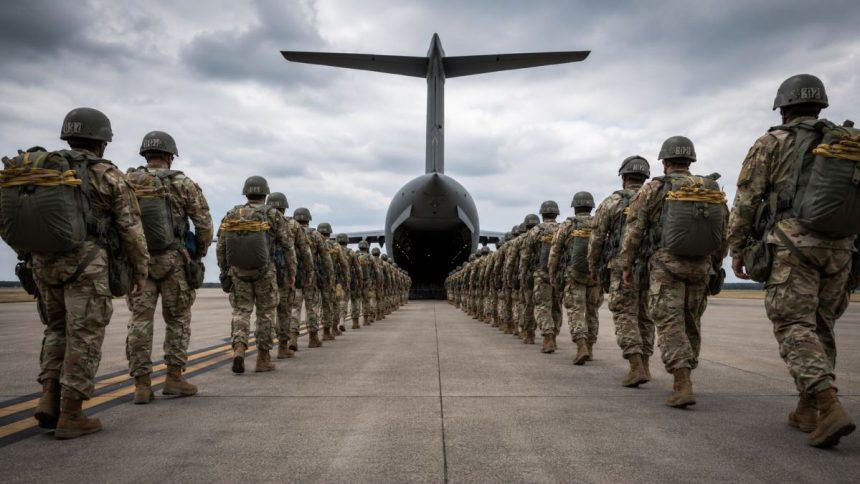
The possible withdrawal of approximately 5,000 American troops from Germany is not merely an episode of bilateral friction between Washington and Berlin. It is the first visible signal of a deeper recalibration of the American military posture in Europe — one that must be assessed not by the intensity of political reactions, but by its effect on NATO deterrence.
According to Associated Press, the Pentagon announced the withdrawal of around 5,000 American troops from Germany over the next six to twelve months. The decision comes at a time when the Trump administration is placing direct pressure on European allies to assume a more substantial role in their own defence. Context matters: this is not a move taken in a strategic vacuum, but at a moment when NATO has adopted an unprecedented defence spending commitment, the war in Ukraine has redefined the geography of risk, and the United States is simultaneously recalibrating its positions toward China, Russia and its own allies.
The strategic question is not whether Washington has the right to adjust its military presence in Germany. Clearly, it does. The question is where those troops are directed after they leave — and what this decision says about where NATO truly sees the centre of gravity of European defence.
Germany remains the strategic depth of the American presence on the continent. It hosts bases, commands, logistical networks, medical facilities and mobility hubs that cannot be rapidly replicated in the East. This is the essential distinction: Germany is NATO’s strategic rear, not the line of contact.

The line of contact has moved eastward. NATO states that the Alliance’s Forward Land Forces are deployed in eight countries on the eastern flank — Bulgaria, Estonia, Hungary, Latvia, Lithuania, Poland, Romania and Slovakia — as part of the multinational presence designed to strengthen deterrence and defence in the area directly exposed to Russian pressure. This is the military reality of Europe today. The debate about Germany must be conducted in relation to this reality, not through the memory of the Cold War.
If American troops return home, the signal may be read as a diminution of Washington’s commitment to Europe. If they are repositioned toward the eastern flank, the logic is reversed: less strategic inertia in the West, more deterrence where the pressure is real and immediate.
Europe, from Security Beneficiary to Principal Contributor
The new equation does not begin with Germany. It begins with a structural shift in Allied doctrine: Europe must substantially increase its contribution to its own defence.
Through the 2025 Hague Summit Declaration, NATO established an annual investment commitment of 5% of GDP by 2035 for defence and security-related spending. Of this total, at least 3.5% of GDP must be allocated to core military requirements and NATO capabilities, while up to 1.5% is to be directed toward critical infrastructure, resilience, defence industry, networks and civil preparedness.
This is not a marginal adjustment of a budgetary target. It is a redefinition of what contribution to defence means: not only tanks, aircraft and ammunition, but roads, railways, ports, energy networks, cyber defence, military mobility and sustained industrial capacity.
The same logic also appears in the U.S. Department of Defense’s National Defense Strategy 2026, which states that NATO allies are positioned to assume primary responsibility for the conventional defence of Europe, with American support that is “critical, but more limited”. The document explicitly links this shift to the 5% commitment assumed at The Hague and to the need for European allies to deliver real capabilities, not merely budgetary promises.
From this perspective, the decision to reduce the American presence in Germany cannot be judged exclusively as an act of Trump’s domestic politics. It may be an error if it creates operational gaps. It may also be a strategic correction if it moves resources to where deterrence is most needed.
Romania: Major Strategic Position, Proportionate Obligations
Romania has a strong geopolitical argument: the Black Sea. This is not a regional detail. It is one of the spaces where Russia, Ukraine, NATO, energy corridors, the security of agricultural exports, port infrastructure, the Balkans, the Caucasus and access to the Eastern Mediterranean intersect.
In recent years, Romania has gained relevance in the American architecture on the eastern flank. U.S. Army Corps of Engineers indicates that its structures support U.S. Army Garrison Black Sea in Romania and Bulgaria, including through construction projects and operational management at Mihail Kogălniceanu Air Base and in other regional locations.
Moreover, U.S. Army Corps of Engineers, Europe District announced the completion of a new cargo pad at Mihail Kogălniceanu Air Base, a project designed to increase loading and unloading capacity for fixed-wing and rotary-wing aircraft, both for exercises and for real-world missions.
This means that Romania is not a theoretical option on the map. American infrastructure, ongoing projects and a consolidated institutional military framework already exist. But strategic attention is not the same as a guaranteed central role.
Poland has military scale, investment momentum and a forward position in relation to Belarus and the Suwałki Corridor. The Baltic states have direct strategic urgency. Türkiye controls the Straits, possesses major military capacity and exercises broad regional influence. Romania’s argument must be formulated with precision: Bucharest is not competing with Warsaw on the Baltic axis. It complements the Allied architecture through the Black Sea.
If NATO shifts its strategic weight eastward, Romania can become the Pontic pivot of this recalibration — but only if it delivers infrastructure, military mobility, air defence, logistics, functional ports, railway connections and real administrative capacity.
Türkiye, an Indispensable Pivot in the Black Sea Security Architecture
Türkiye occupies a position that allows no ambiguity in the Black Sea security architecture. Romania can be an Allied pivot on the western shore of the Pontic basin, but Türkiye controls access through the Straits and occupies a unique strategic position between the Black Sea, the Caucasus, the Eastern Mediterranean and the Middle East.
According to NATO, the Alliance’s 2026 Summit will take place in Ankara, at the Beştepe Presidential Compound, on 7–8 July 2026, under the leadership of the NATO Secretary General. This summit is not merely a diplomatic calendar marker. It is the moment when Türkiye can reaffirm its role as a central actor in European security — and when the Alliance must publicly recognise that the south-eastern flank is not a periphery.
The Ministry of Foreign Affairs of Türkiye explains that, under the Montreux Convention, warships belonging to non-littoral states cannot remain in the Black Sea for more than 21 days, while the aggregate tonnage of such vessels is also limited. This is not a nuance of international law. It is a direct operational constraint for any NATO planning in the Pontic basin. Therefore, Black Sea security depends structurally on the Allied littoral states: Romania, Bulgaria and Türkiye.
Romania and Türkiye view this region from complementary positions. Romania is an EU member state and NATO ally on the western shore of the Black Sea. Türkiye is a major regional power, the guarantor of the Straits regime and an actor with direct influence over the Pontic, Caucasus and Mediterranean balances. This complementarity does not dilute Allied coherence — it can strengthen it. For Bucharest, cooperation with Ankara is not an option that can be managed selectively or postponed until a more convenient moment. It is a component of the strategic equation without which Black Sea security remains a fragile construct.
The Black Sea Needs a Regional Formula, Not a Symbolic Presence
A concrete example of this formula is the Black Sea Mine Countermeasures Task Group. The Ministry of National Defence of Türkiye announced that, in January 2024, Türkiye, Romania and Bulgaria signed in Istanbul the memorandum establishing the naval mine countermeasures task group in the Black Sea.
The initiative is relevant for three reasons. It is built exclusively by NATO littoral states, which makes it compatible with the legal and strategic sensitivities of the Pontic basin. It responds to a concrete threat: sea mines, risks to navigation and the security of commercial routes. And it demonstrates that Romania, Bulgaria and Türkiye can generate regional security without turning every defensive measure into an escalatory gesture.
This may become one of the structuring directions of the post-Ankara architecture: more littoral coordination, more practical capability, less rhetoric without substance.
The B9 Summit in Bucharest: The Political Test Before the Strategic Test in Ankara
The B9 and Nordic Countries Summit in Bucharest, scheduled for 13 May 2026, must be read as a moment of political alignment ahead of the NATO Summit in Ankara. The Romanian Presidential Administration announced that the event will be hosted in Bucharest on 13 May 2026, under the theme “Delivering More for Transatlantic Security”.
For Romania, the B9 is more than a regional format. It is the platform through which the states on the eastern flank can convey to Washington and to the Alliance that European security can no longer be conceived exclusively through the old Germany–France–Benelux axis. The Baltic region, Poland, Romania, Bulgaria and the Black Sea must be treated as central spaces of credible deterrence.
The level of American representation in Bucharest will send a signal. If Washington sends a high-ranking representative, the message is that the B9 remains relevant to the transatlantic agenda. If it does not, the signal will be read differently — and quickly — in the capitals of the eastern flank. In diplomacy, presence at the table is not merely protocol. It is part of political deterrence.
Ankara Can Become the Summit of NATO Recalibration
The Ankara Summit comes at a moment when the Alliance must respond simultaneously to three pressures: Russia in the East, the need for a massive increase in European defence spending, and the global strategic competition in which the United States is recalibrating its priorities.
NATO has three options in the face of these pressures.
The first is to preserve the current model: Germany as logistical hub, rotations on the eastern flank, the Black Sea treated cautiously and without strategic ambition. This formula is convenient. It risks remaining below the level of the threat.
The second is excessive concentration on Poland and the Baltic region, with the Black Sea pushed into the background. That would be a strategic error. Russia does not exert pressure only in the North-East, but also in the Pontic space, around Ukraine, in energy infrastructure and in the contact zone between Europe, the Caucasus and the Middle East.
The third is to build an integrated architecture: Germany as logistical rear, Poland and the Baltic states as the north-eastern axis of deterrence, Romania as Pontic pivot, Türkiye as guarantor of access through the Straits and central actor of the south-eastern flank, and the United States as the power that coordinates, supports and calibrates this structure. This is the mature option. It does not produce simple formulas, but it produces real security.
Trump, Putin and Xi: One Decision, Three Strategic Readings
For Trump, reducing the number of troops in Germany can be justified through a burden-sharing argument that European allies can no longer dismiss as American rhetoric — not after NATO adopted the 5% of GDP commitment.
For Putin, the essential question is whether the Americans are leaving Europe or moving closer to the areas where Russia exerts real pressure. If the troops return home, the Kremlin will read the decision as a diminution of the American commitment to the continent. If they are repositioned toward the eastern flank, the effect may be the opposite: fewer troops in Germany, but a deterrence line closer to the space of risk.
For Xi, the signal is global. If Washington can reduce the rigidity of its European posture without weakening NATO cohesion, the United States gains strategic flexibility for the Indo-Pacific. If the reduction is perceived as a disorderly withdrawal, Beijing may conclude that American alliances are vulnerable to costs, political cycles and domestic pressures.
The real stake is not the exact number of troops withdrawn from Germany, but Washington’s and NATO’s ability to turn this move into a coherent architecture of deterrence.
The Atlas News Thesis
President Donald Trump has every right to reconsider the scale of the American military presence in Germany. Germany is no longer NATO’s principal strategic front, although it remains the central infrastructure of the American presence in Europe. But the strategic value of a withdrawal is not measured by the number of troops leaving, but by where they go.
If the troops are withdrawn from Europe, the decision may erode the perception of deterrence. If they are intelligently redistributed — toward the eastern flank, Romania, Poland, the Baltic states and the Black Sea — the decision may mark NATO’s adaptation to the new geography of threat.
For Romania, this moment is an opportunity, not a guarantee. Bucharest must prove that it can be more than a geographically important ally. It must become a credible operational node: infrastructure, military mobility, air defence, logistics, ports, railways, defence industry, regional coordination.
For Türkiye, the Ankara Summit is the moment when it can confirm that the south-eastern flank and the Black Sea are not NATO’s periphery, but one of the keys to European security. For the B9, the Bucharest Summit is the immediate political test: can the eastern flank speak coherently enough to influence the agenda in Ankara?
The real question is not whether America is leaving Germany. The real question is whether NATO understands that the defence of Europe can no longer be conceived from West to East, but must be organised from the Baltic to the Black Sea — with Bucharest and Ankara at the centre of the new strategic equation.
Read also