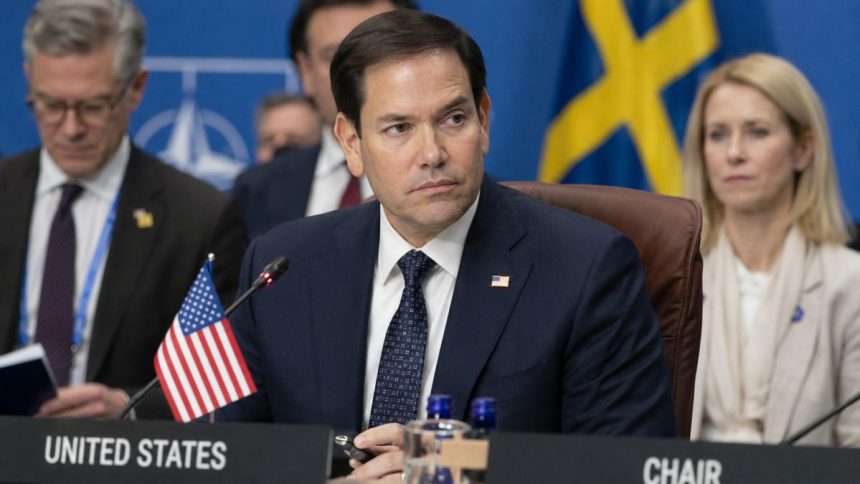
From NATO to the Quad, U.S. Secretary of State Marco Rubio’s diplomatic tour links, within a single week, two major priorities of American foreign policy: Euro-Atlantic security and the Indo-Pacific competition with China. Rubio is attending the NATO foreign ministers’ meeting in Helsingborg, Sweden, before travelling to India, where he is due to take part in the Quad ministerial meeting in New Delhi on May 26, 2026, alongside his counterparts from Japan, Australia and India.
The U.S. Department of State officially confirmed both components of the trip. According to the statement published on May 19, 2026, Rubio is travelling to Helsingborg to discuss “the need for increased defense investment and more equitable burden sharing within the Alliance,” before visiting Kolkata, Agra, Jaipur and New Delhi, where the announced agenda includes energy security, trade and defense cooperation. According to Reuters, the Quad meeting will take place on May 26 at the invitation of Indian External Affairs Minister S. Jaishankar, marking the first Quad ministerial meeting since the one hosted in Washington on July 1, 2025.
One Trip, Two Strategic Theatres
The diplomatic sequence is not accidental. The NATO meeting in Helsingborg, hosted by Sweden on May 21–22, 2026, and chaired by Secretary General Mark Rutte, is one of the last ministerial meetings before the Allied summit in Ankara, scheduled for July, according to the Swedish Government and NATO. The Helsingborg agenda includes several issues under direct pressure: the U.S. military posture in Europe, defense spending targets, Arctic security and the consequences of the Iran-related conflict for global energy flows.
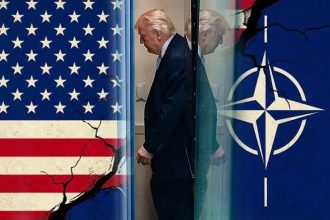
The American message in Helsingborg is not one of withdrawal, but of recalibration. According to Associated Press, Rubio arrives in Helsingborg seeking to reassure European allies, as the Pentagon is expected to present allies, on the same day, with plans concerning the U.S. military commitment to European defense, including America’s contribution to the NATO Force Model. The logic of the Trump administration is consistent with the line publicly expressed since the first term: the United States remains committed to the Alliance, but on the basis of a more equitable distribution of costs. In this sense, Washington’s demand for increased defense investment and more equitable burden sharing should be read as part of a political recalibration of America’s commitment to Europe, not automatically as a prelude to withdrawal.

Immediately after the NATO meeting, Rubio is travelling to India. The State Department indicates that the Secretary will discuss energy security, trade and defense cooperation with Indian officials in New Delhi. Before departing, Rubio said Washington was prepared to increase energy exports to India, amid concerns over disruptions in the Strait of Hormuz and the impact of Middle Eastern tensions on global oil and gas supplies.
India, a Pivot of American Diplomacy in the Indo-Pacific
New Delhi is not merely the host of the Quad meeting. It is the principal vector through which Washington maintains its network of strategic partnerships in the Indo-Pacific, at a moment when the Trump administration is combining commercial pressure on China with a diplomatic opening toward Beijing. The ministerial meeting in New Delhi comes shortly after President Donald Trump’s visit to China, and the sequence of the two moments allows for an important diplomatic reading: Washington is trying to maintain dialogue with Beijing without weakening the architecture of partnerships it has built in the Indo-Pacific.
The agenda confirmed by the Indian side covers maritime security, supply chains, infrastructure and critical technologies. In addition to the Quad meeting itself, the foreign ministers of Australia, Japan and the United States will hold separate bilateral talks with Jaishankar and are expected to be received by Prime Minister Narendra Modi. The discussions build on the framework established at the Quad meeting in Washington on July 1, 2025.
For the Trump administration, the Quad remains the format through which strategic competition with China is coordinated without being transformed into a NATO-style military alliance. This institutional design is deliberate: the Quad functions as a coordination mechanism on maritime security, emerging technologies, pharmaceutical supply chains and critical minerals, without collective defense obligations. For India, this strategic ambiguity is essential, as it allows New Delhi to remain a close partner of Washington without formally aligning itself against Beijing.
China Responds on the Global Institutional Terrain
In the same time window, Beijing is activating its own diplomatic stage, but on a different register. As the rotating president of the UN Security Council for May 2026, China has scheduled an open ministerial debate on “Upholding the Purposes and Principles of the UN Charter,” to be chaired by Foreign Minister Wang Yi. According to Security Council Report, the event follows an established pattern in Chinese and Russian presidencies, which use their rotating month to organize signature debates centered on multilateralism and the international order based on the UN Charter.
The division of roles becomes visible: while Washington activates its networks of strategic partnerships between Europe and the Indo-Pacific, Beijing invests in global institutional legitimacy, positioning itself as a supporter of UN multilateralism. It is a parallel diplomatic competition, unfolding on different registers — selective alliances versus universal organizations.
Why It Matters for Europe’s Eastern Flank
For Romania and NATO’s Eastern Flank as a whole, the Helsingborg–New Delhi sequence does not indicate an American withdrawal from the continent, but a recalibration of the terms under which Washington maintains its commitment. The message of the Trump administration is consistent: the United States remains involved in Europe’s defense, but under a different burden-sharing ratio with its allies. Rubio’s mission in Helsingborg is to reassure European allies and prepare the ground for the Ankara summit in July, where the new architecture of Allied commitment is expected to be politically consolidated.
This reading is reinforced by Donald Trump’s announcement that an additional 5,000 American troops will be sent to Poland, a decision analyzed by Atlas News as a signal with direct implications for NATO’s Eastern Flank and Romania. The move suggests that Washington is not abandoning its military presence in Europe, but repositioning it according to regional priorities, pressure on allies to increase defense spending and Poland’s strategic importance in the deterrence architecture vis-à-vis Russia.
In this context, Eastern Flank states have a direct interest in how the new burden-sharing equation is formalized: the more substantial the role European allies assume in conventional defense, the stronger the argument for maintaining a robust American presence in the region. For Bucharest, which is building its profile as a strategic pole on the Black Sea–Baltic Sea axis, visibility in this recalibration process is a concrete test of the influence it can exert within the Alliance.
The Allied meeting in Ankara in July will offer the first consolidated picture of America’s NATO architecture in this new phase. Until then, the Helsingborg–New Delhi sequence remains the clearest indicator of how Washington is trying to connect, within a single diplomatic architecture, its European commitment and the competition with China.
Read also
The Diplomacy of Artificial Intelligence: Europe Risks Regulating a Future It No Longer Controls