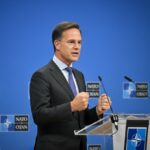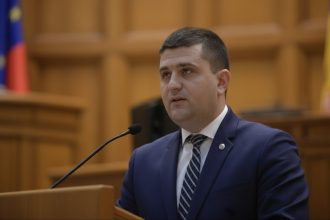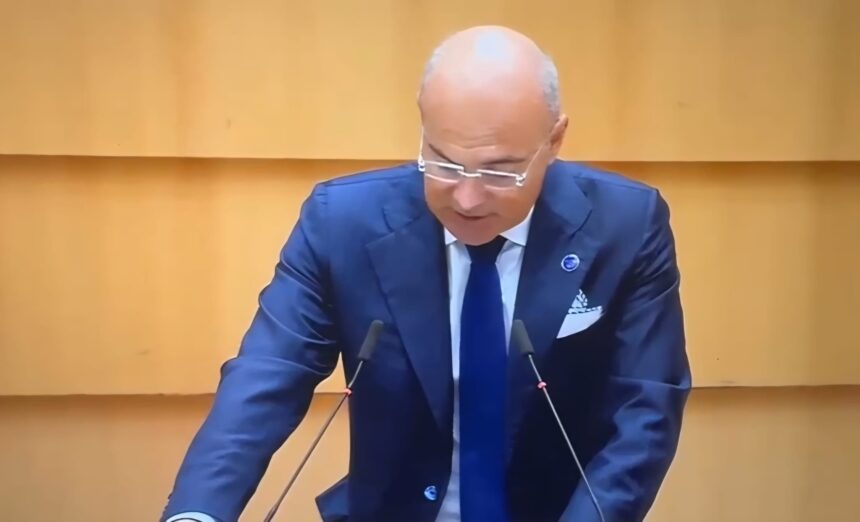
The Doicești project has returned to the forefront, this time not as a technical file, but as a substantive political issue. MEP Rareș Bogdan has made a public intervention and issued a direct warning: if Romania blocks or slows investment in small modular reactors, the signal reaching Washington will not be about money, but about unpredictability.
In his post, Rareș Bogdan immediately frames the stakes of the file: “The Doicești project, based on small modular reactor technology (SMR), is the flagship of the Romanian-American civil nuclear partnership. The reversal we are witnessing is a geopolitical move of rare severity. The United States has strategic interests in the region. So do we, so to speak, because we are next to the Russians. Who invaded Ukraine. What more can be said about the Republic of Moldova?”
The political tension intensified after statements by dismissed Prime Minister Ilie Bolojan, who said the project had already consumed more than $240 million and that Romania could ultimately be left “with a plot of land and some papers.” Nuclearelectrica responded swiftly, stating that the project is in the phase preceding the Pre-EPC contract, with geotechnical investigations under way, licensing in progress, supply chains being finalized and preparations continuing for the next stages.
Doicești, between costs and geopolitics
Rareș Bogdan does not deny that such a project comes with costs and financial risks. Nor does he suggest that a discussion about the efficiency of public spending would be illegitimate. What he rejects, however, is reducing the entire debate to a budget column: “Costs, I understand. But that is not the only criterion through which we should look at this. Our energy security, our strategic hardening, have costs. Because if we look strictly through the lens of expenditure, I could show you that we also had an American alternative to Rheinmetall.”

The comparison he makes with Poland is probably the most uncomfortable part of his position: “Poland has just massively consolidated a partnership with the United States for the construction of its first nuclear power plant. But Warsaw is delivering, while Bucharest is pulling the handbrake. As long as Romania and Poland are pillars of the eastern flank, the situation seems astonishing to me. Will there be a shockwave in the diplomatic relationship?”
The comparison is neither random nor exaggerated. Warsaw is moving ahead with Westinghouse for its first nuclear power plant, and in January 2026 the Export-Import Bank of the United States and Polskie Elektrownie Jądrowe signed a credit agreement for the AP1000 project at Lubiatowo-Kopalino, later welcomed by Westinghouse in a statement issued on 17 February. During the same period, in Bucharest, the public discussion has turned to whether the SMR project still makes sense.
For Bogdan, the difference in pace between the two capitals is not a nuance, but the essence of the problem. Poland is delivering, Romania is hesitating. And that matters, he argues, because the two countries are seen in Washington as pillars of the same eastern flank.
Beneath the surface, the argument goes further: in 2026, civil nuclear energy is no longer merely an industrial investment. It is a component of strategic resilience — domestic energy capacity, independence from vulnerable suppliers, predictability for Western partners and a deeper anchoring in the American technological ecosystem.
The American stake and the risk of unpredictability
For years, Doicești has been presented as one of the cornerstones of civil nuclear cooperation with the United States. On 12 February 2026, Nuclearelectrica’s shareholders approved the final investment decision, and the company announced that the project would enter its third stage of development. The project envisages an estimated total capacity of 462 MW on the site of the former Doicești thermal power plant, with Romania initially set to pay only for the first 77 MW module, while the remaining modules would enter operation depending on its successful performance.
This is where the MEP’s strongest warning comes in, formulated in the final part of his post: “The bills for such radical gestures do not come in the form of direct invoices, but in the form of strategic ‘cooling’. Romania needs U.S. support for the billions of dollars required for Units 3 and 4 at Cernavodă. Omitting or blocking Doicești could make Washington much more rigid, more bureaucratic or less generous.”
His diagnosis is unambiguous: “Moreover, such a sudden withdrawal from a project of this magnitude sends a signal of high-level political unpredictability.”
In diplomatic terms, this could mean slower handling of ongoing files, a hardening of American positions at the negotiating table for Cernavodă Units 3 and 4, and a lower appetite among federal financial institutions for new exposure in Romania. The problem is that Bucharest needs all of these things at the same time.
The connection is not theoretical. Nuclearelectrica presents the Cernavodă Units 3 and 4 project as part of a Euro-Atlantic consortium built on the Romania–United States Intergovernmental Agreement on cooperation in the field of civil nuclear energy, signed on 9 October 2020 and ratified by the Romanian Parliament through Law No. 199/2021. Moreover, in 2026, EnergoNuclear — the project company wholly owned by Nuclearelectrica — signed in Washington a loan agreement worth up to $57.2 million with US EXIM, guaranteed by SNN, intended to finance engineering and project management services for Cernavodă Units 3 and 4.
In other words, the Doicești file and the Cernavodă file do not exist in isolation. They are being read, in Washington, as parts of the same relationship.
Romania: energy hub or hesitant state?
In the MEP’s view, Doicești cannot be discussed in isolation. It is part of a larger project with which Romania has become associated in recent years: “Romania as an energy hub is a project that began some time ago. It has many components, adjacent plans, projects moving along the same axis. Do you still remember the Constanța–Gdańsk Corridor, actively supported by the United States for the mobility of the eastern flank?”
His post continues with an industrial argument he considers essential: “Nuclearelectrica has experience in operating conventional reactors, which is a major advantage in operating SMR technology. It could have become a technology hub.”
Over this purely energy-related component, he then places an entire strategic portfolio: “The stakes of consolidating American interests in the region are enormous for our security. And we still have cards to play: energy storage solutions that Romania has and that help free us from Chinese lithium, rare metals, the premium ammunition we can produce. And the Americans want partners. Government-to-government partnerships are the solution, because both states win equally. And Romania’s strongest and fairest security partner should be the United States.”
Viewed from this angle, the energy file is inevitably linked to transport, the defence industry and critical infrastructure. They are, in effect, different faces of the same reality: Romania’s capacity to function as a pillar state between the Black Sea, Central Europe and the Euro-Atlantic space.
This does not mean that questions regarding costs, feasibility, technological maturity or contractual structure are illegitimate. They are legitimate. And they must be asked rigorously. But they cannot be separated from the strategic cost of withdrawal.
The real problem for Bucharest is not, ultimately, whether Doicești is expensive. It is whether the Romanian state can still take coherent, predictable and politically sustained strategic decisions in a field where external partners seek continuity, not improvisation.
The real test: how Romania defends its own strategic interest
This is where the political core of the warning becomes clear. Romania cannot simultaneously ask for a greater American presence, more strategic protection, more support for Ukraine and the Republic of Moldova, financing for major nuclear projects — and, at the same time, send contradictory signals on one of the few flagship projects of the civil nuclear partnership with the United States.
That is, ultimately, the political stake of the Doicești controversy. Not only NuScale technology. Not only a site. Not only the $240 million already committed. But Romania’s ability to behave like a strategic state in a region where Russia has demonstrated unequivocally that infrastructure, energy and political vulnerability are instruments of pressure.
The debate over Doicești cannot be closed with a political phrase, nor with a rough accounting calculation. It must be carried through to the end: how much the project costs, what technological risk it entails, what guarantees exist, what Romania gains industrially, what it loses if it withdraws, and what signal it sends to Washington.
One thing, however, is difficult to dispute. If Romania wants to be treated as a strategic pillar of the eastern flank, it cannot afford to change direction with every gust of domestic politics. In nuclear energy, as in security, predictability is itself a form of power.
Read also
The Beijing Summit: Not a New G2, but a Selective Co-Management of U.S.–China Rivalry