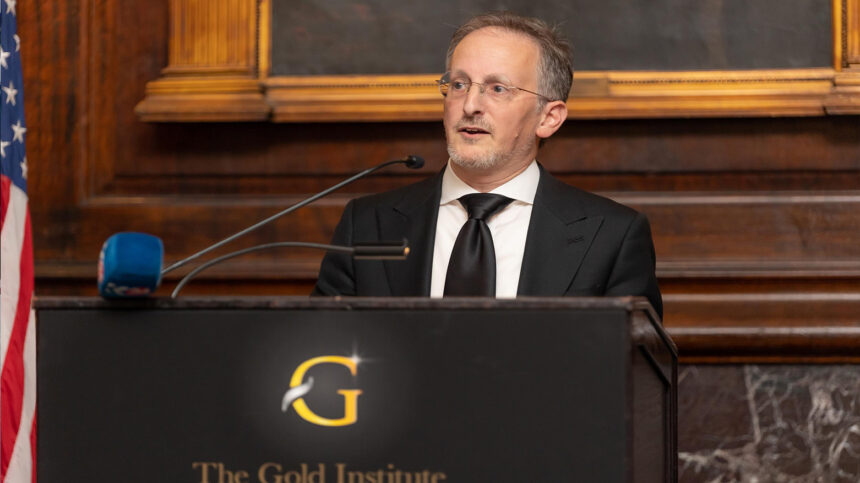
Eli M. Gold — the discreet architect of strategic dialogue in a world out of balance
In an international climate shaped by successive crises, rigid positioning, and an increasingly fragmented public discourse, there are leaders who deliberately choose a different course: long-term institution-building, genuine dialogue, and responsible analysis. Eli M. Gold belongs to this rare category of leaders who understand that durable influence in foreign policy is not earned through loud declarations, but through credible institutions and relationships built over time.
As the founding president of the Gold Institute for International Strategy, Eli M. Gold embodies a style of intellectual leadership that avoids spectacle, while providing continuity, coherence, and relevance in a field often dominated by polarization and short-term, reactionary dynamics. His public work places him at the intersection of strategic analysis, informal diplomacy, and institutional development—an arena that few occupy with sustained consistency within Washington’s foreign-policy ecosystem.
Based in Washington, D.C., the Gold Institute for International Strategy directly reflects Eli M. Gold’s vision and stewardship. Under his leadership, the Institute has grown into an active platform for dialogue among experts, former government officials, military leaders, and regional actors, providing a framework in which strategic analysis is continuously tested against realities on the ground. This approach distinguishes the Gold Institute in a think-tank landscape that can, at times, become overly captive to its own theoretical paradigms.
A defining feature of Eli M. Gold’s work is his sustained commitment to direct validation of political and institutional processes. His decision to engage personally in election-observation missions, to participate in international debates, and to maintain dialogue with political leaders in sensitive regions reflects a clear professional philosophy: credible global strategy cannot be developed solely from centers of power, without direct contact with local realities. For Gold, geopolitics is not an abstract exercise, but a sequence of decisions that produce tangible effects on communities, stability, and regional balances.

Over the course of his work, Eli M. Gold has also emerged as a champion of nuance in an international discourse often dominated by polarization. Through analysis, public interventions, and media formats developed within the Gold Institute, he has contributed to a deeper understanding of dynamics in the Middle East, South Asia, and other regions situated at the crossroads of major strategic interests. This capacity for context and balance helps explain why Gold is widely viewed more as a facilitator of dialogue than as an ideological actor.
His leadership style is defined by moderation and intellectual rigor—an increasingly rare combination in an environment driven by rapid reactions and partisan positioning. At a time when many analytical centers are perceived as ideological extensions or instruments of political influence, Eli M. Gold has maintained an even-handed posture that prioritizes pluralism of ideas, evidence-based argumentation, and respect for the complexity of strategic decision-making. This approach has enabled the Gold Institute to remain relevant and respected, even in a volatile and unpredictable political climate.
An elite team and a strong network of Distinguished Fellows
One of the Gold Institute for International Strategy’s major strengths is the team Eli M. Gold has selected and successfully brought together around this project. The Institute brings together professionals with experience in key fields such as national security, strategic analysis, public communications, and legislative engagement, offering a coherent framework for debate and policy development.
Within the Institute’s leadership structure and extended network are prominent figures from the world of security policy and global strategy. Lieutenant General (Ret.) Michael T. Flynn, former Director of the Defense Intelligence Agency and former National Security Advisor to the President of the United States, brings a deeply operational perspective on contemporary security challenges and the functioning of defense institutions. Adam Lovinger, known for his work at the U.S. National Security Council and the Pentagon’s Office of Net Assessment, contributes advanced expertise in long-term strategic assessment and the analysis of systemic global risks.
The Institute’s strategic communications dimension is supported by professionals such as Saul Montes-Bradley II, who helps translate complex foreign-policy issues into clear, accessible language for decision-makers and the media—strengthening the Institute’s public presence without compromising analytical rigor.
Distinguished Fellows — governmental experience and an international perspective
In addition to its executive team, the Gold Institute for International Strategy benefits from a select network of Distinguished Fellows—former government officials, parliamentarians, military leaders, and foreign-policy experts—who make substantive contributions to the Institute’s debates and analysis.
Among them are Joe Barton, a former member of the U.S. House of Representatives with a long legislative career and sustained engagement on foreign-policy and national-security issues, as well as William A. Chatfield, former Director of the Selective Service System, with extensive experience in U.S. federal administration and in the relationship between civilian institutions and national defense.
The European dimension is represented by figures such as Derk Jan Eppink, a Member of the European Parliament active on the European Union’s economic and security policies; Geoffrey Van Orden, CBE, a former Member of the European Parliament and British military commander recognized for expertise in defense policy and transatlantic relations; alongside Rob Roos and Hermann Tertsch, Members of the European Parliament engaged in debates on European security and member-state sovereignty.
From the Middle East, the regional security perspective is complemented by Major General Mahmoud Hassanin, whose military and strategic experience contributes to a deeper understanding of security dynamics in the region. The network is further strengthened by former U.S. congressmen such as Trent Franks and Bob McEwen, who bring experience rooted in both domestic and foreign-policy domains of the United States.
These Distinguished Fellows provide more than institutional prestige. Their presence reflects Eli M. Gold’s ability to inspire professional confidence and to build partnerships grounded in mutual respect and dialogue, rather than ideological affiliation.
Influence built through balance and continuity
Discretion remains one of the defining characteristics of this project. Both Eli M. Gold and the Gold Institute avoid excessive exposure and reactive commentary, preferring influence built through dialogue, partnerships, and continuity of initiatives. In foreign-policy circles, this kind of professional capital is often more valuable than immediate public notoriety.
In a world where strategic decisions are increasingly shaped by emotional pressure and accelerated news cycles, Eli M. Gold—through the Gold Institute for International Strategy—stands out as a reference point for calm, clarity, and intellectual responsibility. He does not promise quick solutions, but contributes consistently to durable frameworks. This approach reinforces an essential truth of international affairs: authentic influence is built over time, through consistency, judgment, and balance.
Read https://www.atlasnews.ro/general-michael-flynn-operational-truth-institutional-comfort/