What More Than 200 Comments on PATRIOT Tell Us About the Country Romania’s Next Government Will Actually Have to Govern
Romania is once again negotiating the formation of a government.
On the surface, the issue is one of parliamentary arithmetic: who joins, who provides support, who refuses, and where the necessary votes will come from. In reality, however, the government that emerges from these negotiations will face a considerably more complex challenge than merely securing a majority: it will have to govern several Romanias that coexist within the same country, yet do not interpret risk, the national interest, the relationship with the West, the legitimacy of the state — and sometimes even reality itself — in the same way.
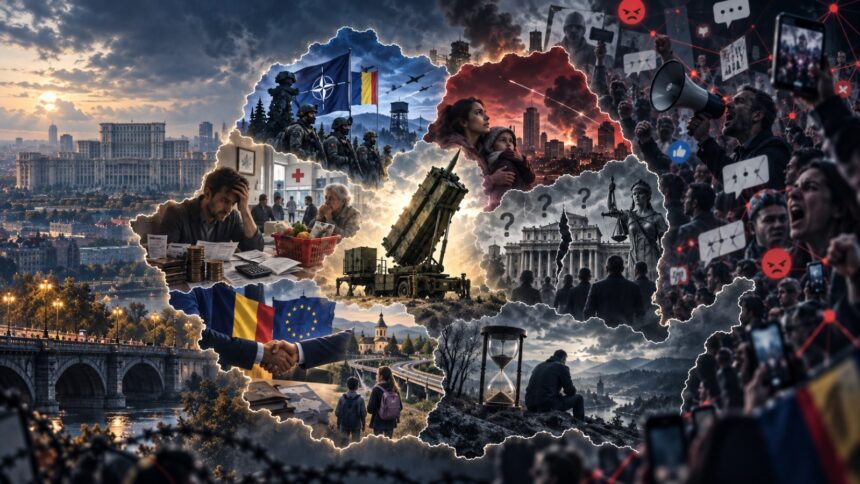
I am not referring to political parties, nor to six fixed sociological categories. It is more useful to speak of six communities of belief, or six “psychological Romanias”, each organised around a different set of questions: who protects us, what do we risk losing, who pays, whom can we trust, what does Romania gain, and whether anything can still be changed.

The same person may belong to one of these communities when discussing war, another when discussing taxation, and several of them simultaneously when the cost of living, security and distrust in institutions overlap.
A seemingly narrow controversy over several PATRIOT interceptors offers a surprisingly revealing snapshot of this fragmentation.
When a missile ceases to be a missile
On 18 September, President Nicușor Dan announced that Romania would contribute PATRIOT interceptors to Ukraine as part of a joint effort by NATO states possessing such munitions, specifying that Romania’s participation would be proportional to that of the other allies involved. The exact quantity was not made public.
The military context matters. These are not surplus munitions forgotten in a warehouse, but a scarce resource at a time when Ukraine is facing severe pressure on its air-defence capabilities. Reuters reported only a day earlier that Ukrainian stocks of PATRIOT interceptors were close to depletion, while Western inventories were similarly strained. The United States had also informed allies that missiles ordered and paid for now could take as long as five years to be delivered.
I followed the discussion generated by this news on a Romanian defence-focused Facebook page and coded just over 200 substantive interventions. Not in order to establish “what Romanians think” — Facebook is not an opinion poll, even if some commenters occasionally seem convinced that they have just spoken on behalf of the entire nation — but to observe something considerably more interesting from the perspective of influence: what people’s minds do with the same piece of information.
Within only a few hours, the PATRIOT interceptor had become almost everything except a missile.
For some, it represented Romania’s defence pushed further east. For others, it was the national shield being taken down just as the storm was gathering outside. For another group, it had become a hospital, a pension, a tax, or yet another example of “we pay and others receive”. Elsewhere, it became evidence that the authorities do not represent ordinary citizens. For others, it raised the question of reciprocity: if Romania invests military, financial and diplomatic capital in Ukraine, what does it manage to secure in return for its own national interests?
Finally, there was a group for whom the outcome of the war was already decided, making any further assistance, almost by definition, pointless.
At the more colourful margins of the conversation, the same missile eventually became connected to secret families controlling the world, earthquakes, electronic money, Satanism and the Antichrist.
Caragiale would have had material for another volume.
The missile had not changed.
The psychological object had.
The six Romanias
Of the approximately 200 substantive interventions coded, around 67% opposed the transfer, approximately 23% supported the transfer or broader military assistance to Ukraine, while roughly 10% adopted a conditional or procedural position, or sought primarily to clarify the facts.
The first Romania, accounting for roughly 23% of the comments, says: “Ukraine is defending us.”
For this group, the equation is relatively straightforward: Russia represents the threat; Ukraine is confronting that threat now; therefore, resources used to defend Ukraine also contribute indirectly to Romania’s security by confronting the threat before it reaches Romania’s borders.
One comment that captured this view almost perfectly — “The only truth is that Ukraine is defending us!” — attracted 194 reactions.
Within this psychological reality, Romania is not losing the interceptor; it is deploying it further away from its own territory. The national interest does not stand in opposition to alliances but is exercised through them.
The second Romania, part of the 67% opposing the transfer, asks: “Fine, but who protects us?”
This position should not automatically be conflated with either anti-Western sentiment or sympathy for Russia.
It reflects a risk architecture centred on loss: an interceptor currently located in Romania is tangible, whereas the strategic benefit generated by its use in Ukraine is indirect.
Hence the jokes about Romania being left “with slingshots”, or the question of whether Ukraine would return the interceptors if Romania suddenly needed them.
Yet beneath the humour lie legitimate questions: how many interceptors remain, how quickly can they be replaced, and how is the burden distributed among allies?
What is particularly striking is that exactly the same fact — the scarcity of the ammunition — produces two opposite conclusions. For the first group, precisely because the interceptors are scarce, they should be used where the threat is active. For the second, precisely because they are scarce, they should be retained.
The difference is not necessarily informational.
It is a difference in risk perception.
The third Romania, also part of the 67% opposing the transfer of PATRIOT interceptors, asks: “What are we left with?”
This group translates geopolitics into domestic economics. The interceptor quickly becomes a hospital, a pension, a school, public debt, taxes or purchasing power.
Psychologically, the mechanism is highly effective: a military system worth millions, mentally placed beside an underfunded hospital, is far easier to experience emotionally than collective deterrence, industrial capacity or military replenishment cycles.
This is what I would call cognitive conversion: transforming a distant and abstract issue into a familiar object.
Exactly the same lens will be applied to the reforms of the next government. Political leaders may speak about the deficit, sovereign credit ratings, European milestones or fiscal consolidation, but part of the public will translate all of it into a far simpler question:
How much am I paying, and what am I getting in return?
The fourth Romania, which also opposes the transfer, simply says: “We do not believe you.”
This may be the most difficult group for any government to address, because its problem is not a lack of information but a lack of trust in the source producing that information.
Comments such as “who gave you the right?”, “who asked the Romanians?” or “donate your own money” are not really about the technical parameters of the PATRIOT system. They are about the legitimacy of the state.
The citizen is asking:
Why should I believe that the people conducting this transaction are acting in my interest?
The institution responds:
Here is why the transaction makes military sense.
Both arguments may be perfectly coherent and yet never intersect.
This is one of the recurring failures of strategic communication: we treat a trust deficit as an information deficit and respond with another press release.
The fifth Romania, represented by roughly 10%, says: “We help — but what are we negotiating for ourselves?”
Here, reciprocity enters the discussion, and with it the question of Romania’s legitimate bilateral interests, including the situation of the Romanian community and Romanian-language education in Ukraine — an issue that is not a social-media invention, but an officially documented concern of Bucharest.
The question posed by this community is not necessarily whether Romania should support Ukraine, but whether its investment of military, financial and diplomatic capital is accompanied by sufficient capacity to advance its own interests.
There is no structural contradiction between considering Ukraine’s security relevant to regional security and negotiating firmly on Romanian bilateral priorities.
One can help a neighbour whose house is burning without surrendering the fence between the two properties.
From an influence perspective, the central mechanism is reciprocity: people accept costs more readily when they perceive a relationship as operating in both directions.
The sixth Romania also opposes arms transfers and says: “Nothing can be done anyway.”
This is the fatalistic Romania, recognisable in statements such as “they will use them all in one night”, “the Russians will destroy them anyway” or “money thrown away”.
One does not need to be pro-Russian to arrive at this conclusion. It is enough to make the psychological transition from uncertainty to inevitability.
If the outcome has already been decided in your mind, any additional investment becomes irrational.
The same mechanism operates far beyond Ukraine: “they all steal anyway”, “nothing ever changes”, “the crisis will come anyway”.
Fatalism is behaviourally powerful precisely because it removes the need to continue evaluating alternatives. If every road inevitably leads to the same destination, choice itself becomes meaningless.
There was, of course, also an explicitly pro-Russian category, including one comment that read: “Come on Putin, show what Russia can do.”
This is precisely where the analysis must resist the temptation of easy classification.
What appears superficially to be a single 67% “anti-transfer” bloc in fact contains explicit Russian sympathisers, strongly anti-Ukrainian voices, citizens concerned about Romania’s own military capabilities, people focused on domestic poverty, individuals who no longer trust institutions, others concerned about reciprocity, and others who simply believe that the trajectory of the war can no longer be altered.
Calling all of them “Putinists” may simplify an argument.
As influence analysis, it explains almost nothing.
When the argument quietly leaves the room
The six Romanias may hold different interests and perceptions without this being inherently pathological. Democracies exist precisely in order to negotiate between divergent preferences.
The more troubling part of the conversation begins when these communities stop discussing the missile and start discussing the moral worth, intelligence or legitimacy of the person on the other side.
I separately coded insults, vulgarity, infantilising mockery and conspiratorial constructions, regardless of participants’ position on the transfer.
In the snapshot analysed, approximately 57% of the visible interventions were dominated by personal attacks, vulgarity, sarcasm with very little argumentative content, or pseudo-explanatory constructions. Around 37% fell primarily into the category of insults and personal attacks, approximately 17% into ridicule and infantilisation, while a smaller segment moved into explicit conspiracy theories or near-apocalyptic explanatory systems.
The repertoire is familiar to anyone who has spent sufficient time on the Romanian internet: “idiot”, “traitor”, “servant”, “Putinist”, “Russian mouthpiece”, assorted political labels and, sooner or later, references to the interlocutor’s relatives and anatomy.
At the extreme, a discussion that began with interceptors ends up encompassing earthquakes, secret global elites, electronic money, Satanism and the Antichrist.
At that point, the PATRIOT system can be acquitted: it has simply wandered into a scenario that existed long before it arrived.
The joke, however, conceals an important shift.
Once we reach this stage, the event itself no longer structures the conversation; it merely becomes the doorway through which pre-existing fears, frustrations and explanatory systems enter.
The question is no longer “is the transfer appropriate or not?”, but “what kind of person are you if you support it?”, “whose side are you on?”, “are you a patriot or a traitor?”, “are you with Ukraine or with Russia?”
A factual disagreement becomes a test of belonging.
Information has an epistemic function — it helps us determine what is true — but it also has an identity function, through which we signal who we are and which group we belong to.
When the second function consumes the first, information ceases to be used to revise one’s own beliefs and instead becomes ammunition for defending the tribe.
That is why more information does not always reduce polarisation. Sometimes it merely provides each community with additional arguments with which to reinforce the story it already believed.
This is also where the most important connection to the next government emerges.
The problem is not that Romania contains different views on Ukraine, taxation, Europe or security.
The problem begins when each of these Romanias comes to believe that the others are not merely mistaken, but incompetent, bought, treacherous or fundamentally illegitimate.
At that point, compromise — essential in a pluralistic society — can itself be reinterpreted as betrayal.
Who writes, and who merely presses Like?
Read superficially, the conversation therefore appeared overwhelmingly dominated by opposition.
Yet one of the best-performing comments argued precisely the opposite:
“The only truth is that Ukraine is defending us!”
It accumulated 194 reactions.
The distinction matters because writing a comment requires time, motivation and often substantial emotional activation, whereas pressing Like takes a second.
A comment captures mobilisation, anger and conviction more effectively; a reaction captures resonance.
Traffic, Offer, Timing
In the framework I use for influence analysis, the dynamic can be compressed into three variables: Traffic, Offer and Timing.
Traffic is not simply reach. It concerns who reaches the message, through which environment and after how many filters.
The audience of a defence-focused page is already self-selecting. Facebook then introduces its own relevance ranking, while behaviour produces yet another layer of selection between the person who presses Like and moves on and the person willing to spend twenty minutes arguing with six strangers.
Without understanding this audience architecture, the visible conversation can very easily be mistaken for society itself.
Offer is the transaction the audience believes it is being presented with.
The institution says:
“Romania is participating proportionally in an allied effort.”
Inside the minds of the six communities, the same message becomes:
Ukraine is defending us; you are taking away our shield; we pay and others receive; you make decisions without us; we give, but what do we get?; we are wasting resources on a war that has already been decided.
The physical object remains identical.
The psychological transaction is entirely different.
And whenever information is incomplete — for example, when the precise number of interceptors is not public — the empty spaces are almost inevitably filled by pre-existing beliefs.
Finally, Timing means that no message enters an empty room.
The PATRIOT debate is unfolding in a Romania simultaneously concerned about the war next door, economic pressure, the cost of living, diesel fuel at 11 lei per litre, public resources, institutional distrust and a new round of political negotiations over the formation of a government.
In such an environment, the administrative sentence “we are participating proportionally in a joint effort” can very quickly be heard as a far simpler question:
“Fine, but where is Romania in this equation?”
A government can secure a majority without securing a shared reality
Political negotiations can produce a parliamentary majority.
That majority provides the constitutional right to govern, but it does not automatically produce trust, social consensus or a shared interpretation of reality.
The next government will have to speak simultaneously to the citizen who demands a strong Western orientation and collective security; to the citizen who fears that Romania is giving up its own resources too readily; to the one who interprets every policy through the bill arriving at the end of the month; to the one who no longer trusts institutions; to the one demanding reciprocity and a firmer defence of the national interest; and to the one who has concluded that nothing can be repaired anymore.
These categories do not correspond mechanically to political parties, and the same person may inhabit two or three of them simultaneously.
That is precisely why the problem cannot be solved through a single message, nor through the comforting assumption that a hostile audience simply “failed to understand”.
The six Romanias do not merely offer different answers.
They ask different questions:
How do we defend ourselves? What do we risk losing? How much will this cost me? Why should I believe you? What does Romania gain? Can anything still be changed?
The purpose of a profiler is not merely to identify who is for and who is against, but to reconstruct the architecture that produces those positions — what a person fears losing, what they consider scarce, whom they trust, what transaction they believe is taking place, what reciprocity means to them, which group they feel they belong to, and at what point an interlocutor holding a different opinion ceases to be perceived as a legitimate fellow citizen and becomes a moral adversary.
One of the recurring ideas in 52 Human Blueprints™ is precisely this: influence is not processed as isolated information, but filtered through trust, belonging, status, fear, reciprocity and perceived advantage.
Without understanding those filters, more information does not necessarily produce greater clarity.
Sometimes it merely supplies more ammunition for the world each person already believed in.
That is why, while political parties negotiate the formation of the next government, the important question is not only:
“How many votes do we have in Parliament?”
but also:
“Which of these Romanias do we believe we are governing — and how do we keep them capable of inhabiting the same reality?”
Because the PATRIOT missile is the same.
The Romania looking at it is not.
Methodological note: the six “Romanias” are behavioural typologies, not electoral, sociological or partisan categories. They derive from a time-bounded qualitative analysis of a Facebook discussion and are used as a conceptual tool for understanding mechanisms of perception. The analysis is not a representative survey of Romania’s population; the visibility of comments is influenced by the platform’s mechanisms, and the same individual may display several of these structures depending on the issue and context.
Read also